
Why Does Artificial Intelligence Need So Many Data Centers?
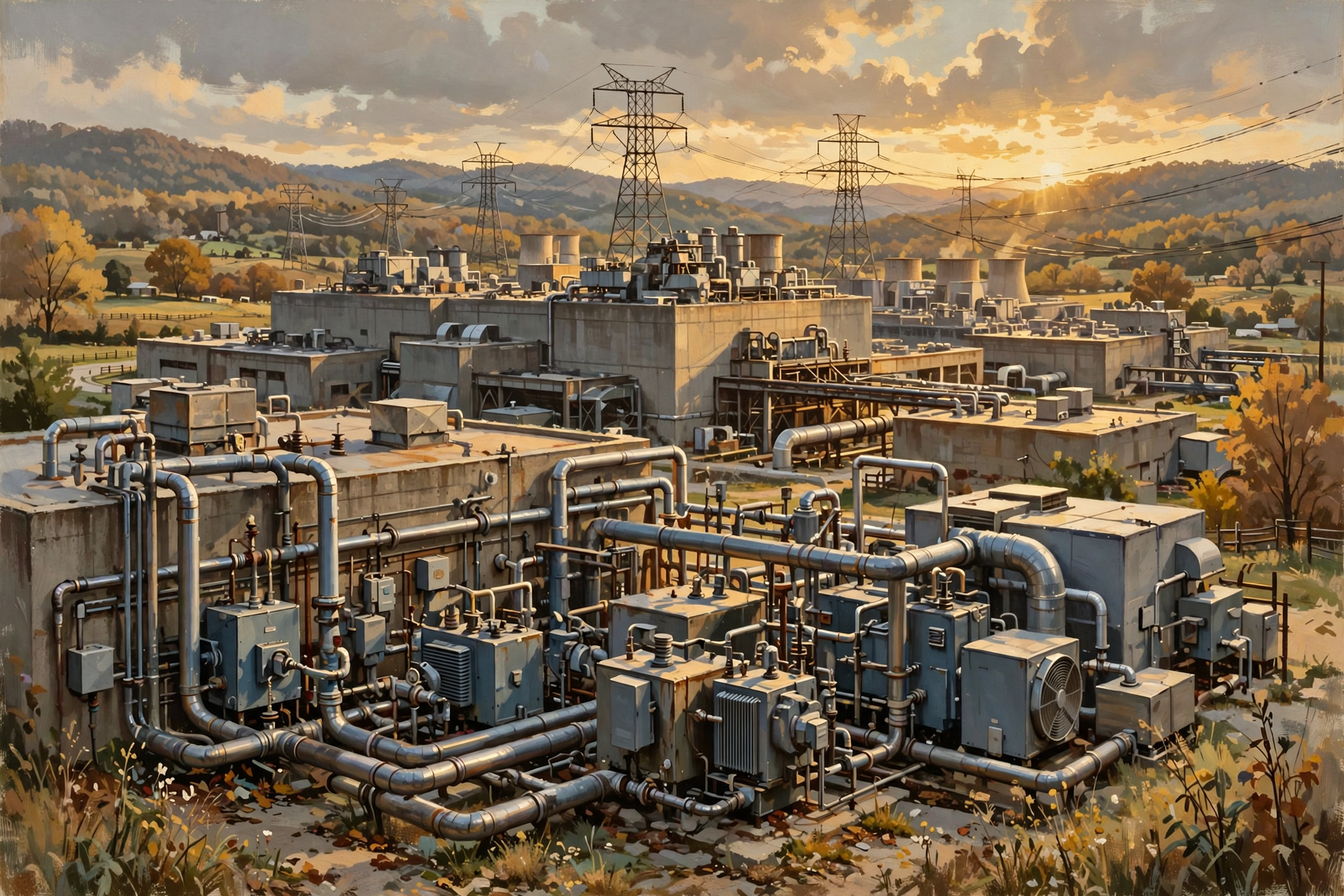
Artificial intelligence has a peculiar trick.
It can feel almost weightless.
You type a question into a box:
Write me a letter.
A few seconds later, the letter appears.
No smoke.
No moving parts.
No diesel engine.
No conveyor belt.
No obvious factory.
It looks like software doing something inside your screen.
So why are companies spending enormous amounts of money building data centers, electrical substations, cooling systems and entire campuses just to run artificial intelligence?
The answer is that AI may look like software, but software does not perform calculations by itself.
Every useful AI response eventually depends on physical computers doing physical work.
And modern AI asks those computers to do an extraordinary amount of it.
AI may be digital, but the machinery underneath it is increasingly industrial.
Start With Something We Already Know: A Calculator

Imagine asking a calculator:
What is 12 times 12?
The calculator follows a very small, well-defined computation and returns:
144.
Now ask an AI system:
Read these 200 pages, compare the arguments, identify contradictions, summarize the findings for a farmer, then write a five-minute speech about them.
That is a very different kind of computing problem.
The machine has to process language, relationships, context and a large number of mathematical operations before producing the result.
And if millions of people are asking similarly complicated questions at the same time, the computing requirement grows very quickly.
AI Is Mostly a Lot of Math
The word intelligence makes AI sound mysterious.
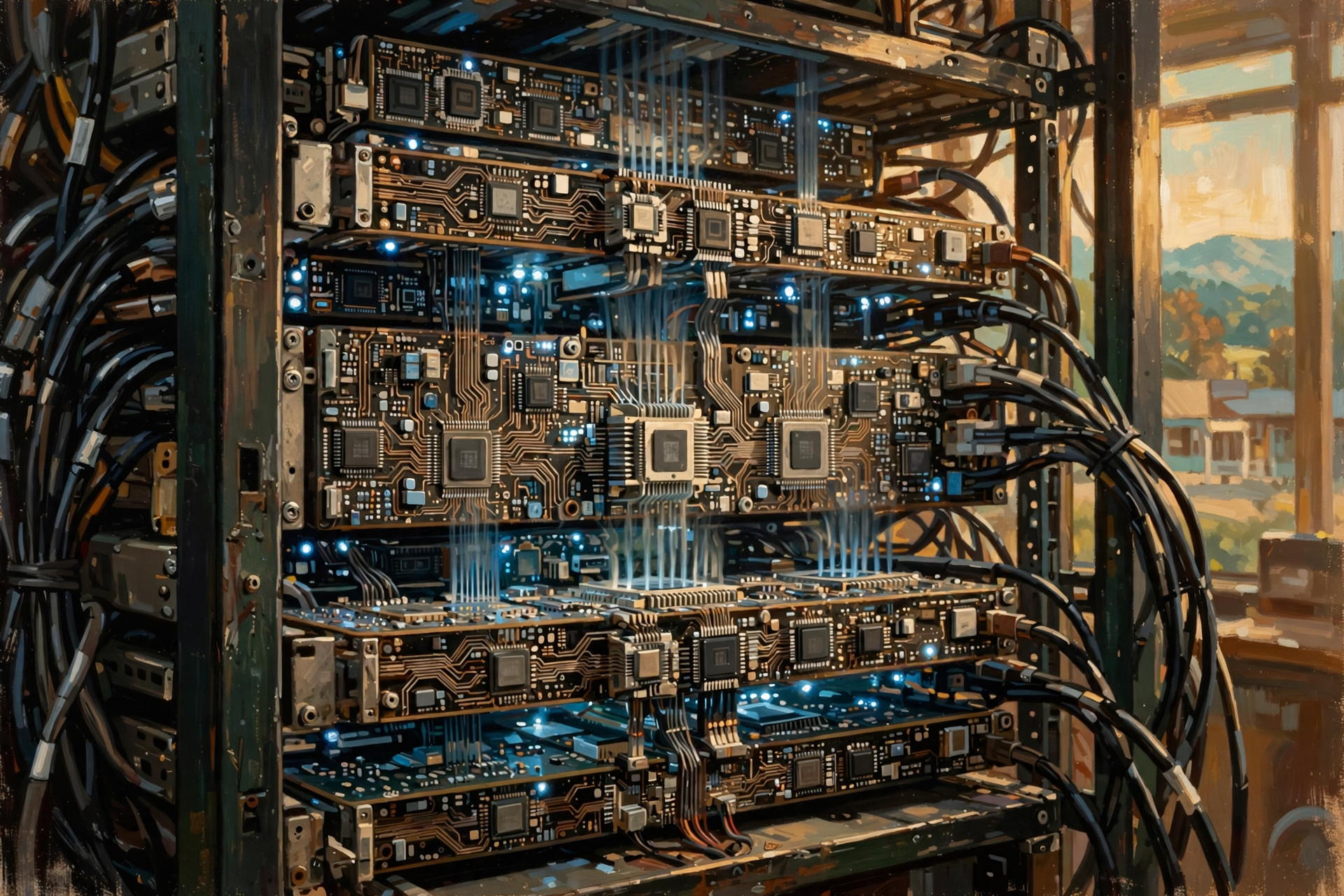
Underneath the useful behavior, however, modern AI involves tremendous amounts of mathematics.
Large artificial-intelligence models contain enormous collections of numerical values often called parameters.
When the model receives information, processors perform large numbers of mathematical operations using those parameters.
The details can become extremely technical, but the practical lesson is simple:
More capable AI generally requires substantial computation.
And computation requires processors.
Processors require memory.
Processors and memory require electricity.
All that electricity eventually becomes heat.
The heat must be removed.
And when many processors need to work together, they also need extremely fast networks.
We have just described a large portion of an AI data center.
There Are Really Two Big AI Jobs
To understand why AI needs so much infrastructure, we need to separate two activities that are often lumped together.
Training
Training is the process of developing an AI model.
During training, computers repeatedly process enormous amounts of information and adjust the model’s internal numerical parameters.
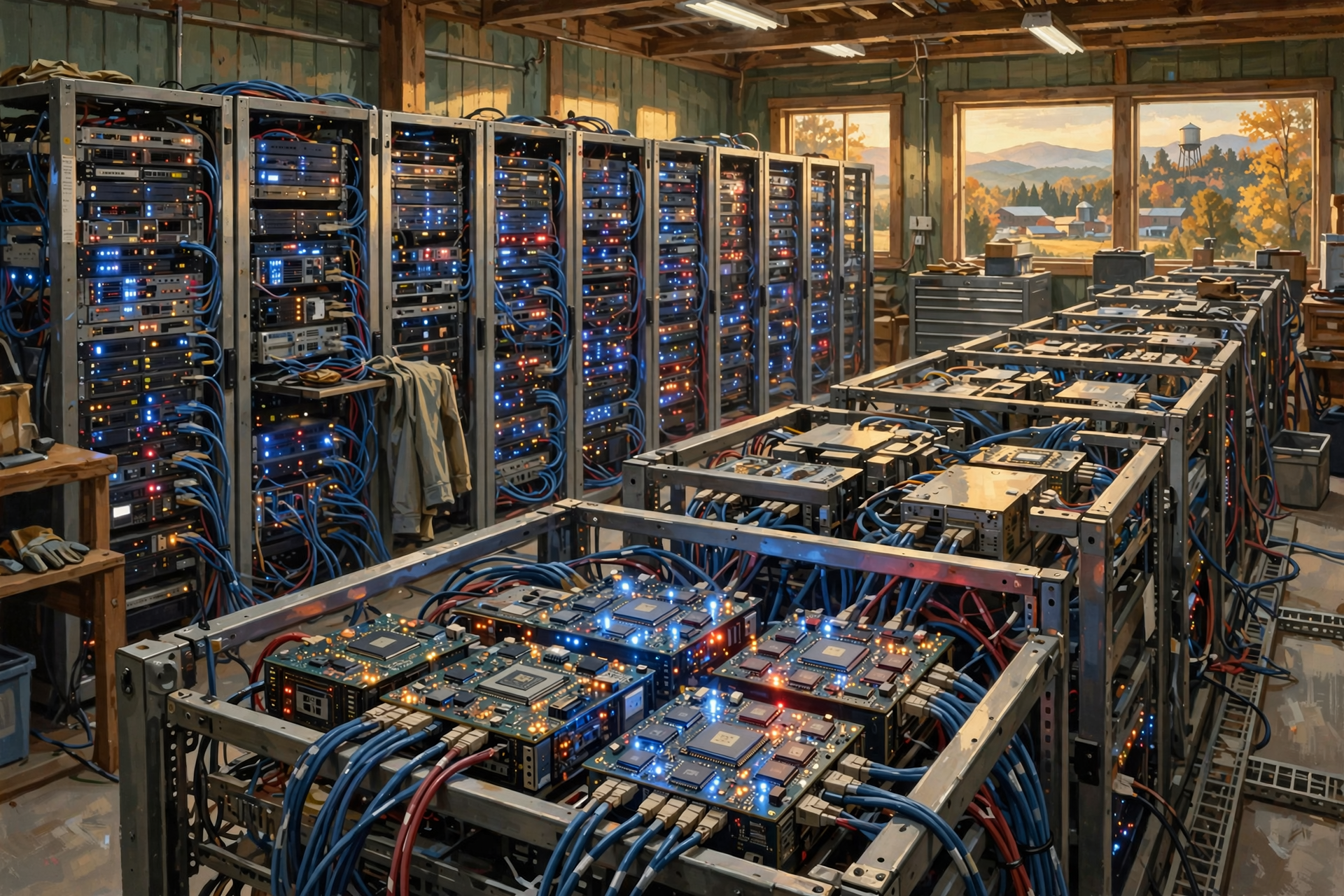
That can require very large clusters of powerful processors working together for long periods.
Inference
Inference is what happens after the model is trained.
You ask a question.
The trained model performs calculations and generates an answer.
Training creates or improves the model.
Inference uses it.
Think of Training as School and Inference as Going to Work

Imagine someone trains for years to become an electrician.
They study.
Practice.
Make mistakes.
Learn from those mistakes.
Study more.
Eventually, they become capable of performing the job.
That long learning process is something like AI training.
Then someone calls and says:
My breaker keeps tripping. Can you figure out why?
Using the knowledge already acquired to solve the problem is more like inference.
Training can be enormously expensive computationally.
But inference becomes enormous for a different reason:
Scale.
One AI Question Is Not the Problem
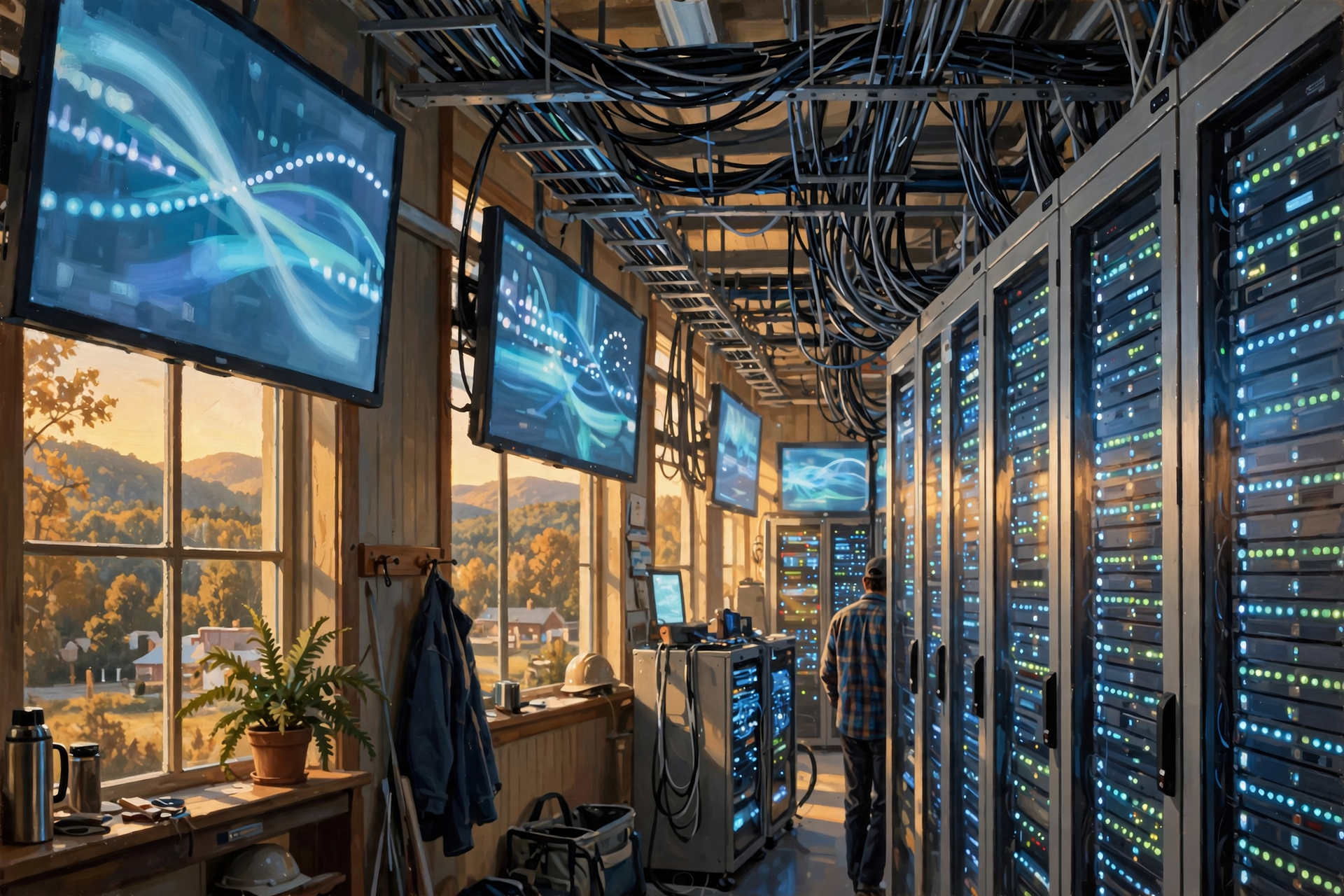
Your individual AI question might represent only a tiny fraction of a data center’s work.
The problem—or opportunity, depending on how you look at it—is that you are not the only person asking.
Imagine an AI service handling requests from:
- individual consumers;
- schools;
- software developers;
- manufacturers;
- banks;
- hospitals;
- government agencies;
- small businesses;
- researchers;
- large corporations; and
- other computer systems using AI automatically.
Now imagine those requests arriving all day and all night from around the world.
One question is tiny.
Millions of simultaneous questions become infrastructure.
The Restaurant Analogy

Suppose you make an excellent hamburger on your backyard grill.
You have proven that hamburgers can be cooked at home.
Now someone says:
Great. Feed 500,000 people lunch at noon.
The fact that one grill can cook a hamburger does not solve the scale problem.
Suddenly you need:
- many grills;
- food storage;
- delivery systems;
- workers;
- power or fuel;
- refrigeration;
- coordination;
- backup equipment; and
- a lot more space.
That is roughly what happens when an AI model moves from a demonstration to a global service.
Why Can’t Normal CPUs Handle Everything?
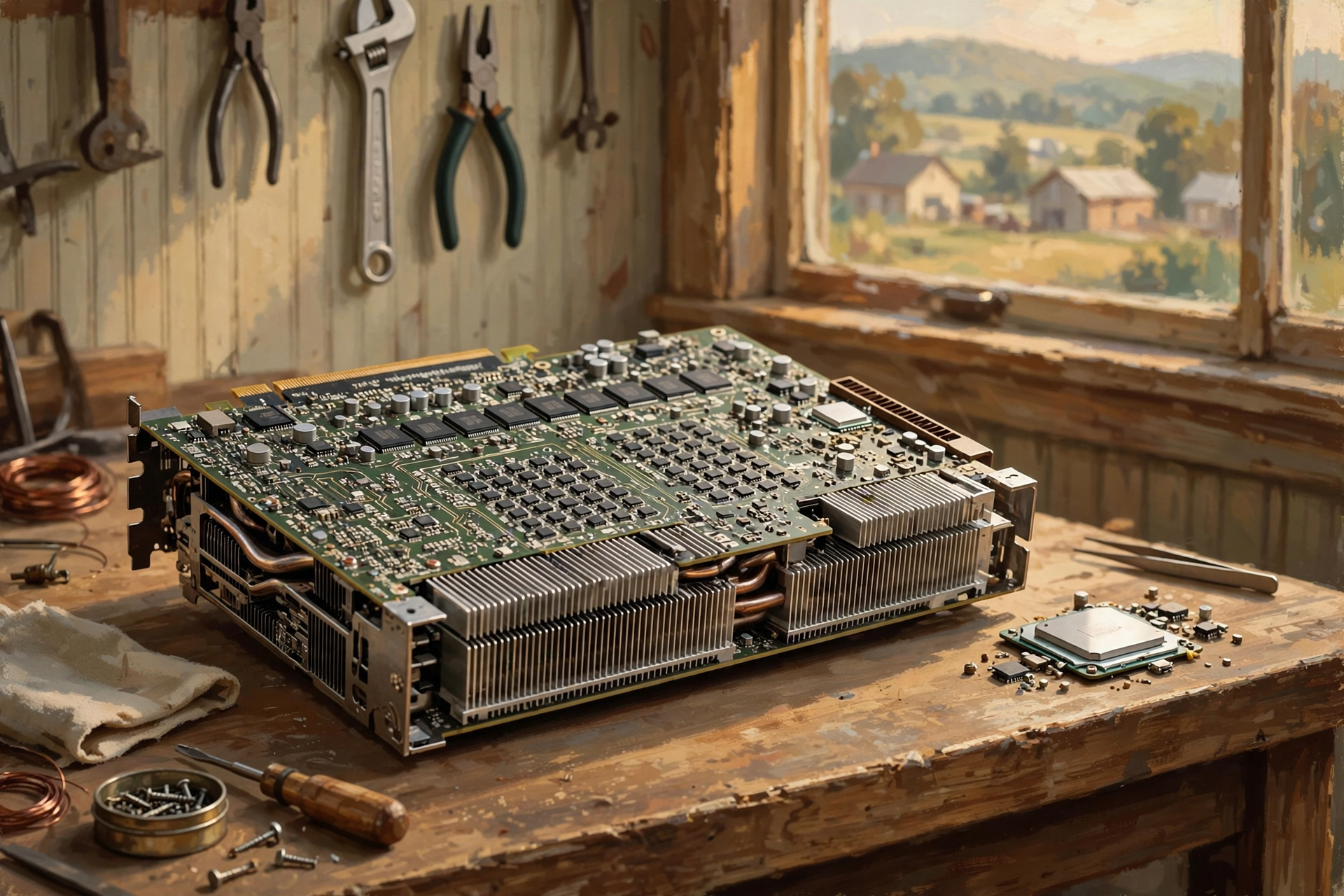
They can handle some AI.
But much modern AI involves enormous numbers of similar mathematical calculations that can be performed in parallel.
This is where GPUs became especially important.
GPUs were originally designed largely around graphics workloads.
Rendering graphics requires performing many similar calculations at the same time.
It turned out that AI needs a lot of that same style of parallel computation.
A modern AI accelerator can therefore perform many calculations simultaneously instead of processing everything one step at a time.
Think of the difference between:
one very talented person stacking firewood
and
1,000 people each carrying a piece at the same time.
For the right job, parallel work changes everything.
Then We Started Connecting Thousands of Those Processors
A single powerful GPU can do remarkable work.
But the largest AI models can require far more computation than one processor can provide efficiently.
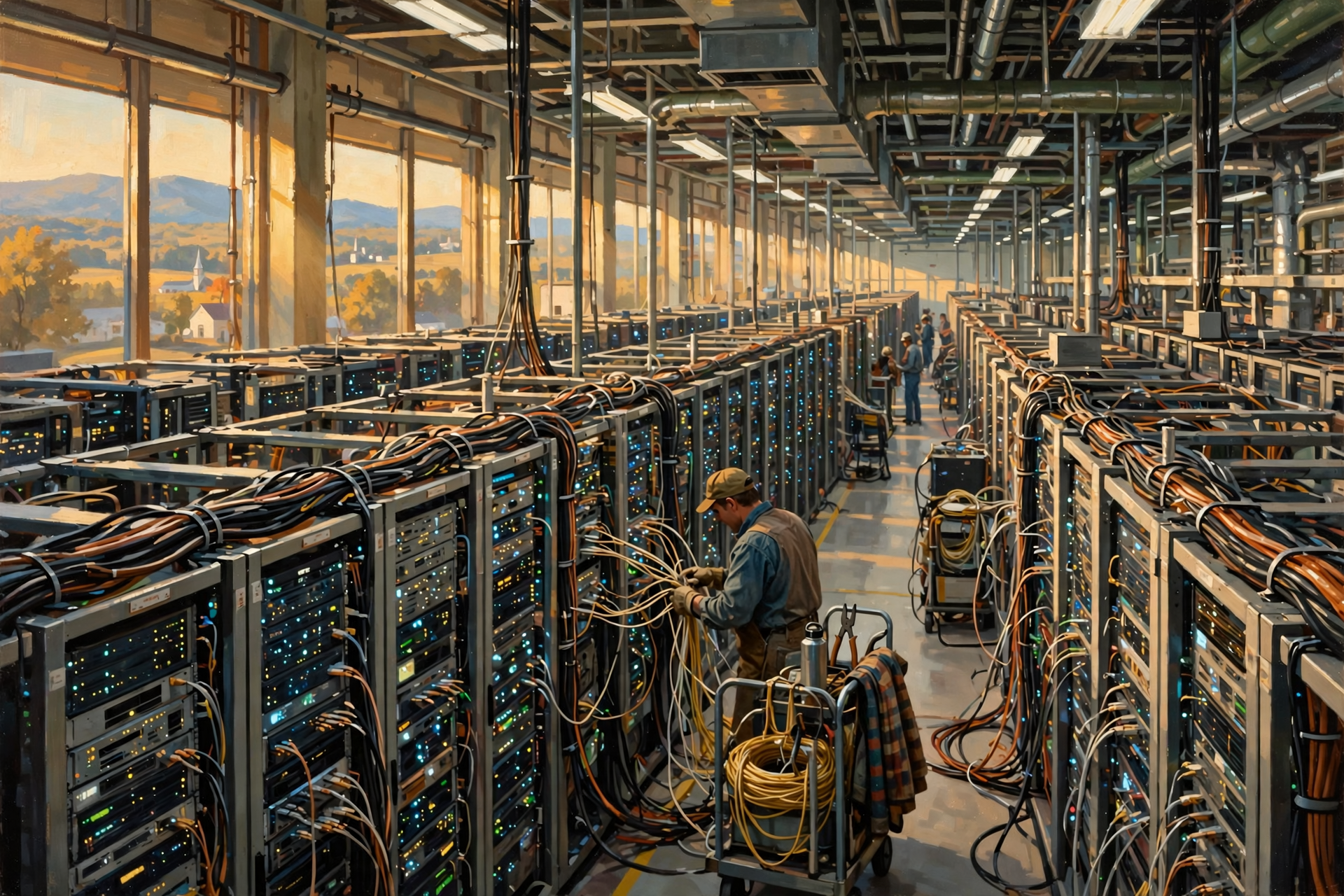
So AI companies connect many accelerators together.
Then many servers.
Then many racks.
Then sometimes entire buildings full of them.
NVIDIA describes modern AI infrastructure as connecting very large numbers of GPUs so they can operate together as a distributed computing engine.
At that point, we are no longer simply building a fast computer.
We are building what behaves like an enormous computer out of thousands of smaller computers.
The Network Becomes Part of the Machine
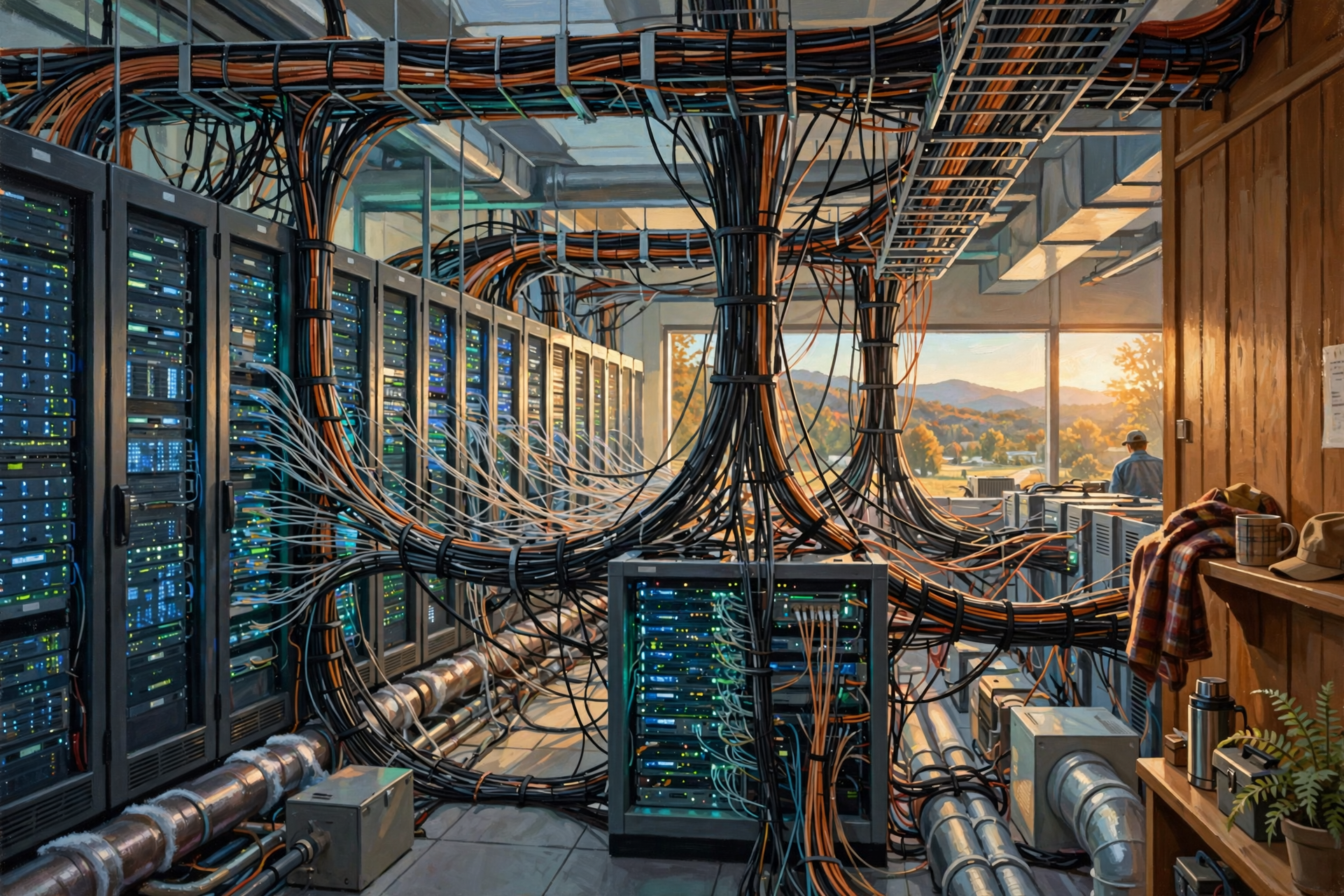
This is one of the biggest differences between ordinary computing and large AI clusters.
On your home PC, networking usually means:
Can I connect to the internet?
Inside a large AI system, networking can be part of the computation itself.
Thousands of processors may need to exchange information constantly while working on the same AI model.
If one processor finishes its piece of the work but has to sit idle waiting for information from another machine, expensive computing hardware is being wasted.
So AI data centers need exceptionally fast internal communications.
The network becomes less like the road leading to the factory and more like the conveyor belts running through the factory.
Memory Becomes a Huge Problem Too
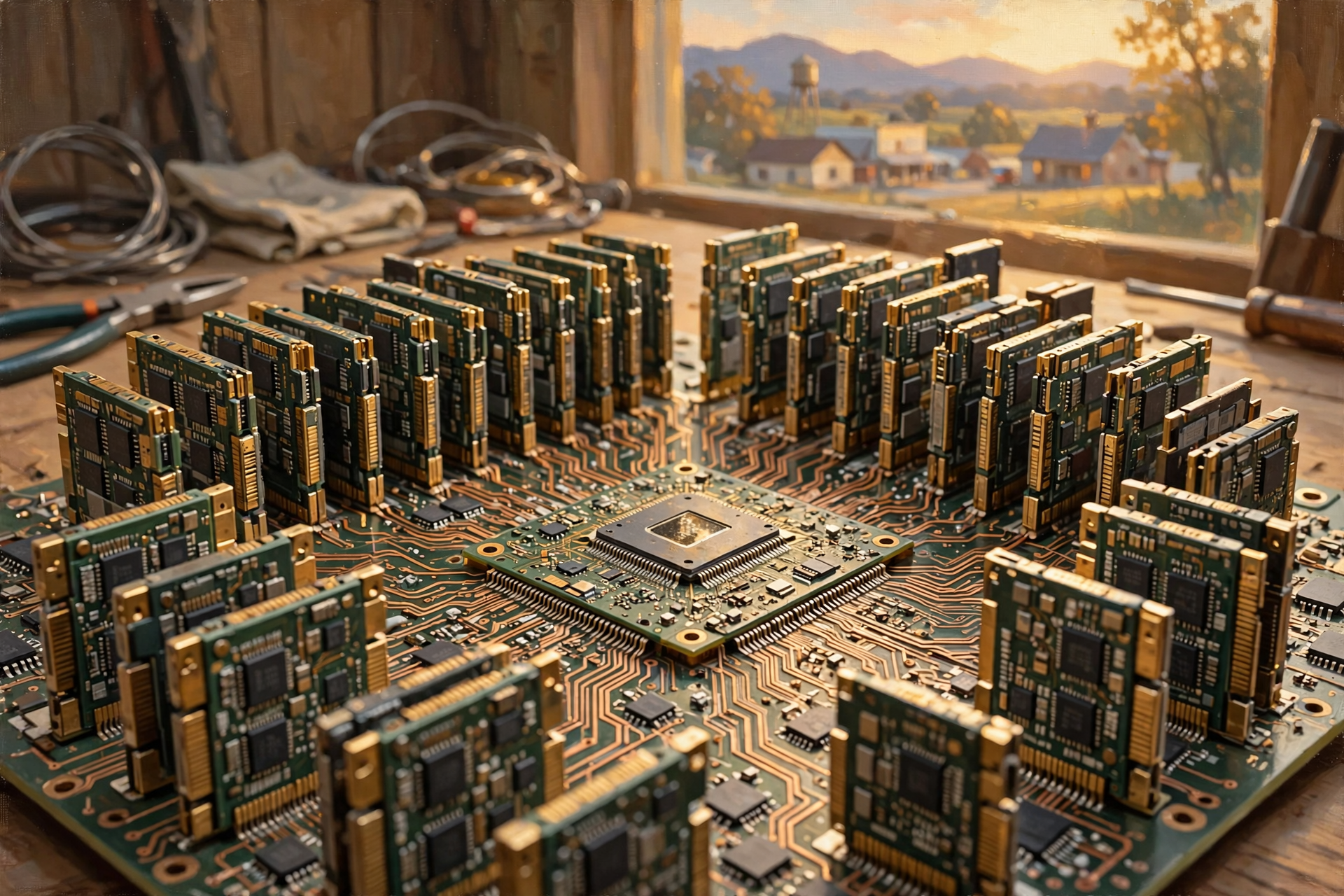
AI models can involve tremendous quantities of numerical information.
Processors need rapid access to that information while performing calculations.
If a processor is extremely fast but constantly waits for information to arrive from slow memory, the expensive processor spends time doing nothing.
Imagine hiring 500 workers to frame a building and giving them one tape measure.
You have plenty of labor.
Now your tape measure is the bottleneck.
Large AI systems therefore depend heavily on high-speed memory located close to the processors.
The faster the processors become, the more important feeding them efficiently becomes.
AI Training Can Be Enormous
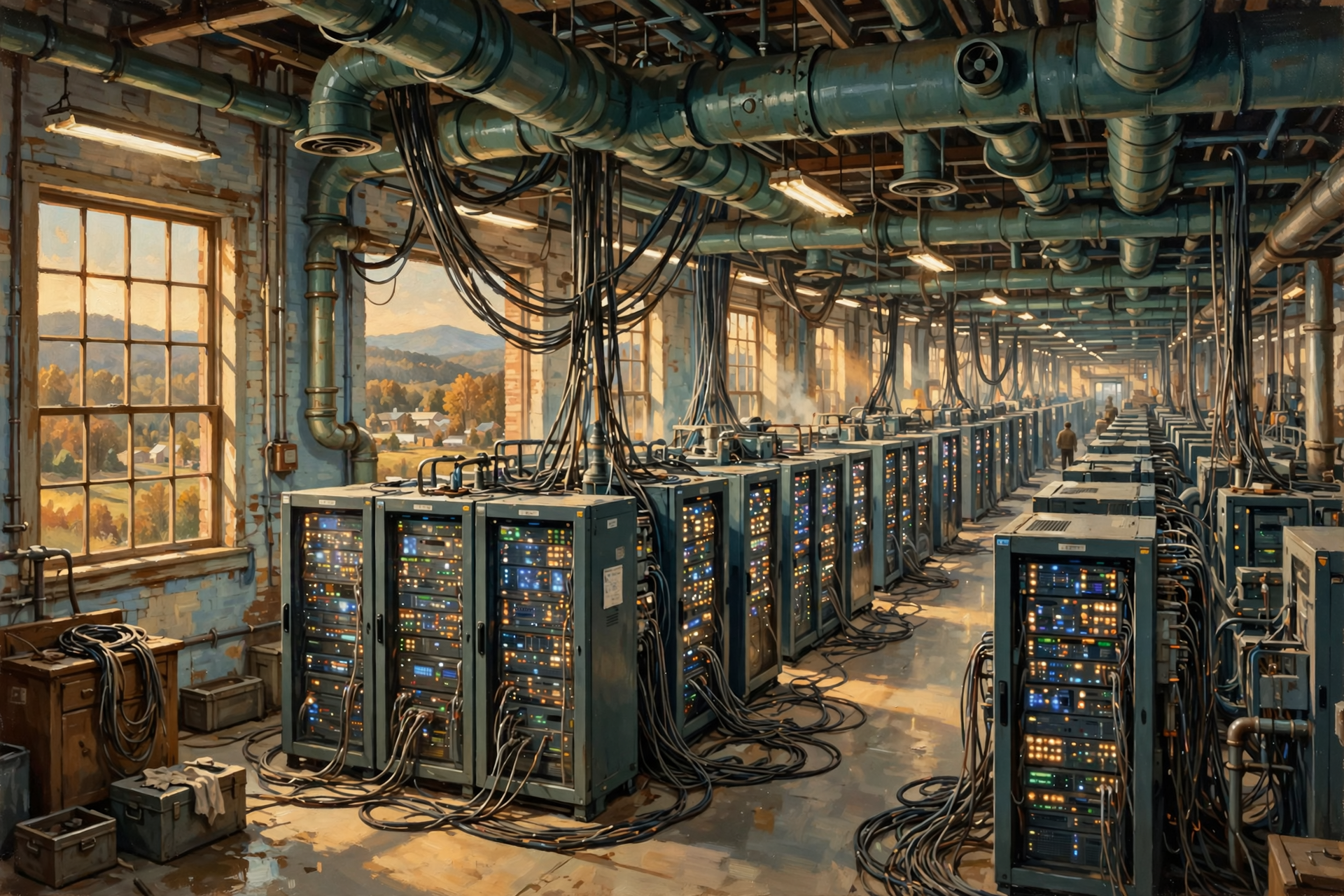
Training a large modern AI model can involve processing enormous collections of information repeatedly while adjusting billions of model parameters.
That work may be spread across thousands of accelerators.
The processors can operate for long periods.
The computers exchange enormous amounts of information.
Storage systems continuously feed data.
Cooling systems remove heat.
Electrical systems supply power around the clock.
Training is one reason AI data centers can look less like traditional office computing and more like industrial facilities.
But Inference May Eventually Be an Even Bigger Story

Training gets attention because individual training runs can be enormous.
Inference has a different multiplier:
Everybody uses the finished model.
Suppose a model is trained once.
Then millions of people use it every day for years.
Every:
- question;
- summary;
- translation;
- generated picture;
- code request;
- voice conversation;
- video;
- analysis;
- AI-agent task; and
- automated software operation
requires additional inference computation.
This is why the growth of AI usage matters just as much as the size of the models.
The International Energy Agency Is Seeing This Growth
The International Energy Agency’s 2026 analysis of AI and energy reports that electricity consumption from AI-focused data centers grew about 50 percent during 2025, substantially faster than overall data-center electricity consumption.
The IEA also reports that capacity in cutting-edge data centers specifically designed around AI has expanded rapidly.
Those numbers do not mean AI electricity use will continue growing at exactly the same rate forever.
They do demonstrate the size of the current infrastructure buildout.
And AI Tasks Are Becoming More Complicated

Early generative AI attracted attention largely through text.
Ask a question.
Generate a paragraph.
Write an email.
But modern AI increasingly handles more computationally demanding tasks.
The IEA notes that workloads such as:
- video generation;
- advanced reasoning; and
- agentic AI
can require dramatically more energy per request than relatively simple text generation.
This is important.
AI is getting more efficient.
But we are also asking it to do harder things.
Generating One Sentence Is Not the Same as Generating a Movie

Imagine telling an AI:
Write a sentence describing a dog.
Now compare that with:
Create a realistic two-minute video of that dog running through a field at sunset while the camera moves around it, shadows change naturally and every frame remains visually consistent.
Those are both called “AI.”
They are nowhere near the same computing job.
This is another reason asking how much energy “AI” uses without specifying the workload can be misleading.
It is like asking how much fuel “transportation” uses without telling us whether you mean a bicycle or a cargo jet.
AI Agents Can Multiply One Request Into Many Tasks

Now add another rapidly developing use: AI agents.
A traditional chatbot might receive one question and return one response.
An agent can potentially take a larger assignment and perform multiple steps.
You might say:
Research these five vendors and recommend which one we should use.
An AI agent could potentially:
- interpret the request;
- build a research plan;
- perform multiple searches;
- open documents;
- read webpages;
- compare specifications;
- perform calculations;
- identify missing information;
- search again;
- write a recommendation;
- check the recommendation; and
- revise the result.
You entered one prompt.
The system may perform dozens or hundreds of computational operations behind it.
This is one reason future AI demand cannot be estimated merely by counting how many times somebody types into a chatbot.
Then Businesses Start Putting AI Everywhere

Another multiplier is that AI is increasingly becoming a feature inside ordinary software.
A worker may never deliberately open an “AI program.”
Instead:
- email software summarizes messages;
- accounting software identifies unusual transactions;
- security cameras recognize events;
- factories inspect products automatically;
- customer-service systems summarize conversations;
- medical software analyzes images;
- software-development tools generate code;
- search engines generate summaries;
- phones improve photographs; and
- business applications answer questions about company data.
One AI tool becomes thousands of AI-enabled applications.
Millions of users become billions of automated operations.
Why Not Run All of This on Our Own Computers?

Some of it increasingly can be.
Earlier in this series, we compared a traditional PC with an AI PC and an AI data-center server.
New laptops and phones increasingly contain specialized AI processors.
Local AI has real advantages:
- lower latency;
- better privacy for some workloads;
- offline operation;
- less dependence on cloud services; and
- potentially lower central computing costs.
But your laptop still primarily serves you.
A global AI provider may need to serve millions of people and businesses simultaneously.
It may also need to run models too large to fit efficiently on an ordinary personal computer.
Local AI and data-center AI are therefore likely to coexist.
Think Pickup Truck and Freight Railroad Again

Your pickup is wonderfully useful.
You can haul lumber.
Pull a trailer.
Move furniture.
Go to the hardware store.
But the existence of pickup trucks does not eliminate freight railroads.
They serve different scales of transportation.
An AI PC and an AI data center can have a similar relationship.
Your personal device handles appropriate local jobs.
The data center handles workloads requiring industrial-scale computing.
Why AI Data Centers Need So Much Electricity
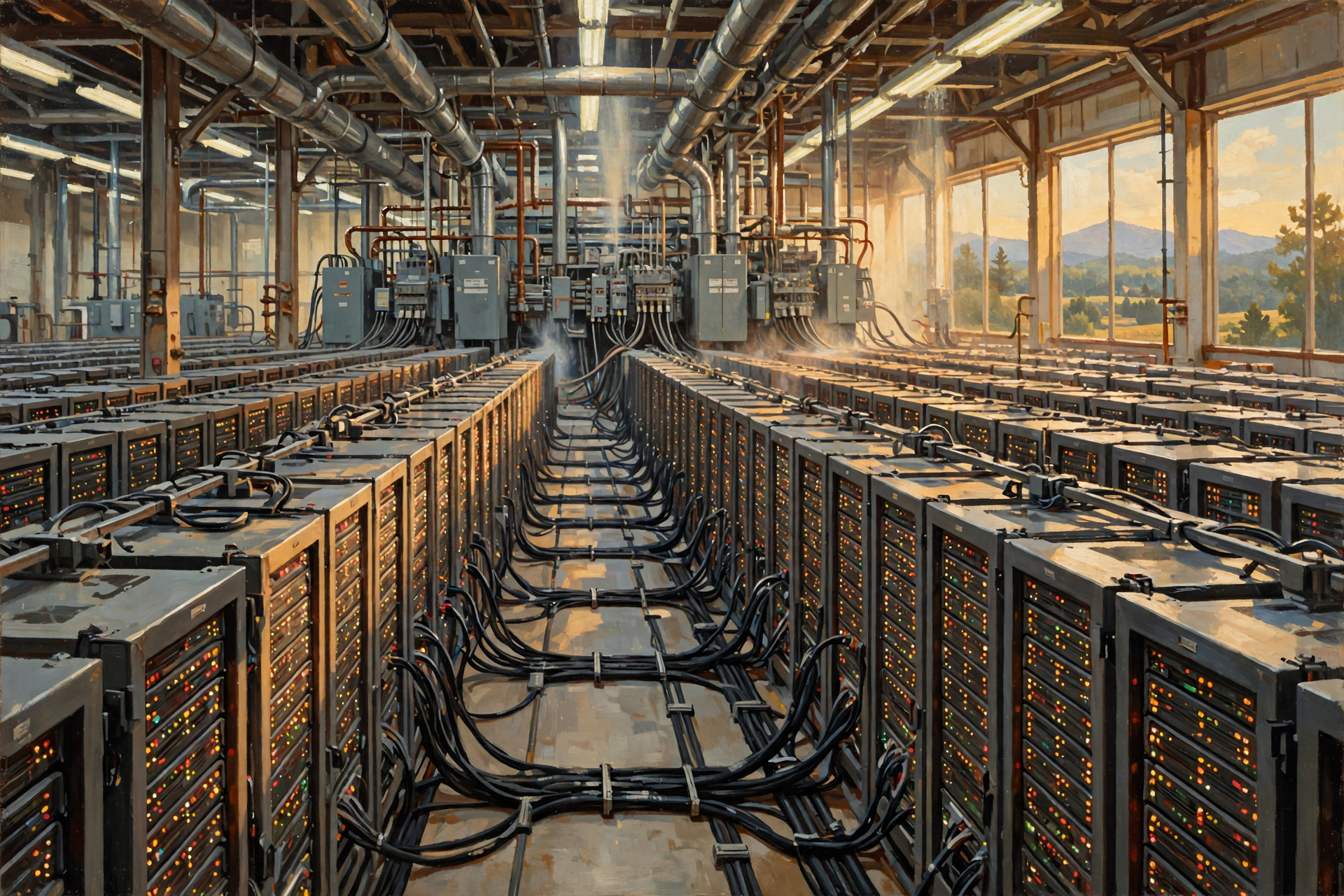
Every AI calculation requires electrical energy.
A processor consumes electricity while operating.
A few processors are ordinary computer equipment.
Thousands of powerful AI accelerators operating simultaneously become a major electrical load.
The IEA’s 2026 Powering Artificial Intelligence report notes that the rapid growth of data centers is creating challenges for local electrical grids, electricity equipment supply chains and planning systems.
This is one of the most important points for rural communities to understand.
The computers may belong to a technology company.
But the electricity often comes through the same broader utility infrastructure supporting everybody else.
AI Also Packs More Power Into Each Rack
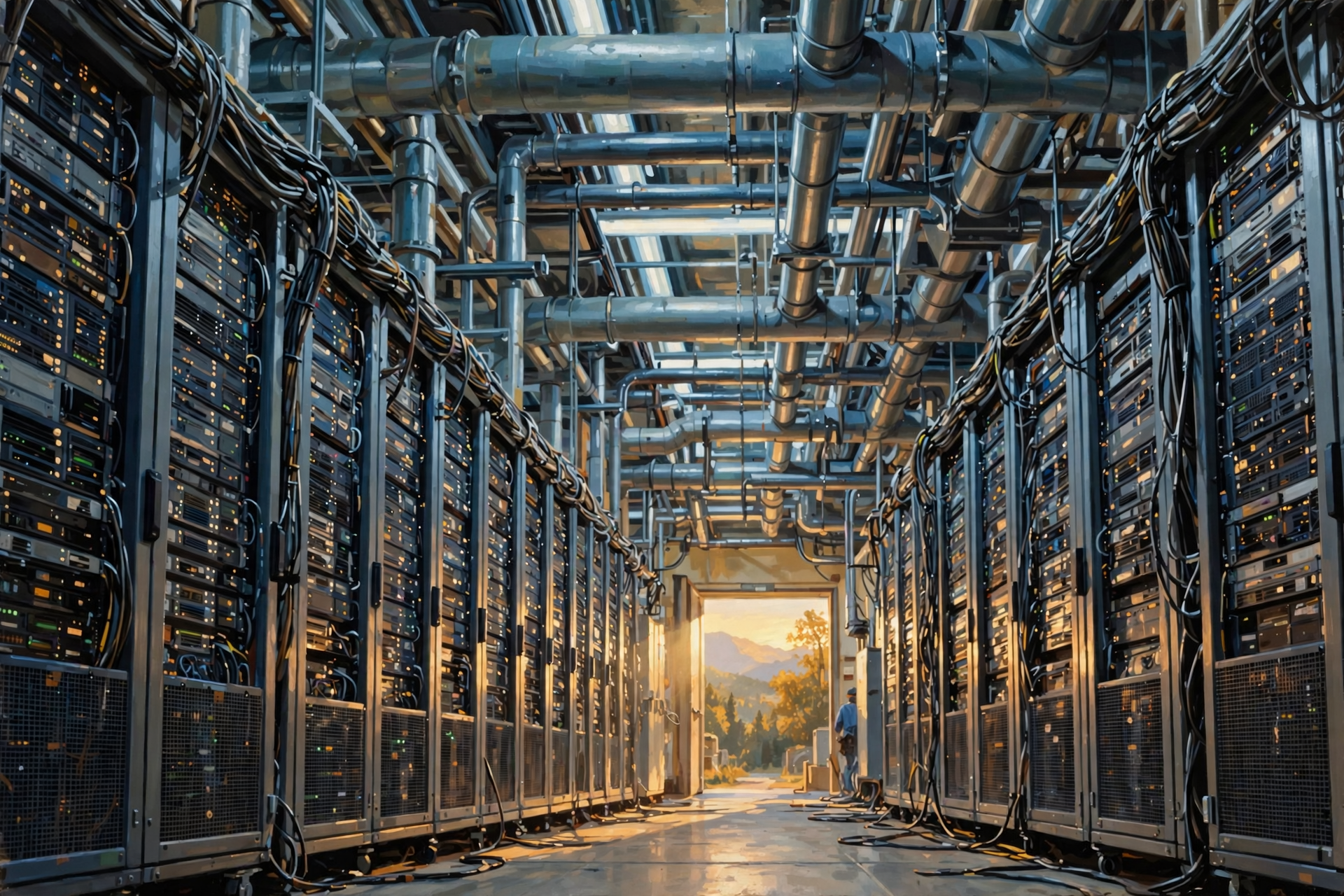
Traditional data centers have always needed substantial electrical infrastructure.
Advanced AI can make the challenge more concentrated.
The IEA reports that power density in AI servers has risen dramatically in recent years.
In plain English:
We’re putting more computing—and therefore more electrical demand—into the same amount of physical space.
That matters because a building designed for ordinary servers cannot automatically support unlimited quantities of high-powered AI hardware.
The electrical distribution and cooling systems have to be designed around the load.
Then Every Watt Becomes Heat
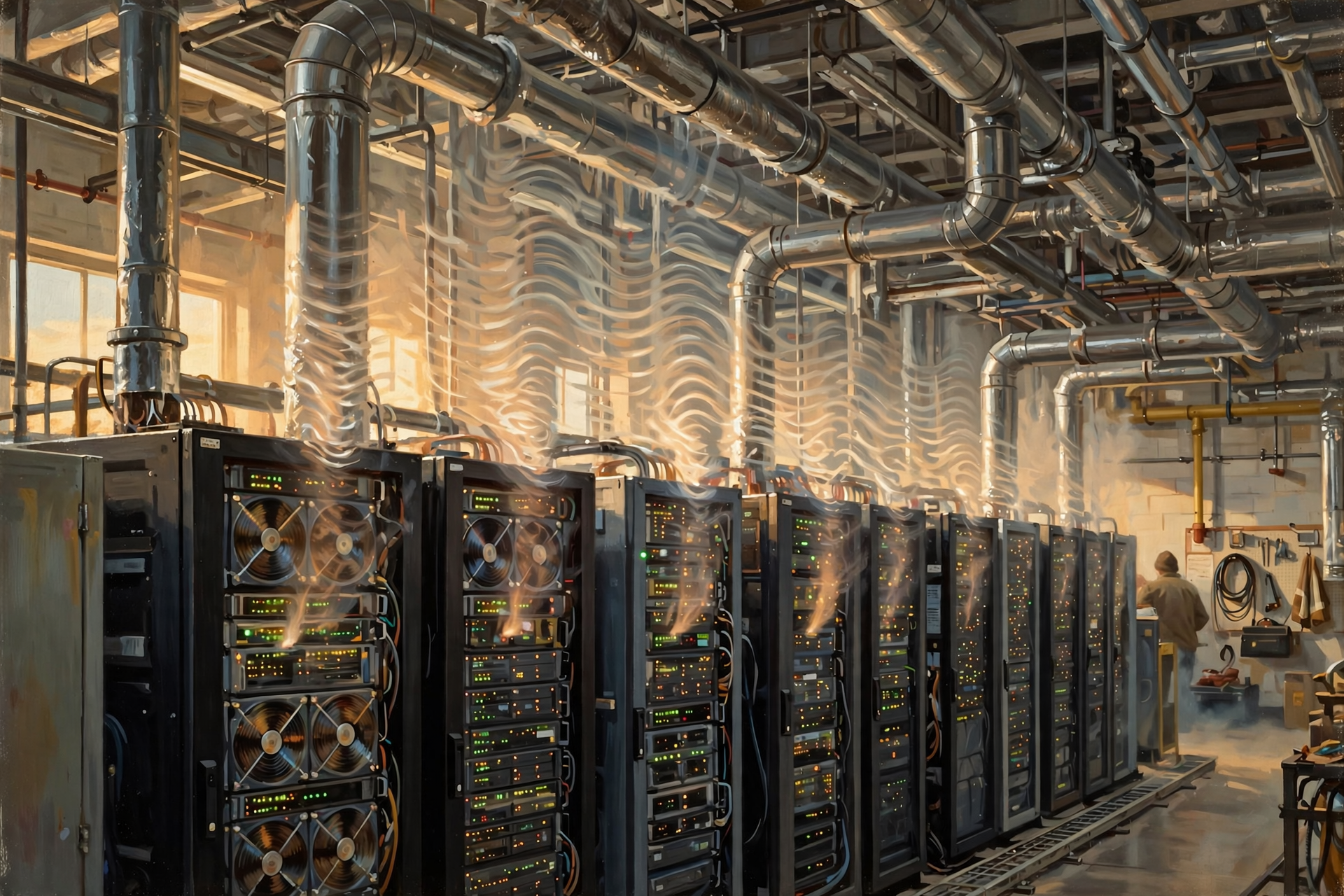
Here is the stubborn law of the data center:
Electricity goes in.
Computing happens.
Heat comes out.
The more computing packed into a rack, the more heat has to be removed from that area.
This is why modern AI facilities increasingly use advanced cooling systems, including forms of liquid cooling.
Ordinary room air conditioning may simply not be enough for very dense AI hardware.
That leads to another physical requirement:
cooling infrastructure.
That Is Where Water Can Enter the Conversation
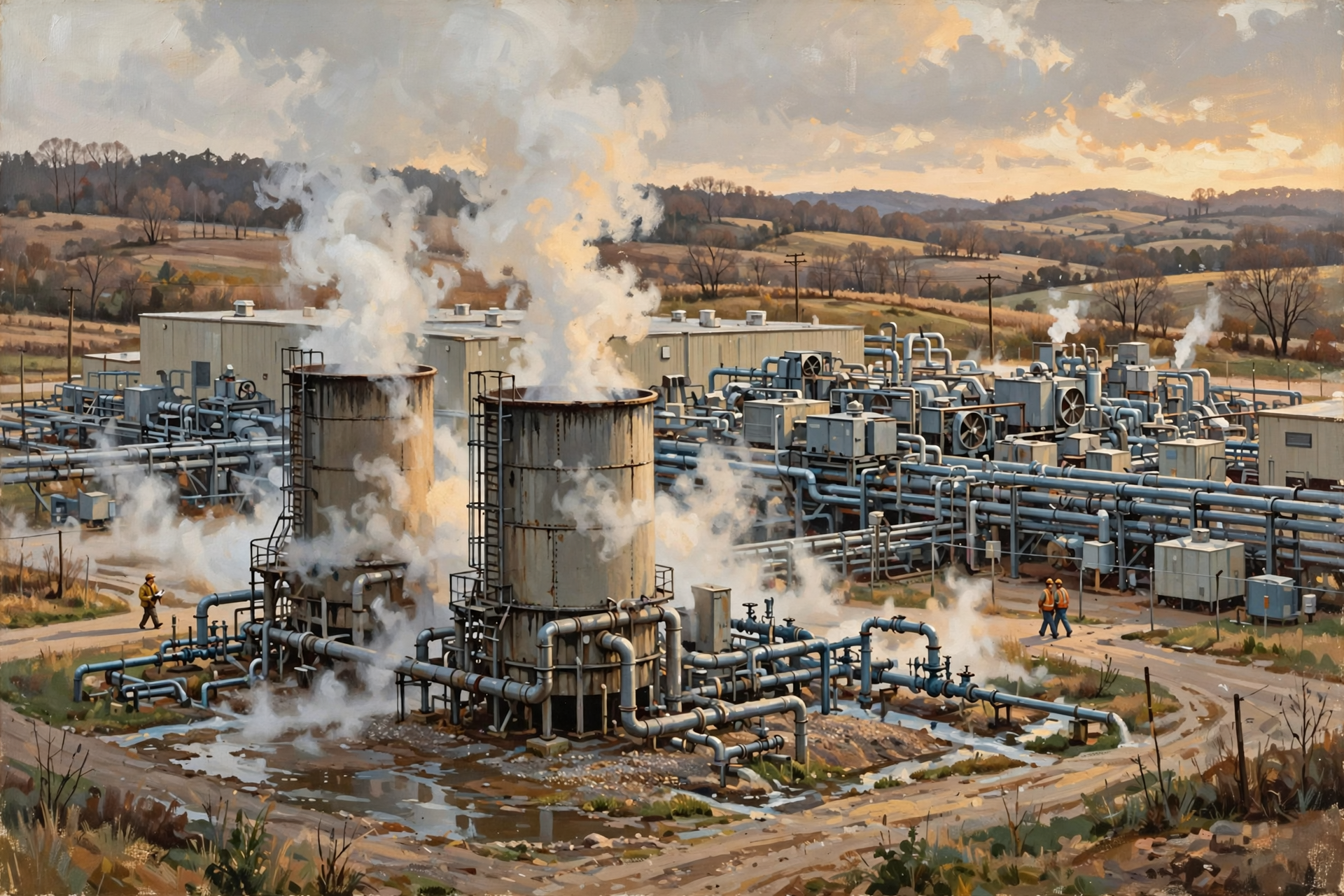
Not every data center cooling system uses water in the same way.
Some designs can use significant amounts.
Others use different cooling approaches.
Local climate, equipment density, cooling technology and water availability all matter.
This is why it is incorrect to take the water use of one AI facility and assume every data center will use the same amount.
Later in this series, we will devote several articles specifically to cooling and water because those subjects deserve careful treatment rather than slogans.
Why So Many Separate Data Centers?
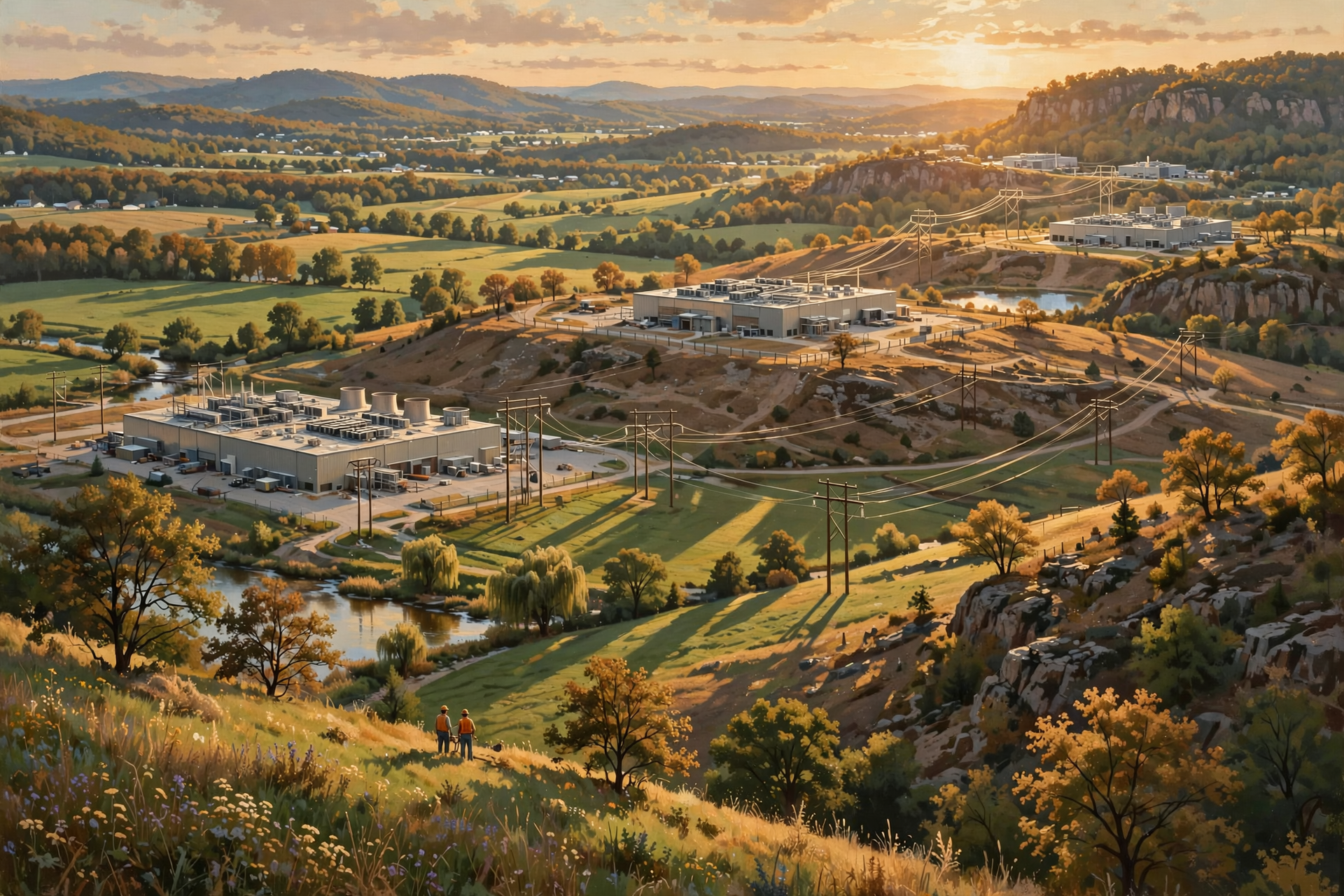
At this point you might reasonably ask:
Why not build one unbelievably enormous AI data center and put everything there?
Several reasons.
Reliability
Putting everything in one place would create an enormous point of failure.
Distance
Serving users from geographically distributed facilities can reduce network delay.
Electricity
One location may not have enough available electrical capacity to support unlimited growth.
Land
Huge campuses require significant suitable acreage.
Networks
Facilities need high-capacity fiber connectivity.
Construction Risk
Building in multiple locations spreads some operational and geographic risks.
Customer Requirements
Some organizations need data and computing located in particular regions.
Expansion
Companies can add capacity across several markets instead of waiting for one giant site to absorb everything.
Electricity May Be the Biggest Limiting Factor
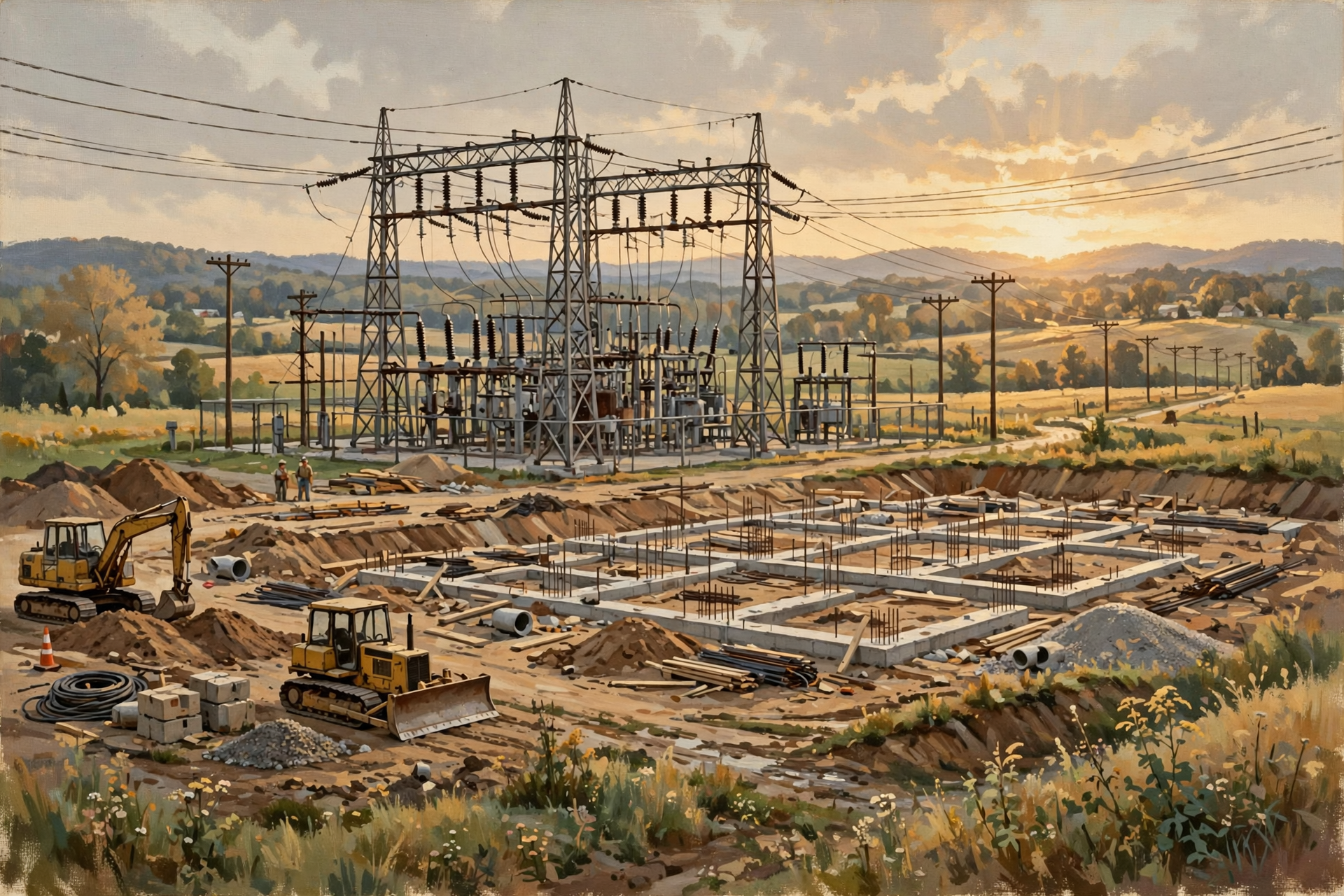
The AI industry can manufacture more servers faster than many communities can build new electrical infrastructure.
Power plants, large transformers, transmission lines and substations do not appear overnight.
The IEA’s 2026 analysis describes a growing scramble not only for chips but also for electricity, grid connections and key electrical equipment.
This means the future geography of AI may be shaped partly by an unexpectedly old-fashioned question:
Where can we get enough electricity?
The world’s most advanced computer may still have to wait for a transformer.
AI Is Becoming an Industrial Load
For much of computer history, people thought about technology as office equipment.
A computer sat on a desk.
A server sat in a rack.
A data center looked like a technology building.
Large AI facilities increasingly belong in a different mental category.
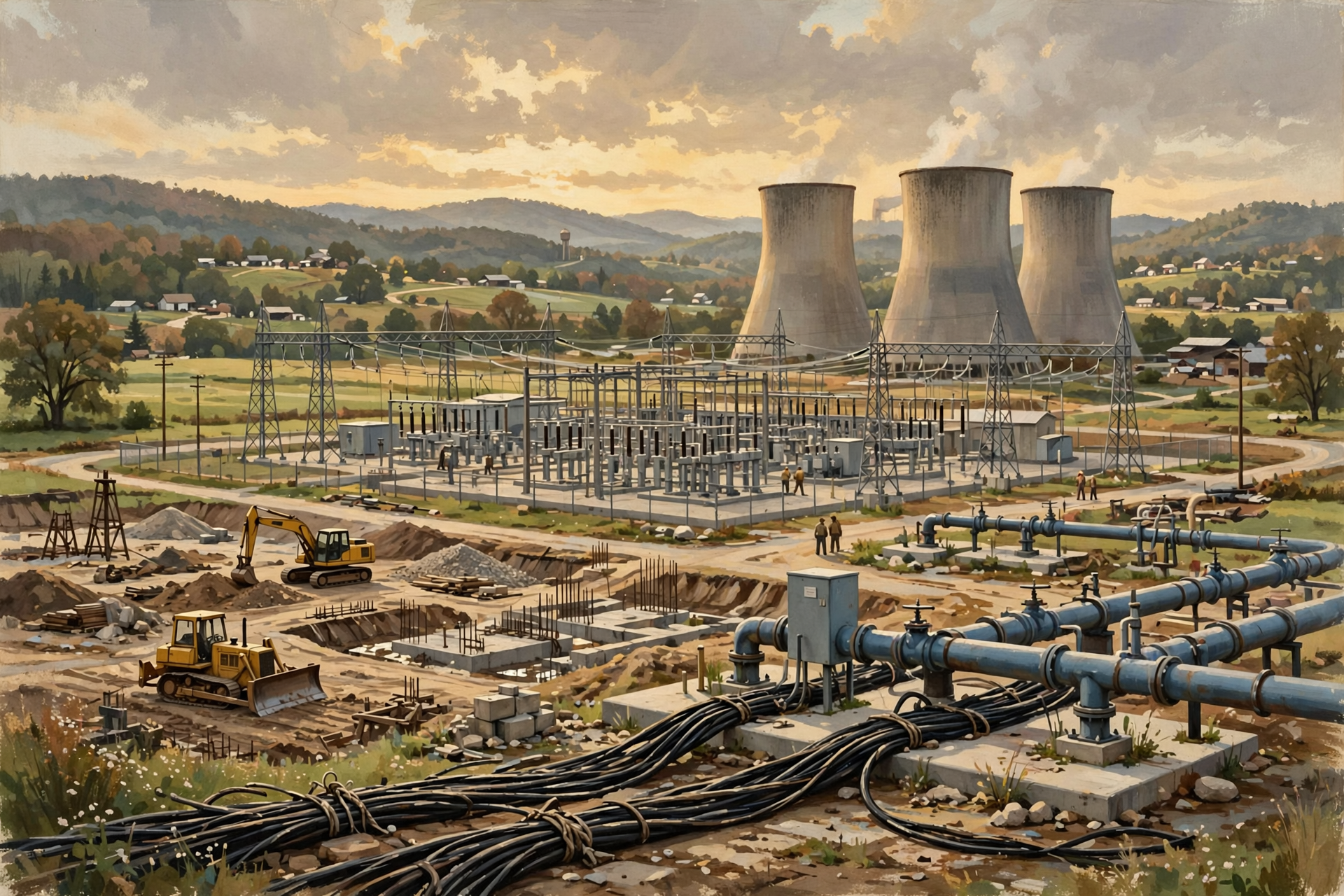
From an infrastructure perspective, some AI campuses resemble heavy industrial projects.
They may require:
- hundreds of acres;
- major utility connections;
- dedicated substations;
- high-voltage equipment;
- very large cooling systems;
- fiber networks;
- backup generators;
- fuel systems;
- water infrastructure depending on cooling design; and
- major construction projects.
This does not make them factories in the traditional sense.
No automobile rolls off an assembly line.
The product is computation.
A Factory Where the Product Is Thinking Work
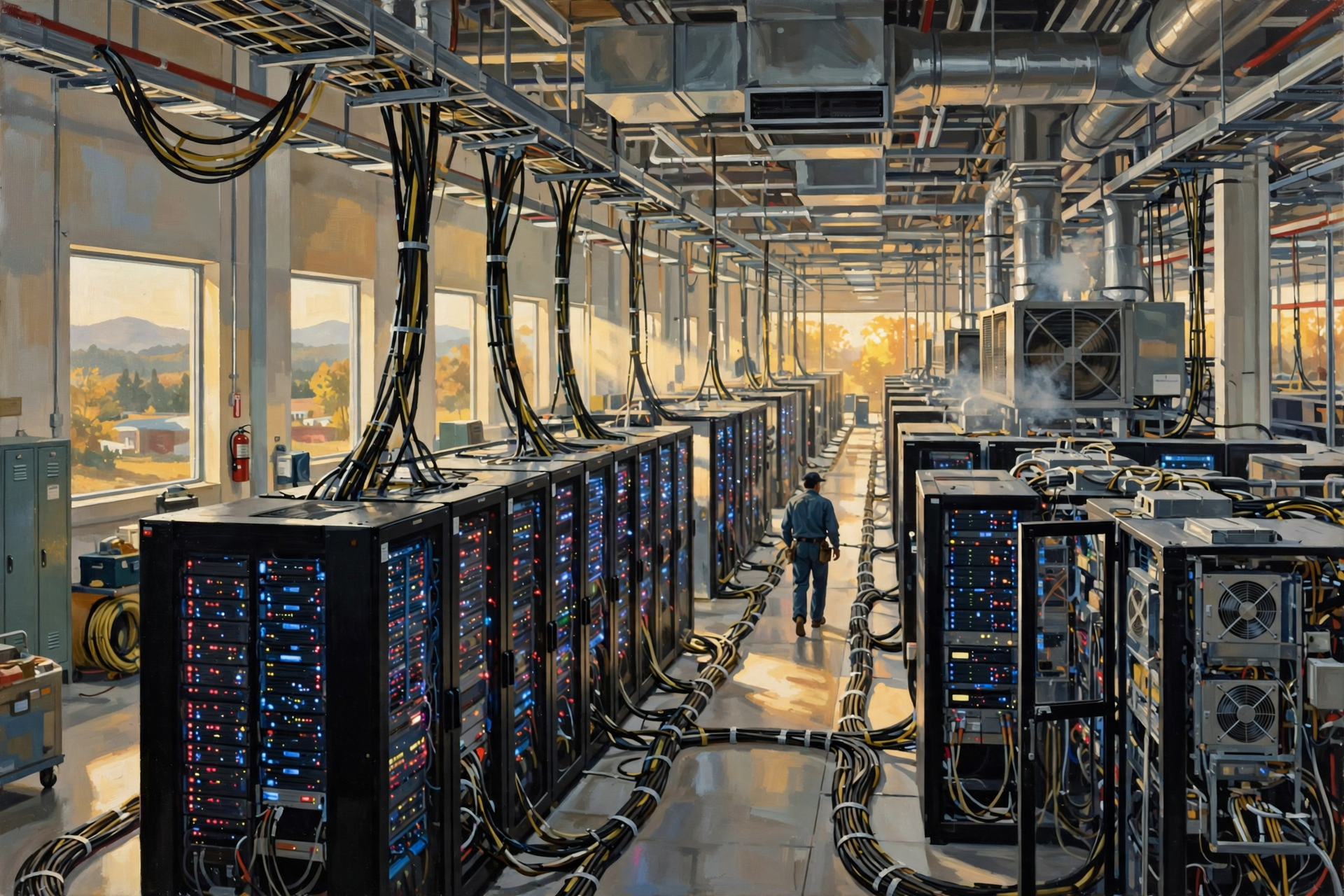
This may be the easiest way to understand an AI data center.
A steel mill turns electricity, heat, raw materials and machinery into steel.
A sawmill turns logs and energy into lumber.
A factory turns materials and energy into manufactured products.
An AI data center turns:
- electricity;
- computer hardware;
- software;
- data; and
- human-designed models
into computation.
The output might be:
- an answer;
- a prediction;
- a photograph;
- computer code;
- a medical analysis;
- a translated conversation;
- a scientific simulation;
- a business decision;
- a video; or
- an autonomous action performed by software.
The product is digital.
The factory is very physical.
Hold On—Is That True? “AI Is the Reason All Data Centers Exist”
No.
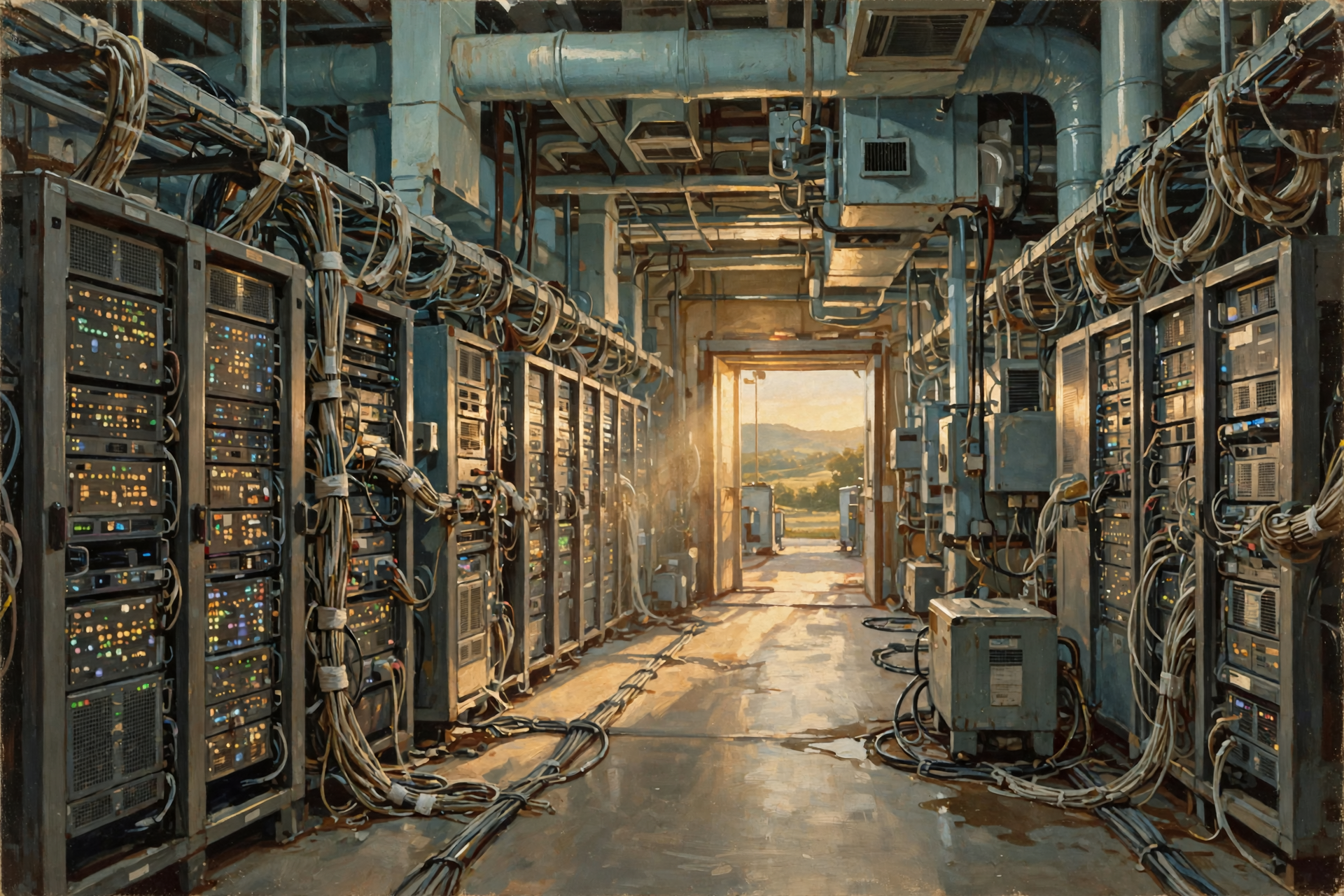
Data centers supported banking, websites, email, online shopping, cloud storage, streaming video, government systems and countless other services long before today’s generative-AI boom.
AI is currently a major driver of new data-center investment.
It is not the only reason data centers exist.
Hold On—Is That True? “Every AI Question Uses an Enormous Amount of Electricity”

No.
The energy required varies dramatically by model, hardware, workload and type of request.
The International Energy Agency emphasizes that newer applications such as advanced reasoning, video generation and agentic tasks can require hundreds or thousands of times more energy than simpler text-generation tasks.
So asking how much electricity “an AI question” uses without specifying what kind of question is not very meaningful.
Hold On—Is That True? “AI Will Need More Data Centers Forever”

Nobody knows.
Current demand is growing rapidly.
But technology changes rapidly too.
Models may become smaller.
Processors may become much more efficient.
More AI may move onto personal devices.
Businesses may discover that some AI applications do not produce enough value to justify their cost.
Current infrastructure plans may prove too aggressive—or too conservative.
The IEA itself emphasizes substantial uncertainty around the future path of AI energy demand.
Forecasts are useful.
They are not promises.
Why This Matters to Rural Tennessee

If AI happened entirely inside a laptop, there would be little reason for counties in Tennessee to care much about AI infrastructure.
But industrial-scale AI requires physical facilities.
Once a proposed facility becomes large enough, the questions are no longer primarily about computer science.
They become questions rural communities already understand:
- Who owns the land?
- How much electricity is needed?
- Will new transmission infrastructure be required?
- Who pays for the substation?
- What water supply is needed?
- What cooling technology will be used?
- How much noise will generators and cooling systems produce?
- How much tax revenue will actually reach the county?
- How many permanent jobs will exist after construction?
- What infrastructure improvements benefit the broader community?
- What happens if the project expands?
- What happens if the projected AI demand disappears?
The Tennessee Department of Environment and Conservation notes that data-center projects can involve several different local, state and utility responsibilities rather than one single regulator.
That is why learning the technology first matters.
It gives us better questions later.
Ten Questions to Ask About an AI Data Center

- Is the facility primarily for AI, or will it support other computing too?
- Will it train AI models, serve models to users, or both?
- What is the electrical requirement at full buildout?
- How many phases are planned?
- What type of processors will be installed?
- What cooling technology will be used?
- What water requirements come with that design?
- What new utility infrastructure is required, and who pays for it?
- How many construction jobs and permanent jobs are expected?
- What happens to the site and infrastructure if AI demand changes dramatically?
Plain-English Glossary

Artificial intelligence: Computer systems designed to perform tasks involving pattern recognition, prediction, language, perception or other capabilities associated with intelligent behavior.
Training: The computational process used to develop or improve an AI model.
Inference: Using a trained AI model to generate an answer, prediction or other result.
GPU: Graphics processing unit, a processor capable of performing large numbers of calculations in parallel and widely used for modern AI.
Accelerator: Specialized computing hardware designed to perform particular types of calculations more efficiently than a general-purpose processor.
Parameter: One of the numerical values within a trained AI model that helps determine how it responds to information.
AI cluster: Multiple AI servers connected so their processors can work together.
Power density: The amount of electrical power required within a particular amount of physical space, such as a server rack.
AI agent: An AI system that can perform multiple steps or use tools in pursuit of a larger task.
FAQ
Does ChatGPT require a data center?
Large online generative-AI services depend on substantial remote computing infrastructure. Your device may provide the interface, while much of the model computation occurs on servers in data centers.
Can AI run without a data center?
Yes. Smaller AI models and specialized AI functions can run locally on PCs, phones, vehicles and other devices. The amount of infrastructure needed depends on the size of the model, the task and the number of users.
Why are GPUs so important for AI?
GPUs are particularly good at performing many similar mathematical calculations simultaneously, which matches important parts of modern AI workloads.
Is training or inference more demanding?
A single large training run can be extraordinarily computationally intensive. Inference may eventually consume enormous resources too because trained models can serve millions of users repeatedly. Which dominates depends on the model and how it is used.
Why can’t all AI companies share one enormous data center?
Electrical capacity, distance, reliability, data-location requirements, network connectivity, geographic risk and the sheer scale of demand all encourage infrastructure to be distributed among multiple locations.
Will better AI chips reduce electricity use?
They can reduce the electricity required for a given amount of computation. Total electricity use can still rise if AI adoption and the amount of computing grow faster than efficiency improves.
Does a bigger AI data center mean better AI?
Not automatically. More computing can support larger models and greater usage, but model design, software, training methods, data quality and efficiency also matter. Computing capacity is one ingredient rather than a guarantee of intelligence.
Wisdom From the Front Porch

AI may live on the screen, but somebody still has to build the barn for all those computers—and wire it, cool it and keep the lights on.
That is why artificial intelligence needs data centers.
Not because AI itself is a building.
Because large-scale AI requires enormous amounts of computation.
That computation needs chips.
The chips need memory.
The machines need networks.
The networks need fiber.
Everything needs electricity.
And nearly all of that electricity eventually becomes heat that must be removed.
Multiply those requirements across millions of users, new models, AI agents, image generation, video generation, business software and applications we have not invented yet, and artificial intelligence stops looking like a little box on a computer screen.
It starts looking like infrastructure.
Want to Learn More About the Infrastructure Behind AI?

If today’s article helped connect the AI program on your screen with the physical buildings, processors, power systems and cooling equipment behind it, the next useful step is understanding how those systems interact with the communities where they are built.
The Van Buren Digital Frontier Symposium on November 19 is an opportunity to continue learning about artificial intelligence, data centers and the infrastructure questions that come with large-scale computing.
You do not need to work in technology to participate. A large AI data center eventually involves subjects many rural Tennesseans already know a great deal about: electricity, land, water, construction, utilities, roads, taxes, jobs and long-term community planning.
The purpose is not to tell people they should support or oppose data centers. It is to understand why companies want them, what they require, what opportunities they may bring, what tradeoffs deserve attention and what questions should be answered before communities make long-term decisions.
For more information, visit the Van Buren Digital Frontier Symposium listing on Dunlap.Directory or the Van Buren Digital Frontier Symposium Facebook page. Either resource can be used for additional information and event updates.
Other Articles In This Data Center Series

- What Happens When You Search Google? Follow One Question Through a Data Center
- What Happens When You Google Something? Follow a Search on a 500-Mile Digital Road Trip
- Not All Data Centers Are the Same: From a Server Closet to an AI Mega-Campus
- If AI Keeps Getting More Efficient, Why Do We Need More Data Centers?
- What Is the Difference Between My PC and an AI PC in a Data Center?
- What Is a Data Center—and What Does It Actually Do?
- A Tour Inside a Data Center: Servers, Racks, Cables and a Whole Lot of Air Conditioning
- Where Does “The Cloud” Actually Live? Inside Buildings Like These
- What Is a Data Center—and What Does It Actually Do?




0 Comments