
🌽 Sweet Corn Under Siege: How Sequatchie Valley Gardeners Are Fighting Wildlife Damage
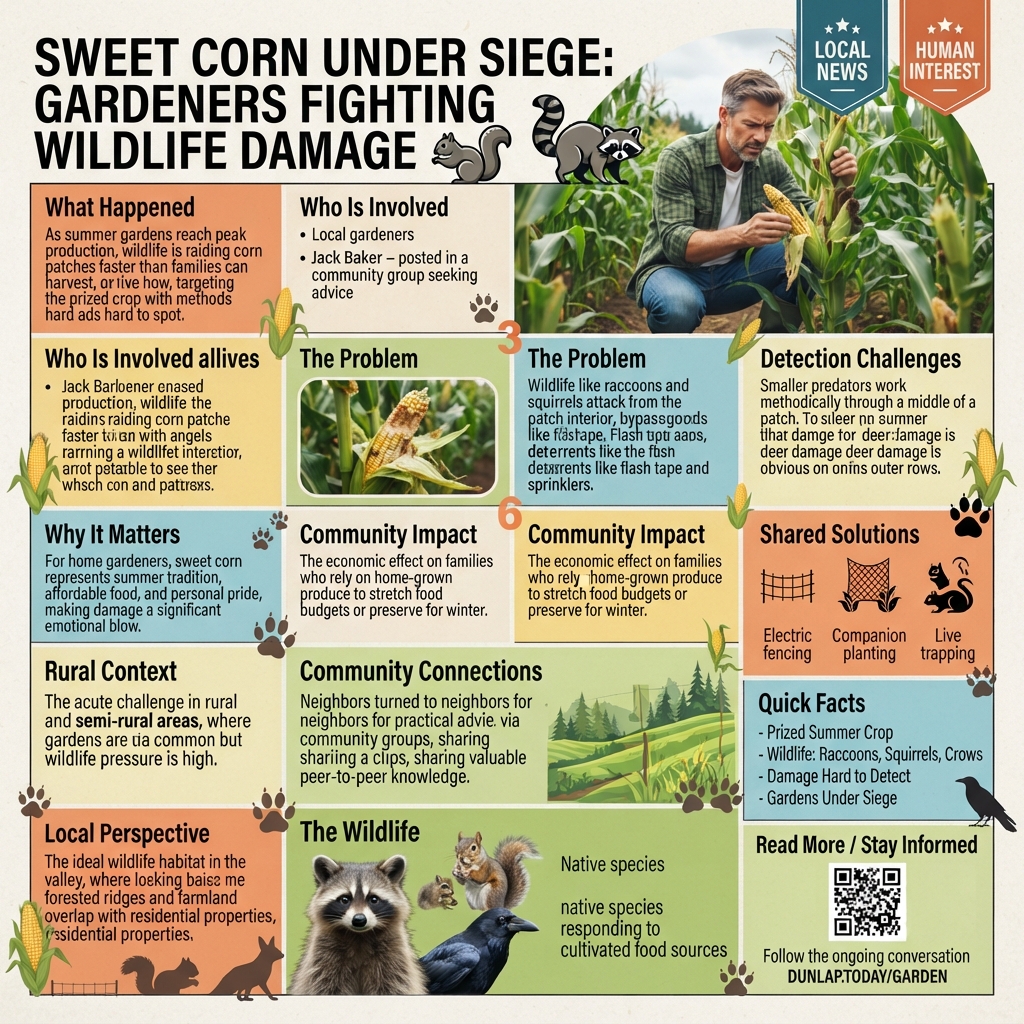
As summer gardens reach peak production across the Sequatchie Valley, a familiar frustration is ripening alongside the corn: wildlife raiding patches faster than families can harvest. Local gardeners are sharing battle-tested strategies—and seeking new solutions—as squirrels, raccoons, and crows target the most prized crop of the season.
🦝 The Problem: Wildlife Pressure on Home Gardens
Jack Baker, a local gardener, recently posted to the Dunlap Enquirer community group asking for advice after discovering partially eaten corn still on the stalk—a telltale sign of raccoon or squirrel damage. Baker has already tried several common deterrents: silver flash tape, motion-activated sprinklers, and cayenne pepper. Yet the wildlife keeps returning, always attacking from the interior of the corn patch where damage is hardest to spot until harvest time. 🎯
The pattern Baker describes—cobs eaten clean or corn stripped while still attached to the stalk—is one many Sequatchie Valley gardeners know well. Unlike deer damage, which typically leaves obvious browse marks on outer rows, these smaller predators work methodically through the middle of a patch, making early detection difficult.
❤️ Why This Matters to Local Families
For home gardeners in the valley, sweet corn represents more than a vegetable. It’s a summer tradition, a way to feed families affordably, and often a point of pride in the garden. When wildlife destroys a significant portion of the crop, it affects household food security, the time invested in planting and tending, and the simple joy of harvesting something you’ve grown. 🏡
The challenge is especially acute in rural and semi-rural areas of Sequatchie Valley, where gardens are common but wildlife pressure is high. Families who rely on home-grown produce to stretch their food budgets or preserve for winter face real economic impact when raccoons and crows reduce yields.
🤝 Community Connections and Shared Solutions
Baker’s post to the Dunlap Enquirer group reflects a broader pattern in Sequatchie Valley communities: neighbors turning to neighbors for practical advice. The group has become a space where gardeners, farmers, and homesteaders share what works—and what doesn’t—based on real experience. This kind of peer-to-peer knowledge is especially valuable in rural areas where extension services may be distant and trial-and-error is often the fastest teacher. 💡
The responses to Baker’s question likely include recommendations from gardeners who have faced the same problem: electric fencing, netting, companion planting, timing strategies, or even live trapping and relocation. Each solution reflects someone’s investment of time and resources—a form of community knowledge that strengthens local resilience.
📍 Local Perspective: Wildlife Pressure in the Valley
Sequatchie Valley’s mix of forested ridges, open farmland, and residential properties creates ideal habitat for raccoons, squirrels, and crows. As the valley develops and gardens become more common in suburban and rural settings, wildlife and human food sources are increasingly overlapping. This is not a new problem, but it is a persistent one—and one that connects gardeners across the valley to a shared challenge. 🌲
The wildlife causing damage are native to the region and thriving. They’re not invaders; they’re responding to the availability of cultivated food sources. This reality shapes how gardeners approach solutions: not eradication, but coexistence and protection.
💬 What Residents Should Know
If you’re growing sweet corn in Sequatchie Valley, here’s what Baker’s experience suggests: Start early with deterrents. Silver flash tape, motion sprinklers, and cayenne pepper may slow wildlife but rarely stop them completely. Monitor the interior of your patch regularly—damage often appears in the middle rows before you notice it at the edges. Consider layered defenses: combining multiple methods (fencing, netting, noise makers, or timing) often works better than any single approach. 🛡️
If you’ve found solutions that work in your garden, sharing them with neighbors—whether through community groups, church gatherings, or casual conversation—strengthens the collective knowledge base and helps others avoid costly mistakes.
🔄 What Happens Next
Baker’s question will likely generate responses from other Sequatchie Valley gardeners who have faced similar damage. Those responses—practical, tested, and rooted in local conditions—become part of the informal knowledge network that helps gardeners adapt year to year. The conversation may also reveal whether certain neighborhoods or areas of the valley experience more wildlife pressure than others, which could help gardeners make informed decisions about planting location and defense strategy. 📢
As the growing season continues, the success or failure of different deterrent methods will become clearer. By late summer, when corn harvest is complete, gardeners will have new data to inform next year’s approach.
🌱 Community Questions Worth Considering
As Sequatchie Valley gardeners work to protect their crops, a few questions emerge:
- Are certain areas of the valley experiencing more wildlife pressure than others, and if so, why? (Proximity to forest, water sources, or previous food availability?)
- How many local gardeners are losing significant portions of their corn crop each year, and what does that mean for household food security?
- Are there proven, affordable solutions that work specifically in our valley’s conditions—and how can gardeners share that knowledge more systematically?
- Could community gardens or shared growing spaces use collective defense strategies (fencing, netting, monitoring) more effectively than individual plots?
🧵 Community Threads: The Invisible Network
Gardening Knowledge Networks: Baker’s post reveals an active, informal network of gardeners in Sequatchie Valley who share experience and advice through community groups. This network strengthens resilience by distributing practical knowledge and reducing the isolation of individual problem-solving. When one gardener finds a solution, others benefit. 🔗
Seasonal Rhythms and Shared Challenges: Summer gardening connects residents across the valley to a common seasonal experience. Wildlife pressure on corn is a shared challenge that transcends neighborhood or income level—it’s a valley-wide reality that creates opportunities for neighbors to help neighbors.
Rural Self-Reliance and Adaptation: The willingness to try multiple solutions, learn from failure, and share results reflects a broader valley culture of practical problem-solving and adaptation. This same resilience shows up in other areas of community life—from home repair to food preservation to mutual aid.
🌾 Long-Term Community Impact
How Sequatchie Valley gardeners respond to wildlife pressure has implications beyond individual harvests. If more families successfully protect their corn crops, home food production increases, which strengthens food security and reduces dependence on external supply chains. If gardeners share solutions effectively, the collective knowledge base grows, making gardening more accessible and rewarding for newcomers. And if the valley develops community-level strategies—shared fencing, coordinated planting, or organized knowledge-sharing—it could shift the balance between wildlife and cultivation in ways that benefit both. 🌍
The conversation Baker started is not just about saving corn. It’s about how a community adapts to the realities of living alongside wildlife, how neighbors support each other’s self-sufficiency, and how local knowledge becomes a form of community wealth.
🤔Source
📰Other Stories
- 🎓 Research Study Seeks Caregivers’ Voices to Improve Local Family Support
- 🩸 Life-Saving Blood Drive at Cagle Community Center – Free & Easy Donation in Sequatchie Valley
- 🍽️ Weekend Specials at Rolling Oak Distillery : Family-Friendly Feasts & Wood-Fired Pizzas
- 🍪 Local Bakery Launches Cookie Dippers—Limited-Time Offer Tempts Sweet Tooths in Sequatchie Valley
- 🐣 Unlikely Newcomers: Flightless Feathers Join Weakley Hog Farm ’s Unexpected Menagerie
- 🛠️ Creative Connections: Local 3D Printing & Design at Dunlap Farmers Market
- 🍽️ Free School Meals Available for All Students in Sequatchie County Schools

0 Comments