

Don’t Get Your Britches in a Bunch: Before Everything Became an Emotional Crisis

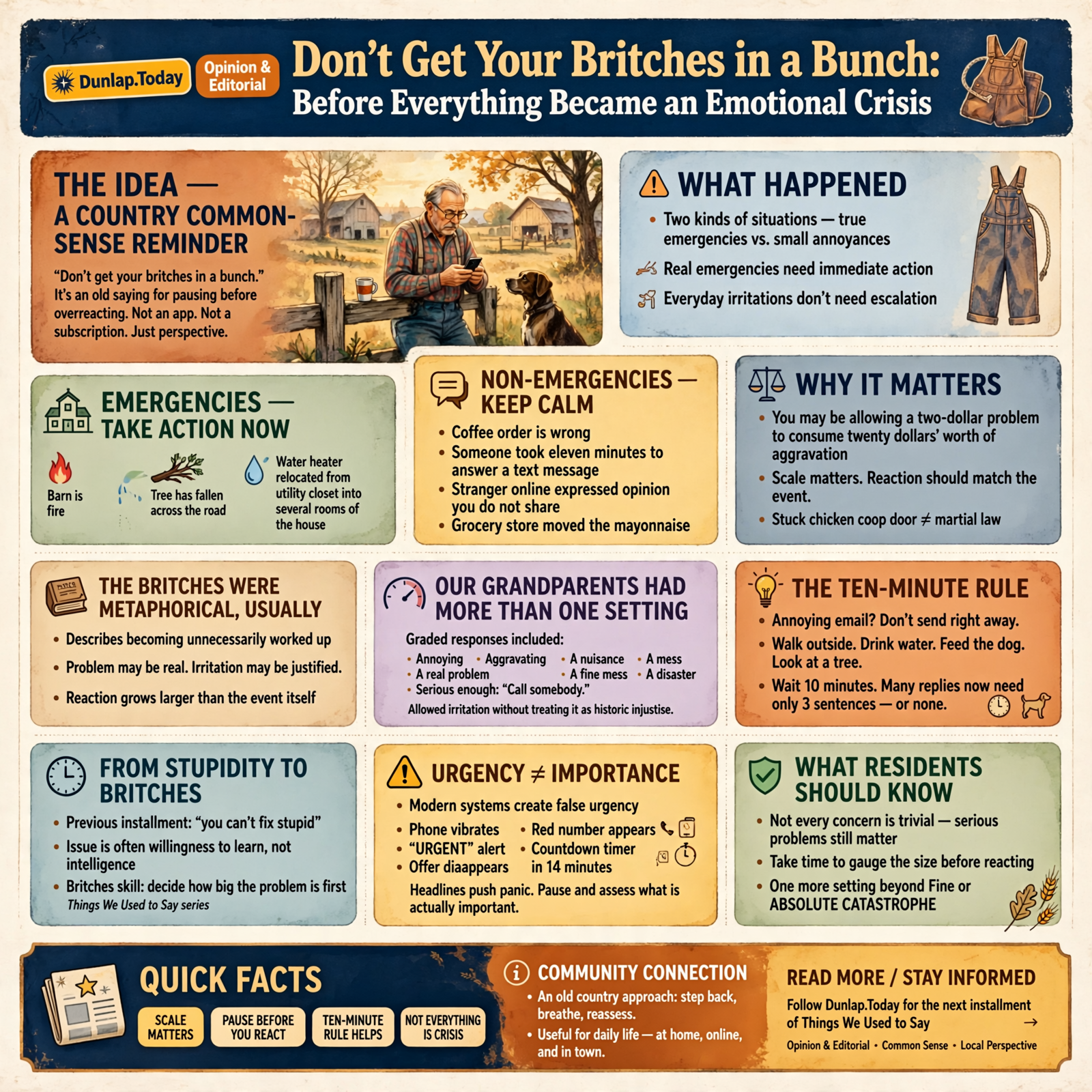
There are emergencies.
A barn is on fire.
A tree has fallen across the road.
The water heater has relocated itself from the utility closet into several rooms of the house.
Those situations deserve immediate attention.
Then there are other events.
Your coffee order is wrong.
Somebody took eleven minutes to answer a text message.
A stranger on the internet expressed an opinion you do not share.
The grocery store moved the mayonnaise.
For these situations, country people once maintained a separate emergency-response protocol:
“Don’t get your britches in a bunch.”
It was not especially scientific.
But it was memorable.
And unlike many modern coping strategies, it required neither an app nor a monthly subscription.
The Britches Were Metaphorical, Usually

The old saying describes the uncomfortable condition of becoming unnecessarily worked up.
The problem may be real.
The irritation may be justified.
But your reaction has begun to exceed the size of the event.
In plain English:
You may be allowing a two-dollar problem to consume twenty dollars’ worth of aggravation.
That does not mean people should ignore serious problems.
It does not mean every concern is trivial.
It means scale matters.
If the chicken coop door is stuck, you probably do not need to declare martial law.
Our Grandparents Had More Than One Setting

Modern communication sometimes behaves as though every event belongs in one of two categories:
Fine.
Or:
ABSOLUTE CATASTROPHE.
Older country language had more settings.
A problem could be:
- annoying,
- aggravating,
- a nuisance,
- a mess,
- a real problem,
- a fine mess,
- a disaster,
- or something serious enough that somebody finally said, “Call somebody.”
This graded system had an advantage.
It allowed people to become irritated without immediately treating irritation as evidence of historic injustice.
From Stupidity to Britches

In the previous installment of Things We Used to Say, we considered the phrase “you can’t fix stupid.”
That article argued that the real issue is often not intelligence but willingness to learn.
“Don’t get your britches in a bunch” adds another useful skill:
Before deciding what to do, decide how big the problem actually is.
That sounds simple.
It is not always easy.
Human beings have a remarkable ability to experience a temporary annoyance as though history itself has taken a personal interest in ruining Tuesday.
The Ten-Minute Rule Would Prevent a Lot of Trouble

Imagine somebody sends you an email that irritates you.
You immediately begin composing a response.
The first draft contains seventeen paragraphs.
The second includes phrases such as “for the record,” “quite frankly,” and “I find it interesting that.”
By paragraph nine, you are no longer responding to the email.
You are settling every grievance accumulated since approximately 2004.
This may be a good moment not to press Send.
Walk outside.
Drink water.
Feed the dog.
Look at a tree.
Come back in ten minutes.
Half the time, the message that seemed to require a constitutional convention now needs three sentences.
Sometimes it needs none.
Urgency and Importance Are Not the Same Thing

One reason our britches become tangled is that modern systems are excellent at manufacturing urgency.
Your phone vibrates.
A red number appears.
A message says “URGENT.”
A countdown timer begins.
An advertisement tells you the offer disappears in fourteen minutes.
A headline announces that something “changes everything.”
A coworker sends a message containing three exclamation marks.
All of these signals say:
Pay attention right now.
But urgency answers a different question from importance.
Urgency asks:
How quickly does this demand my attention?
Importance asks:
How much does this actually matter?
A ringing telephone is urgent.
Your health, family, finances, and long-term work may be more important.
The loudest rooster is not necessarily the one with the best information.
Social Media Discovered the Commercial Value of Bunched Britches

Human beings have always enjoyed gossip, arguments, outrage, and spectacle.
The internet did not invent those habits.
It did make them easier to distribute.
A disagreement that once might have occupied three people at the feed store can now reach thousands before lunch.
Somebody says something irritating.
Another person shares it.
Someone adds a furious caption.
People who were not involved become angry on behalf of people they have never met.
Within hours, complete strangers are demanding explanations.
Meanwhile, the original participants may have already gone to supper.
Technology has become remarkably efficient at importing other people’s britches into our day.
Outrage Feels Productive Even When Nothing Changes

One reason overreaction is attractive is that it feels like action.
You are angry.
You post.
You comment.
You forward.
You explain.
You announce that somebody must do something.
Your pulse rises.
You have clearly been busy.
But activity and effectiveness are different.
If the issue genuinely matters, ask what action would improve it.
Call somebody?
Fix something?
Spend money differently?
Help a neighbor?
Attend a meeting?
Gather better information?
Or is the only available action becoming angrier?
That last option has surprisingly high operating costs.
Small Businesses Cannot Run on Continuous Emergency

Small-business owners are especially vulnerable to bunched britches because every problem can feel personal.
A bad review appears.
A customer complains.
An employee makes a mistake.
A supplier is late.
A machine quits.
The website goes down.
Somebody leaves an unpleasant comment.
When your name is on the door, everything can feel like an attack on your reputation, livelihood, and general worth as a human being.
But not every problem deserves the same response.
A useful owner learns to sort problems quickly.
- Immediate danger: act now.
- Customer problem: respond promptly and solve what can be solved.
- Operational problem: diagnose it.
- Reputation problem: determine whether it is real or merely noisy.
- Internet nonsense: consider the possibility of going back to work.
That final category is larger than many people suspect.
A Bad Review Is Not a Meteor Strike

Suppose a restaurant receives a one-star review.
The owner is furious.
The customer claims the biscuits were cold.
The owner knows for a fact that those biscuits were lukewarm at worst.
There are several possible responses.
One is to write a 1,400-word public rebuttal explaining the thermal history of the biscuits.
This is rarely the strongest option.
A calmer approach might be:
Was the complaint reasonable?
Did something go wrong?
Can it be fixed?
Is a polite response appropriate?
Does one bad review matter much compared with hundreds of good customer experiences?
The goal is not to pretend criticism never hurts.
The goal is to avoid allowing one cold biscuit to become a management philosophy.
Some Problems Shrink When You Measure Them

Emotion uses words such as:
always.
never.
everyone.
nobody.
disaster.
Numbers sometimes behave differently.
“Customers are furious” may become:
“Three people complained out of 480 orders.”
“Nobody uses the new system” may become:
“Seventy-eight percent use it regularly, but the afternoon shift is struggling.”
“Sales have collapsed” may become:
“Sales were down six percent last week compared with an unusually strong week last year.”
Measurement does not make a real problem disappear.
It gives the problem edges.
That makes it easier to decide whether we need a wrench, a meeting, or simply less drama.
There Is a Difference Between Calm and Passive

“Don’t get your britches in a bunch” can be misused.
Sometimes people say things like this to dismiss legitimate concerns.
That is not wisdom.
A serious safety issue deserves attention.
Fraud deserves attention.
A broken machine that could hurt someone deserves attention.
A repeated customer problem deserves attention.
A family problem may deserve difficult conversation.
Staying calm does not mean doing nothing.
It means trying to keep your thinking equipment operational while deciding what to do.
You can be calm and firm at exactly the same time.
The Fire Extinguisher Should Match the Fire

Imagine walking into your kitchen and seeing a birthday candle burning.
You could call the fire department.
You could evacuate the neighborhood.
You could contact the television station.
Or you could blow it out.
Now imagine the curtains are on fire.
Different response.
The skill is not staying relaxed no matter what happens.
The skill is matching the response to the problem.
Some things require patience.
Some require action.
Some require documentation.
Some require help.
And some require turning off the phone and going to bed.
The Internet Removed the Cooling-Off Period

Older communication contained natural delays.
If somebody irritated you by letter, you had time before the reply arrived.
If you wanted to publish your opinion, somebody might have to print it.
If you became angry at 11:30 at night, there was a reasonable chance nobody else would know until morning.
Modern technology lets us experience emotion and distribute it to the world almost simultaneously.
That is convenient when the message is useful.
It is less convenient when your judgment improves fifteen minutes later.
The Send button has no wisdom requirement.
AI Can Help, but It Can Also Help You Overreact More Professionally

Artificial intelligence adds a strange new option.
Suppose you receive an irritating message.
You can ask an AI system to help you understand it, summarize it, or draft a calm response.
That can be useful.
You can also ask it to produce a devastating six-page rebuttal with numbered arguments and impeccable grammar.
Technology cannot decide whether the argument deserves six pages in the first place.
Before using AI to make your response more powerful, ask whether a response is needed.
Sometimes the smartest prompt is:
“Am I making this bigger than it is?”
Just remember that a machine can help you examine the situation, but it does not have to live with your relatives at Thanksgiving.
Children Understand This Better Than Adults Sometimes Do

A child drops an ice cream cone.
For thirty seconds, life is over.
There has never been such suffering.
The universe is unjust.
Then somebody produces another cone.
Within minutes the crisis has been resolved.
Adults are more sophisticated.
We can remain irritated about our ice cream cone for seventeen years.
We can remember who was present.
We can explain why it revealed something troubling about society.
We can mention it every Christmas.
Maturity ought to include the ability to recognize when the replacement cone has already arrived.
Ask Whether Tomorrow Will Care

One useful way to put a problem in proportion is to change the time frame.
Will this matter tomorrow?
Next week?
Next year?
In five years?
Some problems become more serious under that test.
A leaking roof may seem minor today but expensive next year.
A neglected health problem may deserve attention even if it is not currently dramatic.
Other problems evaporate.
Someone cut you off in traffic.
The cashier seemed grumpy.
A stranger misunderstood your comment.
Your sandwich arrived with pickles.
If the event will become completely irrelevant before the dog’s next meal, it may not deserve the rest of your afternoon.
Wisdom From the Front Porch

Our old sayings were often crude little packages containing fairly sophisticated ideas.
“Don’t get your britches in a bunch” is really advice about proportion.
Feel what you feel.
Notice the irritation.
Then ask whether the situation deserves control of the whole day.
You do not have to turn every disagreement into a relationship-ending event.
You do not have to turn every mistake into a character judgment.
You do not have to turn every inconvenience into evidence that civilization is collapsing.
Some problems need fixing.
Some need discussing.
Some need forgiveness.
And some need five minutes.
Plain-English Glossary

Proportion: Matching the size of your response reasonably well to the size and importance of the problem.
Urgency: How quickly something appears to require attention. Urgent things are not always the most important things.
Escalation: When a disagreement or problem becomes more intense, serious, or difficult to resolve.
Cooling-off period: Deliberately waiting before reacting so emotion has time to settle and clearer judgment can return.
Perspective: Looking at a situation in a broader context rather than only through the immediate emotion it creates.
Rumination: Repeatedly thinking about an upsetting event without necessarily moving toward a solution.
Signal versus noise: Separating information that actually matters from activity, commentary, alerts, or emotion that attracts attention without adding much value.
Frequently Asked Questions

Does “don’t get your britches in a bunch” mean people should suppress their emotions?
No. Emotions provide useful information. Anger may indicate unfairness, fear may signal danger, and frustration may reveal a recurring problem. The useful question is what the emotion is telling you and whether the eventual response fits the situation.
How can I tell whether I am overreacting?
Ask what actually happened, what consequences are likely, what evidence you have, whether the problem will matter later, and what action would genuinely improve it. If the response is growing while the underlying problem remains small, your britches may be heading in the wrong direction.
Should a business ignore angry customers who seem unreasonable?
No. Listen for useful information even when the delivery is unpleasant. Some complaints reveal real problems. Others may not. A calm response allows a business to separate the customer’s emotion from whatever facts are underneath it.
Is social media really making people angrier?
Social platforms can make emotional content easier to encounter, share, and respond to quickly. But users still have choices about what they follow, what they amplify, how quickly they react, and whether every argument deserves participation.
Can taking time before responding make you look weak?
Usually not. A measured response often looks more confident than an immediate emotional one. Serious emergencies require quick action, but many conflicts improve when the first response is not the final response.
What if the problem really is serious?
Then act seriously. The point is not to minimize real danger, harm, or important problems. It is to preserve enough perspective to recognize the difference between a burning barn and a missing pickle.
The “Are My Britches Bunched?” Checklist

Before turning an irritation into a full-scale event, ask:
- What exactly happened?
- What part of this is fact, and what part is my interpretation?
- Is anybody in immediate danger?
- What is the actual consequence if I do nothing for ten minutes?
- Will this matter tomorrow, next month, or next year?
- Am I responding to this event, or to five older frustrations piled underneath it?
- Would I react the same way if I were well-rested and not already aggravated?
- What outcome do I actually want?
- Will my planned response make that outcome more likely?
- Does this require action, conversation, documentation, or simply time?
- Am I solving the problem or performing my anger?
- Would I be comfortable with my response being read aloud tomorrow morning?
If the answers reveal a serious problem, deal with it.
If they reveal a small problem wearing a large emotional hat, adjust accordingly.
Final Thought

The world contains enough genuine problems.
We do not need to promote every irritation into management.
Some things deserve outrage.
Some deserve urgency.
Some deserve patience.
And some deserve nothing more than:
“Well, that was annoying.”
Then you move on.
That may be the deeper wisdom hiding inside the old expression.
Keep the emergency response available for emergencies.
Keep your attention for things that matter.
Do not hand strangers on the internet the keys to your blood pressure.
And when a relatively small inconvenience begins expanding until it occupies the whole pasture, remember that generations before us had already developed a technical procedure.
Stop.
Look at the problem.
Decide how large it really is.
Then, if necessary, straighten your britches and get on with the day.



0 Comments