
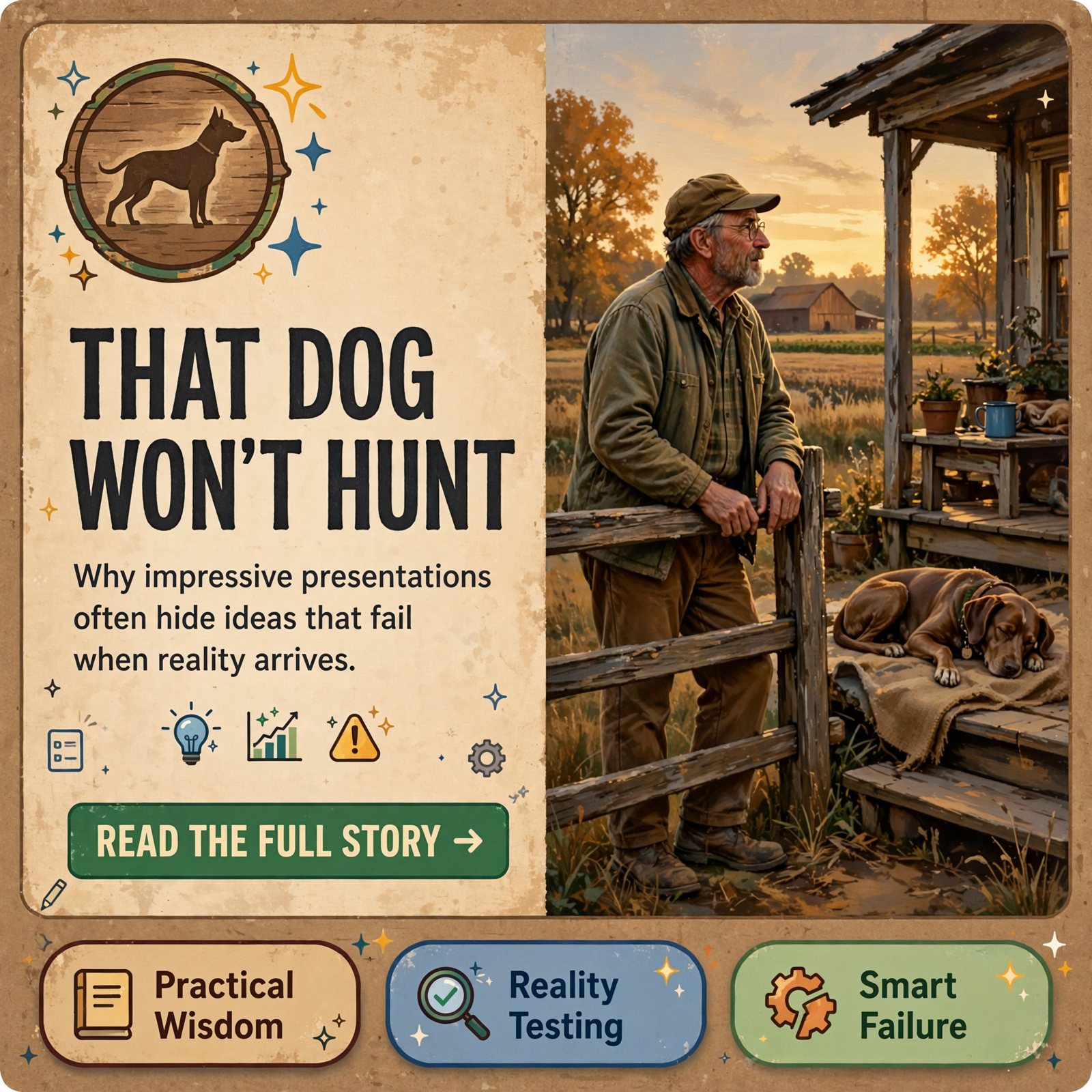
That Dog Won’t Hunt: A Countryman’s Guide to Bad Ideas and Worse PowerPoints

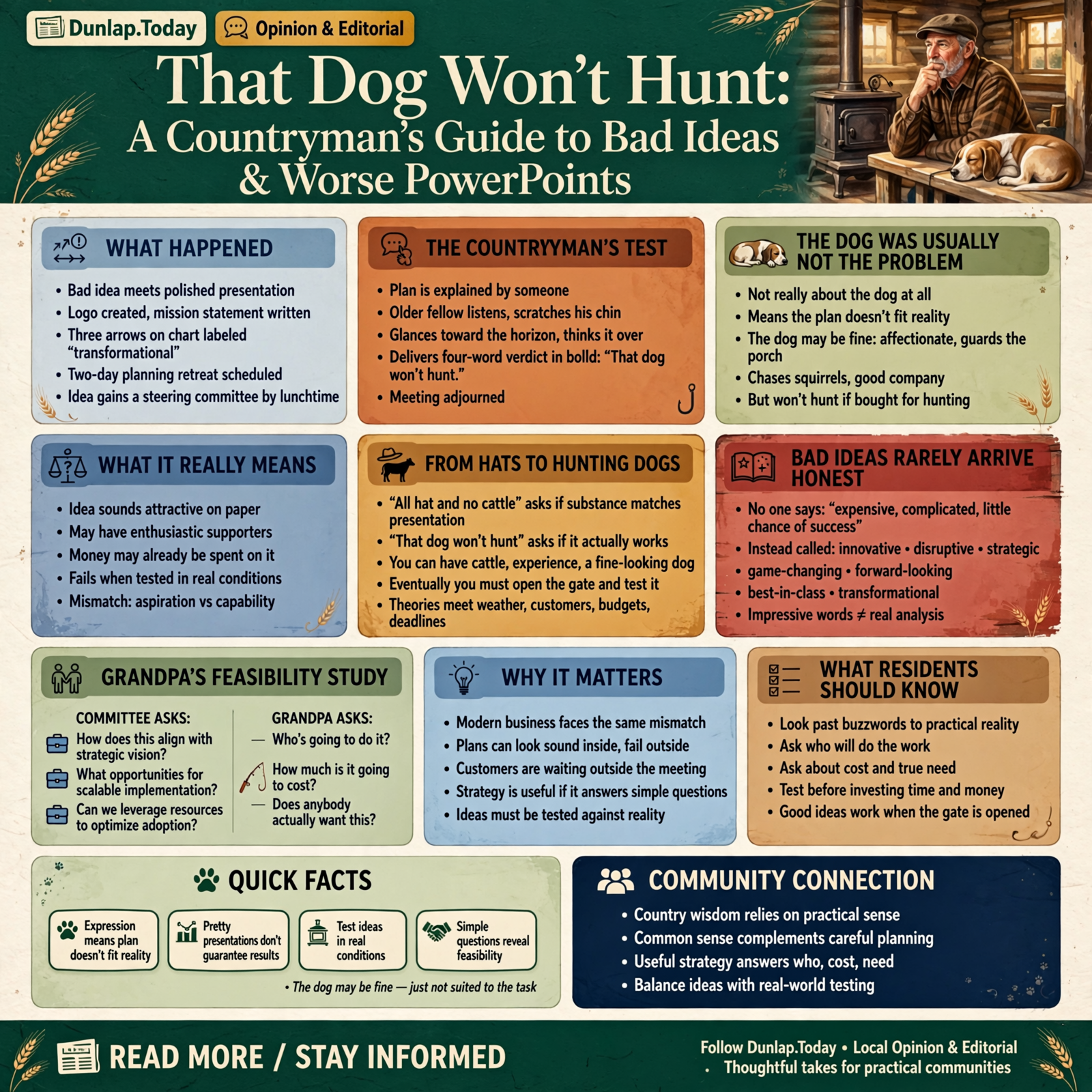
There are few things more impressive than a bad idea with a professionally designed presentation.
Give it a logo.
Add a mission statement.
Put three arrows on a chart.
Describe it as “transformational.”
Schedule a two-day planning retreat.
By lunchtime, an idea that should have died quietly behind the barn may have acquired a steering committee.
Country people developed a simpler evaluation system.
Somebody would explain the plan.
An older fellow would listen.
He might scratch his chin.
He might glance toward the horizon.
Then he would deliver the entire feasibility study in four words:
“That dog won’t hunt.”
Meeting adjourned.
The Dog Was Usually Not the Problem

Like most good country expressions, “that dog won’t hunt” is not really about the dog.
It means the plan does not fit reality.
The idea may sound attractive.
It may have enthusiastic supporters.
Somebody may have already spent money on it.
But when the moment comes for the thing to perform its intended function, it simply does not.
A hunting dog that refuses to hunt may still be a perfectly fine dog.
It may be affectionate.
It may guard the porch.
It may chase squirrels.
It may be excellent company.
But if you bought it for hunting and it prefers sleeping beside the stove, you have discovered an important mismatch between aspiration and capability.
Modern business encounters the same problem regularly.
From Hats to Hunting Dogs

In the previous article in this series, we considered the old expression “all hat and no cattle.”
That phrase asks whether the substance matches the presentation.
“That dog won’t hunt” takes us one step further.
Now we are asking whether the thing actually works.
You can have cattle.
You can have experience.
You can even have a respectable-looking dog.
But eventually somebody has to open the gate and see what happens.
This is where theories encounter weather, customers, employees, budgets, machinery, deadlines, and all the other unpleasant features of reality.
Bad Ideas Are Rarely Introduced as Bad Ideas

No one walks into a meeting and says:
“Ladies and gentlemen, I have developed an expensive, complicated proposal with very little chance of success.”
Bad ideas usually arrive wearing their Sunday clothes.
They are described as:
- innovative,
- disruptive,
- strategic,
- game-changing,
- forward-looking,
- best-in-class,
- or, when everyone has completely run out of useful adjectives, transformational.
None of those words makes an idea good or bad.
The problem is that impressive language can create the feeling that serious analysis has already occurred.
Sometimes it has.
Sometimes somebody simply found a thesaurus.
Grandpa’s Feasibility Study

A practical person often evaluates an idea differently from a committee.
The committee may ask:
“How does this initiative align with our long-term strategic vision?”
Grandpa may ask:
“Who’s going to do it?”
The committee asks:
“What opportunities exist for scalable implementation?”
Grandpa asks:
“How much is it going to cost?”
The committee asks:
“Can we leverage existing resources to optimize adoption?”
Grandpa asks:
“Does anybody actually want this?”
The committee schedules another meeting.
Grandpa goes fishing.
This does not mean strategy is useless.
It means good strategy eventually has to answer simple questions.
The Customer Is Usually Waiting Outside the Meeting
Businesses can become especially vulnerable to ideas that make sense internally but not externally.
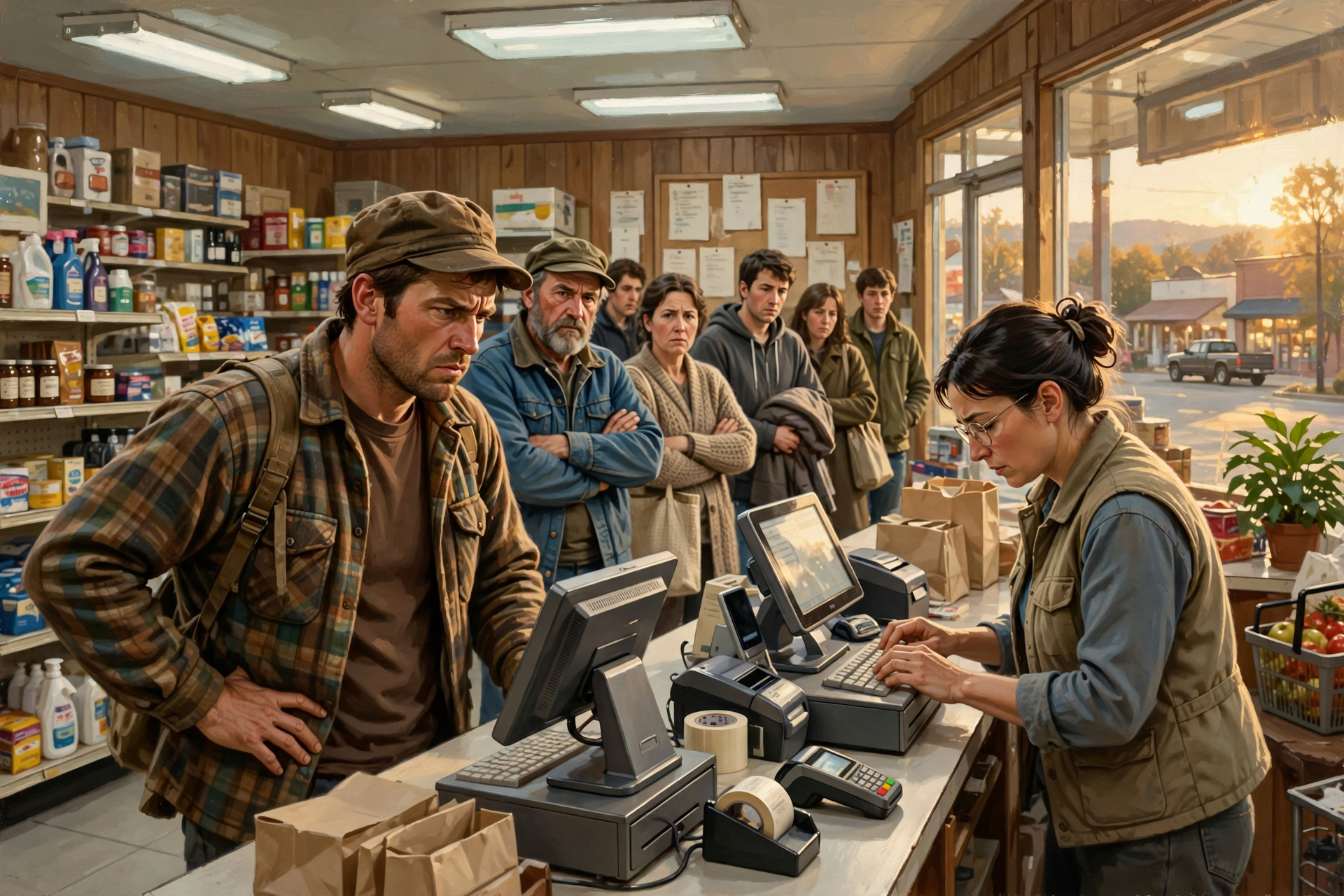
Imagine a local store redesigning its checkout process.
The new system is modern.
It gathers more data.
It supports loyalty programs.
It integrates with three other systems.
It produces beautiful reports.
There is only one problem.
Checking out now takes four minutes longer.
The owner sees a technology upgrade.
The customer sees a line.
That is an important distinction.
Sometimes the dog performs beautifully in the conference room and refuses to leave the porch once customers arrive.
Small Businesses Cannot Afford Too Many Decorative Dogs

Large organizations can carry bad ideas for a surprisingly long time.
They have departments.
They have budgets.
They have enough people that responsibility can occasionally wander off and hide.
A small business has fewer places for a bad idea to conceal itself.
If you own a heating-and-air company, restaurant, repair shop, farm, construction business, rental property, or store, a poor decision becomes visible quickly.
Money leaves the checking account.
Employees lose time.
Customers become confused.
The phone stops ringing.
Or everybody discovers that the new system requires seventeen steps to accomplish something that previously required three.
Small businesses therefore have a competitive advantage that does not get enough attention:
They can stop doing stupid things faster.
At least in theory.
The Hardest Words in Business May Be “This Isn’t Working”

Once people invest time, money, reputation, or emotion into an idea, abandoning it becomes difficult.
This is ordinary human behavior.
You spend $5,000 on a piece of equipment.
It does not solve the problem.
But now you feel pressure to keep using it because you spent $5,000.
You spend six months developing a product customers do not want.
Rather than stop, you spend another six months trying to explain to customers why they should want it.
You hire someone who is clearly wrong for the job.
Instead of correcting the decision, you reorganize half the company around them.
Sometimes we stop evaluating the dog and start defending the purchase.
Throwing More Dog Food at the Problem

One of the great organizational traditions is responding to failure by increasing the investment.
The first version does not work.
So we add features.
The features make it more complicated.
Adoption declines.
So we schedule training.
The training reveals that nobody understands why the system exists.
So we create documentation.
The documentation becomes 83 pages long.
Now nobody reads it.
So we hire a consultant.
Six months later, the consultant recommends “improving stakeholder engagement.”
The old farmer watches all this from the fence.
The dog still won’t hunt.
But Be Careful: Some Dogs Just Need Training

This is where the old saying needs a little wisdom.
Not every struggling idea is a bad idea.
Sometimes a good idea is poorly implemented.
Sometimes people need training.
Sometimes customers need time to understand something new.
Sometimes the first version is rough.
Sometimes the environment changes.
Sometimes an idea fails because it was introduced at the wrong time rather than because the idea itself was wrong.
There is an important difference between:
“This dog won’t hunt.”
and:
“This dog hasn’t learned to hunt yet.”
Good judgment requires figuring out which situation you are actually in.
How Do You Tell the Difference?

One useful approach is to separate the idea from its implementation.
Ask:
- Is the underlying problem real?
- Does anyone actually care about solving it?
- Does this approach make the problem meaningfully better?
- Can people use it without heroic effort?
- Are the costs reasonable compared with the benefit?
- Are the obstacles temporary, or are they built into the idea?
- What evidence would convince us to continue?
- What evidence would convince us to stop?
That last question matters.
If there is no possible evidence that would cause you to abandon an idea, you are no longer testing it.
You are believing in it.
PowerPoint Cannot Make a Dog Hunt

Presentations are useful.
They help organize information.
They can clarify complicated decisions.
They can show costs, benefits, timelines, alternatives, and evidence.
But presentations also have a peculiar psychological power.
Put a bad idea on a clean slide with a professional chart and it begins to look respectable.
Add a blue arrow pointing upward and things become downright optimistic.
By slide twelve, everyone may forget to ask whether the original assumption was true.
A useful discipline is to reduce the proposal to one plain-English sentence.
If the idea stops sounding sensible after the jargon is removed, the jargon may have been doing most of the work.
A Practical Example: The Restaurant Tablet

Suppose a small restaurant considers replacing printed menus with tablets.
The proposal sounds modern.
Prices can be updated instantly.
Photos can be displayed.
Specials can change automatically.
Maybe customers can even order directly.
There are real potential benefits.
But now ask practical questions.
Who charges the tablets?
Who cleans them?
What happens when one breaks?
Can an elderly customer read the screen?
Does the dining room have reliable Wi-Fi?
Do customers actually prefer them?
Will they save enough labor to justify the expense?
The correct answer might still be yes.
Or the answer might be that laminated menus cost $6.75 and have never requested a software update during dinner service.
The point is not that old technology is always better.
The point is that technology needs a job.
Artificial Intelligence Has Produced Some Very Fancy Hunting Dogs

Artificial intelligence belongs in this conversation because businesses are currently surrounded by new possibilities.
AI can genuinely help with writing, analysis, customer service, research, scheduling, software development, document processing, photography, accounting review, and many other tasks.
It can also be attached to things that did not particularly need AI.
This happens whenever a technology becomes fashionable.
Years ago, everything needed a website.
Then everything needed an app.
Then everything needed to be “in the cloud.”
Now many products are discovering that they apparently needed artificial intelligence all along.
Sometimes that is true.
Sometimes someone simply put a very expensive electronic collar on a dog that still will not leave the porch.
The Right Question Is Not “Does It Use AI?”

The better questions are:
- Does it save meaningful time?
- Does it reduce errors?
- Does it improve service?
- Does it help people make better decisions?
- Does it reduce costs?
- Does it create revenue?
- Does it remove tedious work?
- Does it create new risks that outweigh the benefits?
If the answer is yes, the technology may be valuable.
If the main benefit is being able to say “we use AI,” then we may be back in the pasture admiring hats.
Failure Can Be Useful If It Is Cheap

One of the healthiest ways to handle uncertain ideas is to make the first experiment small.
Before buying twenty devices, test one.
Before rebuilding the whole website, test the new feature on one page.
Before changing every employee’s process, try it with one person.
Before ordering 5,000 units, see whether fifty customers actually want one.
This is not pessimism.
It is economical curiosity.
A cheap failure can be excellent information.
An expensive failure containing exactly the same lesson is usually less charming.
Set the Fence Before You Release the Dog

A good experiment should include success and failure conditions before it starts.
For example:
“We will try this new scheduling system for 30 days. If missed appointments fall by at least 20 percent and employees can use it without additional administrative work, we will continue.”
Now everybody knows what success means.
Without that agreement, people tend to reinterpret results after the fact.
If the system works, supporters say they were right.
If it fails, supporters say it needs more time.
If it fails badly, supporters say the organization was not ready for transformation.
Eventually somebody needs permission to say:
“No. We tried it. The dog didn’t hunt.”
Beware the Person Who Can Never Kill an Idea

Good leaders generate ideas.
Great leaders can also retire them.
There is no shame in discovering that something did not work.
The shame comes from allowing pride to keep everybody feeding it indefinitely.
A healthy organization makes room for sentences such as:
- “We thought this would work, and it didn’t.”
- “The assumptions changed.”
- “Customers do not value this enough.”
- “The cost is higher than the benefit.”
- “There is a better approach now.”
- “We learned what we needed to learn.”
Those are not statements of failure.
They are evidence that somebody is paying attention.
Sometimes Yesterday’s Bad Idea Becomes Tomorrow’s Good One
There is another complication.
A dog that will not hunt today may deserve another look years later.
Technology changes.
Prices fall.
Customers change habits.
Infrastructure improves.
A process that once required ten employees may eventually be automated.
An idea that was too expensive in 2015 may be affordable in 2026.
This is why rejecting an idea does not always mean burying it permanently.
Sometimes the correct decision is:
“Not now.”
Good judgment preserves the reason.
What would have to change before the idea became practical?
If those conditions eventually appear, it may be worth letting the dog out again.
Wisdom From the Front Porch

The deeper lesson in “that dog won’t hunt” is not cynicism.
It is honesty.
Good ideas deserve enthusiasm.
Promising experiments deserve patience.
People deserve opportunities to learn.
Innovation always involves uncertainty.
But optimism works best when somebody occasionally looks at the evidence.
The country version of critical thinking is often surprisingly practical:
What is it supposed to do?
Did it do it?
If not, why not?
Can we reasonably fix that?
And if we cannot?
Quit feeding the dog.
Plain-English Glossary

Feasibility: Whether something can realistically be done with the available money, people, technology, time, and conditions.
Pilot: A small-scale test performed before committing to a larger rollout.
Sunk cost: Time or money already spent that cannot be recovered. Past spending should not automatically justify future spending.
Success metric: A measurable sign that tells you whether the idea is producing the intended result.
Assumption: Something treated as true when making a plan, even though it may not yet be proven.
Iteration: Trying something, learning from the result, making changes, and testing again.
Opportunity cost: What you give up by spending money, time, or attention on one choice instead of another.
Frequently Asked Questions
Does “that dog won’t hunt” mean we should reject unusual ideas?
No. Many excellent ideas sounded unusual at first. The expression is useful when evidence shows that a particular approach is unlikely to accomplish its intended purpose. The goal is not to punish creativity. It is to distinguish experimentation from endless denial.
How long should you give a new idea before deciding it does not work?
That depends on the idea. A restaurant promotion may produce useful evidence in a week. A new employee process may need several months. The important step is deciding beforehand what evidence you expect and how long a fair test should take.
What if employees resist every new idea?
Resistance does not automatically mean the idea is bad. People may need training, explanation, or time. But resistance can also contain useful information. Ask what specifically is difficult rather than assuming either management or employees must be wrong.
When should a failed idea be reconsidered?
When one or more of the conditions that originally made it impractical have materially changed. Lower costs, better technology, new customer demand, improved infrastructure, or a different implementation method can turn an old “no” into a sensible new experiment.
Can AI help determine whether an idea will work?
AI can help organize assumptions, compare options, analyze data, identify risks, model scenarios, and suggest questions. It cannot eliminate uncertainty or replace real-world testing. A computer can describe a hunting dog in extraordinary detail. Eventually somebody still has to open the gate.
The “Will This Dog Hunt?” Checklist

Before committing serious money or time to a new idea, ask:
- What specific problem are we trying to solve?
- Who actually experiences that problem?
- How are they solving it today?
- What measurable improvement should this idea create?
- What assumptions have to be true for it to work?
- What is the smallest realistic test we can run?
- How much can we afford to lose while learning?
- What evidence will make us continue?
- What evidence will make us stop?
- If the test fails, what did we learn?
- Could changing technology or conditions make the idea worth revisiting later?
If nobody can answer those questions, you may not have a plan yet.
You may have a PowerPoint.
Final Thought

There is something refreshing about an expression that refuses to be impressed by presentation.
You can name the initiative.
You can create the logo.
You can hire consultants.
You can build dashboards.
You can put artificial intelligence in it.
You can describe it as revolutionary.
But eventually reality gets a vote.
The customer either buys.
The employee either uses it.
The machine either runs.
The process either improves.
The savings either appear.
The dog either hunts.
And when it does not, one of the most valuable people in the room may be the person willing to say so.
Not angrily.
Not triumphantly.
Not because they dislike change.
Just because sometimes common sense still deserves a chair at the meeting.
So bring the charts.
Bring the strategy.
Bring the technology.
Bring the optimism.
Then open the gate.
If the dog hunts, wonderful.
If it does not, bless its heart and quit buying dog food.

0 Comments