

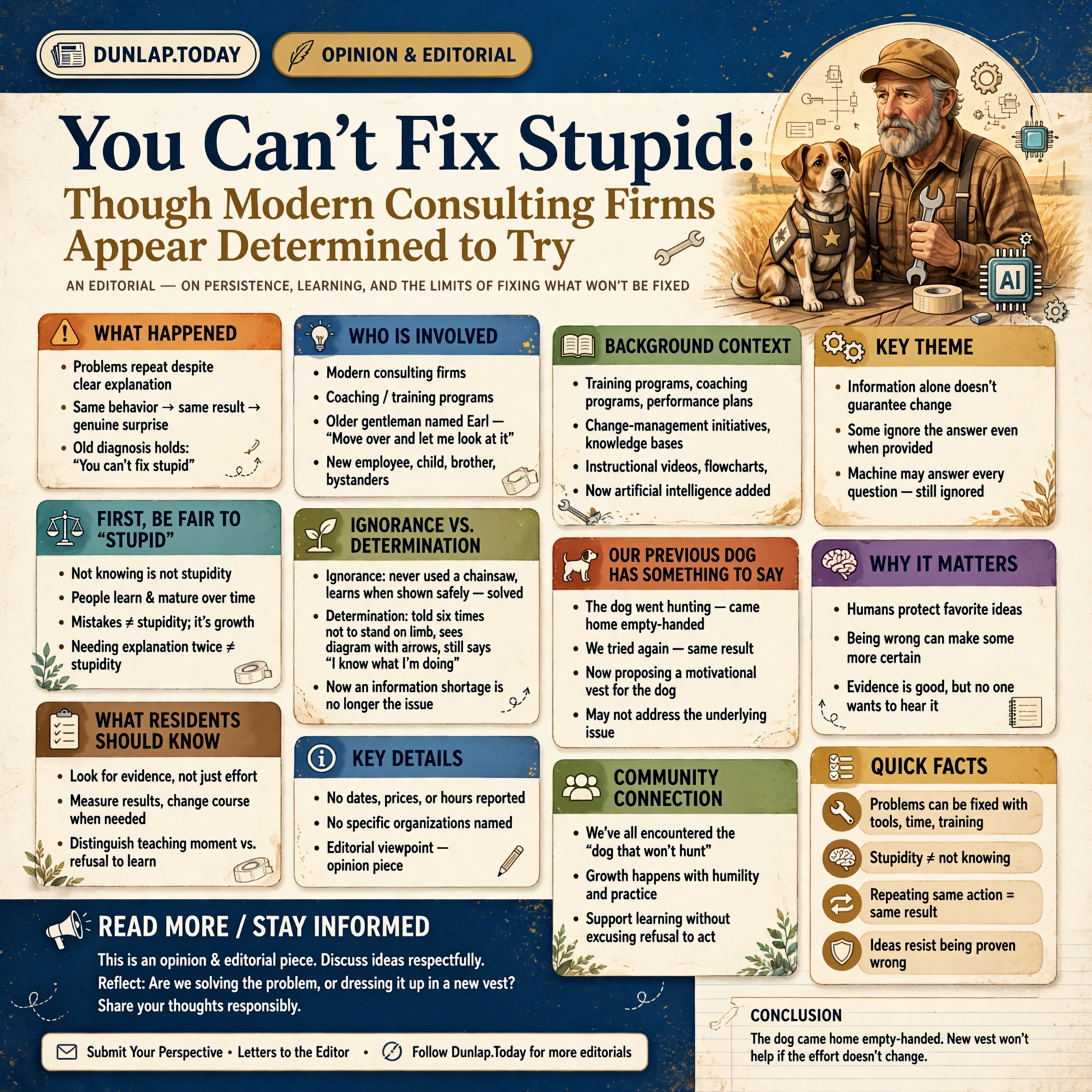
You Can’t Fix Stupid: Though Modern Consulting Firms Appear Determined to Try

There are problems you can repair with a wrench.
There are problems you can repair with money.
There are problems you can repair with training, patience, experience, duct tape, a YouTube video, or an older gentleman named Earl who says, “Move over and let me look at it.”
Then there are certain situations where somebody watches a problem happen, receives a clear explanation of why it happened, repeats exactly the same behavior, produces exactly the same result, and looks genuinely surprised.
Country people eventually developed a diagnosis:
“You can’t fix stupid.”
Modern organizations have been less willing to accept this conclusion.
They have developed training programs.
Coaching programs.
Performance plans.
Change-management initiatives.
Knowledge bases.
Instructional videos.
Flowcharts.
Consultants.
And now artificial intelligence.
At some point, humanity may create a machine capable of answering every question ever asked.
Somebody will still ignore the answer.
First, We Ought to Be Fair to Stupid

The old expression is funny because it is blunt.
It is also not particularly accurate.
People learn.
People mature.
People gain experience.
People make spectacular mistakes at twenty and become remarkably sensible by forty.
Someone who knows nothing about plumbing today may become an excellent plumber.
A new employee may struggle for three weeks and become the best person in the department three years later.
A child who asks a question that sounds ridiculous may simply be encountering the subject for the first time.
Not knowing something is not stupidity.
Making a mistake is not stupidity.
Needing something explained twice is not stupidity.
Trying something difficult and failing is definitely not stupidity.
If anything deserves the old expression, it is something more specific:
The persistent refusal to learn from available evidence.
That is a different animal entirely.
The Difference Between Ignorance and Determination

Suppose somebody has never used a chainsaw.
He does not know how to start it.
That is ignorance in the original sense of the word: he simply does not know yet.
Show him.
Explain the safety features.
Teach him how the saw behaves.
Give him supervised practice.
Problem solved.
Now suppose another fellow has been told six times not to stand on the limb he is cutting.
He has watched three instructional videos.
His brother has explained gravity.
There is a diagram.
The diagram has arrows.
He announces, “I know what I’m doing.”
At that point we are no longer dealing with an information shortage.
We have entered the field of applied philosophy.
Our Previous Dog Has Something to Say About This

In the previous installment of Things We Used to Say, we considered the phrase “that dog won’t hunt.”
The lesson was that ideas should eventually face reality.
Try the thing.
Measure what happens.
Learn.
Change course when necessary.
“You can’t fix stupid” introduces the uncomfortable possibility that sometimes the evidence is perfectly good and the problem is that nobody wants to hear it.
The dog went hunting.
The dog came home empty-handed.
We tried again.
Same result.
Now somebody proposes purchasing the dog a motivational vest.
This may not address the underlying issue.
Humans Are Extremely Good at Protecting Their Favorite Ideas

One of the stranger features of the human mind is that being wrong does not always make us less certain.
Sometimes it inspires us to work harder at explaining why we were actually right.
The project failed because the employees resisted it.
The product failed because customers did not understand it.
The advertising failed because the market was not ready.
The investment failed because circumstances were unfair.
The homemade trailer failed because the state has too many regulations about wheels remaining attached to trailers.
Any one of those explanations could be true.
But there is another possibility worth considering:
Maybe the idea was bad.
Common sense begins when that possibility is allowed into the room.
The Most Dangerous Person May Be the One Who Cannot Say “I Don’t Know”

Not knowing is uncomfortable.
Especially when other people expect an answer.
So humans sometimes substitute confidence for knowledge.
You have probably met the type.
Ask a question about engines, economics, computers, medicine, roofing, international trade, chicken feed, or septic systems.
The answer arrives immediately.
There is no hesitation.
No uncertainty.
No suspicious pause during which actual thought appears to occur.
That confidence can be persuasive.
It can also be expensive.
One of the most useful sentences any competent person can learn is:
“I don’t know, but I can find out.”
Those words do not reveal weakness.
They reveal that the speaker knows where the edge of the map is.
Consultants Cannot Manufacture Curiosity

Consultants receive plenty of jokes, some deserved and some not.
A good consultant can bring valuable outside experience.
They may recognize patterns that people inside an organization no longer notice.
They can ask uncomfortable questions.
They can provide specialized knowledge that a small company has no reason to employ full-time.
That can be extremely useful.
But there are limits.
If a business hires an expert, receives good advice, ignores it, repeats the original behavior, and then hires another expert to explain why the first expert’s advice did not work, consulting may not be the bottleneck.
You cannot outsource willingness.
A consultant can bring the map.
Somebody still has to stop driving toward the lake.
Training Has Limits Too

Organizations frequently respond to mistakes with training.
Sometimes that is exactly right.
If people do not know the procedure, teach the procedure.
If software changes, show employees how the new version works.
If a safety rule is unclear, explain it.
But training only solves problems caused by insufficient knowledge or skill.
It does not automatically solve:
- carelessness,
- lack of attention,
- poor incentives,
- unreasonable workloads,
- bad processes,
- equipment that does not work,
- people knowingly ignoring the procedure,
- or a procedure that was foolish in the first place.
If an employee must click through seventeen screens to perform a three-minute task and regularly makes mistakes, the solution may not be another training session.
Perhaps screen number twelve needs to die.
Sometimes the System Is Stupid

This is an important correction to the old saying.
Before declaring the person foolish, inspect the environment.
Suppose employees repeatedly enter the wrong information into a form.
Management concludes that employees need more training.
Maybe.
Or perhaps the labels on the form make no sense.
Suppose customers repeatedly call because they cannot find the price.
Maybe customers need to read more carefully.
Or perhaps the price is hidden behind six tabs and a button labeled “Explore Solutions.”
Suppose drivers repeatedly miss the same turn.
Maybe everybody in town suddenly lost their sense of direction.
Or perhaps the sign is behind a tree.
Sometimes the most intelligent response to repeated human error is to redesign the system so the error becomes harder to make.
That is not coddling people.
That is good engineering.
A Tractor Usually Tells You Something Before It Quits

Practical people become good at paying attention to signals.
An engine develops a knock.
A bearing starts whining.
A tire wears unevenly.
A cow stops eating.
A roof develops a stain.
Those clues may not tell you exactly what is wrong.
But they tell you to investigate.
Human systems produce clues too.
If the same error appears every week, investigate.
If every new employee struggles with the same instruction, investigate.
If customers repeatedly misunderstand the same policy, investigate.
If every person who uses a piece of software invents a workaround, investigate.
Repeated problems are information.
Calling everybody stupid may feel satisfying for approximately thirty seconds.
It rarely fixes the tractor.
Small Businesses Need Teachability More Than Genius

A small company cannot hire the smartest person in the world for every job.
Fortunately, it does not need to.
Many businesses are better served by people who are dependable, curious, honest, and willing to learn.
A brilliant employee who refuses feedback can become exhausting.
A moderately experienced employee who asks good questions and improves every month can become invaluable.
That applies to owners too.
Running a business requires making decisions with incomplete information.
Some will be wrong.
The advantage does not necessarily belong to the person who is never wrong.
Such a person has not yet been located.
The advantage often belongs to the person who notices sooner.
The Three Most Expensive Words May Be “I Know That”

You have probably seen this conversation:
“Remember, that valve has to be closed first.”
“I know that.”
“Make sure you save the file before—”
“I know.”
“The customer asked specifically that we—”
“I know.”
Ten minutes later:
Something leaks.
The file disappears.
The customer calls.
Knowing something and behaving as though you know it are surprisingly different activities.
Sometimes “I know” really means:
“I would like this explanation to stop.”
That is not quite the same thing.
Artificial Intelligence Can Explain It Again

Artificial intelligence introduces a fascinating new chapter in humanity’s long struggle against preventable foolishness.
We can now ask a machine for instructions at almost any hour.
It can simplify a complicated explanation.
It can produce a checklist.
It can translate technical language into plain English.
It can explain the same idea five different ways without visibly losing patience.
This is useful.
It also reveals an old truth:
Access to information and willingness to use information are not the same thing.
A person can now have more knowledge available in his pocket than entire libraries once contained and still decide that the warning label probably applies to somebody else.
AI Can Be Wrong With Impressive Confidence Too

Humans should not feel singled out.
Artificial intelligence has its own version of the problem.
An AI system can produce an answer that sounds polished, organized, and authoritative while being incorrect.
That means the smartest use of AI still requires judgment.
Check important claims.
Look at evidence.
Compare the answer with what you already know.
Test recommendations when practical.
Ask the machine to explain uncertainty.
In other words, do not replace one overly confident human with one overly confident computer and declare the problem solved.
We have enough hats already.
Common Sense Is Often Experience With the Serial Numbers Filed Off

People talk about common sense as though everyone should arrive from the factory carrying the same supply.
Much of what we call common sense is actually accumulated experience.
An older farmer knows not to park downhill from the cattle gate because something unpleasant happened forty years ago.
A mechanic can hear a bad bearing because he has heard dozens of good ones.
A restaurant owner knows not to schedule three new employees on the same Saturday night because she once did.
Experience creates mental shortcuts.
That is one reason older people can sometimes recognize trouble before younger people understand what they are looking at.
It is also why older people should occasionally remember that they were once the young person learning the lesson.
There Is a Difference Between a Mistake and a Pattern

Everybody makes mistakes.
A useful workplace separates an isolated mistake from a repeated pattern.
First mistake:
“Let’s figure out what happened.”
Second similar mistake:
“Do we need training or a better process?”
Repeated mistake after clear instruction and adequate support:
“Why does this continue happening?”
The answer may be skill.
It may be attention.
It may be motivation.
It may be workload.
It may be the system.
It may be that the person is simply wrong for the role.
But treating every mistake as evidence of stupidity prevents you from discovering the real cause.
Knowing When to Stop Explaining Is Also a Skill

Patience is valuable.
Infinite patience is not always practical.
If someone has been taught, shown, supported, reminded, and given reasonable opportunities to improve, eventually a decision may be necessary.
That does not require anger.
It does not require humiliation.
It simply requires acknowledging reality.
Not every employee fits every job.
Not every customer will follow reasonable instructions.
Not every business relationship can be repaired.
Not every argument is waiting for the perfect explanation.
Sometimes the most sensible conclusion is:
“We have supplied the information. The rest belongs to them.”
Wisdom From the Front Porch

Maybe the useful part of “you can’t fix stupid” is not the insult.
Maybe it is the reminder that there are limits to what one person can fix in another.
You can teach.
You can demonstrate.
You can warn.
You can build better systems.
You can provide tools.
You can offer second chances.
You can ask better questions.
What you cannot do is perform another person’s learning for them.
Somewhere along the road, they have to become curious enough to notice what happened.
That may be what our old saying was circling around all along.
Perhaps stupidity is not a shortage of intelligence.
Perhaps the more troublesome version is a shortage of willingness to reconsider.
Plain-English Glossary

Teachability: A willingness to receive new information, practice, accept feedback, and change when evidence shows a better approach.
Feedback: Information about how something performed, especially information that can help improve the next attempt.
Root cause: The underlying reason a problem keeps occurring rather than merely the most visible symptom.
Process problem: A recurring difficulty caused partly or primarily by the way a task or system is designed.
Confirmation bias: The human tendency to notice information that supports what we already believe and discount information that challenges it.
Overconfidence: Being more certain about our knowledge or ability than the evidence reasonably supports.
Continuous improvement: The habit of making repeated small changes based on results and experience rather than assuming the first method must remain permanent.
Frequently Asked Questions

Is intelligence fixed?
People can learn skills, gain knowledge, improve judgment, and become considerably better at solving problems through practice and experience. That is one reason the old expression works better as humor than as a literal theory of human ability.
What is the difference between ignorance and stupidity in this article?
Ignorance simply means not knowing something. Everyone is ignorant about countless subjects. The behavior this old saying is really useful for describing is repeated refusal to learn, consider evidence, or change course despite reasonable opportunities to do so.
When is training the right response to a workplace mistake?
Training helps when the underlying problem is missing knowledge or skill. If people already understand what to do, investigate other causes such as poor processes, inadequate tools, competing priorities, excessive workload, unclear responsibility, or deliberate noncompliance.
How can a business tell whether the person or the process is the problem?
Look for patterns. If many capable people make the same mistake, inspect the process closely. If most people succeed with the process while one person repeatedly struggles despite appropriate training and support, the issue may be more individual.
Can AI compensate for poor judgment?
AI can provide information, alternatives, reminders, analysis, and explanations. It cannot guarantee that its own advice is correct, and it cannot force someone to use good information wisely. Judgment still matters.
Is common sense something people can learn?
Much of what we call common sense develops through experience, observation, feedback, and seeing consequences. Good mentors can shorten that learning process by explaining lessons before someone has to discover every one personally.
The “Can This Be Fixed?” Checklist

Before concluding that somebody simply cannot learn, ask:
- Do they clearly understand what is expected?
- Have they actually been shown how to do it?
- Do they have the right tools and enough time?
- Is the process unnecessarily confusing?
- Do other people make the same mistake?
- Has feedback been specific rather than vague?
- Has the person demonstrated improvement after previous feedback?
- Do they ask questions when uncertain?
- Can they admit when they do not know something?
- Do they take responsibility when a decision goes wrong?
- Are they repeating a mistake because they cannot perform the task, or because they refuse to change?
- Would redesigning the system prevent the same problem for everyone?
If those questions reveal a solvable problem, fix it.
If they reveal a teachable person, teach them.
If they reveal a bad process, redesign it.
And if everyone has done everything reasonably possible and the same person remains determined to touch the hot stove?
At some point, you may simply have to stop purchasing oven mitts.
Final Thought

“You can’t fix stupid” survives because everybody has experienced the frustration behind it.
We have all watched somebody ignore an obvious warning.
Most of us have also been that somebody at least once.
That second fact deserves remembering.
The real divide may not be between smart people and stupid people.
It may be between people who can learn from being wrong and people who must remain right even after reality files an objection.
The first group can improve remarkably fast.
The second group can keep consultants employed for generations.
So teach what can be taught.
Fix what can be fixed.
Simplify what can be simplified.
Design better systems.
Ask questions.
Listen to evidence.
Admit when you were wrong.
And every once in a while, when the smoke clears and somebody asks why the ladder was balanced on top of two five-gallon buckets in the first place, accept that English already contains a traditional phrase for the occasion.
Just try to make sure nobody is using it about you.




0 Comments