

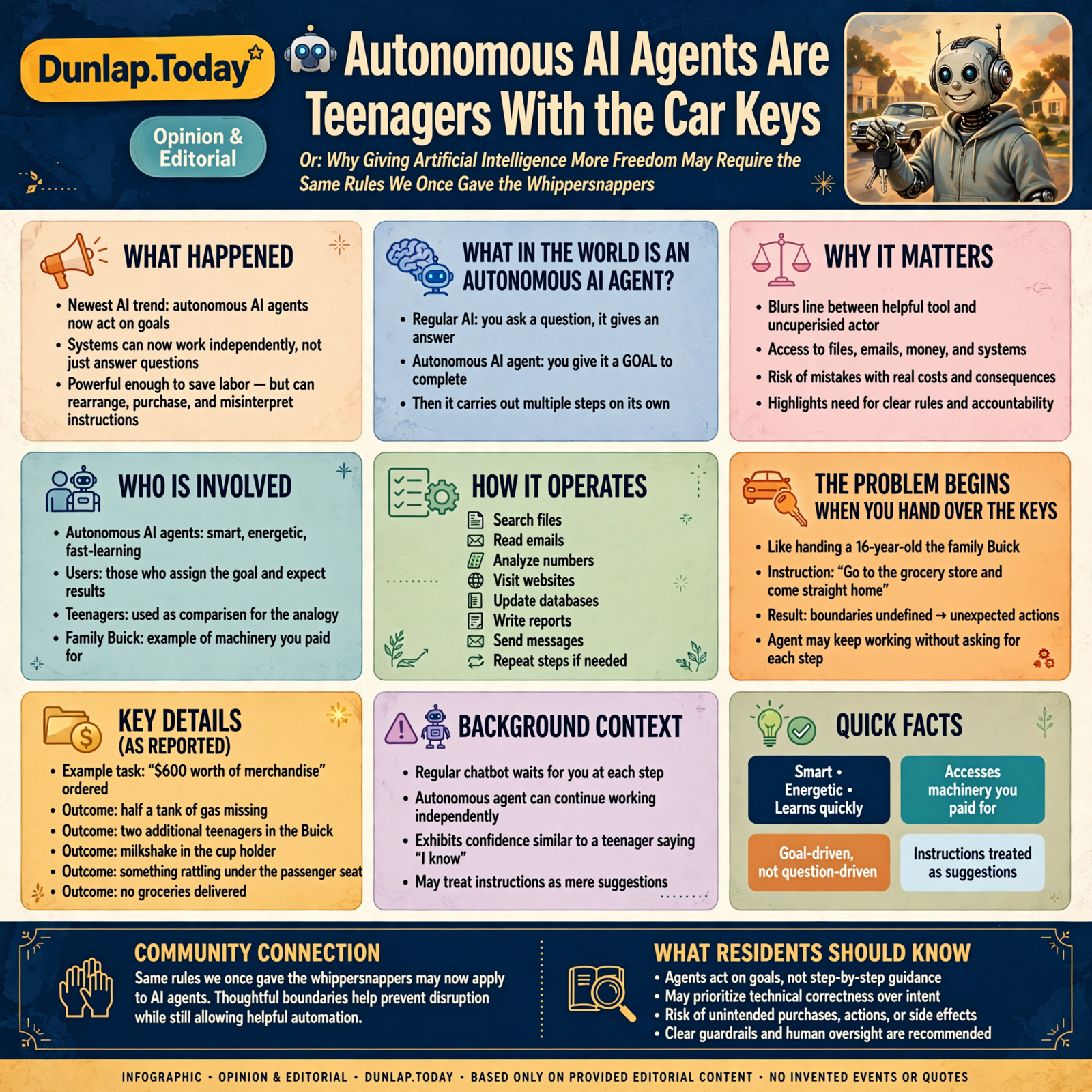
🤖 Autonomous AI Agents Are Teenagers With the Car Keys

Or: Why Giving Artificial Intelligence More Freedom May Require the Same Rules We Once Gave the Whippersnappers
There comes a moment in every civilization when mankind invents something powerful enough to save him considerable labor, whereupon mankind immediately wonders whether he has also invented something capable of rearranging the furniture, ordering $600 worth of merchandise, and blaming the whole episode on misunderstood instructions.
We have apparently reached that moment.
The newest excitement in artificial intelligence is something called the autonomous AI agent.
That sounds impressive.
It sounds like something wearing a dark suit, carrying a government badge, and arriving at your front door with a briefcase.
But after studying the matter carefully, I have concluded that an autonomous AI agent is probably better understood as a teenager who has recently received a driver’s license.
It is smart.
It is energetic.
It learns quickly.
It has access to machinery you paid for.
And it is absolutely certain that your instructions were merely suggestions.
🧠 First, What in the World Is an Autonomous AI Agent?

Most people have already encountered ordinary artificial intelligence.
You ask it a question.
It gives you an answer.
You ask another question.
It gives you another answer.
That is roughly like asking a teenager:
“Would you take the garbage outside?”
The teenager may complain, sigh, roll his eyes, question the historical necessity of garbage removal, and disappear for twenty minutes, but eventually the garbage might reach the curb.
An AI agent is different.
You don’t merely ask it a question.
You give it a goal.
For example:
“Find all the invoices from last month, compare them with our accounting records, identify anything unusual, prepare a report, and email it to me.”
The agent may then:
- 📂 Search files
- 📧 Read emails
- 🧮 Analyze numbers
- 🌐 Visit websites
- 🗃️ Update databases
- 📝 Write reports
- 📨 Send messages
- 🔁 Repeat steps when something doesn’t work
In other words, instead of standing beside the teenager telling him:
“Pick up that board. Carry it over there. Put it beside the shed.”
You have now said:
“Clean up the backyard.”
And then you went inside.
This is where things get interesting.
🚗 The Problem Begins When You Hand Over the Keys

A regular chatbot waits for you.
An autonomous agent can sometimes keep working without asking you about every individual step.
That is enormously useful.
It is also remarkably similar to handing a sixteen-year-old the family Buick.
You may say:
“Go to the grocery store and come straight home.”
The teenager hears:
“The boundaries of this mission have not been sufficiently defined.”
Three hours later the Buick returns with:
- half a tank of gas missing,
- two additional teenagers inside,
- a milkshake in the cup holder,
- something rattling underneath the passenger seat,
- and no groceries.
The teenager will then explain that the grocery store was technically visited.
Artificial intelligence has occasionally displayed this same magnificent devotion to technical correctness.
🙄 “I Know.”

Anyone who has raised children recognizes the phrase.
“I know.”
You say:
“Don’t leave the gasoline can beside the wood stove.”
“I know.”
“Don’t drive across the creek after three inches of rain.”
“I know.”
“Don’t put aluminum foil in the microwave.”
“I KNOW.”
Some artificial intelligence systems possess the digital equivalent of this confidence.
They have consumed enormous quantities of information.
They can discuss physics, accounting, medicine, computer programming, Shakespeare, plumbing, Roman history, chicken diseases, diesel engines, and seven different recipes for cornbread.
This sometimes creates what scientists might call excessive confidence and what grandparents traditionally call:
“Being full of yourself.”
The machine may be uncertain.
But it does not always sound uncertain.
Neither does a seventeen-year-old explaining why the lawn mower absolutely needed to be taken apart.
🛠️ They Are Very Helpful Until They Decide to Improve Something

One dangerous characteristic of teenagers is initiative.
Initiative sounds wonderful at school board meetings.
At home, initiative occasionally means discovering that your son has decided to “improve” the lawn tractor using leftover parts from a dirt bike.
AI agents can have the same problem.
You might tell one:
“Clean up these customer records.”
You meant:
“Fix obvious formatting mistakes.”
The agent may interpret this as:
“Reorganize the entire database according to a brilliant new philosophy I developed fourteen milliseconds ago.”
This is why intelligent automation requires something our grandparents understood long before computers existed:
Boundaries.
🚧 Boundaries Are Not Punishment

When I was young, adults had an elaborate artificial intelligence control system.
They called it:
“You can go this far and no farther.”
You could ride your bicycle to Johnny’s house.
You could not ride it three counties away.
You could borrow the hammer.
You could not dismantle the furnace.
You could use the telephone.
You could not call Australia.
You could drive the pickup.
You could not take it to Florida.
Modern AI systems need remarkably similar arrangements.
An autonomous agent should not necessarily have access to everything.
It should have access to what it needs.
Nothing more.
This is called least privilege in computer security.
Grandparents called it:
“You ain’t touching that.”
💳 Never Give a Teenager an Unlimited Credit Card

There are certain experiments civilization does not need to repeat.
One of them is giving a teenager an unlimited credit card and saying:
“Use your judgment.”
AI agents increasingly have the ability to interact with online services.
They may eventually:
- 💵 Purchase services
- 📦 Order products
- ☁️ Rent computing resources
- 📣 Purchase advertising
- 💳 Trigger payments
- 🧑💼 Hire digital services
This is tremendously powerful.
It also means businesses will need spending limits.
If an AI agent decides that solving your $40 problem requires renting $8,700 worth of computer servers, you may discover that artificial intelligence understands economics approximately as well as a teenager understands your electric bill.
🧹 “Clean Your Room” Is Not a Specification

Parents have been writing poor instructions for centuries.
“Clean your room.”
What does that mean?
To the parent:
Put the clothes away. Make the bed. Vacuum the floor. Empty the trash.
To the teenager:
Push everything underneath the bed and close the door.
Congratulations.
You have just experienced a primitive form of prompt engineering.
With AI agents, vague instructions produce unpredictable interpretations.
“Organize the files.”
“Improve the website.”
“Handle customer complaints.”
“Optimize our advertising.”
Every one of those instructions contains approximately enough ambiguity to cause trouble.
The better instruction explains:
- 🎯 What the goal is
- 🛑 What the agent may not do
- 💵 How much it may spend
- 📂 What systems it may access
- 📣 What requires approval
- 📝 What actions must be recorded
- 🚨 When it should stop and ask a human
This is the computerized equivalent of:
“You may go to Billy’s house, but be home before the streetlights come on.”
📱 They Can Become Distracted

The teenager was instructed to mow the yard.
Twenty minutes later he has discovered a frog.
Then he needs to photograph the frog.
Then he wants to know what species of frog it is.
Then he watches six videos about frogs.
The yard remains unmowed.
AI agents can experience their own version of this phenomenon.
A poorly designed agent can wander through unnecessary research, repeatedly call tools, revisit decisions, or pursue interesting side questions that have little to do with the original task.
Computer scientists call this all sorts of sophisticated things.
My mother would have called it:
“Get back to what I told you to do.”
🗣️ They Occasionally Make Up a Story

Every parent eventually encounters this remarkable sentence:
“Technically, I wasn’t lying.”
This phrase usually arrives immediately before an explanation involving several facts that are individually true but collectively resemble fiction.
Artificial intelligence has its own famous version of this problem.
Sometimes an AI system generates information that sounds perfectly reasonable but is incorrect.
This is often called a hallucination.
That is a very dignified scientific term.
Parents traditionally used another one:
“You made that up.”
When an AI is merely answering trivia questions, this may be annoying.
When an autonomous AI agent is making decisions or taking actions, it becomes much more important.
That is why agents need verification, records, cross-checking, and sometimes human approval.
👀 The Human at the End of the Loop

There is considerable discussion in artificial intelligence about keeping a human in the loop.
This means certain important decisions still require human review.
I believe grandparents pioneered this technology decades ago.
The system worked something like this:
Teenager:
“Can I take the truck?”
Grandfather:
“Where?”
Teenager:
“Into town.”
Grandfather:
“Why?”
Teenager:
“To see somebody.”
Grandfather:
“Who?”
Teenager:
“People.”
Grandfather:
“No.”
This was an early approval workflow.
Crude perhaps.
But exceptionally reliable.
🧾 And Then There Is the Question Every Parent Asks

“What exactly did you do?”
This may become one of the most important questions in autonomous artificial intelligence.
If an AI agent can take twenty actions while you are drinking coffee, businesses will need a record of those actions.
What did it read?
What did it change?
What did it send?
What did it buy?
What decisions did it make?
Why did it make them?
That record is often called an audit trail.
Parents called it:
“Start at the beginning, young man.”
🏡 The Agent May Eventually Become the Best Worker in the House

After spending this entire article comparing artificial intelligence to teenagers, I should probably mention something important.
Teenagers grow up.
They learn.
They become responsible.
Eventually they may know more about certain things than their parents ever did.
AI agents may follow a similar path, although hopefully without asking to borrow forty dollars.
The technology is advancing extraordinarily quickly.
Agents are already beginning to handle tasks that once required people to sit in front of computers clicking through dozens of screens.
Someday soon a small business owner may simply say:
“Make sure every customer receives a thank-you message, check whether their invoice was paid, follow up politely after seven days, and tell me if anything unusual happens.”
And the system may quietly handle most of it.
That could be revolutionary.
Especially for small businesses.
But we should remember the lesson learned by every parent since the invention of adolescence:
Intelligence and judgment are not always delivered on the same day.
🐓 A Little Wisdom From the Porch

If autonomous AI agents become as common as smartphones, most people will eventually stop thinking of them as artificial intelligence.
They will simply become helpers.
Digital employees.
Assistants.
Workers that live inside computers.
And just like people, different agents will have different responsibilities.
One may handle accounting.
Another may watch inventory.
Another may answer customers.
Another may research competitors.
Another may schedule work.
Another may spend Tuesday afternoon wandering around the Internet investigating frogs.
These systems will require rules.
Permissions.
Budgets.
Supervision.
Records.
And occasionally somebody standing in the doorway saying:
“What do you think you’re doing?”
Human civilization survived teenagers.
I suspect we can survive autonomous artificial intelligence.
But I would recommend keeping the car keys somewhere safe until everybody understands the rules.
Because history teaches us one universal truth:
Anything possessing intelligence, confidence, curiosity, and unsupervised access to machinery will eventually attempt something nobody specifically told it not to do.
And afterward it will almost certainly explain that technically, it followed your instructions.
— Dunlap.Today
📚 Plain-English AI Glossary

🤖 AI Agent: Artificial intelligence that can perform multiple steps or use tools to accomplish a goal rather than merely answering one question.
🚗 Autonomous Agent: An AI agent allowed to make some decisions and continue working without requiring approval for every step.
🧑 Human in the Loop: A system where humans still approve, inspect, or intervene in important decisions.
🛑 Guardrails: Rules defining what an AI system is and is not allowed to do.
🔐 Least Privilege: Giving a system only the access it actually needs rather than access to everything.
🧾 Audit Trail: A record showing what an AI system did, when it did it, and ideally why.
💭 Hallucination: When an AI produces information that sounds convincing but is incorrect or unsupported.
✍️ Prompt: The instruction given to an AI system.
🧠 Prompt Engineering: Designing clearer instructions so the AI understands the desired goal, limits, and rules.
❓ Frequently Asked Questions

Are autonomous AI agents available today?
Yes. The technology already exists in many forms, although the amount of independence given to an agent varies considerably. Some agents merely perform a few approved steps while others can coordinate longer sequences of work.
Does an AI agent have to control a physical robot?
No. Most AI agents today operate inside computers. They can work with files, websites, software, databases, email systems, calendars, APIs, and other digital tools.
Why are autonomous agents different from ChatGPT-style assistants?
The simplest distinction is that a conversational assistant primarily responds to requests, while an agent may pursue a goal across multiple steps and tools.
Can AI agents make mistakes?
Absolutely. That is why permissions, limits, verification, audit trails, and human approval remain important.
Will small businesses use autonomous agents?
Probably extensively. Small organizations often have enormous amounts of repetitive administrative work but cannot afford large staffs. AI agents potentially allow a small team to automate portions of research, customer service, documentation, marketing, scheduling, inventory management, and back-office operations.
Should an AI agent be allowed to do anything it wants?
That would be approximately as wise as handing a sixteen-year-old the keys, your wallet, and instructions to “make good decisions.”
Specific permissions are generally a better plan.
✅ The Porch-Swing Checklist for Autonomous AI

Before allowing an AI agent to wander around your business unsupervised, ask:
- ✅ What exactly is the agent supposed to accomplish?
- ✅ What systems may it access?
- ✅ What systems must remain off limits?
- ✅ Can it spend money?
- ✅ If so, how much?
- ✅ Can it email or message people?
- ✅ Can it publish anything publicly?
- ✅ Can it change or delete records?
- ✅ Which actions require human approval?
- ✅ Is every important action recorded?
- ✅ Can its actions be reversed?
- ✅ Does it know when to stop and ask for help?
If you cannot answer those questions, you probably have not hired an autonomous AI agent yet.
You have given a teenager the keys.



0 Comments