
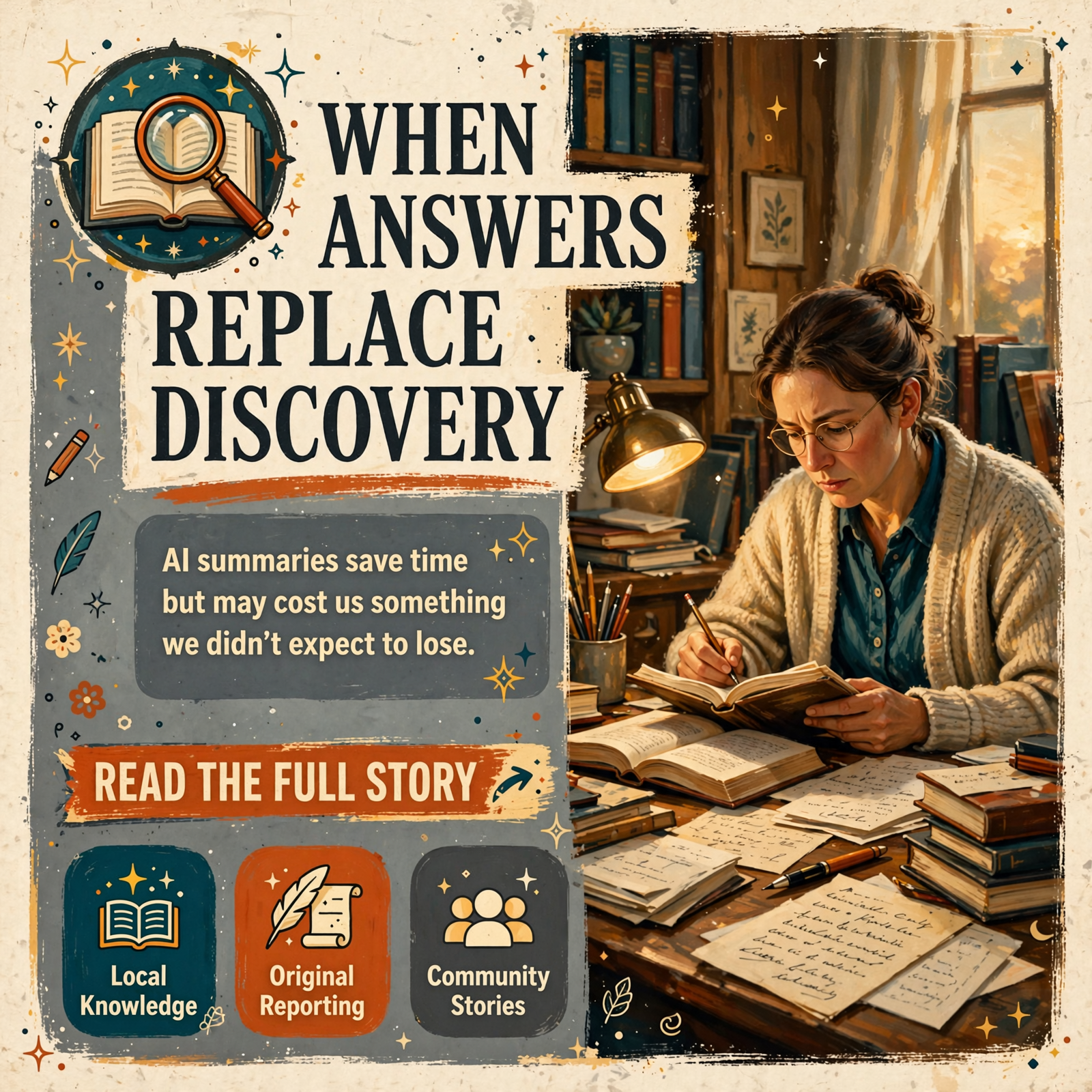
Are We Getting Tired of AI Answers, or Just Tired of Looking for Information?

Search engines give us instant answers. Publishers want subscriptions. Websites compete for our attention. But what happens when people stop looking?
I had a strange thought the other day.
I was researching something and asked an artificial intelligence assistant a question.
As usual, it gave me an answer almost immediately.
Everything was nicely organized. The explanation was clear. It even offered to provide more details if I wanted them.
And I caught myself thinking something I never expected to think.
I don’t want another AI summary. I want to read the original articles.
I wanted to hear what the people who actually study the subject had to say. I wanted to read several different perspectives, compare their arguments, and figure things out for myself.
That’s a peculiar complaint coming from somebody who uses artificial intelligence almost constantly.
I develop software with AI. I research with it, write with it, and spend an unreasonable amount of time experimenting with what it can do.
I’m certainly not campaigning to bring back the typewriter.
But something about that perfectly reasonable AI answer left me unsatisfied.
It wasn’t necessarily wrong.
I was just tired of being given the answer.
Then I started wondering whether artificial intelligence was really the problem.
Maybe I was just tired of the internet.
Remember When Looking Something Up Was Actually Interesting?

Before artificial intelligence began answering our questions, researching something usually meant opening several websites.
You might read an article, follow a link, discover an unfamiliar term, and go looking for an explanation.
Sometimes you found two people who disagreed. You had to decide which argument made more sense.
Occasionally you discovered that the question you originally asked wasn’t even the right question.
And every once in a while, you encountered something completely unexpected.
You could start out researching an old property boundary in Tennessee and end up reading about a railroad that disappeared a hundred years ago.
You hadn’t planned on learning about the railroad.
But you were glad you did.
Today, AI can condense hours of research into four tidy paragraphs.
That’s a remarkable achievement.
But it also makes me wonder whether something gets lost when we remove the process of discovery.
And a recent study about Google search behavior suggests that our relationship with information may be changing in ways that go well beyond artificial intelligence.
Here’s a Number That Made Me Stop and Think

In July 2025, the Pew Research Center published an analysis of how Americans behaved when using Google.
The researchers examined browsing activity from 900 adults, including nearly 69,000 unique Google searches conducted during March 2025.
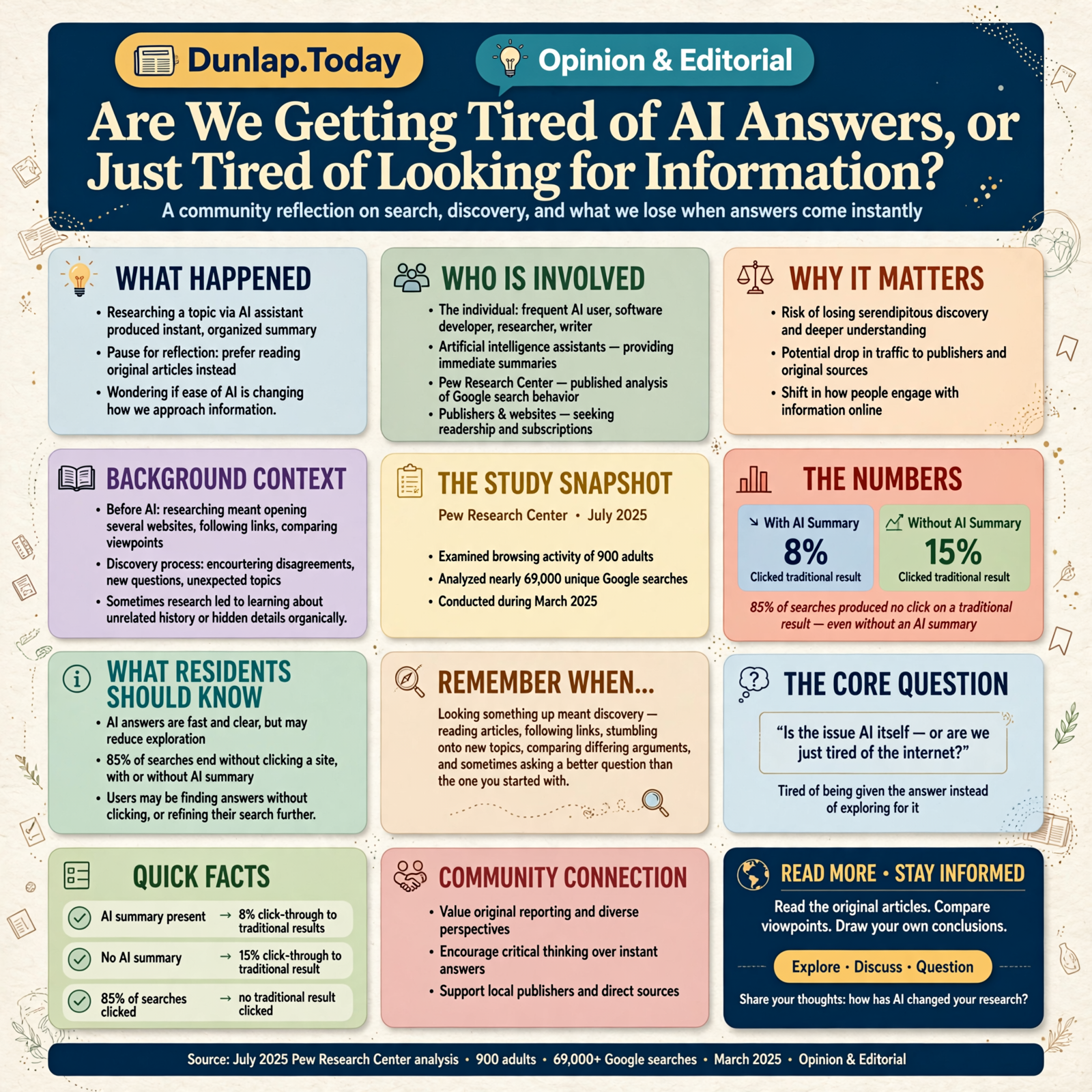
They discovered that when Google displayed an AI-generated summary, users clicked a traditional search result on only 8% of visits.
When there was no AI summary, they clicked a traditional result on 15% of visits.
At first glance, that seems like a story about artificial intelligence taking traffic away from websites.
And it certainly raises that concern.
But I found myself thinking about another number.
Even without an AI summary, 85% of those searches did not produce a click on a traditional search result.
What were those people doing?
Were they finding their answers without clicking anything?
Were they searching again because the results weren’t useful?
Were they getting frustrated?
Or were they simply giving up?
As it turns out, Pew investigated what people did next.
What Happened to the Other 85%?

For Google searches without an AI summary, the researchers found that approximately 35% were followed by another Google search.
About 33% were followed by browsing somewhere else without clicking one of the tracked search-result links.
Another 16% ended with the person closing or leaving their browser session for at least five seconds.
And 15% resulted in a traditional search-result click.
The numbers are rounded, but the larger picture is interesting.
People weren’t necessarily clicking on the information Google had found for them.
Many were continuing to search, navigating elsewhere, or ending their browsing sessions.
Now consider what happened when AI summaries appeared.
Only 8% clicked traditional results, while approximately 1% clicked a link in the AI summary itself.
And 26% ended their browsing sessions, compared with 16% when there was no AI summary.
That sounds dramatic.
But there’s an important catch.
Researchers could observe what people did. They couldn’t necessarily tell us why they did it.
Someone who receives a perfect answer and closes the browser looks much like someone who gets irritated and gives up.
The data cannot tell us whether those people were satisfied.
And I think that missing distinction might be the most interesting part of the entire story.
Has Searching the Internet Become an Obstacle Course?

Think about what happens when you search for something today.
Maybe you’re trying to understand why your property taxes increased.
You type a question into Google.
First you encounter some sponsored results.
Then perhaps an AI overview.
Then websites that have worked very hard to appear near the top of the results.
You finally find an article that looks promising.
You click.
A subscription notice appears.
You return to Google and try another result.
This time you encounter a cookie consent banner, a newsletter invitation, and an advertisement that seems determined to occupy half your screen.
You close those and start reading.
The article begins with six paragraphs explaining why property taxes are important before finally getting around to your question.
Somewhere between the third advertisement and the second request for your email address, you begin wondering whether you really needed to know the answer in the first place.
And then there’s the AI summary sitting right there on Google.
It’s free, immediate, and doesn’t ask you to subscribe to anything before explaining what it thinks you need to know.
Suddenly, accepting the AI answer doesn’t seem like laziness.
It seems like a perfectly reasonable response to an internet that has become unnecessarily difficult to use.
Paywalls May Be Telling Us Something Important

Another Pew Research Center study, published in June 2025, examined what Americans do when they encounter news articles that require payment.
The results are revealing.
Among adults who encounter news paywalls, 53% said they typically try to find the information somewhere else.
Another 32% said they usually give up trying to access the information.
And just 1% said their first response is to pay for access.
Think about that.
Nearly one-third of people who encounter these paywalls say they typically abandon the effort to get the information.
That doesn’t mean every paywall is unreasonable.
Journalists, researchers, editors, and photographers need to earn a living. Good reporting costs money.
And somebody has to pay for the work of finding information, checking facts, attending meetings, interviewing people, and explaining complicated subjects.
But there’s an obvious tension.
Publishers need readers to support their work.
Readers increasingly encounter obstacles when trying to access that work.
And AI systems offer a convenient way around some of those obstacles.
It’s easy to see how the whole arrangement could become a problem.
The Internet May Be Caught in a Circle of Its Own Making

For years, websites have competed for attention through search engine optimization, advertisements, sponsored content, and increasingly sophisticated techniques to keep visitors engaged.
Some of those tools have genuine value. Advertising helps support free content, and search optimization can make useful information easier to discover.
But incentives can also produce unintended consequences.
A website that depends on advertising may need more page views.
A publisher struggling with declining revenue may introduce subscriptions.
A business trying to attract customers may write articles designed primarily to appear in search results.
A search engine trying to provide faster answers may show more information directly on its own pages.
And an AI system may summarize information from those publishers without requiring the reader to visit them.
Each decision can make sense to the organization making it.
But together, they may create a rather strange outcome.
The people producing information need readers. The readers want fewer obstacles. And the platforms helping people find information increasingly have ways to keep those readers from visiting the original sources.
That is not proof that the internet has entered some irreversible decline.
But it does suggest that the incentives aren’t always working together.
And if fewer readers visit the original publishers, somebody eventually has to figure out how the original work gets paid for.
What Happens to the People Who Know Something Nobody Else Knows?

This is where the issue becomes particularly important for small communities like ours.
Think about someone who spends months researching the history of a little-known community in the Sequatchie Valley.
They visit libraries, examine old newspaper clippings, interview longtime residents, and compare conflicting accounts.
Eventually, they publish a detailed article.
Maybe only a few hundred people ever read it.
But those readers discover something about their community that might otherwise have been forgotten.
Now imagine an AI system using that article to answer questions about local history.
The person asking the question receives a convenient summary.
But the original researcher might never receive a visitor.
The same concern applies to a retired machinist who documents how to repair an obsolete industrial machine.
Or a local gardener who has spent 30 years experimenting with vegetables that grow particularly well in our climate.
Or an attorney who publishes a detailed explanation of an unusual provision of Tennessee law.
Or a small-town newspaper reporter who attends a three-hour public meeting and explains what happened.
These aren’t necessarily subjects that attract enormous audiences.
Sometimes their value comes precisely from how specialized they are.
And those specialized articles provide information that more general sources may never contain.
If AI can deliver the useful parts of that knowledge without sending readers to its creators, what encourages people to continue producing it?
Personal interest, professional reputation, community service, and other motivations will certainly continue to matter.
But for publishers who depend on advertising, subscriptions, or business referrals, reduced traffic creates an obvious economic challenge.
That’s particularly concerning because artificial intelligence cannot simply invent reliable local knowledge that nobody has ever documented.
Somebody still has to do the original work.
There’s Another Problem: Everything Is Beginning to Sound Alike

Meanwhile, I have another increasingly common reaction to AI-generated writing.
I’m getting tired of the sound of it.
The paragraphs are organized.
The sentences are polished.
Every topic has important considerations.
Every issue requires a balanced approach.
And every conclusion seems determined to remind us that the best solution depends on our circumstances.
None of that is necessarily bad.
But after reading enough of it, the experience can become oddly monotonous.
Sometimes I want somebody to make an unusual observation.
Tell me a story.
Explain why the conventional wisdom doesn’t match what happened in the real world.
Describe a spectacular failure.
Or introduce me to the old fellow down the road who fixed tractors for 50 years and understood something that never appeared in an engineering textbook.
Real people have distinctive experiences, peculiar interests, regional expressions, and occasionally some wonderfully unreasonable opinions.
They don’t always organize their thoughts into five convenient bullet points.
And sometimes that’s what makes them worth reading.
There is value in efficiency.
But there is also value in personality.
A Summary Is Not the Same Thing as Understanding

Consider a legal question.
You ask whether a property owner is responsible when somebody gets hurt on the property.
AI can give you a quick overview of negligence, premises liability, and the importance of state law.
That’s useful, especially when you’re unfamiliar with the subject.
But suppose you read several original articles instead.
One attorney discusses how Tennessee courts approach the issue.
Another explains an unusual exception.
A third examines a court decision that appears to complicate the general rule.
Now you’re discovering the difference between knowing a general answer and understanding why particular facts matter.
You’re also getting an opportunity to notice something that an automated summary might overlook.
The same principle applies to medicine, farming, history, business, technology, and nearly every complicated subject.
An AI summary selects and compresses information for us.
That saves time.
But reading competing explanations helps us develop our own judgment about what matters.
Sometimes the most useful information is the detail that didn’t make it into the summary.
But Maybe We’re Being Too Hard on AI

There’s another side to this story, and it’s worth considering.
Maybe artificial intelligence is simply giving people what they’ve wanted all along.
Suppose you want to know what time the hardware store closes.
Do you really need to visit a website, dismiss three popups, and read an article about the history of hardware stores?
Of course not.
You want the hours.
And if AI gives you the correct answer immediately, everybody wins, except perhaps whoever was hoping you’d click an advertisement.
Artificial intelligence also makes complicated subjects more accessible to people who might otherwise struggle to understand them.
It can explain unfamiliar terminology, translate technical language, and help someone figure out which questions to ask next.
Those are meaningful improvements.
And a search without a click isn’t necessarily an unsuccessful search.
Someone may have found exactly what they needed.
That’s why we shouldn’t interpret every zero-click statistic as evidence of consumer frustration.
But we shouldn’t automatically interpret it as consumer satisfaction, either.
Which brings us back to the question that started bothering me.
Are People Finding Answers, or Are They Giving Up?

A 2026 analysis by SparkToro, using Similarweb data, estimated that approximately 68% of U.S. Google searches during the first four months of the year ended without a click.
That study measures search behavior differently from Pew’s research, so the percentages aren’t directly interchangeable.
Still, both point toward an internet where a large share of searches no longer produces a visit to another website.
That isn’t automatically good or bad.
What matters is what happens to the person asking the question.
Did they get a correct answer?
Did they find information they trusted?
Did they learn something useful?
Did they discover a source worth reading further?
Or did they stop because the process had become frustrating, expensive, confusing, or simply exhausting?
Those experiences can produce surprisingly similar browsing statistics.
Yet they tell very different stories about whether the internet is serving its users well.
Maybe we should spend less time measuring whether people click and more time asking whether they found what they were looking for.
The Small-Town Internet Has Something Worth Protecting

Here in the Sequatchie Valley, there’s an enormous amount of knowledge that doesn’t exist in the world’s most popular databases.
It’s in old photographs, handwritten records, church histories, family collections, courthouse documents, and the memories of people who’ve lived here for generations.
It’s in the experience of local business owners, farmers, teachers, mechanics, and neighbors.
Some of it has been documented.
Much of it hasn’t.
And a surprising amount could disappear without anybody noticing.
That’s one reason I believe local publishing matters, even when the audience for a particular story is small.
Not every article needs to reach a million readers.
Sometimes helping a hundred people understand something about their own community is enough.
But someone still needs a reason to gather that information, preserve it, and make it available.
Perhaps the future of local journalism will involve new ways of funding original reporting, stronger direct relationships with readers, or AI systems that do a better job of sending attention back to the people who created the information.
There are opportunities here as well as risks.
AI could help small publishers research more efficiently, preserve oral histories, organize archives, and make local knowledge accessible to people who would never have discovered it otherwise.
But those benefits depend on original knowledge continuing to exist.
And that depends on people continuing to create it.
Maybe We Need to Rediscover the Joy of Looking Things Up

I’m not planning to stop using artificial intelligence.
Tomorrow I’ll probably ask it another hundred questions.
And I’ll be delighted when it solves a software problem in ten minutes that might otherwise have taken half a day.
But I think I’m going to make a small change in how I use it.
Sometimes, instead of asking for a summary, I’m going to ask it to find the most interesting original sources.
Show me where the authors disagree.
Find the unusual exceptions.
Point me toward the court opinion, the historical document, the detailed technical explanation, or the person who actually experienced something.
And then let me read.
It’s a little like driving through the Sequatchie Valley.
If all you want is to get from Dunlap to Pikeville, the fastest route is probably the sensible choice.
But sometimes the interesting part of the trip is the little road you didn’t plan to take.
The old barn.
The unusual house.
The beautiful view you never knew existed.
Research can be like that, too.
AI gets us to the destination.
But I wonder how much we’re missing along the way.
A Question for Our Readers

I’m curious whether other people have noticed this change.
When you search for information online, are you finding what you need more quickly than you used to?
Or are you getting frustrated with advertisements, subscription requests, complicated websites, and AI summaries that don’t quite answer your question?
Have you ever abandoned a search because finding the information just wasn’t worth the trouble?
And when was the last time you discovered something fascinating while reading an article you hadn’t originally intended to find?
I’d particularly like to hear from people who do research as part of their work, along with readers who remember what the internet was like before every question came with an automatically generated answer.
Because I never expected to reach the point where I would ask a computer a question and then complain that it answered too quickly.
But here we are.
Maybe the next great improvement in artificial intelligence won’t be giving us better summaries.
Maybe it will be helping us rediscover the people, stories, and ideas worth reading in the first place.
And maybe the most important question about the future of internet search isn’t how many people click a link.
It’s how many people stop looking before they find what they came for.
Sources
- Google Users Are Less Likely to Click on Links When an AI Summary Appears in the Results
- Few Americans Pay for News When They Encounter Paywalls
- In 2026, Less Than One Third of Google Searches Still Send a Click
- Americans Have Mixed Feelings About AI Summaries in Search Results
- Local News Fact Sheet
- Why U.S. Adults Don't Pay for Local News
Know about an upcoming event or story in the Sequatchie Valley? Submit it here.


0 Comments