

What If AI Gave Us More Time to Be Human?

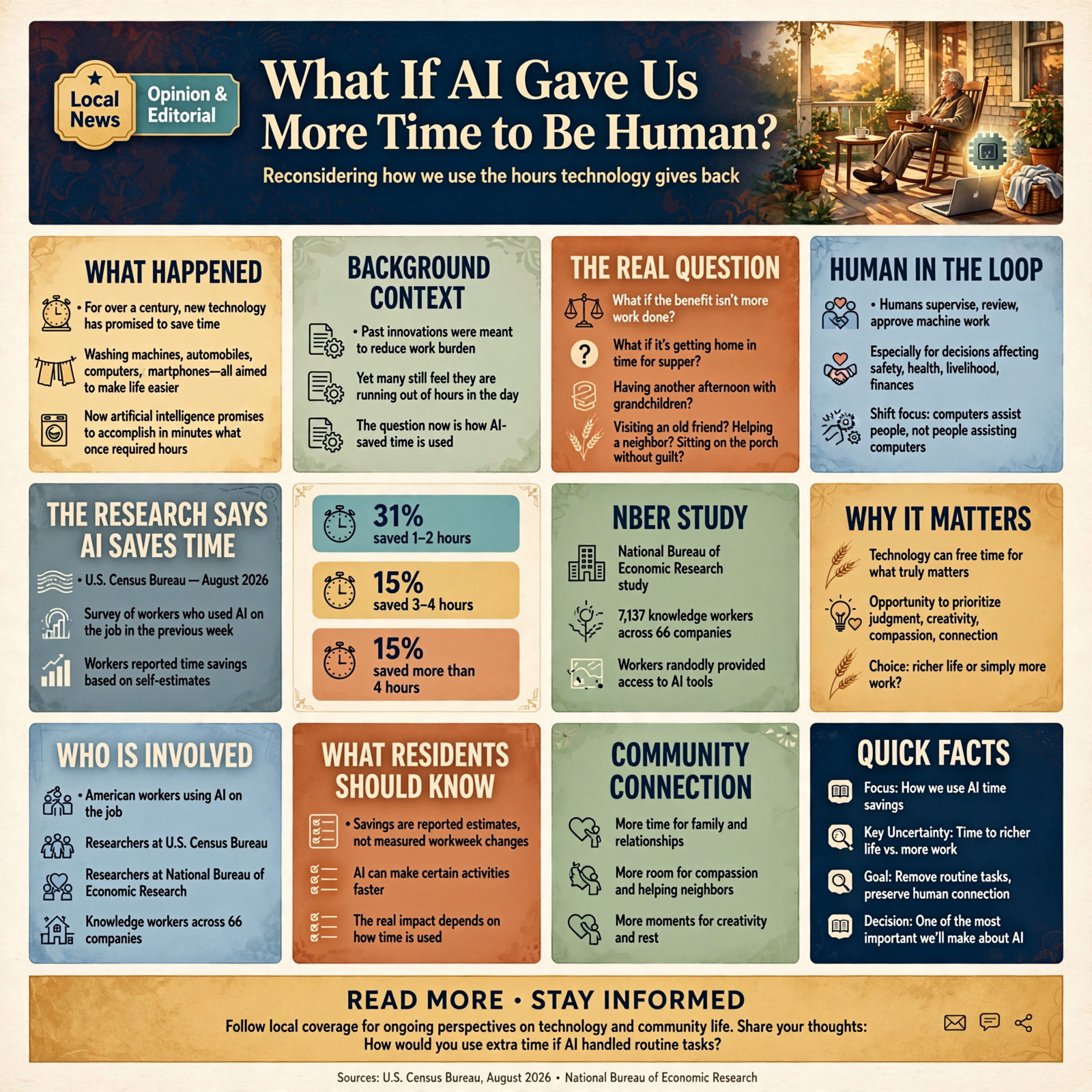
For more than a century, Americans have been promised that new technology would save them time.
Washing machines were supposed to make laundry easier. Automobiles made travel faster. Computers were supposed to eliminate paperwork. Smartphones put nearly the entire world in our pockets.
Yet somehow, we still seem to be running out of hours in the day.
Now comes artificial intelligence, promising to accomplish in minutes what once required hours.
But perhaps we’re asking the wrong question about what to do with all that extra productivity.
What if the real benefit isn’t getting more work done?
What if it’s getting home in time for supper? Having another afternoon with your grandchildren? Visiting an old friend? Helping a neighbor? Or simply sitting on the porch without feeling guilty about everything you haven’t finished?
Researchers are finding that artificial intelligence really can save time. What remains uncertain is whether we’ll use those savings to make our lives richer—or simply find more work to fill the hours.
And that may be one of the most important decisions we make about this technology.
Maybe We’ve Been Asking the Wrong Question About AI

Much of the public conversation about artificial intelligence focuses on what machines will eventually be able to do.
Will AI write our reports? Answer our telephones? Manage our calendars? Handle accounting? Help diagnose illnesses? Operate businesses?
Those are legitimate questions, and some of those capabilities are already becoming practical.
But there’s another question that deserves just as much attention.
What will people do with the time artificial intelligence gives them back?
For years, technology developers have talked about keeping a “human in the loop.”
That generally means people remain involved in supervising, reviewing, or approving work performed by machines. And that’s particularly important when decisions could affect someone’s safety, health, livelihood, or finances.
But imagine organizing ordinary activities so that artificial intelligence handles more of the repetitive work while humans concentrate on the things requiring judgment, creativity, compassion, and personal connection.
Instead of people spending their days assisting computers, computers could increasingly spend their days assisting people.
It’s an important distinction.
The objective wouldn’t be to remove humans from life. It would be to remove some of the routine demands that keep humans from enjoying it.
The Research Says AI Really Can Save Time

Before we get too carried away imagining peaceful afternoons and leisurely family dinners, it’s worth asking whether the technology actually delivers measurable time savings.
Fortunately, researchers have begun answering that question.
In August 2026, the U.S. Census Bureau published findings about artificial intelligence use among American workers.
Among workers who had used AI on the job during the previous week, 31% estimated that it saved them one to two hours. Another 15% reported saving three to four hours, while 15% estimated saving more than four hours.
Those figures represent workers’ estimates, not independently measured reductions in their workweeks. Nevertheless, they suggest that AI is already making certain activities faster.
Another study published by the National Bureau of Economic Research examined 7,137 knowledge workers across 66 companies.
Researchers randomly provided workers with access to AI tools integrated into applications they already used for everyday tasks such as email and writing.
During the latter half of the six-month experiment, employees who used the tools spent approximately two fewer hours per week on email. They also reduced work outside regular business hours.
Two hours might not sound revolutionary.
But consider what two additional hours could mean in an ordinary household.
- Another family dinner without someone rushing back to the computer.
- An afternoon visiting an aging parent.
- Time to attend a child’s ballgame.
- A walk with your spouse or the dogs.
- An opportunity to help a neighbor with something they’ve been struggling to finish.
- Or simply a little more time to sit down, relax, and have an uninterrupted conversation.
Those might not sound like technological breakthroughs.
But they can be the moments people remember years later.
The Most Interesting Research Isn’t Actually About AI

Here’s where the story becomes particularly interesting.
Researchers have been studying the relationship between saving time and improving personal relationships since before today’s artificial intelligence boom.
In 2025, researchers Ashley Whillans, Jessica Pow, and Joe Gladstone published a paper in the Journal of Personality and Social Psychology titled “Buying (Quality) Time Predicts Relationship Satisfaction.”
Across seven studies, they examined what happened when people spent money on services that reduced routine household burdens.
Examples included hiring help with housecleaning or purchasing services that reduced the time required for everyday chores.
The researchers found that time-saving purchases were associated with greater relationship satisfaction.
But there was an especially important detail.
The benefits were strongest when couples converted their recovered time into meaningful experiences together.
It wasn’t simply about getting the laundry finished faster or avoiding another evening spent cleaning.
It was about what people did with the extra time.
Those findings don’t prove that artificial intelligence improves relationships. The research examined time-saving purchases, not AI.
But it suggests a fascinating possibility.
If paying someone to handle a chore can create opportunities for better relationships, could using technology to handle routine administrative work create similar opportunities?
Perhaps the greatest value of having an AI assistant organize paperwork isn’t the organized paperwork.
Perhaps it’s the evening that no longer has to be spent organizing paperwork.
There’s Just One Problem: We Have a Habit of Filling Every Spare Minute

Before celebrating our newly recovered free time, there’s an uncomfortable lesson from the history of technology.
We have an extraordinary talent for using time-saving inventions to make ourselves busier.
Email was supposed to make communication more convenient.
It succeeded.
Now many of us receive more messages in a morning than our grandparents might have received in a month.
Smartphones were supposed to make information available wherever we went.
They succeeded, too.
Unfortunately, they also made us available to everyone else, practically everywhere we went.
We’re carrying devices capable of answering almost any question, yet sometimes we struggle to sit through supper without checking whether somebody needs something.
Artificial intelligence could create exactly the same problem.
In February 2026, researchers at the University of California, Berkeley’s Haas School of Business reported findings from an eight-month study of employees at a technology company.
Instead of simply working less because AI made their tasks easier, employees often expanded the amount of work they performed.
They accepted additional responsibilities, moved more quickly between activities, and extended their working hours.
In some cases, AI increased the intensity of work rather than reducing it.
The study was observational and examined one company. It doesn’t establish that everyone using AI will experience the same result.
But the findings raise a question that matters to employees, employers, and anyone running a business.
When technology saves an hour, who gets that hour?
Does the employee get more personal time?
Does the business owner get to leave the office earlier?
Or does everyone simply receive another hour’s worth of assignments?
We could eventually have astonishingly productive workplaces filled with people who are just as exhausted as before.
That would be quite an accomplishment, although perhaps not the kind we should be aiming for.
What This Could Mean for Families in the Sequatchie Valley

Let’s bring the discussion a little closer to home.
The Sequatchie Valley is home to families, retirees, small-business owners, caregivers, volunteers, tradespeople, and people working jobs that don’t fit neatly into a nine-to-five schedule.
Many have responsibilities extending far beyond their paid employment.
Someone who spends the day serving customers might spend the evening handling invoices.
A parent working full time might return home to manage appointments, school communications, and household paperwork.
A family caring for an older relative might spend hours organizing information and coordinating transportation.
And a volunteer helping with a local organization might spend almost as much time arranging activities as actually participating in them.
These are the kinds of activities where appropriately designed AI tools could make a difference.
The Small-Business Owner Who Wants to Get Home Earlier
Consider someone operating a small repair shop, restaurant, retail business, or local service company.
After a long day serving customers, there’s still bookkeeping, scheduling, recordkeeping, correspondence, and tomorrow’s preparations.
AI tools might help prepare routine communications, organize business information, summarize records, and identify tasks that need attention.
The owner still makes the decisions and checks that the work is correct.
But if those tasks require less time, perhaps the business can close a little earlier.
And perhaps the person running it can spend an evening with family instead of wrestling with spreadsheets.
The Parent Trying to Do Everything
Consider parents balancing employment, children, household responsibilities, and the endless details of modern life.
AI might help prepare schedules, organize information, plan activities, or simplify routine tasks.
That doesn’t mean technology can raise children or replace a parent’s attention.
It means the parent might have fewer administrative demands competing for that attention.
Sometimes being present matters more than being productive.
The Family Caring for an Aging Relative
Anyone who has helped care for an aging family member knows that caregiving involves considerably more than spending time together.
There can be appointments to coordinate, instructions to organize, transportation to arrange, insurance information to understand, and family members to keep informed.
AI might help organize non-sensitive information, prepare appointment questions, explain unfamiliar terminology, and simplify routine coordination.
People still need to verify important details and protect private information.
But reducing some of that administrative burden could leave more time for the part of caregiving that no machine can replace.
Being there.
The Neighbor Who Wants to Help
Our communities depend on people willing to volunteer.
From organizing local events to supporting community groups, considerable effort goes into the paperwork and coordination behind the scenes.
AI could help prepare announcements, organize schedules, summarize meeting notes, and coordinate routine communications.
Maybe the result wouldn’t be a larger organization or a more impressive report.
Maybe it would simply be more time for volunteers to help their neighbors.
That would be a worthwhile return on the technology.
Why Human Connection Matters More Than We Sometimes Realize

There’s another reason to take this possibility seriously.
Research increasingly recognizes that meaningful human relationships contribute to health and well-being.
In 2023, the U.S. Surgeon General published a major advisory describing loneliness and social isolation as significant public health concerns.
The advisory cited research associating social isolation with a 29% increased risk of premature mortality.
That statistic doesn’t mean we can calculate health benefits by counting additional family dinners or hours spent visiting neighbors.
Human relationships are more complicated than that.
But the research reinforces something people have understood long before artificial intelligence existed.
We need one another.
Technology can provide remarkable convenience, but convenience and connection aren’t always the same thing.
A text message can be thoughtful.
A video call can bridge hundreds of miles.
Digital communication can help families stay connected when geography makes regular visits difficult.
But a conversation around the kitchen table, an afternoon working together, or a visit with someone who’s feeling lonely can offer something different.
Our objective shouldn’t be to eliminate technology from those relationships.
It should be to use technology in ways that support them.
Could AI Actually Make Us Less Connected?

There is another possibility that deserves attention.
What happens if people use artificial intelligence not merely to reduce their workload, but to replace some of their interactions with other people?
AI chatbots can answer questions, assist with writing, provide information, and engage in increasingly natural conversations.
Those capabilities can be useful, particularly for someone who needs assistance organizing thoughts, learning something new, or preparing for a difficult conversation.
But an artificial conversation isn’t automatically equivalent to a reciprocal human relationship.
A machine can help someone draft an invitation to a family reunion.
It can’t take the place of the family showing up.
It can help someone remember a birthday.
It shouldn’t become a substitute for the care behind celebrating that birthday.
It can even help someone think of a thoughtful thing to say to a lonely friend.
But someone still has to make the call.
The goal isn’t to replace human relationships with more efficient artificial ones.
It’s to make more room for the relationships we already have—and perhaps a few we’ve been too busy to develop.
Try the One-Hour Human Dividend

Here’s a simple experiment you can try without buying an expensive new computer or reorganizing your entire life.
Over the next week, find one repetitive activity that routinely consumes your time.
Perhaps it’s organizing paperwork, drafting routine correspondence, preparing a shopping list, comparing information, or creating a schedule.
Try using an AI tool to help with that activity.
Check the results. Make sure the tool hasn’t introduced errors. And don’t share confidential information with a service unless you understand how that information will be handled.
Then ask yourself how much time you actually saved.
Maybe it’s ten minutes.
Maybe it’s half an hour.
Maybe it’s an hour.
Or maybe the AI tool didn’t save time at all. That’s useful to know, too.
Now comes the important part.
If you did save time, deliberately give at least some of it back to your life.
- Call an old friend you’ve been meaning to contact.
- Visit a parent or grandparent.
- Spend an uninterrupted evening with your spouse.
- Play a game with your children or grandchildren.
- Take the dogs for a longer walk.
- Help a neighbor with a project.
- Volunteer for something happening in your community.
- Or just sit outside and enjoy a little time without another obligation demanding your attention.
And if you don’t use AI, the experiment still makes sense.
Anything that helps reduce unnecessary obligations can create room for more meaningful experiences.
The technology isn’t the point.
What you do with the time is.
Wisdom From the Front Porch

There’s something slightly amusing about the idea that humanity might spend billions of dollars building extraordinarily intelligent machines so that people can finally have enough time to sit on the porch.
Our grandparents might have wondered why we needed such complicated equipment to accomplish something they already knew how to do.
They might have had a point.
But modern life is complicated, and many of the demands competing for our attention aren’t going away by themselves.
Businesses still need records.
Families still need to coordinate schedules.
Appointments still need to be made.
Information still needs to be organized.
And someone still needs to remember what time the grandchildren are supposed to be at the ballfield.
If artificial intelligence can handle some of those chores, perhaps that’s a good thing.
But here’s the lesson worth remembering:
A faster machine doesn’t automatically create a better life. What matters is what we choose to do with the time it saves.
A Few Questions Worth Asking

Does research prove that AI improves family relationships?
No. Current research demonstrates that AI can save time on certain tasks, while separate research suggests that using recovered time for meaningful shared experiences can benefit relationships. The direct connection between widespread AI use and stronger family relationships remains an important question for future research.
Does using AI always mean working fewer hours?
No. Some research has found reductions in time spent on activities such as email, while other studies suggest AI can encourage people to take on more work. The outcome depends partly on workplace expectations and individual choices.
Do people need advanced technical skills to benefit?
Not necessarily. Many AI tools allow people to ask questions in ordinary language. Simple uses such as organizing information, drafting routine communications, or creating schedules can be accessible to beginners. Results still require checking.
Could this help people who are retired or not employed?
Potentially. Everyday administrative tasks don’t disappear when someone retires. Organizing information, coordinating appointments, planning activities, and managing household responsibilities can consume considerable time at any age.
What if AI doesn’t save me any time?
Then there’s no reason to force it into that activity. A tool should serve a useful purpose. Sometimes the most efficient solution is a simpler routine, a handwritten list, or deciding that something doesn’t need to be done at all.
Maybe Progress Means Something Different Than We Thought

For generations, we’ve measured technological progress largely by how much more we can accomplish.
More products manufactured.
More transactions completed.
More information processed.
More work finished in less time.
Those achievements matter. Productivity helps businesses compete, raises the potential for economic growth, and can improve living standards.
But productivity isn’t the only measure of a good life.
A family that earns more money but never has time together may not feel particularly successful.
A community filled with hardworking people who have no time to help one another may be missing something important.
And a person who finishes twice as many tasks every day isn’t necessarily twice as happy.
Artificial intelligence gives us an opportunity to ask whether all the time we’re saving should automatically be converted into more work.
Perhaps some of it could become something else.
More freedom.
More personal attention.
More shared experiences.
More time to care for people who need us.
More opportunities to participate in the communities we call home.
None of that is guaranteed.
Businesses will have to decide how to share the benefits of greater productivity. Workers will have to establish boundaries. Families will have to make deliberate choices about how they spend their time.
And all of us will have to remember that just because technology makes it possible to do more doesn’t mean we’re obligated to fill every available minute.
Maybe the most significant promise of artificial intelligence isn’t that we’ll finally get everything on our to-do lists completed.
Maybe it’s that we’ll have more freedom to decide which things deserve to be on those lists in the first place.
Perhaps progress means getting home while there’s still daylight.
Perhaps it means having enough time to listen when someone needs to talk.
Perhaps it means visiting an old friend, playing with the grandchildren, or spending an afternoon helping a neighbor.
And perhaps, years from now, the greatest achievement of artificial intelligence won’t be measured by how many tasks machines performed for us.
It will be measured by what we were finally able to do for one another.
Because the most valuable thing AI might give us isn’t more productivity.
It’s more time to be human.
We’d Like to Hear From You

Have you used artificial intelligence or another technology to save time on everyday responsibilities?
Did you spend that recovered time with family, friends, or neighbors? Or did you discover that having more efficient tools simply gave you more work to do?
We’d love to hear your experiences and what you think technology should help us accomplish.
After all, the future of artificial intelligence shouldn’t be a conversation limited to technology companies and corporate boardrooms.
It’s a conversation for families, small businesses, neighborhoods, and communities like ours.
And perhaps the most important question isn’t what artificial intelligence will eventually be capable of doing.
It’s what we want our lives to look like when it does.
Sources
- About a Third of Workers Who Used AI in the Last Week Said They Completed Tasks One to Two Hours Faster
- Shifting Work Patterns with Generative AI
- AI Promised to Free Up Workers’ Time. UC Berkeley Haas Researchers Found the Opposite
- Our Epidemic of Loneliness and Isolation: The U.S. Surgeon General’s Advisory
- American Time Use Survey
- Buying Time Promotes Happiness


0 Comments