

💗 Bless Your Heart: The South’s Most Polite Way to Declare Somebody Hopeless

There are certain phrases in the English language that require a dictionary.
There are others that require context.
And then there is “Bless your heart.”
For that one, you may need a grandmother, a porch swing, three generations of family history, knowledge of local weather patterns, and the ability to detect a change in vocal pitch of approximately one-eighth of an octave.
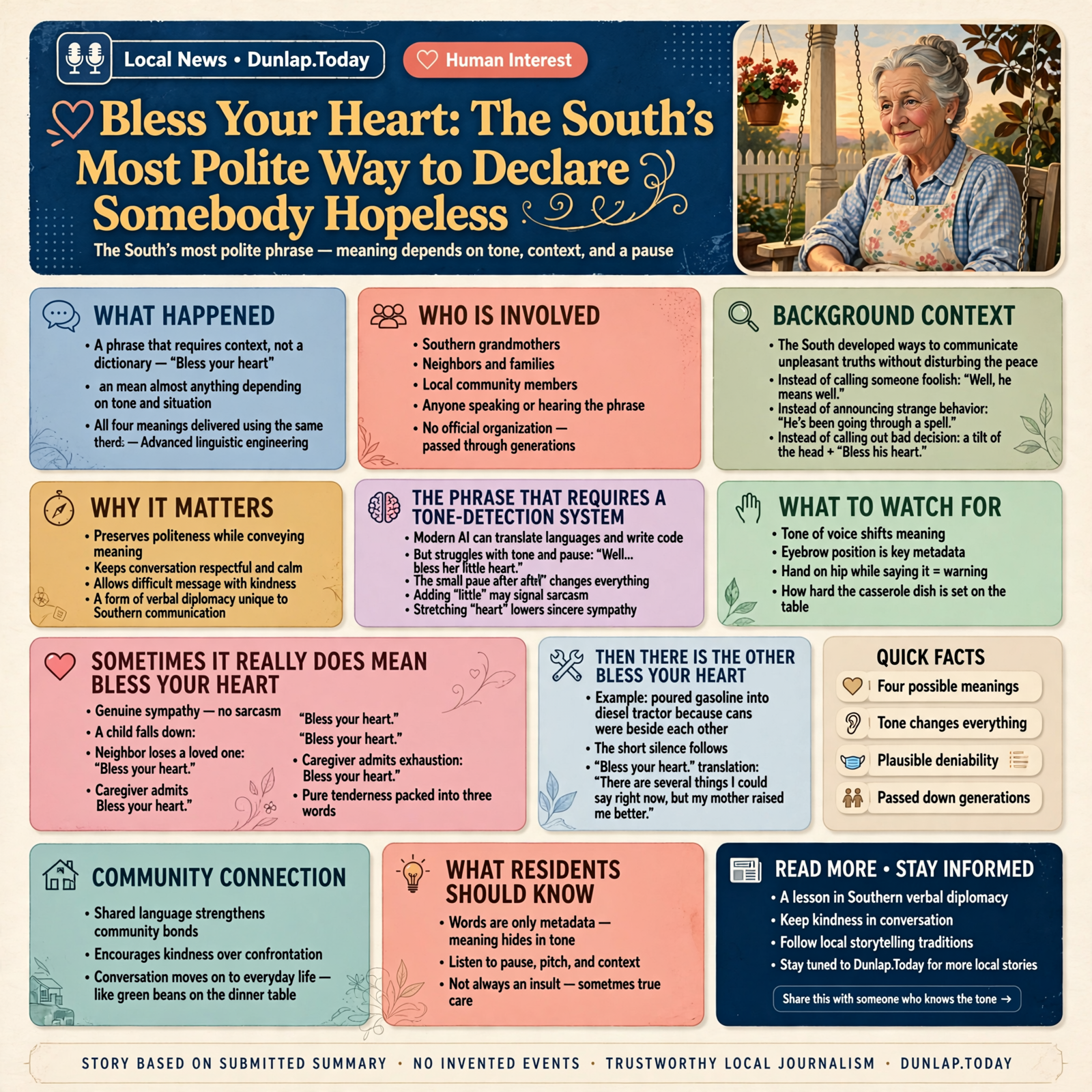
Because in the South, “Bless your heart” can mean almost anything.
It can mean:
“I love you.”
It can mean:
“I feel terrible that happened to you.”
It can mean:
“You poor thing.”
And occasionally it means:
“It is remarkable that a person with your decision-making abilities has survived into adulthood.”
The remarkable thing is that all four meanings may be delivered using exactly the same words.
That is not conversation.
That is advanced linguistic engineering.
🌄 Welcome to the Southern Department of Verbal Diplomacy

The South developed many methods for communicating unpleasant truths without unnecessarily disturbing the peace.
You did not always tell somebody he was foolish.
You might say:
“Well, he means well.”
You did not necessarily announce that somebody was behaving strangely.
You might observe:
“He’s been going through a spell.”
You did not declare that somebody had made a terrible decision.
You might simply tilt your head slightly and say:
“Bless his heart.”
Everybody understood.
No additional documentation was required.
The matter was entered into the permanent public record and conversation moved on to green beans.
🧠 The Phrase That Requires a Tone-Detection System

Modern artificial intelligence can translate languages, recognize faces, write computer code, and explain quantum mechanics.
But I would like to see one correctly interpret:
“Well… bless her little heart.”
That little pause after well changes everything.
Add the word little, and we may be entering dangerous territory.
Stretch the word heart by half a second and the probability of sincere sympathy begins dropping rapidly.
Put one hand on your hip while saying it, and the translation system ought to display a warning.
Meaning uncertain. Proceed carefully.
This may be why Southern grandmothers were decades ahead of modern natural-language processing.
They understood that the words were merely metadata.
The meaning was hiding somewhere between tone, eyebrow position, and how hard somebody set the casserole dish on the table.
❤️ Sometimes It Really Does Mean Bless Your Heart

Contrary to popular internet mythology, Southerners do not always use “Bless your heart” as an insult.
Sometimes somebody genuinely needs blessing.
A child falls down.
“Bless your heart.”
A neighbor loses a loved one.
“Bless your heart.”
Somebody has been caring for an elderly parent for months and finally admits they are exhausted.
“Bless your heart.”
In those moments, there is no sarcasm.
No hidden meaning.
No dagger concealed beneath the lace tablecloth.
It is simply tenderness packed into three words.
That is part of what makes the phrase so dangerous in less charitable circumstances.
It has plausible deniability.
😇 Then There Is the Other Bless Your Heart

You know the one.
A fellow explains that he poured gasoline into his diesel tractor because the cans were sitting beside each other.
There is a short silence.
Someone finally says:
“Bless your heart.”
Translation:
“There are several things I could say right now, but my mother raised me better.”
A woman announces that she has returned to the same boyfriend who has already wrecked her car twice, borrowed $600, and accidentally set fire to her porch.
Grandma takes a sip of sweet tea.
“Well… bless your heart.”
That does not necessarily indicate approval.
It may indicate that Grandma has decided prayer is now the only remaining intervention.
🧐 Context Is Everything

The phrase changes meaning based on circumstances.
Consider:
“Bless your heart, you brought me dinner.”
Good.
“Bless your heart, you tried.”
Concerning.
“Well, bless your heart.”
Danger.
“Oh honey… bless your heart.”
Prepare for impact.
“Isn’t that something? Bless his heart.”
Your reputation is already being discussed at another table.
📊 A Scientific Southern Translation Guide
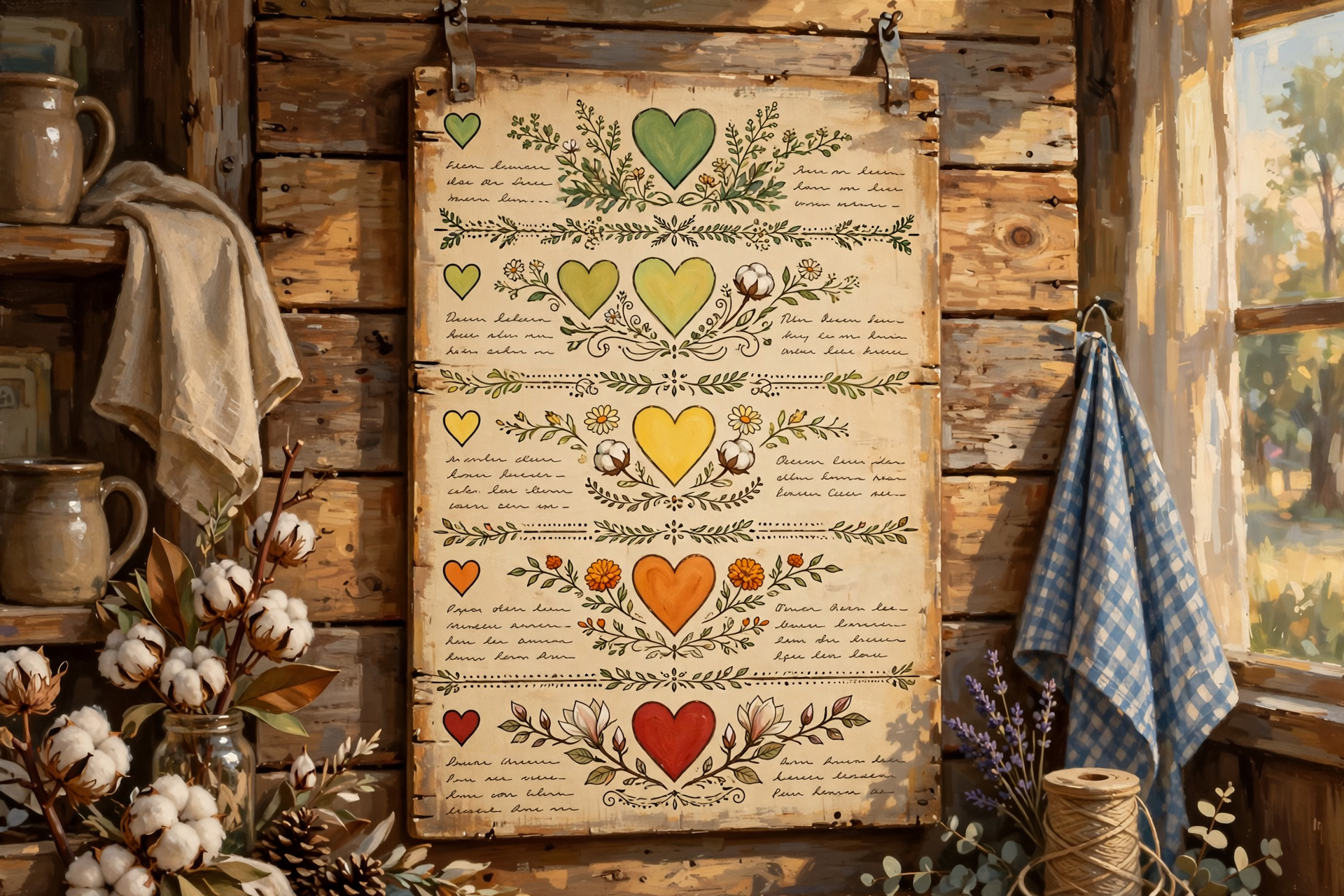
For readers unfamiliar with the dialect, Dunlap.Today offers the following unofficial classification system.
💚 Level One: Genuine Affection
Example: “You drove all the way over here to check on me? Bless your heart.”
Translation: “You are a good person, and I sincerely appreciate you.”
Risk level: None.
💛 Level Two: Compassion
Example: “You’ve been sick all week? Bless your heart.”
Translation: “I am genuinely sorry you are suffering.”
Risk level: Low.
🧡 Level Three: Mild Concern About Your Judgment
Example: “You bought another boat even though the first one doesn’t run? Bless your heart.”
Translation: “I have questions, but I suspect answers would only make things worse.”
Risk level: Moderate.
❤️ Level Four: Polite Condemnation
Example: “He says he is going to become a millionaire selling scented lug nuts on the internet. Bless his heart.”
Translation: “This situation requires observation from a safe distance.”
Risk level: High.
🚨 Level Five: Grandmother Has Reached Her Limit
Example: “Well, honey… bless your precious little heart.”
Translation: Classified.
Recommended response: Stop talking.
🏢 Corporate America Could Learn From This

Modern workplaces have invented entire vocabularies to avoid saying what they mean.
Someone is not wrong.
They are “not fully aligned with current strategic priorities.”
A project did not fail.
It “did not achieve its anticipated outcome.”
Nobody made a bad decision.
There were “unexpected learnings.”
This requires paragraphs.
The South accomplished roughly the same thing generations ago using:
“Bless his heart.”
Three words.
No PowerPoint.
No consultant.
No quarterly retreat.
No flowchart.
Perhaps Southern grandmothers were the original efficiency experts.
💻 What Happens When Technology Encounters Southern Politeness?

Imagine training an artificial intelligence system entirely on conversations from Tennessee porches.
Somebody asks:
“Do you think Billy can fix my transmission?”
The AI replies:
“Well… Billy certainly enjoys working on things. Bless his heart.”
Now what?
Is that a recommendation?
A warning?
A prayer request?
Possibly all three.
A machine designed to interpret Southern speech would need more than language processing.
It would need social archaeology.
It would have to know that Billy once rebuilt a lawn mower using parts from a washing machine.
It would have to remember the incident involving the pontoon boat.
It would need access to what happened at the church picnic in 2017.
And even then, Grandma might fool it.
☕ The Porch Was Our Original Social Network

Long before Facebook, X, TikTok, neighborhood apps, and group text messages, there was the porch.
The porch had excellent bandwidth.
Information traveled quickly.
Privacy settings were admittedly weak.
The algorithm was mostly whoever happened to drive past.
But misinformation was often corrected rapidly because everybody knew your mother.
And reputation management could be accomplished with little more than:
“Well, you know how he is.”
Followed by:
“Bless his heart.”
There was no need to identify precisely how he was.
The community database already contained that information.
😂 Southern Language Left Room for Dignity

This may be the most important part.
Old expressions often allowed people to communicate criticism without completely humiliating somebody.
You could acknowledge foolishness without turning every disagreement into combat.
You could tease people you loved.
You could criticize without necessarily declaring war.
You could recognize that human beings occasionally behave like idiots while continuing to invite them to supper.
That distinction seems increasingly useful.
Modern communication sometimes gives us only two settings:
Approval.
Or:
OUTRAGE IN ALL CAPITAL LETTERS.
Southern grandmothers had approximately forty-seven settings between those extremes.
Most involved casseroles.
🏔️ A Little Mountain Wisdom

There is something profoundly useful about language that leaves a little room for interpretation.
Not everything needs to become a confrontation.
Not every foolish decision needs a tribunal.
Sometimes you can simply acknowledge that somebody has wandered several exits beyond good judgment.
You can hope they find their way back.
You can offer them pie.
And you can say:
“Bless your heart.”
They may understand exactly what you mean.
Or they may think you were complimenting them.
Either way, supper remains peaceful.
🌻 Final Thought

I suspect we should preserve expressions like “Bless your heart” because they represent something increasingly rare:
The ability to disagree with somebody without immediately reaching for a flamethrower.
It can express affection.
It can express sympathy.
It can express doubt.
And, when properly deployed by a Southern grandmother, it can deliver a complete performance review without ever raising her voice.
That is linguistic craftsmanship.
So if someone from Tennessee looks at you thoughtfully, tilts their head slightly, and says:
“Well… bless your heart.”
Smile.
Say thank you.
Then go somewhere private and reconsider every decision you have made during the previous 48 hours.
Just in case.
— Dunlap.Today




0 Comments