
Your AI Is About to Stop Giving Advice and Start Running Errands

For years, artificial intelligence mostly answered questions. The next generation is being built to handle tasks, work across your apps, and carry out instructions. That could save ordinary people a lot of time—but giving a computer permission to act is a bigger decision than giving it permission to talk.
If you’ve tried artificial intelligence during the last few years, you probably learned to use it a little like a very well-read person sitting across the table.
You ask a question.
It gives you an answer.
You ask it to write something.
It writes it.
You ask it to explain Medicare, compare lawn mowers, help with a recipe or turn a pile of notes into a letter.
Useful? Absolutely.
But you’re still doing most of the running around.
That’s beginning to change.
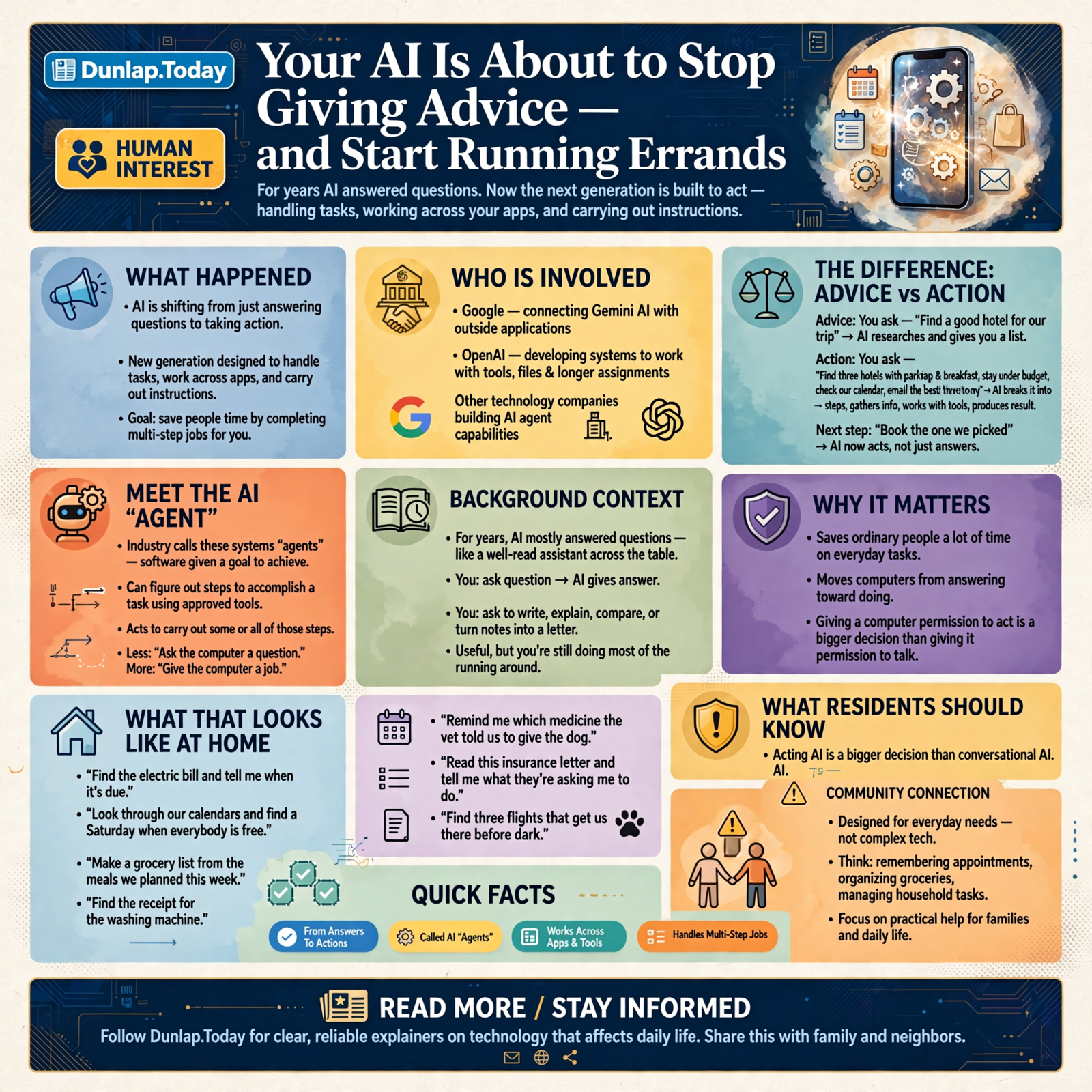
The Difference Between Advice and Action

Imagine asking a very capable assistant:
“Help me find a good hotel for our trip.”
The assistant researches hotels, compares reviews and gives you a list.
That’s roughly how most of us have used AI.
Now imagine saying:
“Find three good hotels near where we’re going, make sure they have parking and breakfast, stay under my budget, check the dates against our calendar and put the best three choices in an email for my wife.”
That’s different.
The computer didn’t merely answer a question. It had to understand the goal, break it into smaller jobs, gather information, work with other tools and produce something useful at the end.
Take it one step further:
“Book the one we picked.”
Now we’ve crossed another line entirely.
The computer isn’t merely helping you think.
It’s acting.
Meet the AI “Agent”

The technology industry has settled on the word agent for many of these systems.
As usual, the technology industry found a way to make a fairly simple idea sound more complicated than necessary.
An AI agent is basically software that can be given a goal, figure out some of the steps required to accomplish it, use approved tools and then carry out some or all of those steps.
Think less:
“Ask the computer a question.”
And more:
“Give the computer a job.”
Google, OpenAI and other technology companies are now building more of these capabilities into their products. Google has been connecting its Gemini AI system with outside applications and is experimenting with an AI family assistant that can help coordinate calendars, household tasks and other logistics. OpenAI is similarly developing systems designed to work with tools, files and longer-running assignments.
Those announcements may sound like technology news.
The important part isn’t the company names.
The important part is that computers are beginning to move from answering toward doing.
What Would That Actually Look Like at Home?

Most normal people aren’t sitting around wishing they had an “autonomous multi-agent artificial intelligence system.”
They are wishing somebody would remember when the dentist appointment is.
That’s where this technology starts making more sense.
You could eventually ask:
- “Find the electric bill and tell me when it’s due.”
- “Look through our calendars and find a Saturday when everybody is free.”
- “Make a grocery list from the meals we planned this week.”
- “Find the receipt for the washing machine.”
- “Remind me which medicine the vet told us to give the dog.”
- “Read this insurance letter and tell me what they’re asking me to do.”
- “Find three flights that get us there before dark.”
In some cases, the AI may only gather and organize the information.
In others, you may eventually give it permission to fill out a form, make a reservation, create an appointment, send a message or perform some other action.
That is where these systems become considerably more useful.
It is also where we need considerably more common sense.
Giving Advice Is Cheap. Giving Permission Is Different.

Suppose your neighbor tells you:
“You ought to call the electric company.”
No great risk there.
Now suppose you hand your neighbor your phone, your account password and permission to negotiate your bill.
That’s a different relationship.
AI is heading toward exactly that distinction.
An AI that tells you, “Your doctor’s appointment is Tuesday at 2:00” needs access to information.
An AI that reschedules that appointment needs permission to act.
An AI that tells you which bill is overdue needs to see financial information.
An AI that pays the bill needs considerably more authority.
The more useful the assistant becomes, the more important the permissions become.
That doesn’t make the technology bad.
It simply means we should treat digital authority the same way we treat authority in the real world.
You probably wouldn’t hire a new office assistant Monday morning and immediately give them the company checkbook, keys to the building, every password and permission to sign contracts.
You’d start with what they actually need.
AI should work the same way.
A Good Rule: Let the Computer Prepare Before You Let It Approve

There’s an easy way to think about this.
Preparation is safer than permission.
I’d be perfectly comfortable asking a computer to:
- Find three contractors.
- Compare their reviews.
- Organize their estimates.
- Point out differences.
- Prepare questions I should ask.
I would be considerably more careful about telling it:
“Hire whichever contractor you think is best and charge my credit card.”
The first use saves me work while preserving my judgment.
The second delegates my judgment.
Those are not the same thing.
For many ordinary people, the sweet spot may be somewhere in the middle:
Let the AI do the legwork. Let the human make the important decision.
This Could Be Especially Important for Small Businesses

There is another side of this technology that could matter enormously in communities like ours.
Big companies have departments.
A small heating and air-conditioning company may have three employees and somebody’s spouse answering the phone between everything else.
A local contractor probably doesn’t employ a full-time researcher, administrative assistant, marketing department, data analyst, receptionist and customer-service team.
AI agents could give very small organizations access to portions of those capabilities without requiring them to become large organizations first.
A small business might eventually tell an AI system:
- “Sort today’s customer inquiries and show me the urgent ones.”
- “Prepare tomorrow’s appointment schedule.”
- “Find customers waiting for estimates.”
- “Draft follow-up messages, but let me approve them before they go out.”
- “Compare what we ordered with what arrived.”
- “Summarize the three things I need to deal with before I go home.”
None of that replaces knowing how to fix an air conditioner, build a cabinet, run a restaurant or install a roof.
It reduces some of the administrative work wrapped around those jobs.
And for very small businesses, administrative work can consume a surprising amount of the day.
Experience May Become More Valuable, Not Less

There’s another interesting wrinkle in all of this.
People sometimes assume the youngest person in the room will automatically be best at using artificial intelligence because younger people grew up with technology.
Maybe.
But an AI assistant still needs somebody who knows whether its work makes sense.
A plumber with 30 years of experience may recognize immediately that an AI-generated estimate forgot something important.
An experienced bookkeeper knows when a number looks funny.
A nurse recognizes when a patient’s story doesn’t fit the neat little box on the screen.
A farmer knows that what’s technically possible and what actually works on the farm aren’t always the same thing.
Artificial intelligence can know a remarkable number of things.
Experience teaches people which things matter.
The best combination may turn out to be neither human alone nor AI alone.
It may simply be an experienced person with a very capable helper.
What Happens When It Gets Something Wrong?

Of course, there’s a catch.
Computers make mistakes.
People make mistakes too, which is why this problem has survived the invention of computers.
But automated mistakes can happen faster.
If an AI incorrectly recommends a restaurant, you might get a lousy hamburger.
If it incorrectly schedules a meeting, you might annoy somebody.
If it incorrectly transfers money, cancels insurance, orders expensive equipment or sends an inappropriate message to every customer you have, the consequences become considerably more interesting.
That’s why the smartest AI systems may not be the ones allowed to do everything.
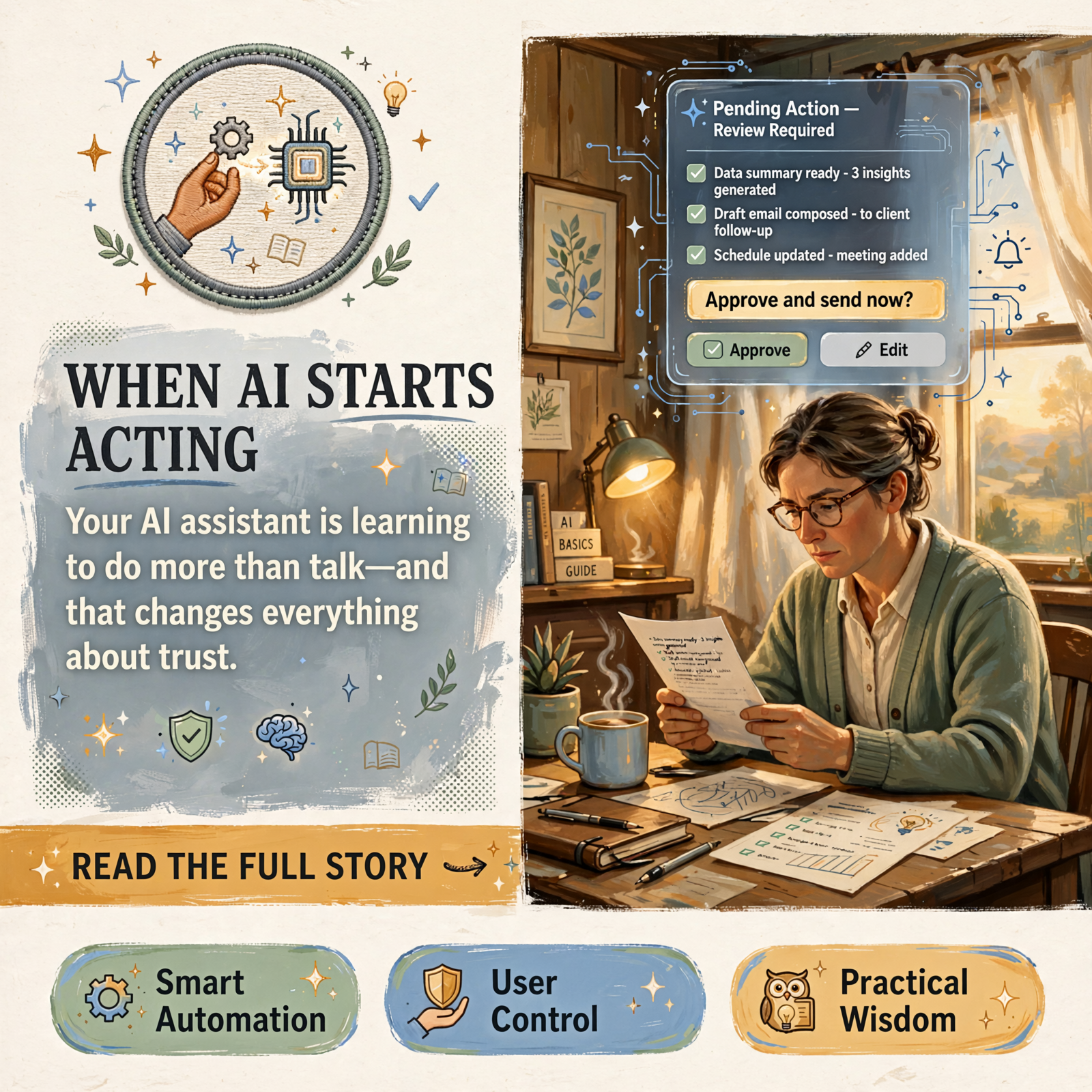
The smartest systems may be the ones designed to know when to stop and ask:
“I have this ready. Would you like me to proceed?”
Sometimes a little friction is useful.
You Don’t Have to Hand Over the Keys

There will probably be plenty of advertising telling us that the future has arrived and that we should connect everything to everything else immediately.
You don’t have to.
You can use AI to explain a letter without letting it answer the letter.
You can let it compare hotels without letting it book one.
You can let it draft an email without letting it send the email.
You can let it organize bills without giving it access to your bank account.
You can let it suggest an appointment without letting it change your calendar.
Permission doesn’t have to be all or nothing.
That’s probably one of the most important things ordinary users should understand as these tools become more capable.
The Computer Is Becoming Less Like a Book and More Like an Assistant

The first useful computers made calculations.
Then they stored information.
Then they connected us to the internet.
Search engines helped us find things.
Smartphones put most of that into our pockets.
And the first generation of modern AI became remarkably good at talking about things.
The next step appears to be doing things.
That doesn’t mean we’re all about to have robot butlers roaming around the kitchen.
It may be much less dramatic than that.
The first truly useful AI “employee” in your house might simply be the thing that knows where the receipt went.
Frankly, around some houses, that may qualify as artificial superintelligence.
So What Should You Do Today?

Probably nothing.
You don’t need to run out and reorganize your life around AI agents.
Many of these tools are still developing, some remain experimental, and companies are still figuring out where automation is genuinely useful and where humans need to remain firmly in control.
But there is one idea worth remembering:
As artificial intelligence becomes capable of doing more than talking, pay attention to what you’re giving it permission to do.
Ask yourself three simple questions:
- What can it see?
- What can it change?
- What must it ask me before doing?
If you can answer those three questions, you’ll already understand one of the most important changes happening in artificial intelligence.
Because the future of AI may not arrive as some giant robot walking through the front door.
It may arrive much more quietly.
It may simply ask:
“Would you like me to take care of that for you?”
AI, In Plain English is an occasional Dunlap.Today series explaining new technology without assuming you have a computer science degree—or particularly want one. We focus on what changed, what it means for ordinary people, what could go right, what could go wrong, and whether you actually need to do anything about it.



0 Comments