

📓 Your AI Chats Aren't a Diary Under the Mattress: A Court Opens Them Up, Hallucination Cases Slow Down, and Experts Get Caught Not Checking

Or: Florida Federal Court Says AI Conversations Can Be Discovered, Reuters Reports Fewer Hallucination Cases, an OpenAI-Case Expert Withdraws AI-Made Charts and Meta Must Name Its Data Deciders: The Week’s eDiscovery AI News in Plain English
By Thomas Seest, Dunlap.Today · Saturday, October 24, 2026
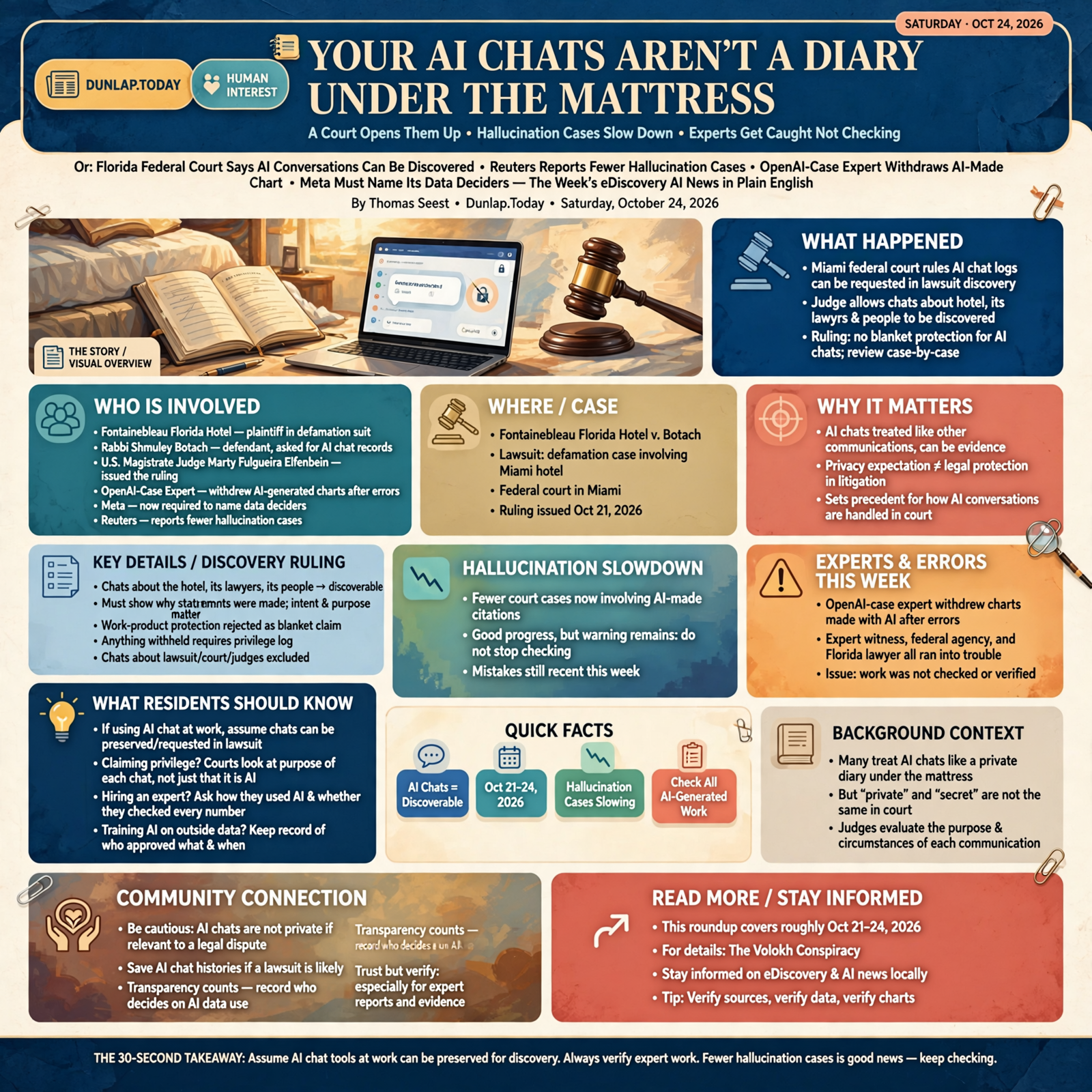
Lots of us grew up with a diary hidden under the mattress. It felt private because nobody else was supposed to read it. Then one day a little brother found it, and you learned that “private” and “secret” aren’t the same thing.
A lot of people treat their AI chatbot the same way. They type in drafts, frustrations and plans as if it were a diary. This week, a federal court in Miami said those conversations can be requested in a lawsuit when they help show why someone did what they did. Meanwhile, the count of court cases about AI-invented citations may finally be slowing, but an expert witness, a federal agency and a Florida lawyer all ran into trouble this week over work nobody checked.
Here’s this week’s roundup: AI chats as evidence, a hallucination slowdown (with a warning), an expert’s unchecked charts, who decided what at Meta, a pile-up of bad citations, and a few numbers and tools worth knowing. Because it’s a quiet Saturday, this roundup covers about Oct. 21–24.
⏱️ What this means for you in 30 seconds
- Using AI chat tools at work? Assume those conversations can be preserved and requested in a lawsuit.
- Claiming privilege over AI chats? Courts look at why each one was made, not just that it was made in an AI tool.
- Hiring an expert? Ask how they used AI and whether they checked every number.
- Fewer hallucination cases? Good news, but don’t stop checking.
- Training an AI on outside data? Keep a record of who approved what, and when.
📓 The Diary Gets Read: AI Chats in Discovery

In Fontainebleau Florida Hotel v. Botach, a Miami hotel is suing Rabbi Shmuley Botach for defamation. The hotel asked for his conversations with AI platforms. On Oct. 21, U.S. Magistrate Judge Marty Fulgueira Elfenbein said yes, in part. Chats about the hotel, its lawyers and its people can be discovered because they may show why he made his statements, which matters for punitive damages.
The judge said those conversations “may reveal not merely the final content of Defendant’s statements but also the purpose for which the statements were created, the instructions Defendant supplied, and the effects he sought to achieve.” The court also rejected a blanket claim that all of the chats were protected work product. The court has to look at “the purpose and circumstances of the particular communications rather than presume protection from the medium.” Anything withheld has to go on a privilege log. Chats about the lawsuit in general, the court’s orders and the judges were left out, and the court didn’t force the defendant to consent to subpoenas sent to the AI companies.
It’s the diary under the mattress again. Writing something in a diary doesn’t make it a secret from the court, and writing it to a chatbot doesn’t either.
What it means for you: If a lawsuit is likely, AI chat histories belong on the list of things to save. And if you want to protect a chat, be ready to explain why it was made for the case.
👉 Read more (The Volokh Conspiracy)
📉 Fewer Made-Up Citations, but Don’t Stop Checking

Researcher Damien Charlotin keeps a database of court decisions about AI-invented material. It now holds 2,207 decisions worldwide, at least 1,500 of them from U.S. courts. According to Reuters, reported cases declined in the second and third quarters of 2026. Charlotin credits better models in part: “new LLMs hallucinate less.” He also warned: “If AI does the job great in 99% of the cases, you’ll eventually stop checking and rely on it – until it hallucinates again.”
It’s like a car that hasn’t broken down in a year. That’s great news, but it’s no reason to skip the oil change.
What it means for you: Keep your checking habits even as the tools improve. The database only counts mistakes that got caught and led to a court decision.
👉 Read more (LargeLanguageLaw)
📊 The Expert Who Said “Always Verify,” Then Didn’t

In the big copyright fight between news publishers and OpenAI and Microsoft, OpenAI and Microsoft are asking the court to throw out the opinions of the publishers’ expert, Professor Oren Etzioni. Techdirt reports that he used Anthropic’s Claude to make charts for his expert report, and that the numbers weren’t in the papers he cited. He admitted he hadn’t checked them and withdrew the charts after his deposition. He had once written: “always verify anything important yourself. AI models hallucinate.”
It’s like the driving instructor who preaches “check your mirrors” and then backs into the mailbox.
What it means for you: If you hire an expert, ask how they used AI and have someone trace every figure back to its source.
🗂️ Meta Has to Say Who Made the Call
In Kadrey v. Meta and related lawsuits over how Meta trained its AI, Magistrate Judge Thomas S. Hixson ordered Meta on Oct. 19 to name every person who made, authorized or approved decisions to get or download “shadow library” datasets, with dates. If a team made the decision, “everyone who participated is responsive.” In the same order, he required the plaintiffs to destroy an unredacted Fox license that had been produced by mistake.
It’s the old question at the family reunion: who decided to put Cousin Billy in charge of the grill? Sooner or later, somebody has to say whose idea it was.
What it means for you: Big AI decisions should leave a paper trail of who approved them and when. You may be asked for it.
🧾 A Pile-Up of Bad Citations

The checking problem showed up in three places this week:
- A federal agency. The Federal Labor Relations Authority found that 35 of the 42 citations in an HHS brief were “fictitious, erroneous, or irrelevant.” It said the agency “may have used a generative artificial-intelligence (AI) tool” and told parties to “verify the accuracy of any AI-generated material.” Above the Law
- A Florida lawyer. A Florida appeals court referred attorney Jaclyn Soroka to the Bar over “AI slop,” saying her response “does not deny using AI but evades the issue.” She says she didn’t use AI. ABA Journal
- A Colorado case. A federal judge struck objections whose citations “bear hallmarks of ‘hallucinated’ citations.” Some cases were real but didn’t say what they were cited for. National Law Review
It’s like grandma’s biscuit recipe copied from memory. It might look right, but you still check the card before baking for the church supper.
What it means for you: Don’t just check that a case exists. Check that it says what you claim it says.
🧭 Quick Hits for the Desk Drawer

- Texas sues OpenAI. Attorney General Ken Paxton sued OpenAI and Sam Altman in Collin County, seeking limits that include blocking minors’ access and having a court-appointed evaluator approve new models. Texas Tribune
- Canada’s “complexity crunch.” A sponsored webinar covers using analytics, TAR and generative AI to cut review “without sacrificing the defensibility that courts expect.” Canadian Lawyer
- The wall is coming down. Law firms and in-house teams now often use the same AI models, “with no legal-specific wrapper.” Bar & Bench
- A firm builds its own. Dutch firm NautaDutilh launched Bluefield to build custom software alongside the tools it buys. Law.com
- Write down why you went offline. After a PHP security scare, ComplexDiscovery says each decision to take systems offline should have its “threshold and timing” recorded. ComplexDiscovery
- Know a rising star? EDRM’s Rising Stars of eDiscovery nominations close Nov. 6. EDRM
- Confidence has to be earned. LexisNexis Australia: “The risk with a convincing citation is that it can invite confidence before it has earned it.” LexisNexis on X
✅ Your Front-Porch eDiscovery AI Checklist

- ✅ Add AI chat histories to your list of things to preserve.
- ✅ Log any AI chats you withhold, with a reason for each one.
- ✅ Set a simple company rule for what goes into AI tools.
- ✅ Ask experts how they used AI, and trace every figure.
- ✅ Check that cited cases say what they’re cited for.
- ✅ Keep a record of who approved big AI and data decisions.
- ✅ Write down when and why systems were taken offline.
- ✅ Keep checking, even as the hallucination numbers drop.
Practical rule: Type into a chatbot only what you’d be comfortable reading out loud in court.
— Dunlap.Today
📚 Plain-English AI Glossary
- eDiscovery: Finding, saving and handing over electronic information (emails, chats, files) for a lawsuit or investigation.
- Discoverable: Something the other side in a lawsuit is allowed to request and see.
- Work product: Material prepared mainly for a lawsuit, which is usually protected from the other side.
- Privilege log: A list describing documents withheld from the other side and the reason for withholding each one.
- Punitive damages: Extra money a court can award to punish especially bad conduct.
- AI hallucination: When an AI tool confidently makes up facts, quotes or court cases that don’t exist.
- Expert report: A written opinion from a specialist hired to explain technical issues in a case.
- Interrogatory: A written question one side must answer under oath during a lawsuit.
- Shadow library: An unauthorized online collection of copyrighted books and articles.
- TAR (technology-assisted review): Using software that learns from human decisions to sort documents faster.
❓ Frequently Asked Questions

Does this mean every ChatGPT conversation can be used against me?
No. In this case, the court allowed requests only for chats tied to the issues, and it left out chats about the lawsuit itself, the court’s orders and the judges. But there’s no automatic protection just because a conversation happened in an AI tool.
Can the other side subpoena the AI company directly?
In this case, the court refused to force the defendant to consent to subpoenas sent to four AI providers. Other courts may handle it differently, so ask your lawyer.
Are AI hallucinations in court going away?
The numbers may be slowing, but this week alone brought problems with an expert’s charts, an agency’s brief and a lawyer’s filings. Checking the work is still the fix.
What should a small business do this week?
Write a one-page rule about what employees can type into AI tools, and make sure AI chat histories are covered when you save records for a dispute.
🔗 Other Resources

- Servient: A Blanket Work-Product Objection Failed to Shield a Litigant’s AI Communications
- Damien Charlotin: AI Hallucination Cases Database
- Trustpoint.One on X: “The future of eDiscovery isn’t just faster review. It’s smarter case strategy.”
- eDiscovery Decoder: Week in Review
🌄 No Need to Worry, Just Stay in the Know

Nobody’s saying throw out the chatbot, any more than anyone said stop keeping a diary. It’s just worth remembering that a tool you talk to like a friend keeps records like a business. If you know that going in and keep checking the work, you’ll be fine.
We’ll keep watching what matters for eDiscovery providers and their clients. Read Dunlap.Today and sign up for our newsletter for plain-English updates.
Know about an upcoming event or story in the Sequatchie Valley? Submit it here.



0 Comments