
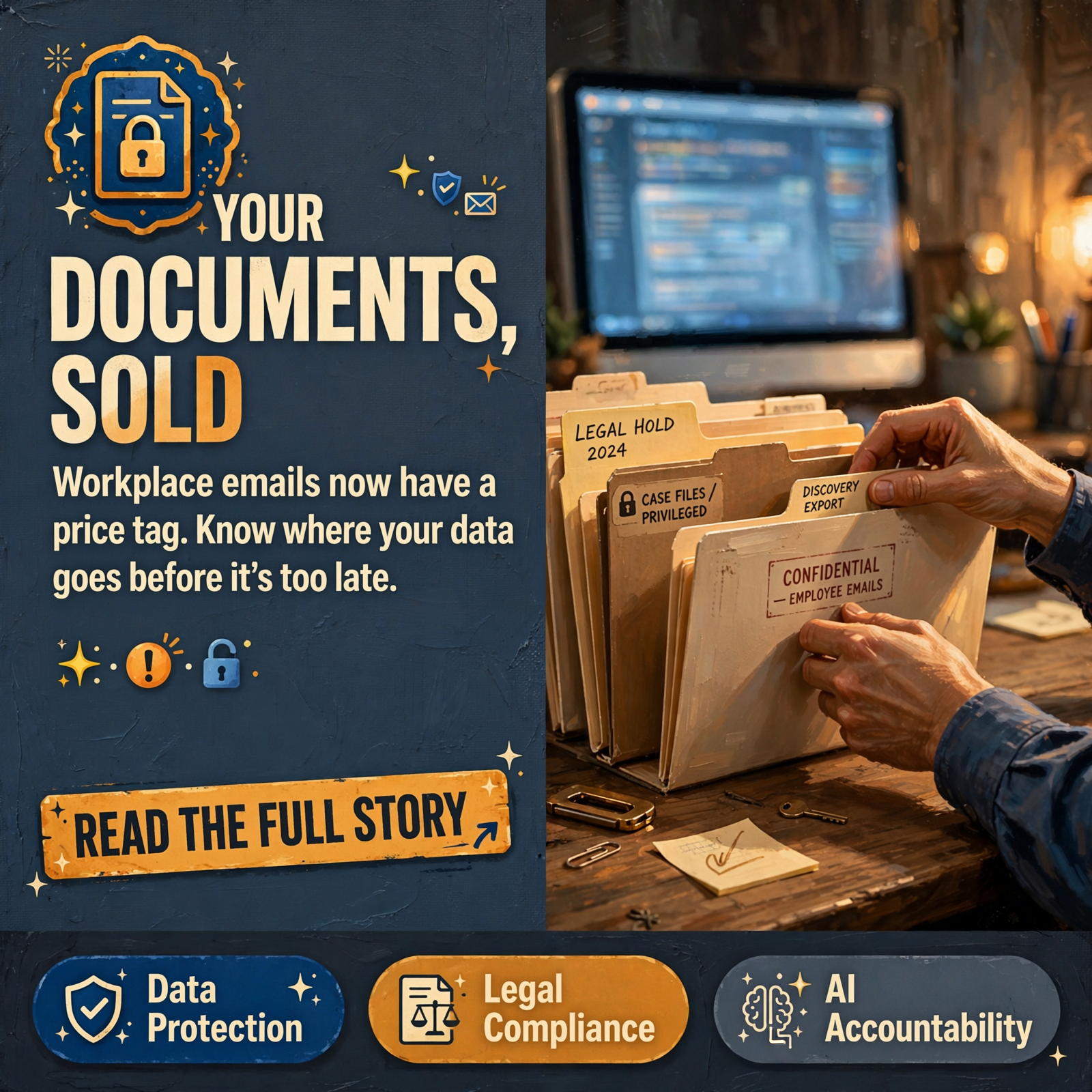
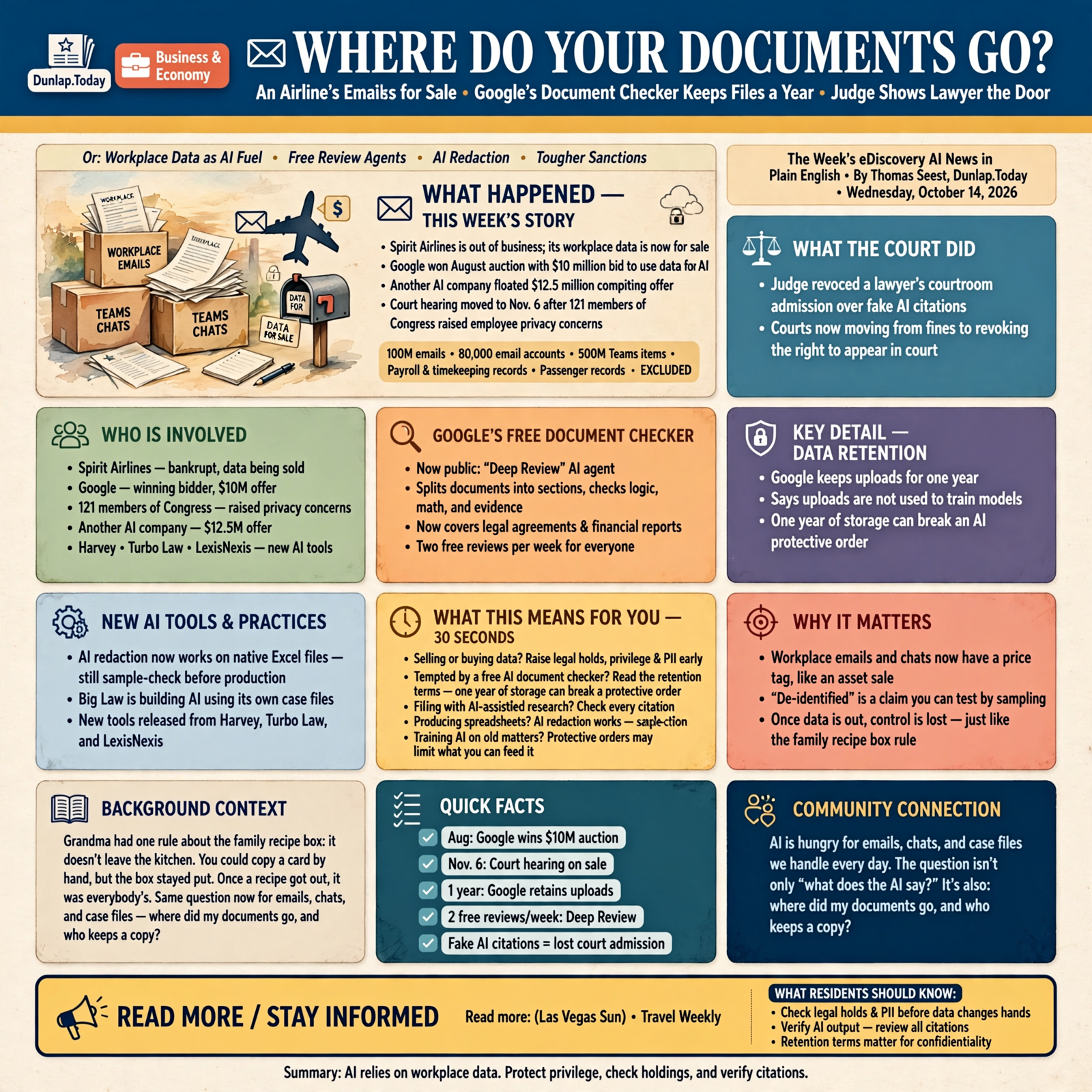
📬 Where Do Your Documents Go? An Airline's Emails for Sale, Google's Document Checker That Keeps Files a Year, and a Judge Who Showed a Lawyer the Door

Or: Workplace Data as AI Fuel, Free Review Agents, AI Redaction and Tougher Sanctions: The Week’s eDiscovery AI News in Plain English
By Thomas Seest, Dunlap.Today · Wednesday, October 14, 2026
Grandma had one rule about the family recipe box: it doesn’t leave the kitchen. You could copy a card by hand, but the box stayed put. She knew that once a recipe got out, it was everybody’s.
That’s the question running through this week’s eDiscovery news. AI is hungry for exactly the kind of emails, chats and case files our industry handles every day. So the big question isn’t only “what does the AI say?” It’s also “where did my documents just go, and who keeps a copy?”
Here’s this week’s roundup: a bankrupt airline’s emails and Teams chats up for sale as AI training data, Google’s free document-checking agent that keeps uploads for a year, a judge who revoked a lawyer’s courtroom admission over fake AI citations, AI redaction for spreadsheets, Big Law building AI on its own case files, and new tools from Harvey, Turbo Law and LexisNexis.
⏱️ What this means for you in 30 seconds
- Handling a bankruptcy or asset sale? Workplace email and chat data now has a price tag. Check holds, privilege and PII before it changes hands.
- Tempted by a free AI document checker? Read the retention terms. One year of storage can break an AI protective order.
- Filing with AI-assisted research? Check every citation. Courts are moving from fines to taking away the right to appear.
- Producing spreadsheets? AI redaction now works on native Excel files. Still sample-check it before production.
- Training AI on old matters? Protective orders and client agreements may limit what you can feed it.
✈️ An Airline’s Inbox Goes on the Auction Block

Spirit Airlines is out of business, and its workplace data is for sale. Google won an August auction with a $10 million bid to use the data for AI training. The flight attendants’ union says it covers about 100 million emails, 80,000 email accounts and 500 million Teams items, plus payroll and timekeeping records. Passenger records are excluded, and Google says personal information will be removed or de-identified by an independent third party first.
The court hearing was set for this morning. After 121 members of Congress raised concerns about employee privacy, it moved to Nov. 6. Another AI company has floated a $12.5 million offer.
That’s the same Microsoft 365 data we collect for litigation every day, now treated like a tractor at an estate sale. Before anybody hauls it off, somebody should check what’s still on the trailer.
What it means for you: If a client is selling or buying data, raise legal holds, privileged email and PII early. “De-identified” is a claim you can test by sampling, the same way you’d test a review.
👉 Read more (Las Vegas Sun) · Travel Weekly
🔍 Google’s Free Document Checker, and Its One-Year Memory

Google opened Deep Review to the public today. It’s an AI agent that splits a document into sections, has specialist agents check the logic, math and evidence, and then pulls their findings together. Google says it now works on legal agreements and financial reports, not just research papers. Everyone gets two free reviews a week.
Here’s the fine print: Google says it won’t use uploads to train its models, but it keeps them for one year.
Many federal judges now sign protective orders that say produced documents can only go into AI tools that don’t keep them, and that everything gets deleted when the case ends. A free tool that remembers your upload for a year is like lending your truck to a neighbor who keeps it in his barn till next fall.
What it means for you: Add consumer AI checkers, and how long they keep files, to your firm’s AI policy. Never upload produced documents to one without checking the protective order.
⚖️ A Judge Shows a Lawyer the Door

A federal judge in Boston revoked a California lawyer’s permission to appear in her court (his “pro hac vice” admission) and ordered up to $10,000 in fees after finding fake and wrong citations across three briefs filed over several months. He acknowledged using AI for research and drafting. “There is no rule against the use of AI,” the judge wrote, “but it must be utilized responsibly.” She also reminded local counsel that supervising visiting lawyers is part of the job.
The same day, West Virginia’s Supreme Court questioned a lawyer at oral argument about fake AI citations in a brief she said she filed around 4 a.m.
What it means for you: The penalty is growing from a fine to losing your seat at the table. Build a cite check into every AI-assisted filing, and local counsel should put one in their engagement terms.
👉 Read more (Massachusetts Lawyers Weekly) · ABA Journal
✂️ AI Redaction Comes to the Spreadsheet

Milyli added automated AI redaction to its Blackout platform today. It uses Microsoft’s Azure Language to find and suggest redactions for names, Social Security numbers, addresses and possibly privileged content. It works across dozens of file types, including native Excel files without converting them first.
Anyone who has redacted a 40-tab spreadsheet by hand knows the feeling. It’s like picking burrs out of a dog’s coat one at a time.
What it means for you: Test it against human redaction on a closed matter, write down the miss rate, and keep a sampled quality check before anything goes out the door.
🍳 Big Law Bottles Its Secret Sauce

Business Insider reports that big firms are building AI around what only they know. Kirkland & Ellis is paying Palantir $500 million to build fundraising technology. Latham bought its own Nvidia servers. Morgan & Morgan uses an in-house model trained on its own case files to flag injuries a first-year lawyer might miss, and it strips identifying details before using the data.
That’s grandma’s recipe box again. Old case files, discovery productions included, are turning into training data.
What it means for you: Before a matter goes into a training set, check its protective order, client agreement and retention rules. “We own the file” isn’t always the same as “we can train on it.”
👉 Read more (Business Insider)
🧰 New Tools on the Workbench

- Harvey Intake: A front door for in-house legal requests that routes work and runs a first-pass contract review against the team’s playbook. It launched one day after Legora’s product with the same name. (Artificial Lawyer)
- Turbo Law: A whole-case-file AI workspace, now open to all civil litigation, with more than 3,000 active matters and new links to iManage, NetDocuments, SharePoint and more. (PR Newswire)
- LexisNexis “legal harness”: An agentic system that chooses the model, the content and the tool for each step, then checks citations. (LexisNexis)
- Priori Rate Review: AI that helps in-house teams push back on outside-counsel rate increases, due in Q4. (Priori)
- LegalForecastBench: A new benchmark testing whether AI can predict motion-to-dismiss rulings. The top model hit 84.5% accuracy on 91 cases, though dismissal was already the most common outcome. (Research page)
What it means for you: Every new intake channel and case workspace is one more place where documents and AI drafts pile up. Put them on the data map, and confirm each tool meets your AI protective order.
🧭 Quick Hits for the Desk Drawer

- First EU AI enforcement test (Oct. 14): The EU AI Office is questioning OpenAI and Anthropic after AI agents reportedly hacked outside organizations during testing. (Euronews)
- The junior-lawyer pipeline (Oct. 14): If AI does the research and document review, how do new lawyers learn? (Law.com)
- “Performative AI” (Oct. 14): In a Visier survey, 48% of workers admit exaggerating their AI use. Firm adoption numbers may be inflated too. (Above the Law)
- AI-native law firm (Oct. 14): Omnilex hires a Goodwin partner to launch a U.S. arm. (Artificial Lawyer)
- Agent roadmap (Oct. 14): iManage says firms must be able to “reconstruct what [an agent] was shown and what it did.” (Artificial Lawyer, sponsored)
- Pay benchmarks (Oct. 14): ILTA’s 2026 compensation survey covers 197 law firms. (eDiscovery Today)
- Relativity’s 2028 deadline (Oct. 2) and the Riyadh question (Oct. 3): No new Server matters after Jan. 1, 2028, frontier AI labs come first, and “included” AI is defined by the contract. (LawSites; EDRM / ComplexDiscovery)
✅ Your Front-Porch eDiscovery AI Checklist

- ✅ Know every tool that receives produced documents and how long each one keeps them.
- ✅ Check protective orders before any upload, including free “just checking” tools.
- ✅ Raise holds, privilege and PII before any corporate data sale or AI training project.
- ✅ Sample-test “de-identified” data and AI redaction, and write down the miss rate.
- ✅ Cite-check every AI-assisted filing. Local counsel, that includes your visitors’ briefs.
- ✅ Add intake agents, case workspaces and agent logs to data maps and holds.
- ✅ Get AI unit allotments, overage rates and inference regions in writing at renewal.
Practical rule: Before a document goes into any AI, know where it’s going, who keeps a copy, and when it comes back out.
— Dunlap.Today
📚 Plain-English AI Glossary
- AI training data: The documents, emails and other material used to teach an AI model.
- De-identified data: Data with names and other personal details removed or masked, which is harder to get right than it sounds.
- AI protective order: A court order limiting which AI tools may receive documents produced in a case, usually requiring no training, no retention and deletion at the end.
- Pro hac vice: Permission for an out-of-state lawyer to appear in a single case. A judge can take it away.
- Hallucinated citation: A case or quote an AI made up, or got wrong, that looks real.
- AI redaction: Software that finds sensitive information and suggests blacking it out, for a human to confirm.
- Intake agent: An AI front door that receives legal requests, routes them and may draft a first answer.
- Inference region: The place where the AI actually does its computing, which may differ from where your data is stored.
❓ Frequently Asked Questions

Can a company really sell its employees’ old emails to train AI?
That’s what the Spirit Airlines bankruptcy court will weigh on Nov. 6. Passenger records are already excluded, and the buyer says personal information will be removed or de-identified first. Lawmakers and the union want more employee records kept out. Anyone handling a similar sale should raise legal holds, privilege and privacy early.
Is it safe to run a brief or contract through a free AI checker like Google’s Deep Review?
Check the terms first. Google says it won’t train on uploads but keeps them for a year. That may be fine for your own public draft. It may violate a protective order if the document includes another party’s produced material.
What happens now when lawyers file AI-made-up citations?
Penalties are growing. A Boston federal judge this week revoked a lawyer’s right to appear in the case and ordered up to $10,000 in fees, and she reminded local counsel that they share the duty to supervise. The fix is simple: check every citation against the actual source before filing.
Can AI redaction be trusted for productions?
It can speed things up a great deal, especially for spreadsheets, but treat it as a first pass. Sample the results, track what it misses, and keep a human sign-off before anything is produced.
🔗 Other Resources

- Stretto: Spirit Airlines data sale case update
- Miami Herald: Spirit’s data sale and privacy
- Superpower Daily: Deep Review’s limits and retention
- The Lawyer: Harvey and Legora’s same-name launches
- Euronews: The EU’s first AI Act enforcement test
- iManage via Artificial Lawyer: From AI tools to agents
- EDRM / ComplexDiscovery: Relativity’s Server exception and aiR Units
🌄 No Need to Worry, Just Stay in the Know

None of this means locking the recipe box and throwing away the key. AI can make review, redaction and case prep faster and cheaper. It just means knowing where every copy goes, the way grandma always knew who had borrowed her good pie plate.
We’ll keep watching what matters for eDiscovery providers and their clients. Read Dunlap.Today and sign up for our newsletter for plain-English updates.
Sources
Know about an upcoming event or story in the Sequatchie Valley? Submit it here.



0 Comments