

Meta Got Caught With Its Hand in the Cookie Jar — So It Rewrote the Cookie Jar Rules

A tale of Facebook, artificial intelligence, disappearing cookies, and the extraordinary ability of billion-dollar corporations to explain why your kitchen was apparently theirs all along.
There was a time in America when a man could bake a batch of cookies, leave them cooling on the kitchen counter, and reasonably expect that the cookies would still be there when he returned.
Those were simpler times.
Today, apparently, a fellow might return to find a trillion-dollar technology company standing in his kitchen, both hands buried in the cookie jar, crumbs covering its shirt, and a team of lawyers explaining that the cookies were actually part of a comprehensive effort to improve the consumer experience.
And if the homeowner objects?
Well, the company will issue a statement.
“We’ve heard you.”
Which is corporate language for, “We had no idea you’d notice.”
Welcome to the latest adventure involving Meta, the parent company of Facebook and Instagram, where the cookies are digital, the jar is your website, and the legal department has apparently been working overtime.
It Started With a Perfectly Innocent Cookie Jar
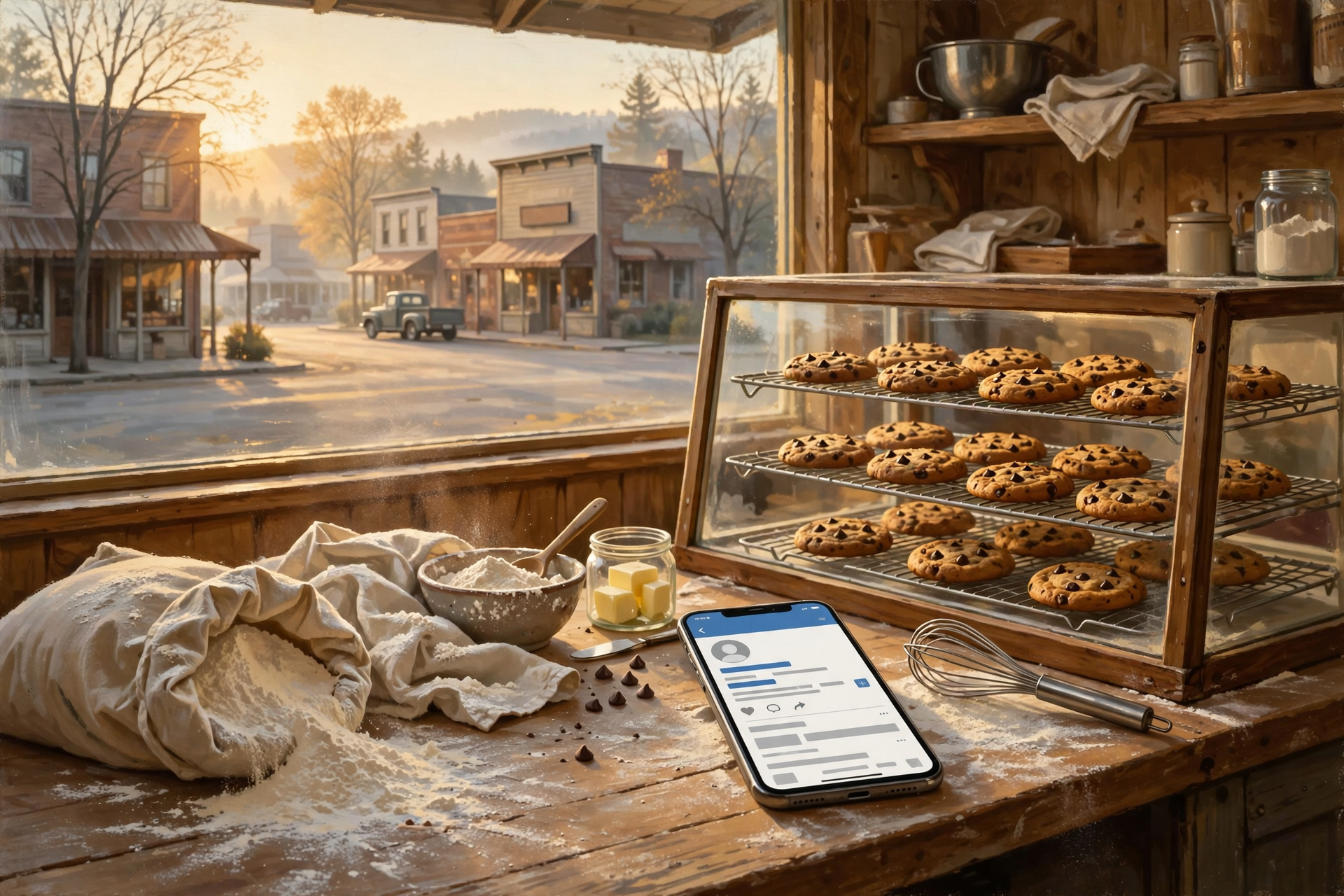
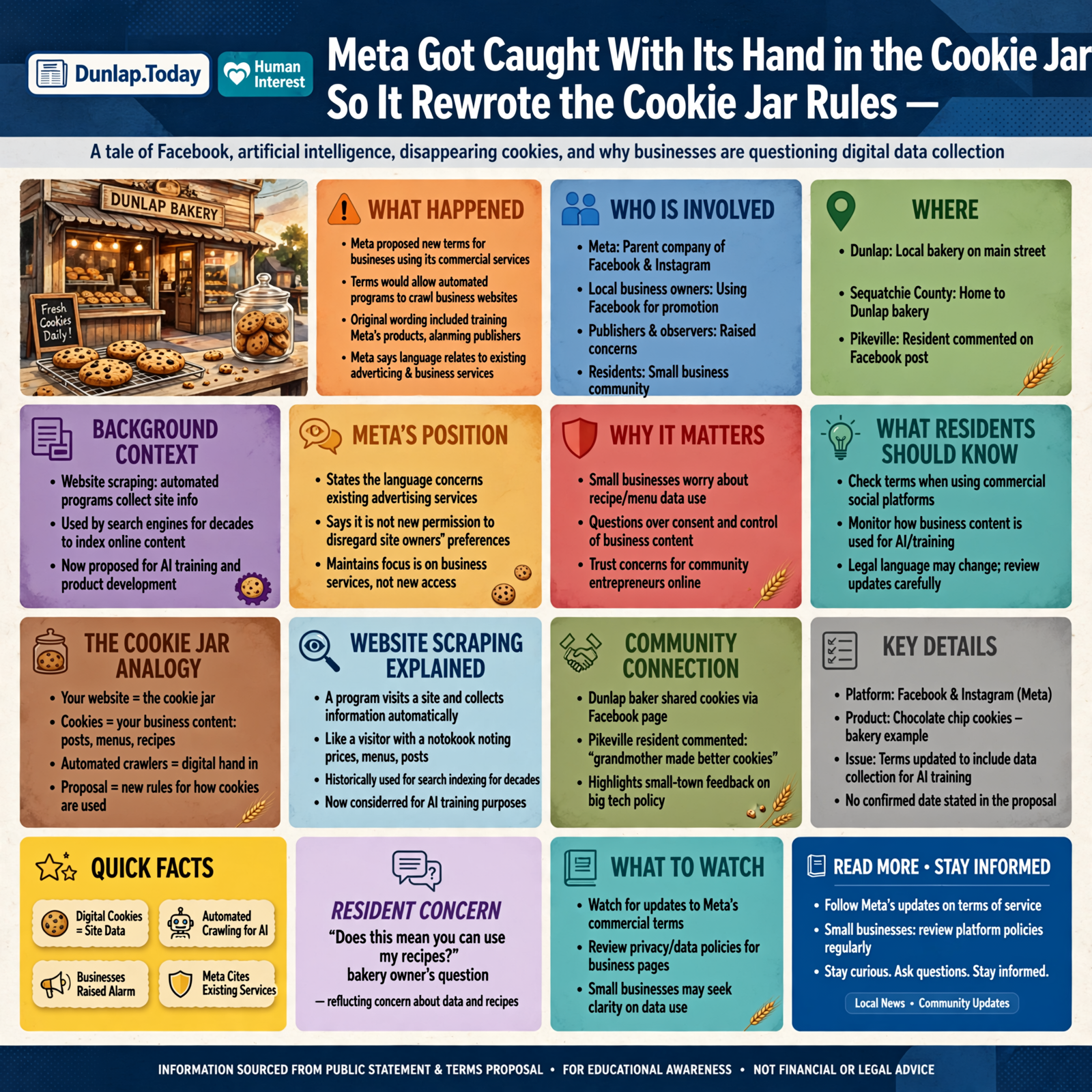
Imagine, if you will, that you own a little bakery in Dunlap.
You get up at four in the morning, mix your dough, bake your cookies, sweep the floor, and put a sign out front announcing that you’ve got the finest chocolate chip cookies in Sequatchie County.
Business is good.
You even create a Facebook page to let people know when fresh cookies are coming out of the oven.
Facebook is delighted.
“Wonderful!” says Facebook. “We love small businesses!”
You post a picture of your cookies.
People like your cookies.
A few people share your cookies.
One gentleman in Pikeville comments that his grandmother made better cookies, but he hasn’t actually tasted yours, which is a longstanding tradition on Facebook.
Everything is going beautifully.
Then one morning, you discover something unusual in the paperwork.
Somewhere among the legal language, Meta has proposed terms allowing its automated programs to crawl websites associated with businesses using its commercial services and collect information for a broad range of purposes.
The original wording explicitly included training Meta’s products, which alarmed publishers and other observers.
In ordinary English, the bakery owner reads this and asks:
“Wait a minute. Does that mean you can come into my kitchen and use my recipes?”
Meta maintains that the language concerns its existing advertising and business services, not some new permission to disregard website owners’ preferences.
Which is an important distinction.
But the bakery owner is still looking suspiciously at the cookie jar.
The Cookie Jar Is Now a Technology Platform

To understand the controversy, you need to understand something called website scraping.
Don’t worry. It isn’t nearly as complicated as the people charging consulting fees to explain it would have you believe.
Scraping is when a computer program visits a website and collects information automatically.
Think of it as sending a very fast fellow through town with a notebook.
He visits the hardware store and writes down the price of nails.
He visits the bakery and records the day’s specials.
He visits the restaurant and copies the menu.
He visits the newspaper and notes all the stories.
Nothing particularly mysterious about that.
Search engines have used automated visitors for decades to help people find websites.
But what happens when that fellow starts collecting enormous amounts of information, possibly using it to develop artificial intelligence products, and website owners aren’t sure how much control they retain?
Now we have a different conversation.
It is one thing to tell somebody that Mrs. Johnson makes a wonderful pecan pie.
It is another thing to copy Mrs. Johnson’s entire recipe collection, study how she makes her pies, and develop a computerized baking assistant that may someday compete with Mrs. Johnson.
Especially when Mrs. Johnson was just trying to advertise her church bake sale.
And especially when the computerized baking assistant has never actually tasted a pecan.
Then Somebody Read the Fine Print

The excitement began when journalists and legal experts examined Meta’s updated commercial terms, scheduled to take effect October 30, 2026.
The original language raised concerns that Meta was seeking broad authorization to gather content from websites associated with businesses using its platforms.
And potentially use that information to train artificial intelligence.
News publishers were particularly unhappy.
Understandably.
Imagine spending hours interviewing people, investigating stories, taking photographs, checking facts, editing articles, and paying employees.
Then imagine a gigantic technology company proposing contractual language that could allow it to collect your website’s content and use that material for its own products.
That is the sort of arrangement that can cause a newspaper publisher to spill his coffee.
Possibly deliberately.
Lawyers began examining the language.
Publishers complained.
Technology reporters started asking uncomfortable questions.
And suddenly, Meta found itself standing in the metaphorical kitchen with suspiciously chocolate-covered fingers.
Then came the announcement.
Meta had heard everybody.
“We’ve Heard You,” Said the Man Holding the Cookies

On Friday, October 16, Meta revised the controversial wording.
The company removed the explicit word “train” and emphasized that the information would be collected and used for advertising and business products.
Meta also said the changes were not intended to introduce new website-crawling practices.
Now, that’s significant.
The company did change the language.
And its explanation deserves to be heard.
But critics were not entirely reassured, because the revised wording still permits automated collection and broad uses connected to advertising and business products.
Let us return to our bakery.
The owner discovers the cookie jar is open.
“Have you been taking my cookies?” he asks.
“Absolutely not,” replies the visitor. “We are merely gathering information to improve our understanding of baked goods.”
“Then why are there crumbs on your shirt?”
“We’ve heard your concerns.”
“Are you going to stop taking cookies?”
“We have updated our terminology.”
“What terminology?”
“We no longer refer to the activity as cookie consumption. It is now part of our ongoing pastry-related business improvement initiative.”
“Are you still eating my cookies?”
“Our legal department would prefer that you not use such unnecessarily restrictive language.”
And somewhere in a glass office building, a public relations executive receives a performance bonus.
The Word That Disappeared

One of the most interesting details in this story is that Meta removed the word “train” from the revised terms.
That word matters because artificial intelligence systems are developed using enormous quantities of information.
Books, articles, websites, photographs, discussions, and other materials can all become valuable resources for AI development.
The more useful the information, the more valuable it may be.
But removing a word doesn’t automatically settle what the remaining language permits.
Critics have argued that broader wording concerning business product development leaves important questions unanswered.
In other words, the bakery owner asks:
“Are you using my cookies to teach your robot how to bake?”
And the company replies:
“We’ve removed the word ‘teach’ from our documentation.”
“Wonderful. So you’re not doing it?”
“We’re improving our robot’s pastry-related capabilities.”
“Using my cookies?”
“We appreciate your feedback.”
It is an extraordinary conversation.
One suspects that if corporate lawyers had been present when Eve offered Adam the apple, there would have been a forty-seven-page agreement explaining that consumption constituted acceptance of the orchard’s revised terms of service.
The Little Sign on the Door

There is another part of this story that deserves attention.
Website owners have something called a robots.txt file.
It sounds complicated, but the idea is simple.
It is a set of instructions posted on a website telling automated visitors which areas the owner would prefer they access or avoid.
Think of it as a sign outside your barn.
“Visitors welcome. Please stay out of the feed room.”
Respectful visitors read the sign.
Other visitors may ignore it.
Unlike a locked door, the sign does not physically prevent entry.
Meta says its revised terms do not represent a change in how its automated crawlers operate.
Critics want stronger assurances written directly into the company’s terms, including clear recognition of website owners’ instructions.
Because a sign is only useful when the visitor agrees to respect it.
And anyone who has ever owned livestock knows there is a considerable difference between telling a goat not to enter the garden and successfully preventing a goat from entering the garden.
The goat considers your instructions advisory.
The garden considers the matter settled.
And the farmer is left examining what remains of his tomatoes.
Small Businesses Are in This Story, Too

It would be easy to dismiss this as a fight between enormous technology companies and enormous publishing companies.
But the language concerns commercial users, which can include ordinary small businesses.
Consider a furniture maker in Dunlap.
He spends years learning his craft, develops his own designs, photographs his work, and builds a website.
He creates a Facebook page because that’s where many of his customers are.
Or consider a restaurant owner in Pikeville who spends years perfecting the menu.
Or a mechanic who publishes detailed explanations of common vehicle problems.
Or a real estate professional, photographer, artist, contractor, or independent publisher.
All of them create information.
Some of that information is ordinary advertising material.
Some is the result of substantial investment, research, or original creative work.
And increasingly, that information has value beyond simply encouraging someone to visit a shop.
It can help power the next generation of digital products.
That doesn’t mean all automated collection is bad.
In fact, many businesses want their websites discovered, indexed, and recommended.
A bakery generally wants people to find its hours, menu, and location.
An independent newspaper wants readers to discover its articles.
But there is a meaningful difference between helping customers discover someone’s work and using that work to build another commercial product.
Exactly where that boundary belongs is one of the great questions of the artificial intelligence era.
And judging by the number of lawyers now involved, we probably won’t settle it before supper.
We Should Also Be Fair to Meta

For all the fun being had at Meta’s expense, there is an important distinction.
The company says the wording change clarifies existing practices connected to advertising and business services.
It says it isn’t announcing some new program to disregard website owners’ preferences or harvest news websites for AI training.
And the controversial terms do not, by themselves, establish that Meta actually scraped a particular website without permission.
Those are meaningful points.
The dispute concerns what the proposed contractual language authorizes, how broadly that language can be interpreted, and how much control website owners retain.
But this is also why the story matters.
Small businesses generally do not employ teams of technology attorneys to analyze every paragraph of every agreement.
Most owners are too busy running the business.
They click the button.
They accept the terms.
They hope the internet works.
And somewhere along the way, the meaning of that little button may have become considerably more important than they realized.
Imagine This Happening at the County Fair

Let’s put the entire situation into terms that would make sense at a county fair.
A fellow rents a booth to sell homemade apple butter.
The fair organizer promises him a wonderful location and plenty of customers.
Everything goes well.
Then the organizer changes the booth agreement.
It now contains language allowing the fair to examine and collect information connected to the vendor’s products and operations for various business purposes.
The apple butter man objects.
The organizer issues a statement.
“We’ve heard you.”
The agreement is revised.
Now the organizer may collect information for fair-related advertising and business development.
The apple butter man looks at the revised agreement.
“Are you still allowed to collect the same information?”
“Much of it, yes.”
“And what are you going to do with it?”
“Develop and improve our business services.”
“Could that include developing a machine that makes apple butter?”
“Our legal team is reviewing your question.”
The apple butter man begins packing his jars.
“Where are you going?” asks the organizer.
“Home. At least there I know who’s stirring the pot.”
Unfortunately, he has already advertised on Facebook that his booth will be open until five.
The customers are still arriving.
And that, friends, is why these relationships are complicated.
The Real Problem Is That Everybody Needs the Same Cookie Jar

Facebook and Instagram are enormously useful to many businesses.
People find restaurants there.
They discover events.
They follow local news.
They see pictures of grandchildren, lost dogs, birthday cakes, and pickup trucks being sold by men who apparently believe that every used vehicle is worth considerably more than the laws of depreciation would suggest.
For small businesses, these platforms can be valuable connections to customers.
That gives Meta a great deal of influence.
A bakery cannot easily abandon its Facebook audience simply because it dislikes a paragraph in the commercial terms.
An independent publisher cannot casually walk away from thousands of readers.
This creates an imbalance.
The platform writes the agreement.
The business decides whether to accept it.
And although businesses have choices, those choices may come with real economic consequences.
It’s rather like being told that you are perfectly free to refuse the town’s only bridge, provided you don’t mind swimming across the river every morning.
Technically, you have options.
Practically, you may want to keep your shoes dry.
A Modest Proposal for the Future

Perhaps these agreements should be written in plain English.
Not corporate English.
Not legal English.
Not the sort of English that requires three attorneys, two dictionaries, and a retired federal judge to explain whether the company is borrowing your cookies.
Just ordinary language.
Something like:
“We would like to collect information from your website to help operate and improve certain Meta business services.”
Then explain exactly what information.
Explain what Meta can do with it.
Explain whether it can be used for AI training.
Explain how website owners can say no.
And explain what happens if they do.
It probably wouldn’t take forty-seven pages.
It might even fit on a sign next to the cash register.
But that would mean businesses could understand the arrangement without consulting an attorney.
And I suspect the legal profession has some strong opinions about that idea.
The Lesson From the Cookie Jar

The broader issue isn’t whether artificial intelligence should be allowed to learn from information.
AI can be extraordinarily useful.
It can help local businesses improve their websites, answer customer questions, analyze information, write better descriptions, and reach people who might otherwise never discover them.
The question is who gets to decide how that information is used.
When a baker publishes a recipe, does that mean every technology company should be able to use it for every conceivable business purpose?
When a newspaper publishes an original story, what rights does the publisher retain?
And when a small business clicks “I Agree,” how clearly has the company explained what is being agreed to?
These are questions worth asking.
Meta has made some changes to its language following criticism.
Whether those changes adequately address the concerns remains a subject of disagreement.
And the revised commercial terms are scheduled to take effect October 30.
Meanwhile, our imaginary bakery owner has decided to install a lock on the cookie jar.
He has also posted a sign.
“Cookies available for purchase. Please ask before taking any.”
Unfortunately, an attorney passing through town stopped to explain that the sign might not be legally enforceable in every circumstance.
The baker listened politely.
Then he picked up his rolling pin.
And for the first time all week, everybody understood the terms.
The End.
Editor’s Note: This article uses fictional characters, imaginary conversations, and satire to explain a real controversy involving Meta’s commercial terms. The fictional cookie jar incident is not an allegation that Meta has stolen content. Meta disputes interpretations suggesting the changes authorize new, unrestricted scraping, while publishers and other critics continue questioning the breadth of the revised permissions.
Sources and Further Reading

Know about an upcoming event or story in the Sequatchie Valley? Submit it here.



0 Comments