

🤖 AI Without Another Monthly Bill: What Local AI Can Actually Do

Most people have learned artificial intelligence like this:
Open a website.
Type a question.
Wait a moment.
Artificial intelligence somewhere out in the great electronic beyond sends an answer back.
That’s how ChatGPT, Claude, Gemini and most of the AI tools people hear about generally work.
Your computer isn’t actually doing most of the thinking.
It’s more like you’re using your computer to make a telephone call to a very large computer somewhere else.
But something interesting has been quietly happening.
The AI can increasingly live in your house.
Or your office.
Or your workshop.
Right there on your own computer.
No, I’m not suggesting R2-D2 is hiding underneath your desk.
At least I hope not.
I’m talking about something called local AI.
And I think ordinary computer users are going to hear that phrase a whole lot more over the next few years.
🏠 What Does “Local AI” Mean?
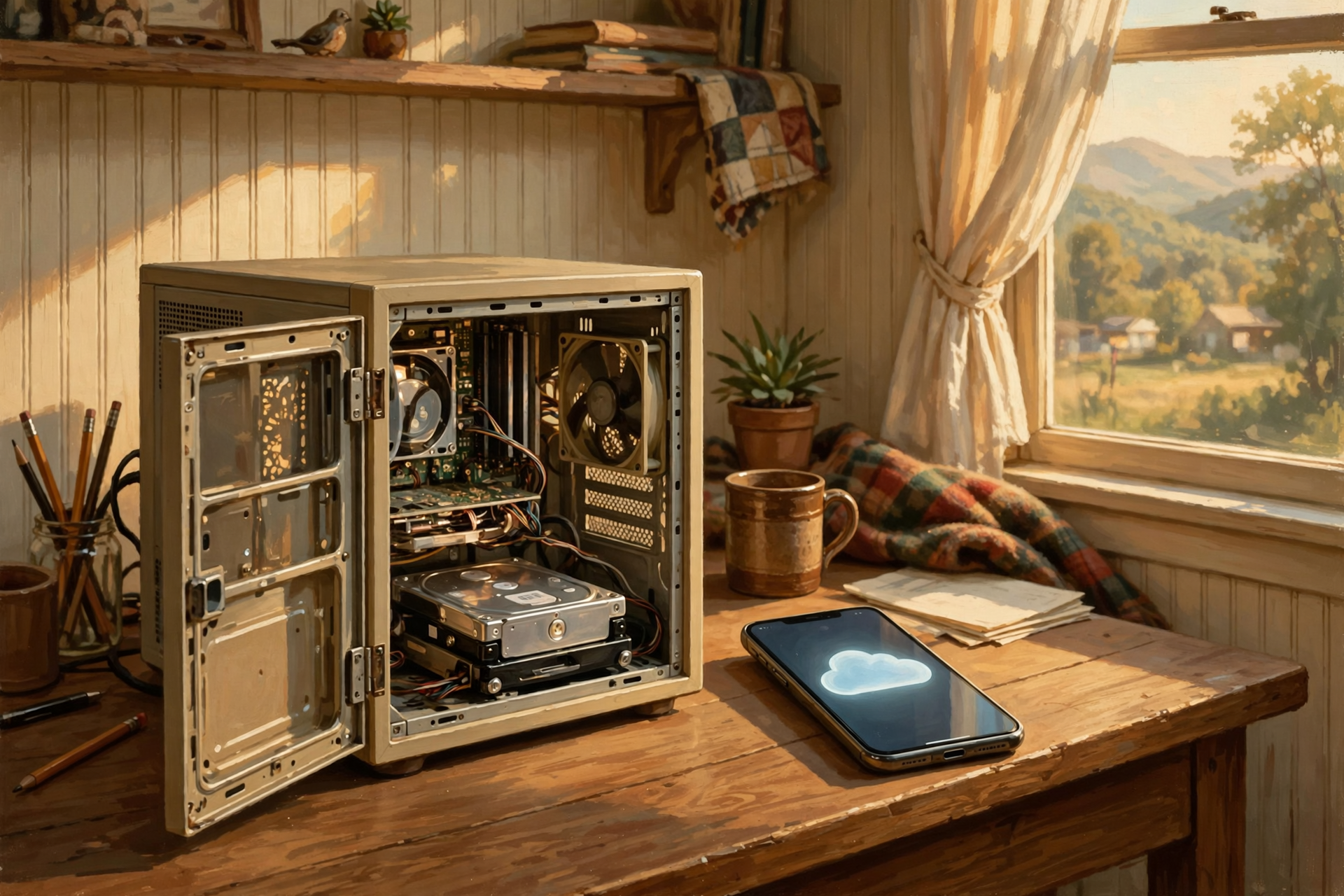
The easiest way to understand local AI is to compare it with something most of us already know.
Think about photographs.
You can store a photograph in the cloud on somebody else’s computer.
Or you can store it on the hard drive sitting inside your computer.
Artificial intelligence can increasingly work the same way.
With cloud AI, your request travels across the Internet to computers operated by somebody else.
Those computers process your request and return the answer.
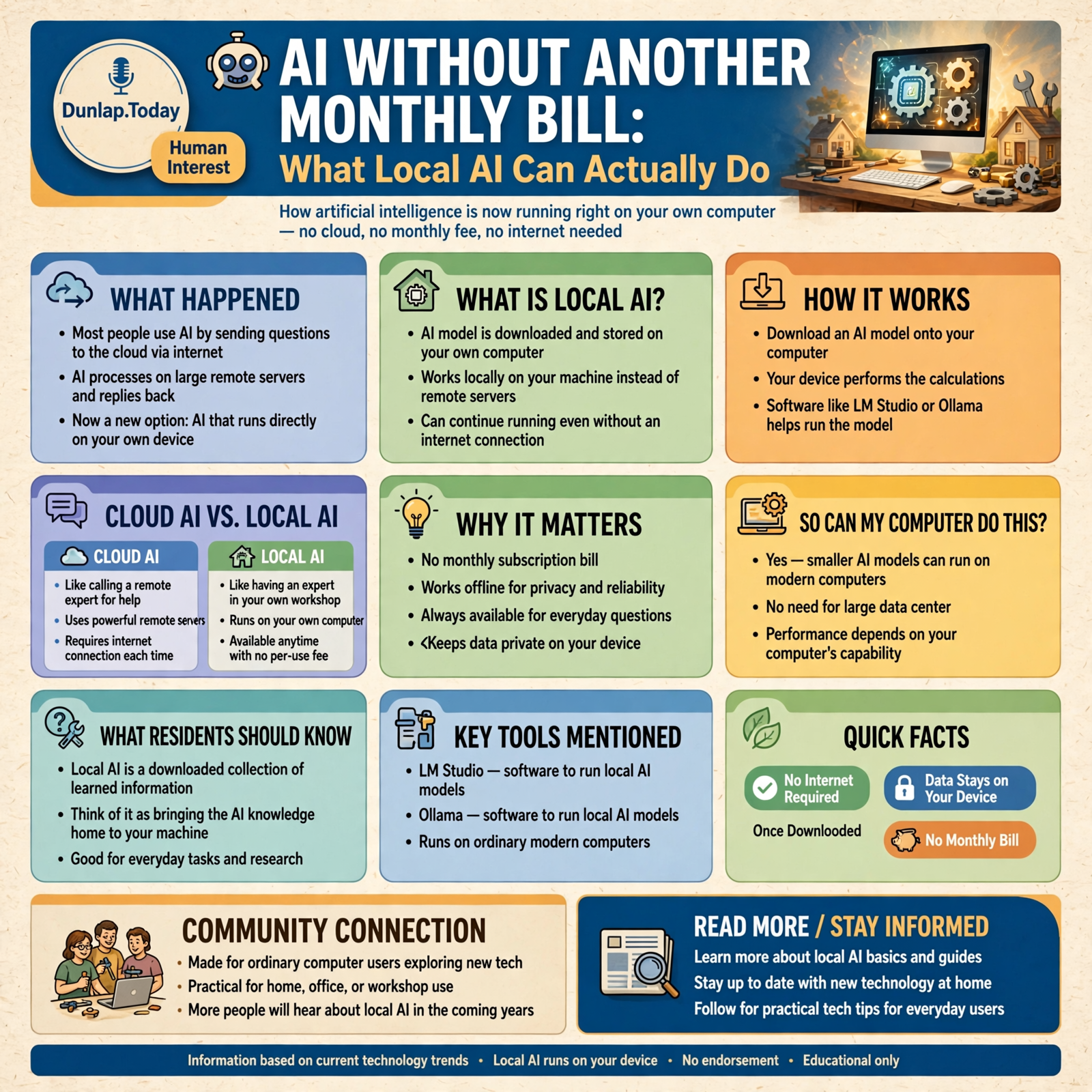
With local AI, you download an AI model onto your own machine and your computer performs the work.
Once everything you need is downloaded, some local AI systems can continue operating even without an Internet connection.
That’s quite a change.
🧠 Wait — You Download the AI?

Pretty much.
Now, before the computer people start throwing tomatoes at me, yes, that’s a tremendous simplification.
But it’s useful.
An AI model is essentially a large collection of learned mathematical information that allows software to recognize patterns and generate responses.
For our purposes, imagine somebody spent years teaching an incredibly fast apprentice about language.
Then instead of sending your questions to the apprentice’s workshop every day, you’re able to bring a copy of that apprentice’s learned knowledge home.
Your computer provides the desk.
The model provides the learned behavior.
Software such as LM Studio or Ollama helps your computer actually run it.
☁️ Cloud AI Is Like Calling an Expert

Let’s use another analogy.
Suppose you’ve got a problem with your tractor.
Cloud AI is like calling the best mechanic in Nashville.
You describe what’s happening.
The information travels to Nashville.
The mechanic thinks about it.
He gives you an answer.
That mechanic may have:
- More tools
- More experience
- Better diagnostic equipment
- More reference material
But every time you need something, you have to call him.
Local AI is more like having a pretty capable mechanic working in the shop behind your house.
Maybe he isn’t the finest mechanic in Tennessee.
Maybe he can’t rebuild a jet engine.
But he’s already there.
He doesn’t charge you every time you ask:
“What size wrench did I need again?”
And you don’t have to describe your tractor to somebody outside the property every time something needs doing.
💻 So Can My Computer Really Do This?

Possibly.
And this is where the answer has changed dramatically in just a few years.
You do not necessarily need a giant corporate data center.
Some smaller AI models can run on ordinary modern computers.
Better computers can generally run larger or faster models.
Computers with powerful graphics hardware can often run them considerably faster.
But don’t get hung up on the hardware vocabulary yet.
Here’s the simple version:
Small AI requires a modest workshop.
Big AI requires a bigger workshop.
If your computer is several years old, has limited memory and takes fifteen minutes to wake up in the morning, local AI may not be its next great calling.
If you have a reasonably modern computer, you may be surprised by what it can do.
🖥️ LM Studio: Local AI for People Who Don’t Want to Become Computer Scientists

One of the applications making this idea easier to understand is called LM Studio.
It gives you something that looks much more like the AI chat experience people already understand.
You can:
- Find downloadable AI models
- Download one to your computer
- Load it
- Open a chat
- Ask it questions
That’s dramatically easier than how local AI worked only a short time ago.
LM Studio currently supports downloadable models from several model families and runs on Windows, macOS and Linux.
Once you’ve downloaded the necessary model, its documentation says core features—including chatting with the model and working with local documents—can operate without an Internet connection.
In other words:
The conversation can stay inside your computer.
🦙 Ollama: Another Road to the Same General Destination
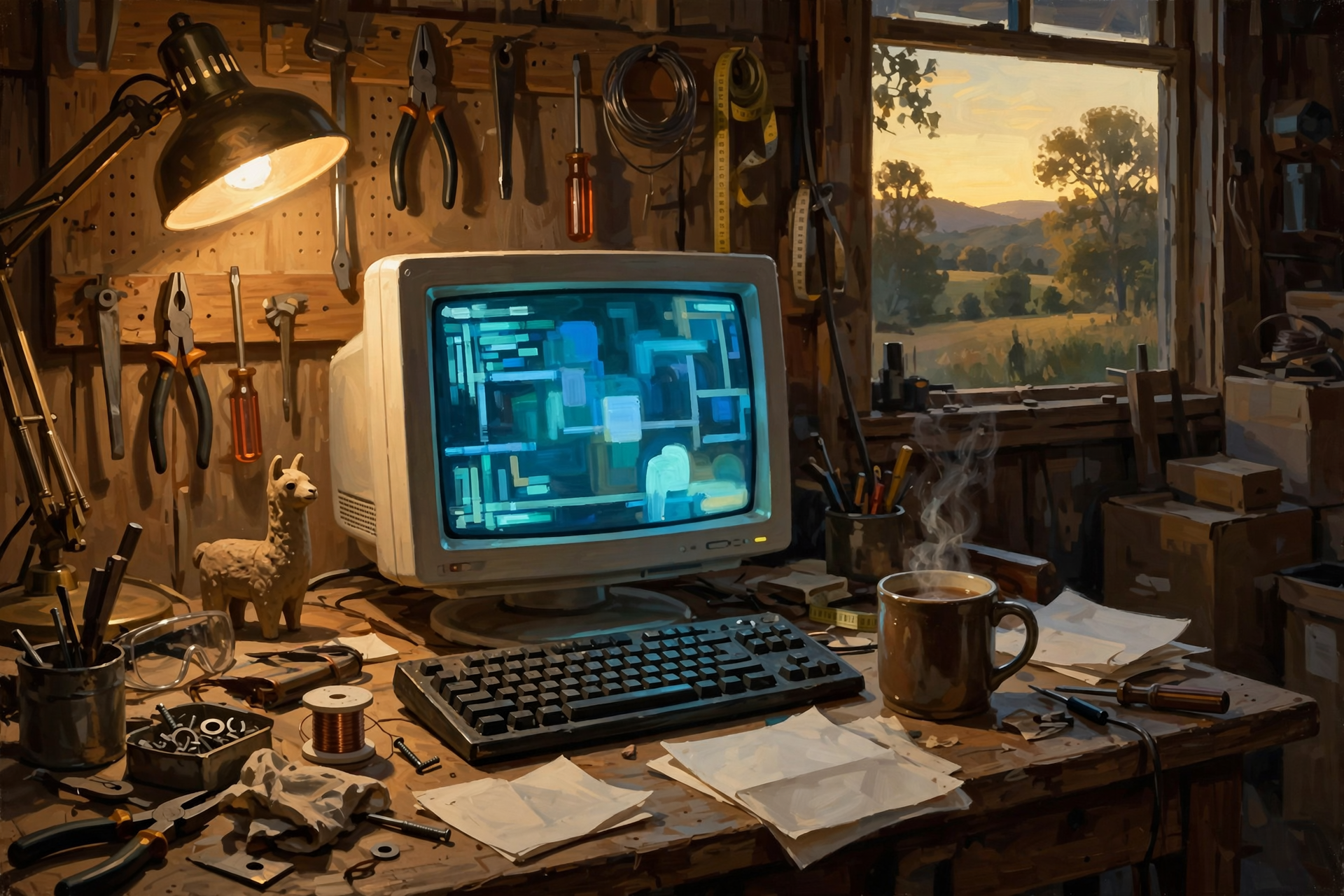
Another name you’ll hear frequently is Ollama.
Ollama also lets people run AI models locally.
Historically it appealed especially to programmers and people comfortable typing commands into a computer terminal, although it continues becoming easier to integrate with other applications.
Think of the difference this way:
LM Studio feels more like walking into the showroom.
Ollama feels more like walking into the machine shop.
Either can be useful.
Which one makes sense depends upon who’s using it and what they’re trying to accomplish.
🔒 The Big Attraction: Privacy

This may eventually become the most important reason businesses investigate local AI.
Suppose you want an AI system to summarize:
- A customer complaint
- An employee handbook
- An internal business report
- A financial spreadsheet
- A private journal
- A family document
- A confidential proposal
With a cloud system, some portion of that information ordinarily has to leave your machine so the remote service can process it.
Reputable AI providers have privacy and security policies, and business plans can offer additional protections.
But sometimes the simplest privacy policy is:
The document never left the computer.
LM Studio, for example, states that once a model is downloaded, local conversations do not leave the device, and documents used with its local document-chat features are processed locally.
That can be very attractive for organizations handling information they’d rather not transmit unnecessarily.
🌐 It Can Even Work Without the Internet

This one feels almost backwards in 2026.
We’re accustomed to modern software becoming nearly useless the moment the Internet disappears.
Local AI can sometimes do the opposite.
Once the application and model are already downloaded, the AI may continue:
- Answering questions
- Writing
- Summarizing
- Working with local documents
- Performing certain classifications
- Helping with programming
even while your Internet connection is down.
You obviously need the Internet initially to download models, updates and new software.
And the AI cannot magically search today’s Internet while disconnected.
But the basic thinking engine can keep running.
For rural areas where Internet service can still occasionally decide to take the afternoon off, that isn’t nothing.
📝 What Can Local AI Actually Do?

Here is where we need to separate reality from science-fiction advertising.
Local AI is already quite good at many ordinary language jobs.
✍️ Drafting
Ask it to create:
- A letter
- An email
- A product description
- A meeting agenda
- A rough social-media post
- A business memo
You still review it.
But it can create the first draft.
📚 Summarizing
Give it a long document and ask:
“Tell me what matters.”
Depending upon the model, software and document size, this can work remarkably well.
🗂️ Sorting and Classification
A business might ask local AI to determine whether something looks like:
- A sales inquiry
- A complaint
- A support request
- Spam
- An invoice
- A purchase order
That may not sound glamorous.
But businesses spend an astonishing amount of human time putting things into piles.
🔎 Extracting Information
You can give AI text and ask:
“Find the company name, phone number, email address and requested service.”
That kind of structured extraction is extremely useful for business automation.
🧹 Cleaning Up Writing
Local models can often:
- Fix grammar
- Shorten writing
- Rewrite awkward sentences
- Change tone
- Turn notes into paragraphs
- Turn paragraphs into bullet points
Again:
Not terribly glamorous.
Extremely useful.
👨💻 Programming Help
Some downloadable AI models are specifically trained or optimized for programming work.
They can help:
- Explain code
- Write small functions
- Find bugs
- Create tests
- Document programs
This has become one of the fastest-moving areas of local AI.
📂 Your Own Documents Become Particularly Interesting

This is where local AI begins to become less of a novelty and more of a tool.
Imagine putting your:
- Employee manual
- Equipment instructions
- Church bylaws
- Business procedures
- Product catalog
- Family records
into a system and then asking ordinary questions about them.
Instead of:
“Where was that paragraph about vacation days?”
you ask:
“How many vacation days does an employee receive after five years?”
The AI can search the relevant material and explain what it finds.
This technique often gets called RAG by computer people.
You don’t need to remember that.
Think:
“Let the AI read my filing cabinet.”
That’s close enough for today.
💵 And Here’s Where the Subscription Question Gets Interesting

Suppose you’re paying $20 every month for an AI service.
That’s $240 a year.
Maybe it’s worth every nickel.
I pay for technology myself when it gives me capabilities I need.
But now ask:
What am I actually using that expensive AI to do?
If your typical request is:
“Please make this email friendlier.”
or:
“Summarize these three paragraphs.”
or:
“Turn these notes into a checklist.”
you may be using the equivalent of a bulldozer to plant tomatoes.
A smaller local AI may handle that work perfectly well.
🚜 Don’t Hire Nashville to Tighten Every Bolt

Remember our mechanic?
If you’ve got a cracked engine block and a problem nobody in the county can diagnose, call the great mechanic in Nashville.
Gladly.
Pay him.
But if you need somebody to:
“Hand me a 9/16 wrench.”
maybe the fellow standing beside you can handle it.
That’s how I think we’re going to use AI increasingly.
Local AI for routine work.
Powerful cloud AI when the task actually warrants it.
That’s not replacing cloud AI.
It’s using each tool intelligently.
🧾 Local Doesn’t Mean Completely Free

Here’s the part where somebody will quite reasonably point out:
“Tom, the computer isn’t free.”
Correct.
Running AI locally consumes:
- Electricity
- Computer memory
- Storage space
- Processor time
- Graphics-processing resources on some machines
And if you purchase a $2,000 computer solely to avoid a $20 monthly subscription, I’m not convinced we’ve discovered the road to financial independence.
Two thousand dollars divided by twenty dollars is a long time.
But if you already own a capable computer, the economics become much more interesting.
Especially if that computer performs many AI jobs every day.
🏢 Businesses Have an Even Bigger Opportunity

Now multiply the idea.
Imagine a business with ten employees.
Does every employee need a premium AI subscription?
Maybe.
But maybe not.
Perhaps:
- Two people need powerful cloud AI
- Three primarily summarize internal documents
- Two classify customer messages
- One extracts information from forms
- Two barely use AI at all
A business could eventually combine:
- Local models
- Cloud AI
- Specialized small models
- Automation
instead of giving everybody the same expensive hammer.
And there’s another possibility.
A sufficiently capable computer can act as a local AI server for other computers on the same network.
LM Studio, for example, currently supports serving a local model over a network so less powerful computers can use the model running on the stronger machine.
Now the conversation gets very interesting for a small office.
🏠 One Good Computer Could Become the Household AI
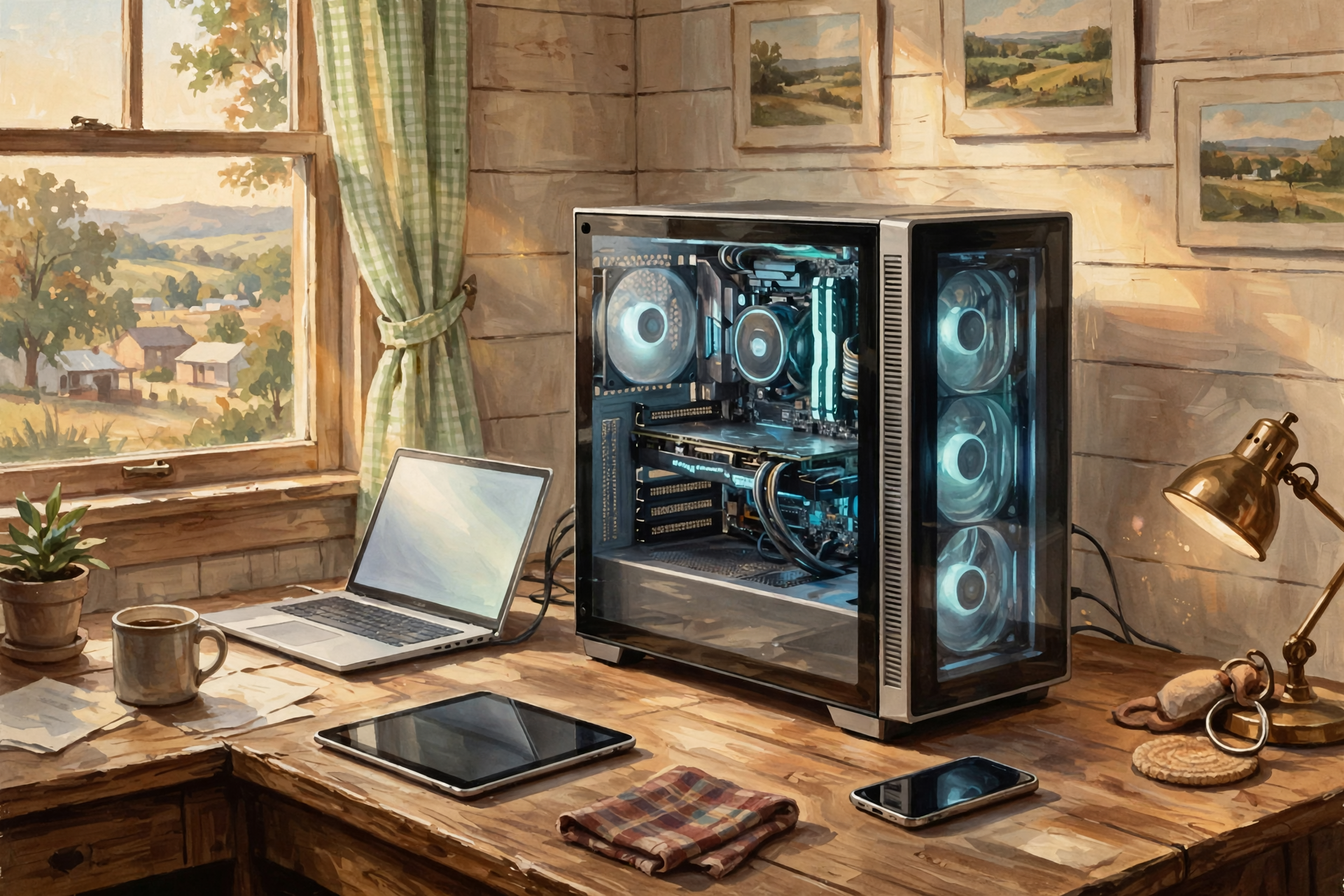
Imagine the same idea at home.
Instead of every laptop needing enough horsepower to run a large model, one stronger computer could potentially do the heavy lifting.
Other devices could connect to it.
Suddenly that powerful desktop in the back room isn’t merely Dad’s ridiculous computer anymore.
It’s infrastructure.
I have been waiting years to find a respectable explanation for owning ridiculous computers.
Local AI may finally be it.
⚠️ Now for the Important Part: Local AI Has Limitations

I don’t want anybody reading this and thinking:
“Well, that’s it. Cancel ChatGPT.”
Not so fast.
Local AI involves tradeoffs.
🧠 Smaller Models Usually Know Less and Reason Less Well
The giant AI systems operated by major cloud providers have access to vastly more computing power than the typical computer sitting under your desk.
A local model may be excellent at rewriting an email but considerably less capable at solving a difficult analytical problem.
📅 It May Not Know What’s Happening Today
A local model typically knows what was in its training information.
Unless you give it Internet-search capabilities or current information, it does not wake up every morning and read the newspaper.
If you ask:
“Who won last night’s game?”
an offline AI has a fairly fundamental problem.
It wasn’t there.
💾 Models Can Be Large
AI model files can consume considerable storage space.
One model might be manageable.
Collecting them can become the digital equivalent of a fellow who owns seventeen socket sets because each one was slightly different.
🐢 It Can Be Slow
Run too large a model on too small a computer and you’ll understand patience at a spiritual level.
The model may work.
You may simply have time to make coffee while it considers the situation.
🛠️ Sometimes You Have to Tinker
Cloud AI companies spend enormous amounts of money making their products simple.
Local AI has improved tremendously, but there can still be:
- Model choices
- Hardware decisions
- Settings
- Updates
- Occasional troubleshooting
We’re getting closer to “install it and go.”
We aren’t always completely there.
🚫 Local AI Is Not Automatically Open Source

This is an important distinction following our last article.
People sometimes use:
local AI
and:
open-source AI
as though they mean exactly the same thing.
They don’t.
A model may allow you to download the files needed to run it locally while still placing various restrictions on how those files can be used.
Different AI models have different licenses.
Some are extremely open.
Some are better described as open-weight models.
Some have commercial-use restrictions or other conditions.
For a household experimenting with AI, this distinction may not matter much.
For a business building a product around a model, it can matter enormously.
Always check the license.
🔐 Local Also Doesn’t Automatically Mean Secure

Here’s another distinction worth making.
If your information stays on your computer, that can provide a meaningful privacy advantage.
But:
Your computer still has to be secure.
If somebody steals the machine…
If malware gets onto it…
If you leave your business server exposed to the Internet…
If everybody in the office has the password…
“Local” won’t magically save you.
Keeping something in your house is more private than leaving it at the courthouse.
Unless you leave your front door standing wide open.
🆚 So Which Is Better: Local AI or Cloud AI?

Neither.
That’s like asking:
“Which is better, a pickup truck or a dump truck?”
Better for what?
Local AI May Be Better When:
- 🔒 Privacy is especially important
- 🌐 Internet access is unreliable
- 💵 You’re doing large amounts of repetitive work
- 📂 You’re processing private local documents
- ⚡ A smaller model is powerful enough for the job
- 🏢 A business wants to operate its own internal AI
- 🛠️ You want greater control over the system
Cloud AI May Be Better When:
- 🧠 You need the strongest reasoning available
- 🌎 You need current Internet information
- 🖼️ You need sophisticated image, video or multimodal abilities
- 💻 Your own computer isn’t powerful enough
- 🛠️ You don’t want to maintain anything
- 👥 You need polished business collaboration features
- 📱 You want seamless access from anywhere
The Smart Answer May Be Both
This is where I think many households and businesses will eventually land.
Not:
local versus cloud.
But:
local plus cloud.
Use local AI for the cheap, repetitive, private jobs.
Use powerful cloud AI for the hard jobs.
In business language that’s called a hybrid strategy.
In Dunlap language I’d call it:
Don’t drive the dump truck to Dollar General for a gallon of milk.
🧮 A Better Way to Think About AI Costs

Instead of asking:
“Do I need an AI subscription?”
try asking:
“Which AI jobs am I actually doing?”
Write them down.
Maybe your list looks like:
- Rewrite emails
- Summarize documents
- Research complicated subjects
- Create images
- Analyze spreadsheets
- Write computer code
- Check current news
Now sort those jobs.
Some may work beautifully on the computer you already own.
Some may justify paying for the smartest cloud model you can get.
And some may not need AI at all.
That’s digital independence.
Not refusing technology.
Understanding which technology belongs where.
👴 Is This Ready for Grandma?

We’re getting there.
If Grandma is comfortable installing software and selecting a model, she may absolutely be able to use local AI today.
But I wouldn’t yet tell every retiree in Sequatchie County:
“Cancel your AI subscription and install a local language model.”
Cloud AI remains easier.
Local AI still asks users to make choices most ordinary people have never encountered.
Which model?
How big?
Will it fit?
Is this the right version?
What license does it have?
That complexity is rapidly disappearing.
And as it does, local AI is going to become much more important.
📈 This Is Where Personal Computing May Become Personal Again

Think about what has happened over the last twenty years.
More and more of our computing moved away from our computers.
Our photographs moved to cloud storage.
Our email moved to web services.
Our documents moved to cloud office systems.
Our music moved to streaming.
Our software moved to subscriptions.
Then artificial intelligence arrived and lived almost entirely in giant remote data centers.
Local AI nudges the pendulum back the other direction.
Not all the way.
And probably not permanently.
But enough to give us something valuable:
A choice.
🏪 What This Could Mean for Small-Town Businesses

I think this is especially worth watching here.
A small manufacturer might eventually have AI that understands its equipment manuals.
A heating-and-air company could classify incoming service requests.
A restaurant could turn notes into draft social-media posts.
A contractor could summarize job documentation.
A retailer could clean product descriptions.
A church could search years of internal documents.
A nonprofit could draft routine communications.
And much of that work might happen:
inside the business.
Without every little request becoming another cloud transaction.
That’s a much bigger story than whether somebody saves twenty bucks a month.
🛠️ You Don’t Need to Become an AI Hobbyist

This is another trap computer people fall into.
We discover something interesting and immediately start collecting it.
There are now thousands upon thousands of downloadable AI models and variations.
You don’t need 173 of them.
You need one that does your job.
Remember the toolbox.
The goal isn’t to own every wrench ever manufactured.
The goal is to have the right wrench when the lawnmower breaks.
✅ A Simple Local-AI Test

If you’re curious about local AI, don’t begin by asking:
“What’s the most powerful model my computer can possibly run?”
Begin with:
“What is one useful job I’d like my computer to do privately?”
Maybe it’s:
- Rewrite an email
- Summarize a document
- Turn meeting notes into tasks
- Organize some text
- Explain something complicated
Try one modest local model.
Give it a real job.
Compare the result with the cloud service you already use.
Then decide.
That’s a far better experiment than downloading half the Internet because somebody on YouTube said one model was “INSANE!!!”
🏁 The Bottom Line

Artificial intelligence no longer necessarily requires sending every question to somebody else’s enormous computer.
Some AI can now run right there on yours.
That creates new possibilities for:
- Privacy
- Offline use
- Cost control
- Business automation
- Personal ownership
- Experimentation
But local AI isn’t magic.
Your computer matters.
The model matters.
The job matters.
And the biggest cloud systems remain extraordinarily useful.
So I’m not suggesting we throw ChatGPT out the window.
I’m suggesting we quit automatically calling Nashville every time somebody needs a wrench.
Let the local mechanic handle what he can.
Call the specialist when you need the specialist.
That may turn out to be one of the most practical ways ordinary people and small businesses use artificial intelligence.
And it fits perfectly with everything we’ve been discussing in this series.
Digital independence isn’t about refusing to use somebody else’s technology.
It’s about knowing when you actually need it.
✅ Local AI: The Quick Checklist

- ☐ Identify a real AI job you perform repeatedly.
- ☐ Determine whether that job requires current Internet information.
- ☐ Ask whether the information involved is private or sensitive.
- ☐ See whether your existing computer can run a suitable local model.
- ☐ Start with a smaller model rather than the biggest one available.
- ☐ Compare its answer with your current cloud AI.
- ☐ Check the model’s license, especially for business use.
- ☐ Remember that downloaded models consume storage space.
- ☐ Protect the computer just as you would any other system containing private information.
- ☐ Keep using cloud AI when it genuinely does the job better.
❓ Frequently Asked Questions

What is local AI?
Local AI generally refers to artificial-intelligence models that run on your own computer or another computer you control instead of requiring every request to be processed by a remote cloud service.
Does local AI require an Internet connection?
Not always. You generally need Internet access to obtain the software, models and updates. Once downloaded, some systems can perform local conversations and document processing completely offline. LM Studio, for example, documents offline operation for downloaded models and local document conversations.
Does local AI cost money?
Some local-AI software and downloadable models can be used without ongoing subscription fees, but local computing is not literally cost-free. You supply the computer, storage, memory, electricity and maintenance. Model licenses also vary.
Do I need an expensive graphics card?
Not necessarily. Smaller models can run on many modern computers. More powerful hardware generally allows larger models to run faster. The appropriate hardware depends heavily on the model and job.
Is local AI as smart as ChatGPT or other cloud AI?
Sometimes for a particular task it may be entirely adequate, but the largest cloud systems generally have access to far more computing resources and may perform substantially better on difficult reasoning, advanced multimodal work and complex tasks.
Is local AI more private?
It can be. If the application genuinely performs inference and document processing locally, your prompts and source files may remain on your machine. However, privacy also depends on the software being used, its settings and the security of your own computer.
Is local AI the same thing as open-source AI?
No. A model that can be downloaded and run locally is not necessarily fully open source. Different models have different licenses and different levels of openness. Businesses in particular should review the license before incorporating a model into products or commercial workflows.
What is LM Studio?
LM Studio is an application that makes it easier to find, download and run compatible AI models on Windows, macOS and Linux. It provides a familiar chat interface as well as features for developers and local networks.
What is Ollama?
Ollama is software for running compatible AI models locally and integrating them with other tools and applications. It is especially popular with developers and automation workflows.
Should I cancel my cloud AI subscription?
Not simply because local AI exists. First identify what you actually use cloud AI for, test whether a local model handles those jobs satisfactorily, and compare convenience, quality, privacy and total cost. Many people may ultimately use both.
💬 Dunlap.Today Question of the Day

If you could have a private AI running inside your own computer, what would you want it to do for you?
Read your documents?
Help with your business?
Write letters?
Organize family records?
Or would you rather let somebody else maintain the machinery and happily keep using AI in the cloud?



0 Comments