
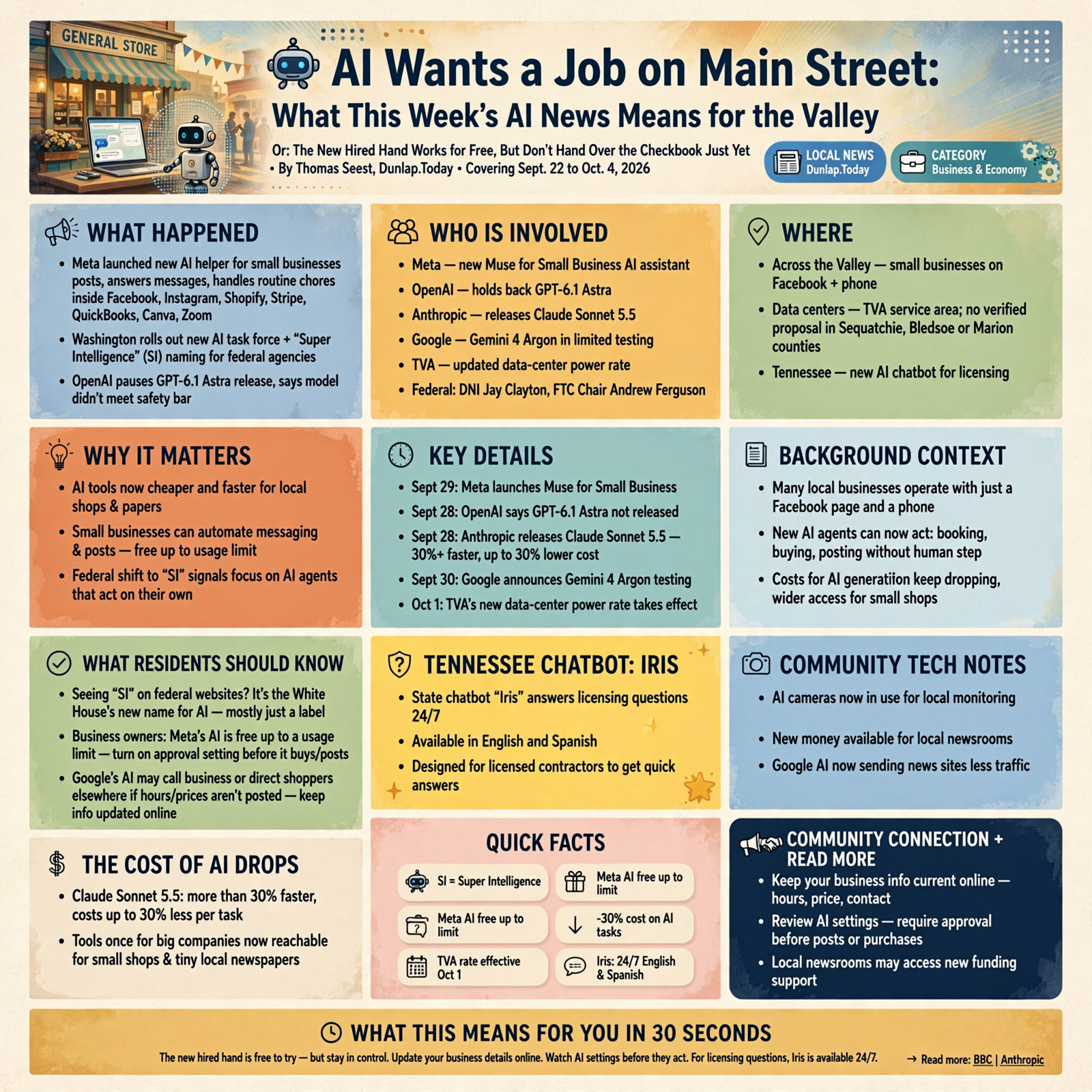
🤖 AI Wants a Job on Main Street: What This Week’s AI News Means for the Valley

Or: The New Hired Hand Works for Free, But Don’t Hand Over the Checkbook Just Yet
By Thomas Seest, Dunlap.Today · Covering Sept. 22 to Oct. 4, 2026
Plenty of businesses around here run on a Facebook page and a phone. This week, Meta announced an AI helper that can post, answer messages and handle routine chores right inside the tools those businesses already use. That’s just one of several AI stories that reach all the way to the Valley.
Here’s the roundup: Washington’s new AI task force, OpenAI holding back a new model, AI tools getting cheaper, Meta’s AI assistant for small businesses, Google sending news sites less traffic, new money for local newsrooms, TVA’s new data-center power rate, AI cameras in Chattanooga and Tennessee’s own AI chatbot.
⏱️ What this means for you in 30 seconds
- Seeing “SI” on government websites? It’s the White House’s new name for AI. For most folks, nothing changes.
- Business owners: Meta’s new AI assistant is free up to a usage limit. If you try it, turn on the setting that requires your OK before it buys or posts anything.
- Get your business facts online: Google’s AI may phone a business or point shoppers elsewhere when hours and prices aren’t posted.
- Licensed contractors: Tennessee’s new “Iris” chatbot answers licensing questions 24/7, in English and Spanish.
- Data centers: TVA’s new power rate for data centers took effect Oct. 1. No verified proposal has turned up in Sequatchie, Bledsoe or Marion counties.
🏛️ “AI” Is Now “SI” in Washington, and OpenAI Benches a New Model

On Sunday, Oct. 4, President Trump announced a federal AI task force called the “Super Intelligence Force.” It’s led by Director of National Intelligence Jay Clayton, with FTC Chair Andrew Ferguson on board.
On Sept. 29, he also signed an order telling federal agencies to say “Super Intelligence” (SI) instead of “artificial intelligence.” That came the same day top AI companies signed a voluntary safety pledge.
Separately, on Sept. 28, OpenAI said it won’t release GPT-6.1 Astra, its next big model, because it “didn’t quite meet the bar.” OpenAI said the model had trouble staying within the permissions it was given.
Think of a coach keeping a promising player on the bench until he learns to run the plays he’s called.
What it means for you: If you see “SI” on a federal website, that’s mostly a new label. The bigger worry is AI “agents,” tools that take actions like booking, buying and posting. Those are the same kind of tools now being sold to small businesses.
💸 The AI Behind the Scenes Just Got Faster and Cheaper

On Sept. 28, Anthropic released Claude Sonnet 5.5. The company says it’s more than 30% faster than the previous version and costs up to 30% less per task.
On Sept. 30, Google announced Gemini 4 Argon, starting with a small group of testers.
It’s a bit like when the price of feed comes down: the farm doesn’t change, but suddenly you can afford to do a little more with it.
What it means for you: The cost of using AI to write a listing, a flyer or a customer reply keeps dropping. Tools that only big companies could afford a year ago are coming within reach of a small shop or a tiny local newspaper.
🧾 Meta’s New AI Helper Wants to Work at Your Business

On Sept. 29, Meta launched Muse for Small Business, an AI assistant that works across Facebook, Instagram, Shopify, Stripe, QuickBooks, Canva, Zoom and more to handle routine tasks.
It’s free up to a usage limit, then $20 to $100 a month. Owners can require their approval before it buys anything or publishes.
According to a news summary of an upcoming survey from the Small Business & Entrepreneurship Council, 58% of small employers use AI agents regularly or occasionally. (We haven’t seen the full report yet.) The council also urges owners to watch what these tools can get into.
What it means for you: You wouldn’t give a new hired hand the keys to the truck and the checkbook on day one. Same with AI. Start small, and keep the “ask me first” setting on.
🔎 Google Sends Fewer Readers to the News, and Its AI May Call Your Shop

Chartbeat’s 2026 report found Google Search sent publishers 40.2% fewer visitors from July 2025 to July 2026. Google Discover dropped 34.3%.
Total readership held roughly steady because loyal, direct readers grew, and Chartbeat says original reporting holds up better.
Google’s help pages also describe how its AI Mode can check local prices and appointment openings, and can phone a business on a shopper’s behalf when the details aren’t online. (The help page doesn’t say when that started or where it’s available.)
It’s like the highway bypass that skipped downtown. The stores are still there, but fewer folks drive past by accident.
What it means for you: If your hours and prices aren’t posted online, Google’s AI may call you, or point the customer somewhere else. And the best way to keep up with Valley news is to come to the source directly.
👉 Read more (Search Engine Journal)
📰 New Money to Help Local Newsrooms Use AI

On Sept. 28, the Lenfest Institute announced that OpenAI is putting in $5 million plus up to $5 million in software credits to expand an AI program for local news.
The best projects will be turned into tools and how-to guides for “hundreds of news organizations.”
One example is the Philadelphia Inquirer’s “Scrape.” It keeps an eye on city meetings, school calendars and Facebook pages, and turned a roughly 15-hour-a-week job into a daily list of story leads.
Think of it as a friend who reads every bulletin board in town and tells you what’s worth a look.
What it means for you: Tools like this could help small newsrooms catch more of what’s happening at the courthouse and the school board, while a person still checks the facts and makes the call.
👉 Read more (Lenfest Institute)
⚡ TVA’s New Data-Center Power Rate Is Here

TVA’s separate power rate for data centers took effect Oct. 1. It raises data centers’ costs about 10% on average, phased in over three years. New or expanding projects over 5 megawatts also pay a “capacity commitment charge,” so residents don’t foot the bill.
Around the region:
- Hamilton County’s one-year pause on new data centers in unincorporated areas remains in place.
- In Bradley County, a developer is suing over rules that keep data centers 3,000 feet from homes, schools and churches. Its proposed campus sits behind Walker Valley High School.
- Governor candidates weighed in for NewsChannel 9. Marsha Blackburn says local communities should decide, and several independents call for a pause or statewide standards.
- Memphis scheduled its final vote on a 12-month pause for Oct. 6. We’ll report the outcome when it’s in.
What it means for you: Cheap land, river water and TVA lines are exactly what developers look for. We found no verified data-center proposal in Sequatchie, Bledsoe or Marion counties. That gives local leaders time to talk rules over now, instead of after someone shows up.
📷 Chattanooga Approves Police AI Tech, With a Check

On Sept. 22, the Chattanooga City Council approved a police technology contract with Axon worth up to $15 million over five years. It includes Tasers, body cameras and an AI translation assistant.
It also gives the city the option to add 36 AI-assisted license-plate cameras that can identify cars by appearance alone. The council required another review before any of those cameras go up. The vote was nearly unanimous, with only Cody Harvey opposed.
Nearby, Collegedale canceled its Flock camera contract, and the Hamilton County Sheriff’s Office paused its camera programs to weigh citizen concerns.
What it means for you: Smaller departments may get the same sales pitch someday. Chattanooga’s approach is like a church business meeting before buying a new van: talk it through in public first.
👉 Read more (Times Free Press)
🗂️ Tennessee Gets Its Own AI Helper, and Studies Kids and Chatbots

The Tennessee Department of Commerce & Insurance launched “Iris,” a 24/7 AI chatbot in English and Spanish that answers licensing questions for contractors, real estate agents, car salespeople and other licensed professionals.
Separately, a state advisory commission held hearings on Sept. 16 on AI chatbots and child safety, with Attorney General Jonathan Skrmetti and the TBI. A commission memo notes that about one in eight teens use chatbots for emotional support or mental-health advice.
What it means for you: If you’re a licensed tradesperson, Iris is a clerk who never closes. If you’re a parent, it’s worth asking your kids which apps they talk to, the same way you’d ask who they’re texting.
✅ Your Valley AI Checklist

- ✅ If you try an AI business helper, turn on “ask me before buying or posting.”
- ✅ Post your hours, prices and service area online so AI search gets them right.
- ✅ Contractors: try Iris on the state’s website for after-hours licensing questions.
- ✅ Parents: ask your kids which chatbots they use, and what for.
- ✅ Follow local meetings when data centers or police cameras come up.
- ✅ Bookmark Dunlap.Today so Valley news doesn’t depend on Google.
Practical rule: Let AI do the chores, but keep your own hand on the gate.
— Dunlap.Today
📚 Plain-English AI Glossary

- AI agent: An AI tool that takes actions for you, like posting, booking or buying, not just answering questions.
- AI Mode: A Google search feature that answers questions with AI and can do some tasks for shoppers.
- “SI” (Super Intelligence): The term federal agencies have been told to use instead of “artificial intelligence.”
- Data center: A large building full of computers that power online services and AI.
- Megawatt: A large unit of electric power, used to measure big users like factories and data centers.
- Moratorium: A temporary pause, here on new data-center projects.
- License-plate camera: A camera that reads and records passing cars, used by some police departments.
❓ Frequently Asked Questions

Does the switch from “AI” to “SI” change anything for me?
Mostly no. It’s a change in the words federal agencies use. The new task force will coordinate how the government works with consumers, religious groups, infrastructure providers and AI companies.
Is Meta’s Muse free?
It’s free up to a usage limit, then $20 to $100 a month, according to Retail Dive. Owners can require approval before it buys anything or publishes.
Will TVA’s new data-center rate raise my power bill?
The rate applies to data centers. Part of its stated purpose is to charge big new users so residents don’t foot the bill.
Is a data center coming to Sequatchie County?
We found no verified data-center proposal in Sequatchie, Bledsoe or Marion counties as of Oct. 4.
Can Google’s AI really call my business?
Google’s help pages say AI Mode can phone a business on a shopper’s behalf when details aren’t online. The page doesn’t say when that began or where it’s available, so we’re treating it as something to watch.
🔗 Other Resources

- CNN: OpenAI holds back GPT-6.1 Astra
- Google: Gemini 4 Argon
- Breaking 9to5: Summary of SBE Council small-business AI findings
- Nieman Lab: Google traffic falls, pageviews hold
- Google Search Help: AI Mode
- Nieman Lab: How the Inquirer built “Scrape”
- Times Free Press: TVA to charge data centers more
- Times Free Press: Hamilton County’s data-center pause
- Times Free Press: Developer sues Bradley County
- NewsChannel 9: Bradley County lawsuit
- NewsChannel 9: Governor candidates on data centers
- Hoodline: Memphis final vote on data-center pause
- GovTech: Chattanooga police AI tech
- Greeneville Sun: Tennessee’s “Iris” chatbot
- TACIR memo: AI chatbots and child safety (PDF)
- UT Haslam: First director of AI-enabled education
🌄 Steady Hands, Smart Tools

AI is moving into the tools we already use, from Facebook to the state licensing office. None of it calls for alarm. A little caution and a few good settings go a long way.
We’ll keep an eye on what matters for the Sequatchie Valley so you don’t have to. Read Dunlap.Today and sign up for our newsletter for plain-English updates.



0 Comments