

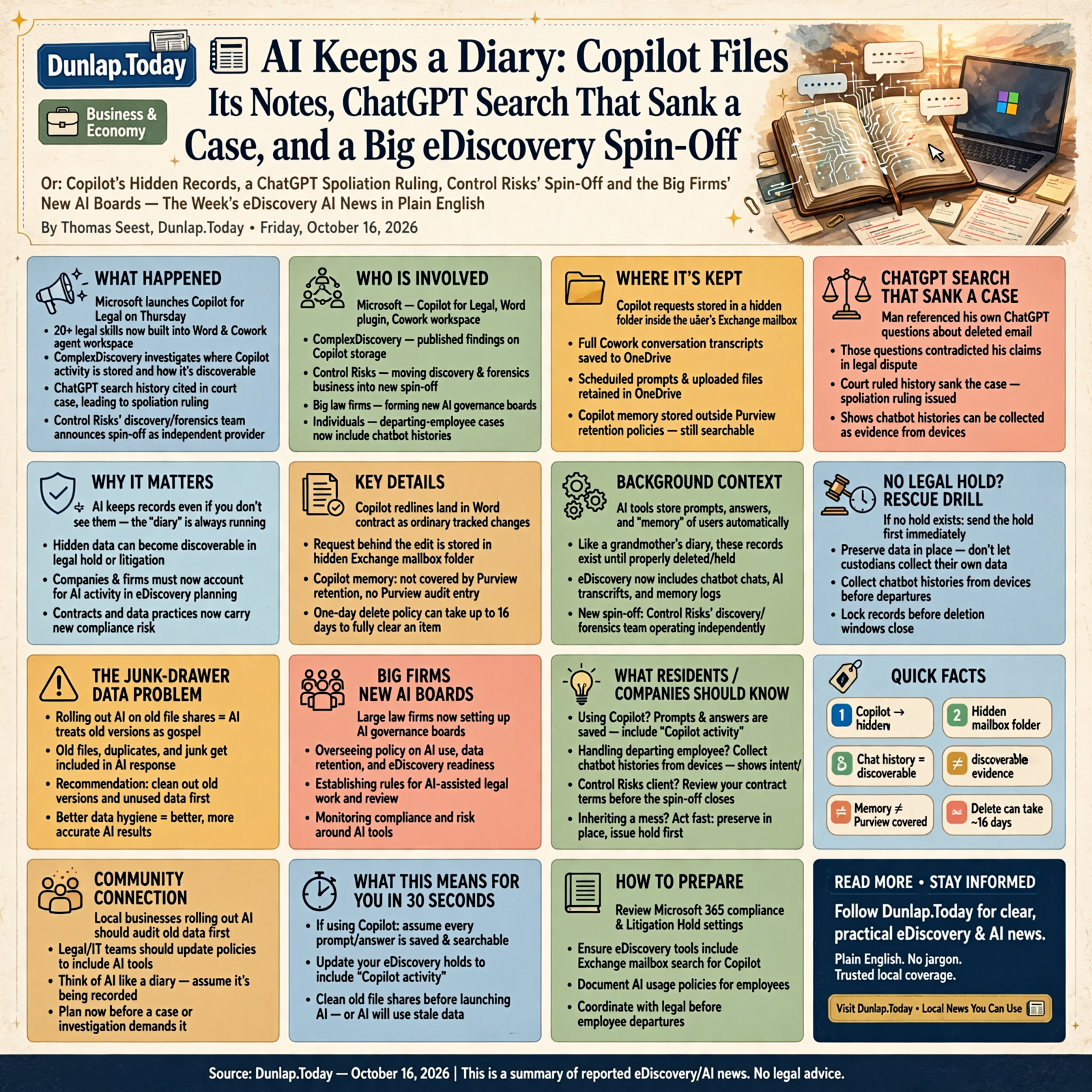
📓 AI Keeps a Diary: Where Copilot Files Its Notes, the ChatGPT Search That Sank a Case, and a Big eDiscovery Spin-Off

Or: Copilot’s Hidden Records, a ChatGPT Spoliation Ruling, Control Risks’ Spin-Off and the Big Firms’ New AI Boards: The Week’s eDiscovery AI News in Plain English
By Thomas Seest, Dunlap.Today · Friday, October 16, 2026
Most families have somebody who keeps a diary. Maybe it was a grandmother with a little notebook in the kitchen drawer, writing down who came to visit, what the weather did and when the cow got out. Nobody paid it much mind, until the day somebody needed to know exactly what happened, and there it was in her handwriting.
AI tools keep a diary too. Every question you type, every answer it gives, and sometimes what it decides to “remember” about you gets written down somewhere. That’s the thread running through today’s eDiscovery news: the AI is taking notes whether you asked it to or not, so the smart move is knowing where the notebook is kept before somebody asks to read it.
Here’s this week’s roundup: where Microsoft’s Copilot for Legal files its notes, a man whose ChatGPT questions about deleted email sank his case, a big eDiscovery provider moving out on its own, a “no legal hold” rescue drill, the junk-drawer data problem, and the big law firms setting up AI boards.
⏱️ What this means for you in 30 seconds
- Using Copilot? Prompts and answers are saved in a hidden mailbox folder that eDiscovery tools can search. Put “Copilot activity” in your hold notices by name.
- Handling a departing-employee case? Collect chatbot histories from devices. They can show what someone meant to do.
- A client of Control Risks’ discovery or forensics team? Review your contract terms before the spin-off closes.
- Rolling out AI on old file shares? Clean out the old versions and junk first, or the AI will treat them all as gospel.
- Inheriting a mess with no hold? Send the hold first, preserve in place, and don’t let custodians collect their own data.
📓 Copilot Keeps Its Notes in a Drawer You Can’t See

On Thursday, Microsoft launched Copilot for Legal, more than 20 legal skills built into Word and into Cowork, its agent workspace. On Friday, ComplexDiscovery did the useful thing and asked where all that work actually ends up.
When a lawyer accepts a Copilot redline, it lands in the contract as an ordinary tracked change. But Microsoft’s own documentation says the request behind that edit goes somewhere else: a hidden folder in the user’s Exchange mailbox. Users and admins can’t browse it directly, but compliance teams can search it with eDiscovery tools, and if the mailbox is under a Litigation Hold or eDiscovery hold, permanent deletion stops. (ComplexDiscovery notes those general pages describe Copilot as a whole and don’t name the new legal skills specifically.)
There’s more. Cowork’s full conversation transcripts, the files it saves to OneDrive, scheduled prompts and uploaded files are all in eDiscovery scope. Copilot memory plays by its own rules: Purview retention policies don’t apply to it and it creates no Purview audit entries, though it can be searched. Microsoft also warns that a chat disappearing from the screen “is not an accurate reflection” of whether it’s still kept, and by its own example, a one-day delete policy can take 16 days to fully clear an item. One more thing worth knowing: the Word plugin is turned on by default for commercial Microsoft 365 Copilot customers.
Think of it like a carbon-copy receipt book. The customer walks off with the top copy, but the yellow copy stays in the book under the counter. Most folks forget it’s there until the tax man asks.
What it means for you: Name “Copilot activity” in hold notices and collection plans, make sure your retention policies cover the location Microsoft calls “Microsoft Copilot Experiences,” and remember that partner plugins like Everlaw and Relativity keep their own records under their own rules.
👉 Read more (ComplexDiscovery) · Microsoft Learn: retention for Copilot and AI apps
🔍 Asking the Chatbot How to Hide the Evidence
Here’s a story that tells you everything about the new diary problem. In a Michigan case, Conlan Tire Co. v. Gonzales, the whole dispute came down to whether a former employee signed a non-solicitation agreement. He said he never did.
Then a forensic examiner looked at his devices. On June 10, 2025, he had asked ChatGPT whether Yahoo could recover an email deleted a year ago, even under a subpoena. He asked how long a permanently deleted email could still be recovered (the answer he got: at most seven days) and whether Yahoo keeps a log of deletions. Judge Shalina D. Kumar called it “compelling evidence of intent to deprive” and awarded fees. It got worse: he’d traded in the phone he swore he still had, and the laptop he handed over wasn’t made until 2024. In March, the court allowed the jury to assume the deleted emails would have hurt him and granted the injunction his former employer wanted.
It’s like asking the hardware store clerk how to pick a lock, on camera, the day before the neighbor’s shed gets broken into.
What it means for you: Chatbot histories belong on the forensic checklist next to browser history and texts, especially in trade-secret and departing-employee cases. Note that the evidence came from his devices, not his email account.
👉 Read more (eDiscovery Today)
🏗️ A Big Discovery Shop Moves Out on Its Own

Control Risks, the global risk consultancy, is spinning off its Discovery + Data Insights and Forensics businesses into a stand-alone company owned by private equity firm Beringer Capital. For now it will be called Control Risks – Compliance, Investigations & eDiscovery. The new CEO is Georges Sabongui, who previously ran CloudNine and was chief commercial officer at X1. Control Risks keeps a “meaningful” stake, the teams across the Americas, Europe and Asia move over, and the deal is expected to close before year-end.
It’s a little like a grown child moving into their own place across the road. Same family, same faces, but now they pay their own light bill and make their own rules.
What it means for you: If you’re a client, now’s the time to read the change-of-control, data location and key-people terms in your contract. Nothing is supposed to change before closing, but new owners usually bring new plans.
🗂️ Clean Out the Junk Drawer Before the AI Reads It

Over at Above the Law, Morae’s Kurt Thies made a point every records manager will appreciate. Firms are full of what the information governance folks call ROT: redundant, obsolete and trivial data. A contract might exist in 15 versions. A lawyer knows to find the signed one. An AI given all 15 may treat every one of them as useful evidence.
The numbers from Morae’s research are humbling: only 26% of legal leaders feel confident their information is ready for AI, and only 37% say they know where all their legal information is stored. Just 33% of senior legal professionals trust AI-assisted results, and 67% worry that checking the AI’s work costs more than it saves. “AI doesn’t inherently know which information is authoritative, current, or appropriate,” Thies said. (Worth knowing: Morae sells information governance services.)
It’s like asking somebody to cook from Grandma’s recipe box when half the cards are crossed out and the other half are for a stove you don’t own anymore.
What it means for you: Defensible cleanup isn’t just about storage bills anymore. It makes AI answers better, and it keeps the AI from surfacing HR files or Social Security numbers to someone who shouldn’t see them.
🚒 When the House Is Already on Fire

ACEDS shared the story of its RelFest session, “Discovery Gone Wrong: Choose Your Own Disaster.” The setup: it’s 4:47 on a Friday, you’ve just inherited a client whose old firm missed a production deadline, and there are 40 custodians, Slack threads, WhatsApp voice notes and Copilot outputs. No legal hold ever went out.
The room voted to send the hold first. Judge Peck, sitting in the audience, said do “as much as possible as soon as possible.” Someone pointed out that IT can often preserve data in place while you plan collections. Letting custodians collect their own data drew what the moderator called a “sea of red” paddles. AI review got the votes, but the panel stressed checking the results, and a search-term hit “does not establish privilege on its own.” On clawbacks, Relativity’s Cristin Traylor put it plainly: “You can’t unring the bell.”
It’s like a kitchen fire. First you turn off the stove, then you figure out who left it on.
What it means for you: Keep a rescue playbook ready: hold notice, preserve-in-place steps, custodian interviews, and a plan for a first rolling production. Copilot outputs belong on the list of sources.
👉 Read more (ACEDS via JD Supra)
🏛️ The Big Firms Are Building AI Front Offices

Two big firms formalized their AI leadership this week. Hogan Lovells Cadwalader named Paul Otto Managing Partner for Legal Technology and AI, created an AI Board to decide whether to build or buy tools, signed agreements with both Harvey and Legora, and started a Commercial Unit for pricing and client delivery. “There is no single AI solution that will meet every need of a modern global law firm,” said CEO Miguel Zaldivar. Morgan Lewis named an AI Leadership Council chaired by Barbara Melby, alongside its AI Studio, AI Lab and AI Works engineering arm.
And from the client side, in-house lawyer Lisa Lang wrote in Above the Law that AI doesn’t make legal work faster so much as different: “Someone has to check the citations.” Her advice to firms is to show clients how they validate AI work. “Speed alone is, quite frankly, dangerous.”
Think of a church potluck that’s grown too big for the fellowship hall. At some point somebody has to make a sign-up sheet.
What it means for you: More AI platforms per firm means more places AI records can live. Providers should be ready to explain to these new boards how review results get checked and what the AI savings look like on the bill.
👉 Read more (Hogan Lovells Cadwalader) · Morgan Lewis · Above the Law (Lisa Lang)
🧰 New Tools on the Workbench

- Court dockets inside your AI assistant. Bloomberg Law and Trellis (state trial courts in 40+ states) brought docket data into Microsoft Copilot, and Docket Navigator launched a connector for Claude covering federal district courts, the PTAB and the ITC. Bloomberg Law · Trellis · Docket Navigator
- InFactIQ Live. An AI “second chair” for depositions and examinations under oath that flags contradictions with the case file while the witness is still testifying. It works with Zoom, Teams, Google Meet and the court reporter’s realtime feed. PRWeb
- CoCounsel Legal goes multinational. Thomson Reuters added a profile covering law from 100+ countries and territories, rolling out this month in the U.S., Europe, the UK, Canada and Australia. TNGlobal
- NetDocuments ndMAX Studio. Six new apps, 45 in all, including a divorce financial disclosure analyzer that hunts for gaps between disclosures and tax records. NetDocuments
- Deloitte + Sirion. A U.S. alliance for AI contract management, which means more AI-extracted contract data to collect when deals go sideways. Deloitte
🧭 Quick Hits for the Desk Drawer

- AI incidents are reaching the boardroom. In IBM’s survey of 3,221 executives in Europe and the Middle East, 80% said an AI incident reached the board or C-suite in the past year. No one role was named accountable for AI agents by more than 17% of respondents. (IBM sells governance software.) ComplexDiscovery · IBM
- Eight states sue OpenAI. Iowa, Kansas, Nebraska, West Virginia, Arkansas, Arizona, Idaho and Montana filed consumer-protection suits over alleged harm to children. Discovery into chat logs will be a big job. NBC News
- Fake citations get expensive. A New York federal judge ordered a lawyer to pay $38,877.59 to opposing counsel for tracking down his AI-invented citations, and a Florida appeals court made both a client and its lawyer liable for fees over a made-up case cited seven times. Flycatcher summary · Kid International summary
- Government lawyers in hot water over an Army AI tool. Four were ordered to explain alleged misstatements about how the “Fast Track” AI was used in a roughly $450 million procurement. Law360 (paywalled)
- From X: Josh Kubicki says Claude “keeps outperforming every other model” in one law firm’s AI working group, including legal tools the firm already pays for. That’s one observer’s take, but it’s a good reminder to test tools on your own work. X post
- Listen in: HaystackID’s Robb Caruso on where cyber and eDiscovery meet, from preservation to agentic AI governance. EDRM Illumination Zone
✅ Your Front-Porch eDiscovery AI Checklist

- ✅ Add “Copilot activity” and other AI app interactions to hold notices and collection templates by name.
- ✅ Check that your retention policies cover “Microsoft Copilot Experiences,” not just older Teams chat policies.
- ✅ Put chatbot histories on the forensic checklist for departing-employee and trade-secret cases.
- ✅ If a provider you use is changing owners, review change-of-control and data-location terms now.
- ✅ Clean out old versions and junk before pointing AI at a file share.
- ✅ Keep a “no hold went out” rescue playbook on the shelf: hold first, preserve in place, no self-collection.
- ✅ Be ready to show clients how AI-assisted work was checked.
Practical rule: If an AI tool touched the work, assume it kept notes, and know where those notes are before anybody asks.
— Dunlap.Today
📚 Plain-English AI Glossary
- Copilot for Legal: Microsoft’s set of legal AI skills built into Word and Cowork.
- Cowork: Microsoft’s agent workspace, where Copilot can handle multi-step, multi-file jobs.
- Legal hold: A notice telling people (and IT) not to delete anything that might matter to a case.
- Preserve in place: Locking data where it already lives, instead of copying it out right away.
- Spoliation: Destroying or losing evidence that should have been kept.
- Adverse inference: When a jury is allowed to assume missing evidence would have hurt the side that lost it.
- ROT data: Redundant, obsolete and trivial files that clutter systems and confuse AI.
- MCP (Model Context Protocol): A standard way to plug outside data sources, like court dockets, into an AI assistant.
- Clawback: Asking the other side to return privileged documents that were produced by mistake.
❓ Frequently Asked Questions

If a Copilot chat disappears from my screen, is it gone?
Not necessarily. Microsoft says what you see in the app “is not an accurate reflection” of whether a message is kept, and holds stop permanent deletion. Check with eDiscovery tools, not by looking at the screen.
Can my ChatGPT history be used against me in court?
It can. In Conlan Tire, a defendant’s ChatGPT questions about deleted emails, found on his devices, helped prove he meant to destroy evidence. Treat chatbot history like any other record.
Does the Control Risks spin-off change anything for clients right now?
Control Risks says the businesses operate as usual until closing, which is expected before year-end. It’s still smart to review your contract terms now.
Why does old, messy data matter to AI?
AI doesn’t know which version is the final one. If it sees 15 drafts, it may treat each as true, and it may surface sensitive files to people who shouldn’t see them.
🔗 Other Resources

- Microsoft Learn: Learn about retention for Copilot and AI apps
- Unite.AI: Harvey on Hogan Lovells Cadwalader’s custom agents
- Artificial Lawyer: Friday wrap
- Flycatcher v. Ozmos fee opinion (CourtListener)
- Iowa Attorney General’s petition against OpenAI
🌄 No Need to Worry, Just Stay in the Know

None of this means you have to be afraid of AI tools. They can save real time, and a good record is often your best friend in a dispute. It just means remembering that the AI keeps a diary, the way Grandma did, and making sure you know which drawer it’s in.
We’ll keep watching what matters for eDiscovery providers and their clients. Read Dunlap.Today and sign up for our newsletter for plain-English updates.
Know about an upcoming event or story in the Sequatchie Valley? Submit it here.


0 Comments