

🚧 AI Guardrails: Because “Don’t Do Anything Stupid” Is Not a Complete Safety Policy

Or: Why Artificial Intelligence Needs Rules More Specific Than the Ones We Gave Teenagers Before They Left the House
There are certain instructions adults have been giving young people since approximately the beginning of civilization.
“Behave yourself.”
“Don’t do anything stupid.”
“Use your head.”
“Be home before dark.”
“And whatever you do, don’t make me come looking for you.”
These instructions have one important feature in common.
They sound perfectly reasonable to the person giving them.
They are considerably less useful to the person receiving them.
Exactly how stupid is “stupid”?
Does “before dark” mean sunset?
When the streetlights come on?
When you can no longer distinguish a possum from a mailbox?
And what exactly qualifies as behaving yourself?
Parents eventually learn that general wisdom is not always enough.
Sometimes you need rules.
Specific rules.
You may go here.
You may not go there.
You may spend this much.
You may not take the truck.
You must call if plans change.
You must ask before inviting six additional teenagers into the house.
Artificial intelligence is discovering the same principle.
Engineers call these rules guardrails.
Grandparents called them:
“Here’s what you’re not going to do.”
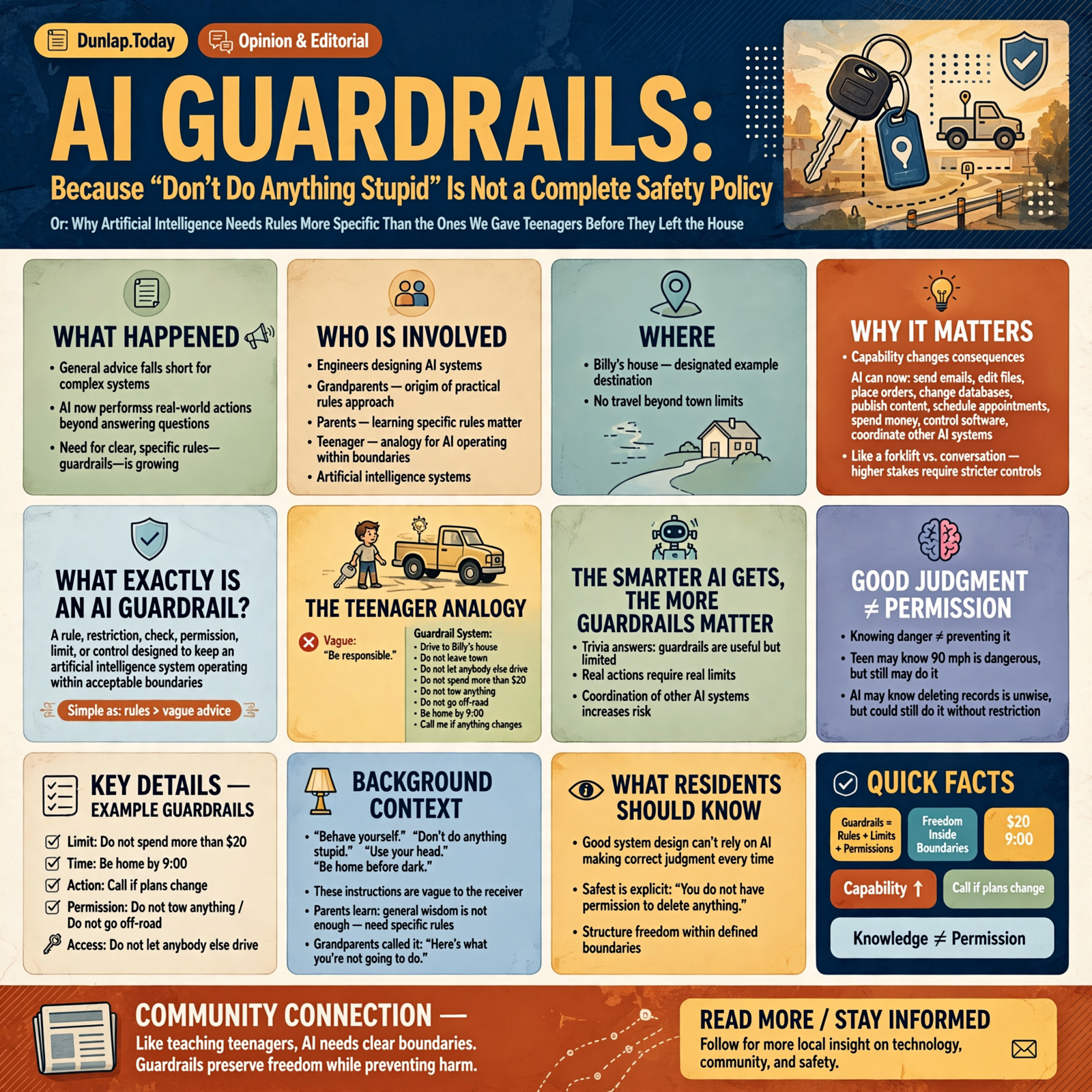
🚧 What Exactly Is an AI Guardrail?

An AI guardrail is a rule, restriction, check, permission, limit, or control designed to keep an artificial intelligence system operating within acceptable boundaries.
That sounds complicated.
It is not.
Imagine handing a teenager the keys to the family truck.
You could say:
“Be responsible.”
Or you could say:
- Drive to Billy’s house.
- Do not leave town.
- Do not let anybody else drive.
- Do not spend more than $20.
- Do not tow anything.
- Do not go off-road.
- Be home by 9:00.
- Call me if anything changes.
The second version is a guardrail system.
The teenager still has freedom.
But it is freedom inside defined boundaries.
That is exactly what modern AI systems increasingly need.
🤖 The Smarter AI Gets, the More Guardrails Matter

If artificial intelligence merely answers trivia questions, guardrails are useful but limited.
If artificial intelligence can:
- send emails,
- edit files,
- place orders,
- change databases,
- publish content,
- schedule appointments,
- spend money,
- control software,
- or coordinate other AI systems,
then guardrails become considerably more important.
This is the difference between:
“Billy said something foolish.”
and
“Billy said something foolish while operating a forklift.”
Capability changes the consequences.
The more an AI system can do, the more carefully we must define what it may do.
🚗 Good Judgment Is Not a Permission System

One common mistake is assuming that a sufficiently intelligent AI will simply “know better.”
Parents have tested this theory extensively.
Results have been mixed.
A teenager may fully understand that driving ninety miles per hour is dangerous.
This does not necessarily prevent ninety miles per hour.
Knowledge and permission are different things.
An AI system may know that deleting all your customer records would be unwise.
That does not mean it should possess unrestricted permission to delete them.
This distinction is important.
Good system design should not depend entirely on the AI making the correct judgment every single time.
Sometimes the safest instruction is not:
“Please don’t delete anything important.”
It is:
“You do not have permission to delete anything.”
That is a guardrail.
🔐 Least Privilege: Give the Whippersnapper Only the Keys He Needs

Computer security has a principle called least privilege.
It means a person or system should receive only the access necessary to perform its job.
This is one of those ideas technologists gave a fancy name to after grandparents had already understood it for generations.
Suppose your teenage son needs to mow the lawn.
He requires access to:
- the mower,
- the gasoline,
- perhaps the shed.
He does not require:
- the deed to the house,
- Grandpa’s shotgun cabinet,
- the business checking account,
- the tractor-trailer,
- or the safe combination.
His task is mowing the yard.
Give him what he needs to mow the yard.
AI should work the same way.
If an AI agent needs to read customer records, perhaps it receives read access.
That does not automatically mean it should receive:
- delete access,
- bank access,
- administrator access,
- password access,
- or permission to publish something publicly.
Least privilege is simply:
“You can use this key. You’re not getting the whole key ring.”
💳 Spending Limits: Because AI May Discover Your Credit Card

Autonomous AI systems can increasingly interact with paid services.
They may call outside computer systems.
Rent cloud resources.
Purchase advertising.
Order products.
Hire digital services.
Or run thousands of operations that each cost a little money.
This creates a wonderfully modern problem.
You may wake up one morning and discover that your AI solved a $50 problem with a $4,700 solution.
Parents recognize the pattern.
Give a teenager twenty dollars and ask him to buy lunch.
He returns with:
- two cheeseburgers,
- a milkshake,
- a fishing lure,
- a phone charger,
- and $1.37.
He will explain that every purchase made sense individually.
This is why AI guardrails can include:
- per-transaction limits,
- daily limits,
- monthly budgets,
- approval thresholds,
- allowed vendors,
- and automatic shutdown when costs become unusual.
A budget is a guardrail with dollar signs.
🛑 Some Things Should Always Require Permission

There are tasks an AI may perform automatically.
There are others where asking first is wiser.
For example, an AI assistant might reasonably:
- draft an email,
- organize files,
- summarize documents,
- research a topic,
- prepare a proposed schedule.
But perhaps it should ask before:
- sending an email to 10,000 customers,
- deleting financial records,
- signing a contract,
- publishing a statement publicly,
- moving money,
- firing an employee,
- or ordering a truckload of anything.
This is often called a human approval step.
Families have another phrase for it:
“You’d better ask me first.”
📋 Policies Are Guardrails Written Down

Businesses already use guardrails every day.
They simply do not call them that.
An employee handbook is full of guardrails.
So is an accounting policy.
So is a purchasing policy.
So is a safety manual.
So are the handwritten instructions taped beside the shop compressor saying:
“DO NOT TOUCH THIS VALVE.”
AI guardrails can be built from the same logic.
A business may define rules such as:
- Never disclose customer information to unauthorized parties.
- Never issue a refund above $250 without approval.
- Never publish a social media post containing unverified claims.
- Never delete original records.
- Never change pricing without approval.
- Never contact customers after 9:00 PM.
- Never use an unapproved vendor.
The AI does not need to guess what “responsible” means.
The business has defined it.
🪜 Guardrails Can Have Layers

Good guardrails are often layered.
One rule catches what another misses.
Consider a teenager heading out for the evening.
There may be several layers:
- Parents establish where he may go.
- The car has a speedometer.
- The road has speed-limit signs.
- The highway has guardrails.
- The police enforce traffic laws.
- The teenager knows Dad is still awake.
No single mechanism controls everything.
Together they create a safer system.
AI can use layers too.
For example:
- the prompt contains instructions,
- the application limits available tools,
- the database limits permissions,
- the payment system enforces spending caps,
- another AI reviews sensitive output,
- a human approves high-impact actions,
- and logs record what happened.
This is sometimes called defense in depth.
Grandpa called it:
“I told you no, your mother told you no, and I hid the keys.”
🧠 A Prompt Is Not Always Enough

Here is an important distinction.
You can tell an AI:
“Never spend more than $100.”
That is useful.
But an even stronger system also configures the payment mechanism so the AI physically cannot spend more than $100.
Why?
Because instructions can be misunderstood.
Software permissions are harder to misunderstand.
Think about telling a child:
“Do not eat the cake before dinner.”
That is a prompt.
Putting the cake in a locked refrigerator is a system-level guardrail.
The second has certain reliability advantages.
For important limits, the strongest guardrails often exist outside the AI itself.
🧱 Hard Guardrails and Soft Guardrails

It can be useful to think of guardrails in two broad categories.
Soft guardrails are instructions and guidance.
Examples:
- “Be polite.”
- “Avoid making unsupported claims.”
- “Prefer the least expensive reasonable option.”
- “Ask for clarification when uncertain.”
Hard guardrails are limits the system cannot simply talk its way around.
Examples:
- no delete permission,
- a $500 transaction limit,
- access only to one folder,
- certain websites blocked,
- approval required before publishing.
This is the difference between:
“Please stay out of Grandpa’s workshop.”
and
Grandpa locking the workshop.
Both may be useful.
One is more dependable.
🚨 Guardrails Should Know When Something Looks Strange

Good systems do not merely enforce fixed rules.
They can also notice unusual behavior.
Suppose an AI normally spends $3 per day using outside services.
Today it spends $47 by breakfast.
Perhaps something has changed.
Perhaps it entered a loop.
Perhaps a task is unusually difficult.
Perhaps somebody configured it incorrectly.
A good guardrail might stop the process and ask for help.
Parents use the same instinct.
If your teenager normally walks quietly through the front door and tonight you hear:
BANG.
Then:
CRASH.
Then:
“Everything’s fine!”
You do not continue watching television.
You investigate.
“Everything’s fine” is frequently the most reliable alarm system ever invented.
🔄 Good Guardrails Should Fail Safely

Suppose an AI encounters something unexpected.
What should happen?
A badly designed system may improvise.
A better system may stop.
That principle is often called fail-safe behavior.
If the system does not know whether it is authorized to perform an important action, the safer default may be:
Do nothing and ask.
This is wisdom adults try desperately to teach teenagers.
If you do not know whether Dad wants you operating the backhoe…
the answer is not:
“He never specifically said I couldn’t.”
The answer is:
“I should probably ask.”
This rule alone could prevent a remarkable amount of damage in both artificial intelligence and adolescence.
🧪 Testing the Guardrails Matters Too

There is an old problem with rules.
Rules frequently work perfectly until somebody discovers the thing nobody thought about.
You tell the teenager:
“Do not take the truck out of town.”
Later you discover he drove it through three fields, down an abandoned logging road, and across the creek.
He never left town.
Technically.
This is why guardrails must be tested.
Developers deliberately try:
- unexpected instructions,
- conflicting instructions,
- ambiguous requests,
- strange data,
- malicious inputs,
- and unusual combinations of actions.
The purpose is to discover where the rules break before the real world discovers it.
Parents call this:
“Trying to think like that boy.”
🧾 Guardrails Need an Audit Trail

Suppose something does go wrong.
You need to know:
- what the AI was asked to do,
- what information it saw,
- what decision it made,
- which tool it used,
- what action occurred,
- and which guardrails were triggered.
This is why logs and audit trails matter.
Without them, the conversation becomes familiar:
“Who did this?”
“Wasn’t me.”
“Who changed this?”
“I don’t know.”
“Why is there a wheelbarrow on the roof?”
“That’s weird.”
Businesses should not manage autonomous AI systems using the investigative methods of a household containing four teenage boys.
Keep records.
🏪 Small Businesses May Need Guardrails More Than Big Ones

Large companies can afford departments.
Legal departments.
Compliance departments.
Security departments.
IT departments.
Accounting departments.
The average small business may have:
Sharon.
Sharon handles invoices, answers the phone, remembers everybody’s birthday, orders office supplies, knows which customer is angry, and is the only person who understands the printer.
AI agents may become enormously useful to small businesses because they can automate work that previously required additional employees.
But that also means small businesses need simple, understandable controls.
The AI should know:
- what it may spend,
- what it may publish,
- who it may contact,
- what data it may access,
- what requires approval,
- and when it should stop.
That does not require an army of consultants.
It requires clear rules.
🏡 The Best Guardrails May Become Almost Invisible

Most people do not think about the guardrails already surrounding them every day.
Your debit card has limits.
Your bank watches unusual transactions.
Your phone asks permission before applications use the camera.
Your computer restricts certain files.
Your car warns when you leave your lane.
Your thermostat refuses to heat the house to 400 degrees.
Good guardrails quietly prevent bad outcomes without requiring constant attention.
AI will likely evolve the same way.
Eventually, we may barely notice the layers of permissions, approvals, spending limits, monitoring, verification, and logging operating underneath everyday AI assistants.
We will simply notice that the technology behaves more predictably.
Which is approximately the goal of parenting as well.
🐓 Wisdom From the Front Porch

Artificial intelligence guardrails can sound like another complicated technological subject.
But the basic philosophy is remarkably familiar.
Trust does not mean unlimited access.
Intelligence does not eliminate rules.
Good intentions do not replace permissions.
And “use good judgment” is not a complete operating manual.
We have spent generations teaching young people how to gradually handle greater responsibility.
First the bicycle.
Then the lawn mower.
Then the car.
Then the credit card.
Hopefully not all on the same afternoon.
Artificial intelligence deserves the same gradual approach.
Give it useful responsibilities.
Give it clear boundaries.
Give it only the tools it needs.
Make important actions require approval.
Keep a record of what it does.
And when it encounters something unexpected, teach it perhaps the most valuable sentence any teenager ever learned:
“I better ask first.”
Because the goal of guardrails is not to make artificial intelligence useless.
The goal is to let it become extremely useful without waking up one morning to discover that it has somehow purchased a bass boat.
And if your AI ever explains:
“You never specifically told me I couldn’t buy a bass boat…”
then your guardrails need work.
— Dunlap.Today
📚 Plain-English AI Glossary

🚧 Guardrail: A rule, permission, limit, or control designed to keep an AI system operating within acceptable boundaries.
🔐 Least Privilege: Giving an AI only the access and permissions necessary for its assigned job.
🧑 Human Approval: Requiring a person to authorize an important action before the AI performs it.
🧱 Hard Guardrail: A technical limit the AI cannot simply ignore, such as a spending cap or lack of permission to delete files.
📝 Soft Guardrail: An instruction or policy guiding how the AI should behave.
🚨 Anomaly Detection: Watching for behavior that differs substantially from what is normal or expected.
🛑 Fail-Safe: Designing a system so that when something goes wrong or becomes uncertain, it moves toward a safer state rather than improvising.
🪜 Defense in Depth: Using several layers of protection rather than relying on a single safeguard.
🧾 Audit Trail: A record showing what the AI did, what tools it used, and what decisions or approvals were involved.
🧪 Guardrail Testing: Deliberately trying unusual, confusing, or problematic situations to find weaknesses before they cause real trouble.
❓ Frequently Asked Questions

Are AI guardrails the same thing as censorship?
No. Guardrails are a broad engineering concept. They can include security permissions, spending limits, privacy rules, approval requirements, operational boundaries, safety controls, and many other mechanisms. Their purpose depends on the system being built.
Can an AI ignore its guardrails?
It depends on the type. An instruction written into a prompt may sometimes be misunderstood or overridden by conflicting instructions. A system-level permission—such as denying access to a database—is much stronger because the AI cannot simply choose to bypass it.
Why not simply give the AI full access if it is intelligent?
Because mistakes, misunderstandings, software failures, unusual inputs, and security problems remain possible. Restricting unnecessary access limits the consequences when something goes wrong.
What kinds of actions should require human approval?
That depends on the organization, but actions involving significant money, deletion of important records, public communication, contracts, sensitive information, legal commitments, or major operational changes are common candidates.
Can small businesses use AI guardrails?
Yes. Many useful guardrails are straightforward: spending caps, read-only permissions, restricted folders, approved contact lists, publication approval, activity logs, and requirements to ask before sensitive actions.
Will guardrails prevent every AI mistake?
No. Guardrails reduce risk and limit consequences. Effective systems usually combine several layers of controls, testing, monitoring, and human oversight rather than assuming any single safeguard is perfect.
✅ The Front-Porch AI Guardrail Checklist

Before giving an AI agent more independence, ask:
- ✅ What exactly is this AI allowed to do?
- ✅ What is it specifically forbidden from doing?
- ✅ Does it have only the access required for its job?
- ✅ Can it spend money?
- ✅ What is the spending limit?
- ✅ Can it send messages without approval?
- ✅ Can it publish publicly?
- ✅ Can it delete or permanently change records?
- ✅ Which actions require human approval?
- ✅ What happens when the AI is uncertain?
- ✅ Does unusual behavior automatically trigger a warning or stop?
- ✅ Are important actions logged?
- ✅ Have the rules been tested against unusual situations?
- ✅ Can mistakes be reversed?
The simplest rule may still be the best one:
If an AI has enough power to create a serious problem, it should also have enough guardrails to prevent one.
Or, as Grandpa might put it:
“You can use the mower. You’re not getting the bulldozer.”



0 Comments