
📡 A Router Bug Found With AI, a Voice Fight, and a Map of Who's Watching
Or: Your Router Might Be the Bug, Your Voice Might Not Be Yours, and Now Your Map Shows the Cameras
By Thomas Seest, Dunlap.Today · Sunday, October 18, 2026
When most folks picture a “bug,” they picture something tiny taped under a desk.
This week’s news is a reminder that the box blinking on your shelf—the one the internet company gave you—can be a bug, too. And AI is helping people find those weak spots faster than ever, for better and for worse.
Here’s the roundup for folks who buy bug sweeps and the private investigators who do the work: a router flaw found with AI’s help, a fight over whose voice is whose, a map of the cameras watching the road, camera glasses headed to court, and gadgets that can be turned against you.
⏱️ What this means for you in 30 seconds
- Still using the router password that came on the sticker? Change it today, and ask your internet company about firmware updates.
- Got a call in a voice you know asking for money? Hang up and call back on the number you already have.
- Wondering where plate cameras are? MapQuest now shows many of them—but not all.
- Own a cheap home camera? Update it. Some can be taken over by anyone on your Wi-Fi.
- Found a tracker that never beeped? Some have been silenced on purpose. Call a pro.
📡 The Router That Can Be Taken Over From Across the Street
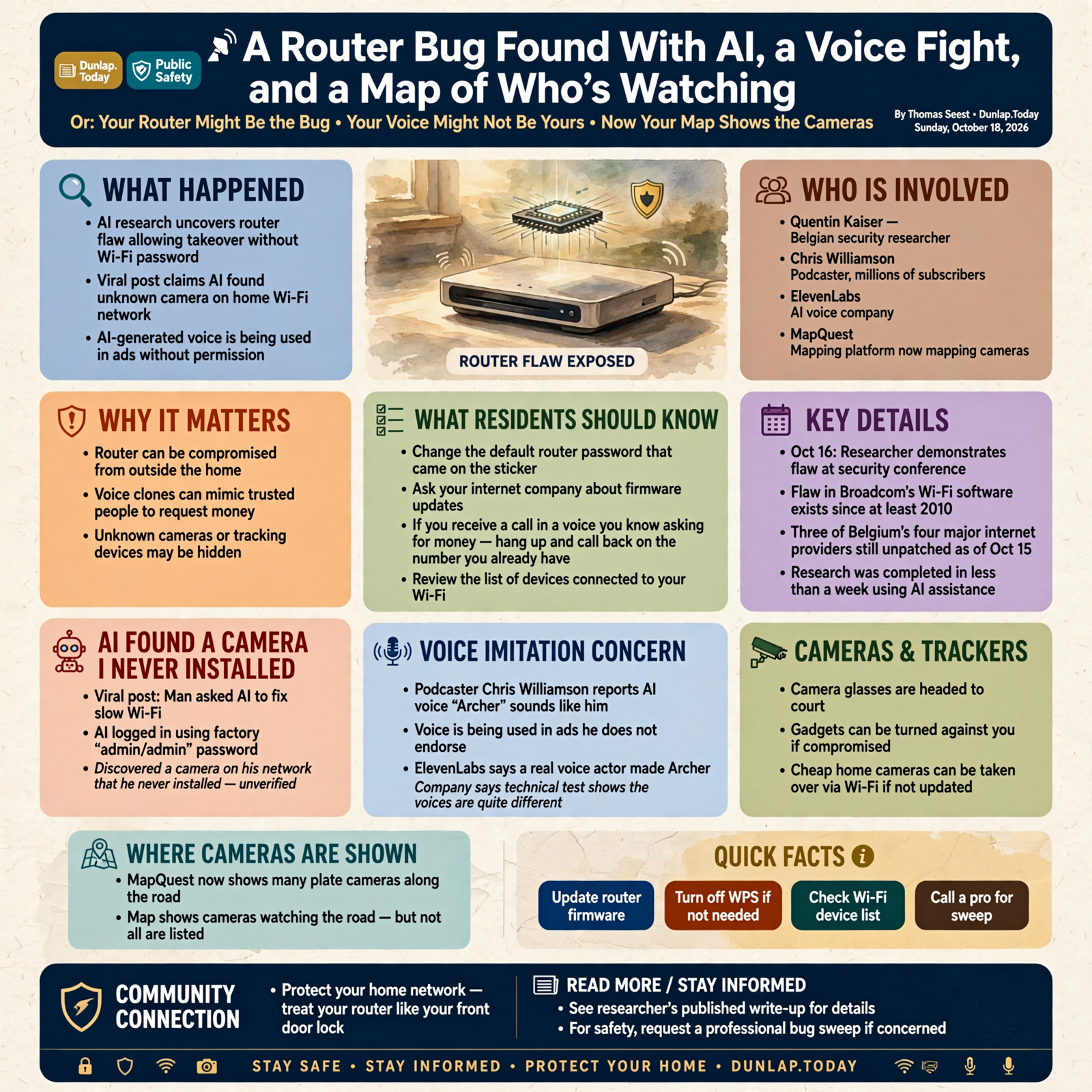
A Belgian security researcher, Quentin Kaiser, showed a conference in Paris on Oct. 16 how a flaw in Broadcom’s Wi-Fi software—around since at least 2010—lets someone take control of certain internet-company routers over the air, without knowing the Wi-Fi password. In one demo, he pulled the password right out of the router and joined the network.
He says he tested routers from three of Belgium’s four big internet providers, and none had been fixed as of Oct. 15. The part that caught our eye: he wrote that with AI’s help, the research took him “less than a week” instead of months.
It’s like finding out the lock on your back door has a known trick to it—and that the trick has been written down since your kids were in diapers.
What it means for you: If you’re paying for a sweep, ask whether the router is part of it. Change default passwords, turn off WPS if you don’t use it, and ask your internet company when your box last got an update.
🤖 “My AI Found a Camera I Never Installed”

A post on X that drew hundreds of thousands of views Sunday claims a man asked an AI assistant to fix his slow Wi-Fi. He says it logged into his router—using the factory “admin/admin” password he’d never changed—and listed a camera on his network that he never put there.
Nobody has confirmed the story, and folks in the replies had plenty of questions. But it shows where things are headed: regular people are pointing AI helpers at their own homes to look for snoops.
What it means for you: A list of what’s connected to your Wi-Fi is a smart first look. But many hidden cameras just record to a memory card and never join Wi-Fi at all. If you’re really worried, a physical sweep is still the answer.
🎙️ Whose Voice Is It, Anyway?

Podcaster Chris Williamson, whose show has millions of subscribers, says an AI voice called “Archer” from the company ElevenLabs sounds just like him—accent and all—and is being used in ads he doesn’t endorse. The company says a real voice actor made Archer and that its technical test shows the voices are quite different. “I can’t prove that my voice is mine,” Williamson said. “What chance do other people have?”
In Brazil, police arrested eight people at a house they say ran a scam call center that used AI to pose as a famous TV host and talk victims into sharing their phone screens. And India’s biggest bank, SBI, warned its customers flat out: “Scammers can now clone voices to trick you!”
It’s like the old party line. Back then, you never quite knew who else was listening. Now you can’t be sure who’s talking.
What it means for you: Set up a family code word. Never share your screen with someone who called you. And if a voice you love asks for money, call them back on their real number.
👉 Williamson vs. ElevenLabs · Brazil AI TV-host scam · SBI warning
🚘 A Map of the Cameras Watching the Road

MapQuest added a “Surveillance Layer” to its phone app that shows known license-plate cameras from Flock and other companies as little eyeball icons. The locations come from volunteers, so cameras nobody has reported won’t show up.
In Congress, Rep. Pat Harrigan of North Carolina introduced a bill that would require warrants for most plate-camera searches, delete records within 24 hours, block searches based on political or religious bumper stickers, and stop companies from using plate data to train AI. Tempe, Arizona, voted to ban city plate cameras outright. League City, Texas, will take its Flock cameras down if voters say no on Nov. 3.
What it means for you: If you’re counting on plate-camera footage for a case, find out who owns the camera—city, store, or HOA—and ask quickly. The rules are changing town by town.
👉 MapQuest camera map · Harrigan bill · Tempe ban
👓 Camera Glasses Headed to Court

A Dutch consumer group, the Consumentenbond, has taken Meta to court over its Ray-Ban camera glasses. It says the little recording light isn’t easy enough for bystanders to see and can be covered up, and it wants the glasses changed to meet privacy law. Only if Meta says that can’t be done does the group ask for a sales ban—with an exception for people who need the glasses for medical reasons, like blind users. A hearing is set for Nov. 26.
What it means for you: You don’t need to wait for a judge. If you hold private meetings—at a law office, clinic, or church board—it’s fair to ask folks to take camera glasses off at the door.
🔇 Silenced Trackers and Hackable Cameras
A company called Elevation Lab pulled a tool that permanently silenced an AirTag’s speaker. It said the product was meant for bike owners but admitted it could help “someone with bad intentions” track a person who wouldn’t get a phone alert—and said it will use its patent to keep others from making one.
TP-Link also put out updates for two popular Tapo home cameras after researchers showed that someone on your Wi-Fi could take them over completely and use them to attack other gadgets in the house.
It’s like a guard dog that can be bribed with a biscuit. Still looks like protection—until somebody else is holding the leash.
What it means for you: Update your home cameras. And if you’re worried about being tracked, have your car checked by hand—a silenced tracker won’t beep.
👉 AirTag Silencer pulled · Tapo camera fix
⚖️ AI Fakes, Real Consequences

In Pennsylvania, prosecutors charged a New Jersey deputy attorney general with using AI to make child sexual abuse material; they say a search turned up the prompts and scripts he used. He is presumed innocent. In Malaysia, police named a high-school student as a suspect in AI-made explicit pictures of schoolgirls. And Apple tightened its App Store rules against so-called “nudify” apps that make fake intimate pictures of real people.
In Australia, federal police say a forensic look through a man’s phone turned up footage from a hidden camera in a bedroom—proof that many hidden cameras are only discovered after the fact.
What it means for you: If a fake picture of your child or employee shows up, save everything, report it to the app or site, and call police. Don’t delete it in a panic—it’s evidence.
👉 New Jersey case · Malaysia school case · Apple’s new rules
🛡️ New Tools on the Defense Side

Pindrop launched BotStopper, which it says can tell in about two seconds whether a caller is a machine. Netarx and Onecom rolled out their own tools to flag fake voices on business calls. Across the pond, Manchester police say face-scanning cameras checked more than 1.3 million faces for 126 arrests—while a privacy watchdog found they weren’t tracking which staff looked at the data.
What it means for you: Ask your phone provider whether it can flag fake voices. And if a face-scan ever puts your name in a case, ask how close the “match” really was and who checked it.
👉 Voice-bot detectors · Manchester face scanning
— Dunlap.Today
📚 Plain-English AI Glossary
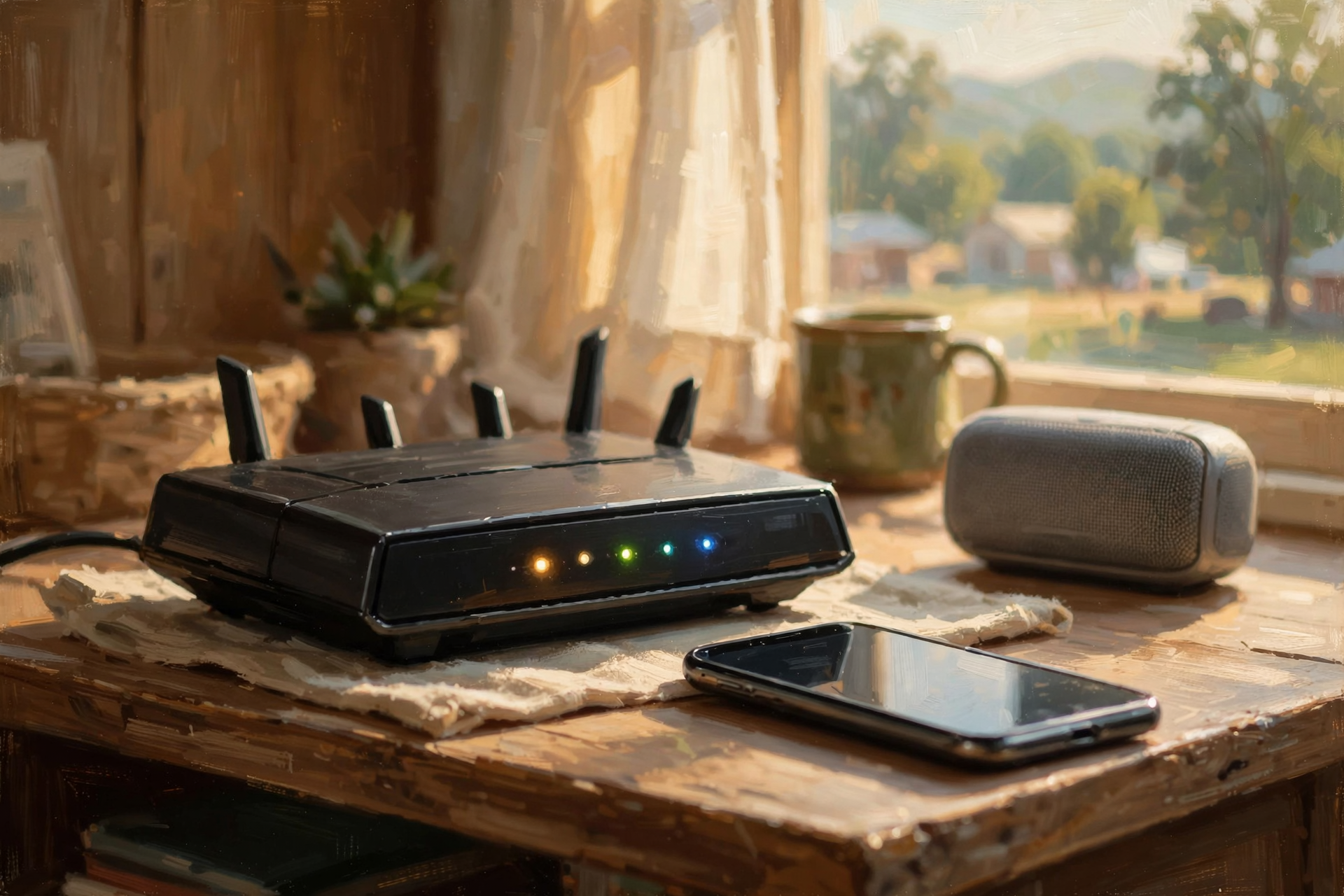
- Router: The box that brings internet into your home and runs your Wi-Fi. If someone takes it over, they can see or redirect what goes through it.
- WPS: A “push the button to connect” Wi-Fi feature. Handy, but it’s where this week’s router flaw lives.
- Default password: The factory password a device ships with, like “admin.” Crooks know them all.
- Voice clone: A computer copy of someone’s voice, made with AI from recordings.
- ALPR: Automatic license-plate reader—roadside cameras that log plates into a searchable database.
- Nudify app: An app that uses AI to make fake naked pictures of real people. Making them of others without consent is harmful and often illegal.
- Live facial recognition: Cameras that scan faces in a crowd and compare them to a watch list in real time.
❓ Frequently Asked Questions

Can someone really hack my router from outside my house?
For some older router models with this Broadcom flaw, the researcher says yes, from a distance. Change default passwords, turn off WPS if you don’t need it, and ask your internet provider about updates or a newer box.
Can an AI app find hidden cameras in my home?
It may spot cameras that are on your Wi-Fi. It can’t see cameras that record to a memory card or use their own cellular connection. A professional sweep checks for those, too.
How do I know if a voice on the phone is fake?
You often can’t tell by listening. Hang up and call back on a number you already have, or ask a question only the real person would know.
Should I worry about plate cameras?
They’re mostly used to find stolen cars and suspects, but they also log ordinary drivers. Ask your town who can search the data and how long it’s kept.
What do I do if I find a tracker on my car?
Don’t toss it. Take photos, note where it was, and call police or a professional. It’s evidence, and there could be more than one.
✅ This Week’s Counter-Surveillance Checklist
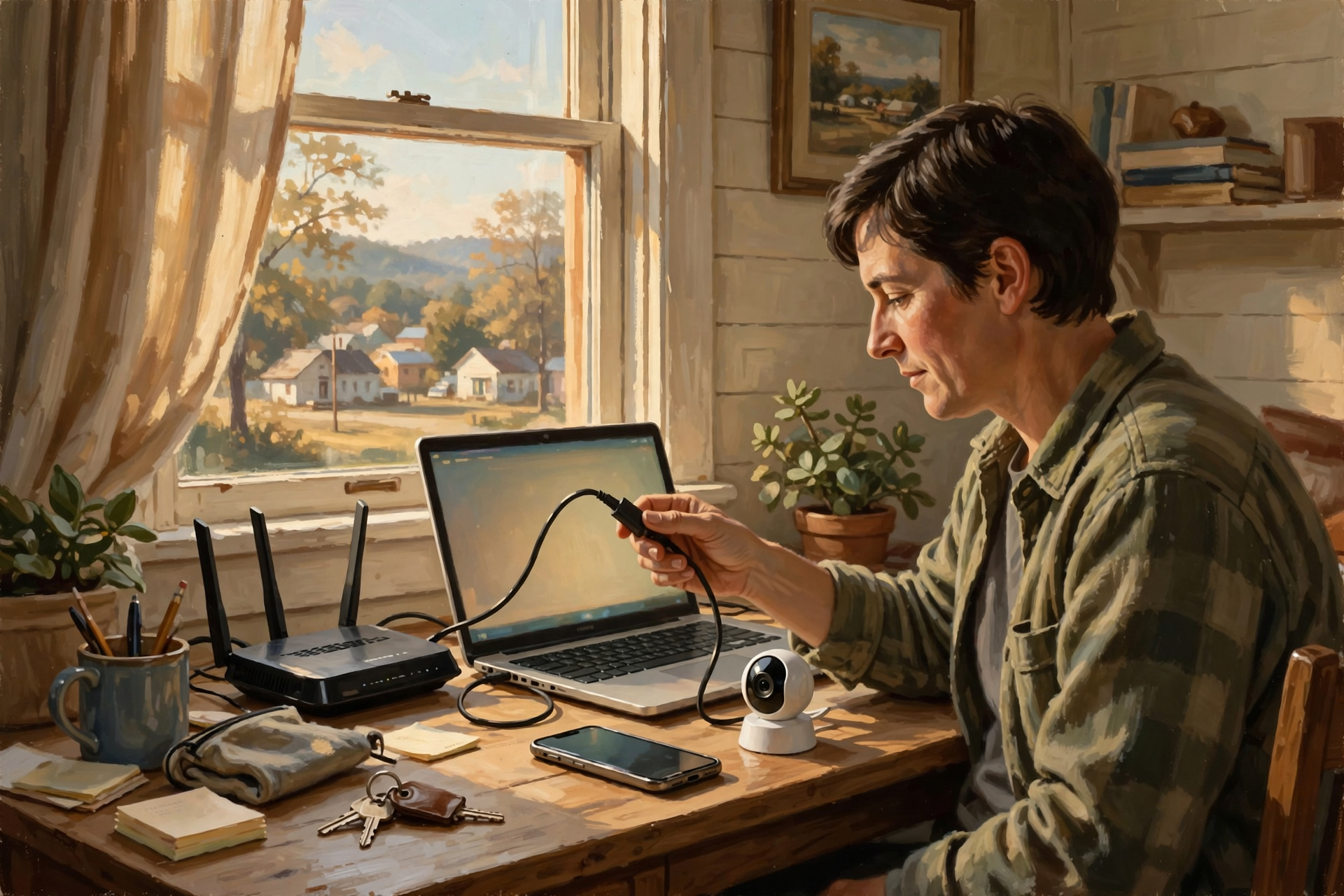
- ✅ Change your router’s default password and turn off WPS if you don’t use it
- ✅ Ask your internet company when your router last got a security update
- ✅ Update every home camera’s firmware—especially cheap cloud cameras
- ✅ Set a family code word for any phone call asking for money
- ✅ Never share your phone screen with someone who called you
- ✅ Make a no-camera-glasses rule for private meetings
- ✅ Have your car checked by hand if you think you’re being tracked—silenced tags don’t beep
Practical rule: AI makes it faster to find weak spots and easier to fake a voice—so lock down the boxes on your shelf, verify every urgent call, and remember the quietest bug is often the one already plugged in.
Sources
Know about an upcoming event or story in the Sequatchie Valley? Submit it here.




0 Comments