

🔌 A Bug Behind the TV, a Watch That Listens, and Glasses That Read the Cards

Or: Check Behind the TV, Mind the Watch, and Don’t Trust That Voice
By Thomas Seest, Dunlap.Today · Monday, October 19, 2026
Most of us never look behind the TV unless we’re hunting for the remote.
This week’s biggest bug story says maybe we should. New court papers in the OpenAI case say the man accused of planting a listening device photographed the plugs on the backs of TVs in more than one meeting room.
Here’s the roundup for folks who buy bug sweeps and the private investigators who do the work: a bug case that points at the TV, gadgets that listen all day, glasses that can read a poker hand, a world police warning about fake voices, and plate cameras with a login problem.
⏱️ What this means for you in 30 seconds
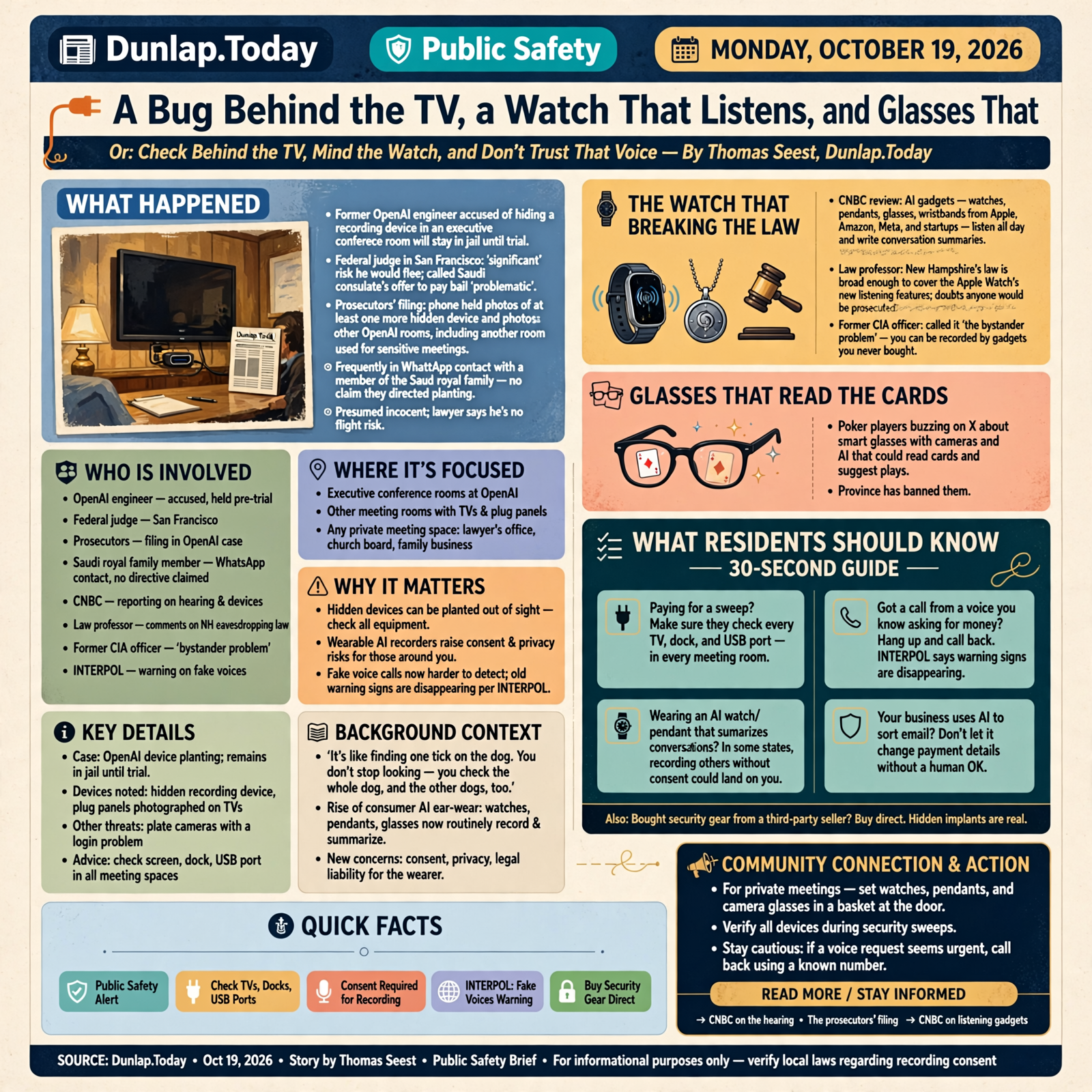
- Paying for a sweep? Make sure they check every TV, dock, and USB port—in every meeting room.
- Wearing an AI watch or pendant that summarizes conversations? In some states, recording others without consent could land on you.
- Got a call from a voice you know asking for money? Hang up and call back. INTERPOL says the old warning signs are disappearing.
- Bought security gear from a third-party seller? Buy direct. Hidden implants are real.
- Your business uses AI to sort email? Don’t let it change payment details without a human OK.
🔌 The Bug Behind the TV

The former OpenAI engineer accused of hiding a recording device in an executive conference room will stay in jail until trial. A federal judge in San Francisco said Monday there’s a “significant” risk he would flee and called the Saudi consulate’s offer to pay his bail “problematic.”
A prosecutors’ filing says his phone held photos of at least one more hidden device and of the plug panels on TVs in other OpenAI rooms, including another room used for sensitive meetings. It also says he was in frequent WhatsApp contact with a member of the Saudi royal family—though it doesn’t say that person told him to plant anything. He’s presumed innocent, and his lawyer says he’s no flight risk.
It’s like finding one tick on the dog. You don’t stop looking—you check the whole dog, and the other dogs, too.
What it means for you: If you pay for a sweep, ask that every screen, dock, and USB port in every meeting space gets checked—not just the room you’re worried about.
👉 CNBC on the hearing · The prosecutors’ filing
⌚ The Watch That Might Be Breaking the Law

CNBC took a hard look at the new crop of AI gadgets—watches, pendants, glasses, and wristbands from Apple, Amazon, Meta, and startups—that listen all day and write up summaries of your conversations.
Some lawyers say that in states with strict eavesdropping laws, the person wearing the gadget, not the company that made it, could be the one in hot water for capturing a private conversation without everyone’s OK. A law professor said he believes New Hampshire’s law is broad enough to cover the Apple Watch’s new listening features, though he doubts anyone would be prosecuted for it.
A former CIA officer called it “the bystander problem”: you can be recorded by gadgets you never bought.
What it means for you: For private meetings—a lawyer’s office, a church board, a family business—it’s fair to ask folks to set watches, pendants, and camera glasses in a basket at the door.
👓 Glasses That Read the Cards—and a Province That Bans Them

Poker players are buzzing on X about smart glasses with cameras and AI that could read cards and suggest the best play in real time. One pro called for banning glasses at the table. (The details of new tournament rules haven’t been confirmed yet.)
Over in Pakistan, the Punjab province announced it will ban “spying” gadgets with hidden cameras and recorders—pens, eyeglasses, and watches—with a formal order due in a few days.
It’s like Cousin Billy’s card trick. Fun at the kitchen table, not so fun when there’s real money in the pot.
What it means for you: If your business runs on information people can see—bids, exams, negotiations—put eyewear and wearables on your security checklist.
👉 Punjab’s gadget ban · Poker glasses warning (X summary)
🎭 INTERPOL Says: Wait. Validate. Don’t Take the Bait.

The world’s police network launched a campaign warning that AI can copy the face or voice of someone you love using just a little material found online. “AI is erasing the tell-tale signs of a scam,” said INTERPOL’s innovation director. Police in Cyprus joined in Monday.
In India, the national cybercrime center warned of fake videos of the prime minister and other leaders pitching phony government handouts. And Sen. Chuck Schumer asked the FCC to say no to a request that would let political groups send AI-voice robocalls to cellphones without permission.
On the defense side, a company called DetectifAI opened its fake-voice checker to developers. It says it catches 97.3% of cloned voices, but a test also found it flagged 8.4% of real voices as fake. And Ant Group released free voice-cloning software anyone can download.
What it means for you: Pick a family code word tonight. If a voice—even a perfect one—asks for money, hang up and call back on the number you already have.
👉 INTERPOL’s campaign · Schumer on AI robocalls · DetectifAI
🔍 Finding the Spy Chip Without Opening the Box

Remember the crypto wallets that had tiny cell-phone chips hidden inside, reading secret recovery words off the screen? The former head of Mt. Gox, Mark Karpelès, says he’s designing a cheap gadget that sends out a faint radio signal to spot a hidden antenna inside a sealed device. It’s still on the drawing board, with plans promised in the coming weeks.
That’s the same idea a professional bug sweeper uses: find the transmitter without tearing the wall apart.
What it means for you: Buy security devices straight from the maker or an authorized store. A “deal” from a third-party seller can come with a stowaway.
🚘 Plate Cameras With a Password Problem

In Savannah, Georgia, a police officer was fired after sharing her Flock plate-camera login with her husband, an ICE agent, who ran 983 searches on 97 plates. Five other employees were let go in a wider misuse probe. Flock itself is cutting about 270 jobs as lawmakers in both parties write bills to rein in plate cameras, and New Jersey is weighing rules on plate readers, face-matching, and police reports written by AI.
It’s like handing your house key to a cousin “just for the weekend.” Pretty soon nobody knows who’s been in the kitchen.
What it means for you: If a plate-camera search ever shows up in your case, ask for the audit log—who searched, under whose login, and why.
👉 Savannah firing · Flock layoffs · New Jersey bills
🕵️ AI on the Investigator’s Desk—Done Right and Done Wrong

In New Zealand, police documents show an AI tool translated 250 hours of wiretapped calls in 10 hours instead of about 750. But when the tool was taken away, one investigator pasted 350,000 lines of evidence into Google Translate and others took evidence home—exactly the kind of leak nobody wants.
In Utah, a startup called ShieldView says its AI helps police sort through phone dumps and videos while sparing investigators from looking at the worst material over and over.
What it means for you: If you hire a PI, ask what AI tools they use and where your files go. “We’ll figure it out” is the wrong answer.
📬 When the Threat Comes Home

A survey from security firm Semperis says hackers used AI in 87% of the ransomware attacks it studied, and 40% of attacks involved threats against workers or their families—including fake police calls to their homes. Separately, researchers at Barracuda found scam emails with hidden instructions meant to trick AI email helpers into marking them safe or changing payment details.
And scientists showed that six cheap Wi-Fi boards and one router can track people walking through a building—no camera needed.
What it means for you: If your business is ever hit, think about the family at home, too. And don’t let an AI assistant approve a payment change on its own.
👉 Semperis survey · Barracuda on hidden prompts · Wi-Fi tracking study
— Dunlap.Today
📚 Plain-English AI Glossary
- USB port: The little rectangular plug on TVs, computers, and chargers. A tiny bug can hide in one and draw power from it.
- Always-listening wearable: A watch, pendant, or pair of glasses that hears what’s said around you and uses AI to summarize it.
- Wiretap law: State and federal rules about recording or capturing other people’s conversations. Some states require everyone’s permission.
- Deepfake: A fake video, photo, or voice made with AI to look or sound like a real person.
- Voice clone: A computer copy of someone’s voice, made from a short recording.
- Hardware implant: A tiny chip secretly added inside a device to spy on it.
- Audit log: A record of who searched a system, when, and why.
❓ Frequently Asked Questions

Where do bugs usually hide in a meeting room?
Anywhere with power and a good spot to hear: behind TVs, in USB ports, chargers, power strips, and phone docks. A good sweep checks those by hand and with equipment.
Is my AI watch illegal?
Owning one isn’t. But in some states, using a feature that captures other people’s conversations without their consent could be a problem. When in doubt, turn listening features off around others or ask permission.
How can I tell if a voice on the phone is fake?
Often you can’t by ear. Hang up and call back on a number you already have, or ask for your family code word.
Are AI fake-voice detectors reliable?
They help, but they make mistakes both ways. Treat them like a smoke alarm—a reason to check, not the final word.
Should I ask my private investigator about AI?
Yes. Ask which tools they use, where your files are stored, and whether a person double-checks everything the AI finds.
✅ This Week’s Counter-Surveillance Checklist

- ✅ Have every TV, dock, and USB port in your meeting rooms checked during your next sweep
- ✅ Set a “wearables in the basket” rule for private meetings
- ✅ Pick a family code word for any call asking for money
- ✅ Buy security hardware only from the maker or an authorized store
- ✅ Require a human OK before any AI tool changes a payment or vendor
- ✅ Ask your PI what AI tools they use and where your files go
- ✅ Request audit logs if a plate-camera search shows up in your case
Practical rule: AI makes bugs smaller, voices fakeable, and gadgets always on—so check behind the TV, ask before you record, and call back before you pay.
Sources
Know about an upcoming event or story in the Sequatchie Valley? Submit it here.




0 Comments