
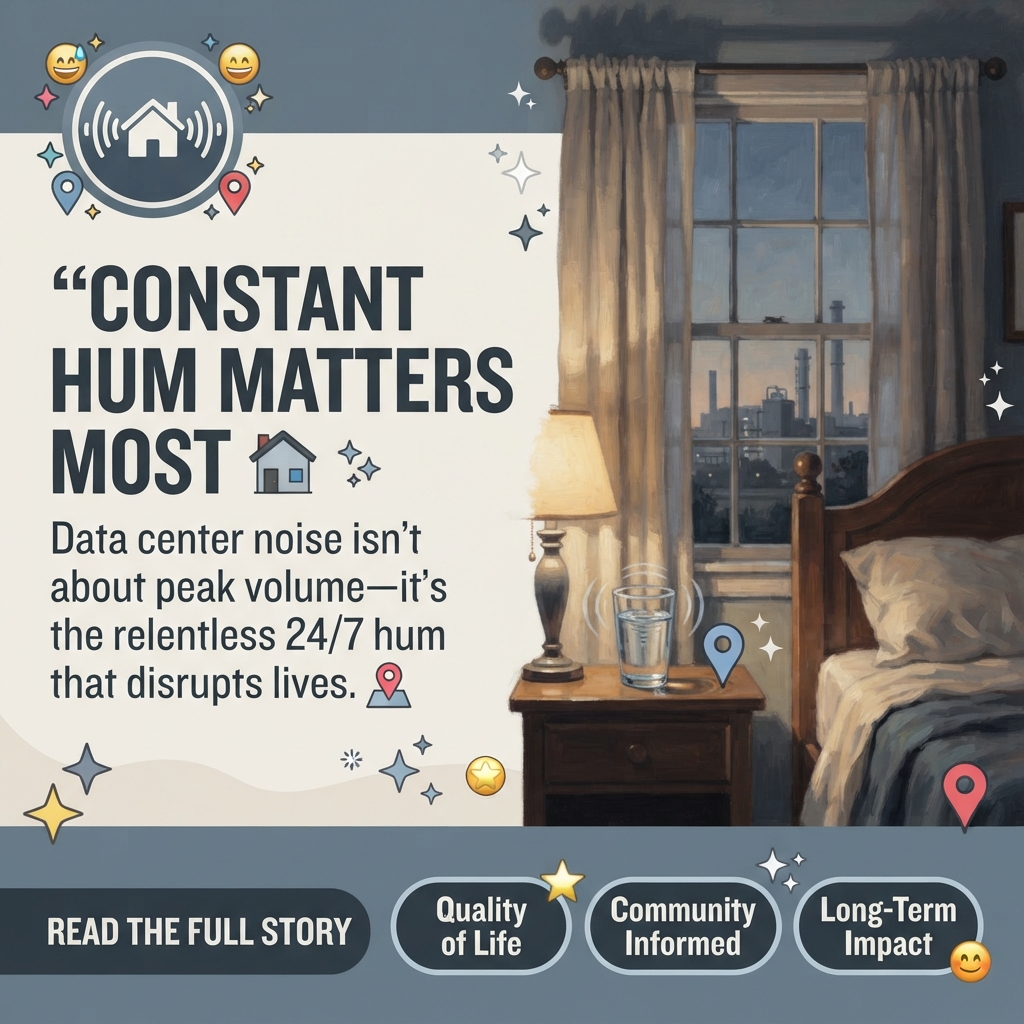
🔊 Understanding Data Center Noise: Why the Constant Hum Matters More Than Peak Volume
As data centers become more common infrastructure across rural and suburban regions, including areas like the Sequatchie Valley, neighbors and community members are increasingly asking questions about what it means to live near one—particularly when it comes to the constant, low-frequency noise these facilities produce. Understanding the difference between occasional loud sounds and persistent industrial hum is becoming essential knowledge for residents considering or already living near such facilities.
📊 The Decibel Paradox: Louder Isn’t Always the Problem
When most people think about noise, they imagine volume—the kind of immediate, overwhelming sound that makes you wince. A gas-powered lawn mower, for example, operates at 85–100 decibels (dB), depending on whether it’s a push or riding model. That’s genuinely loud: loud enough to risk hearing damage after just 1–2 hours of continuous exposure. 🏡
A data center operating at a nearby property line or residential distance, by contrast, typically produces 55–70 dB of noise. That’s comparable to a household dishwasher, an air conditioning unit, or a normal conversation. On paper, it sounds manageable—even quiet. But this comparison reveals a critical misunderstanding about how noise affects quality of life.
The decibel scale is logarithmic, meaning a 20–40 dB difference represents a massive gap in raw sound intensity. Yet the lawn mower, despite being far louder, stops when you finish cutting the grass. The data center does not. ⏰
🌙 The Real Challenge: 24/7 Persistence
The primary complaint from residents living near data centers is not peak loudness—it’s the relentless, never-ending nature of the sound. A data center operates continuously, day and night, 365 days a year. There is no off switch, no seasonal break, no quiet evening or early morning. 🔄
Residents have described the experience as “having a lawn mower running in your living room 24/7,” though this comparison refers more to the inescapable quality of the sound than its literal volume. The human experience of noise is shaped not just by how loud it is, but by whether you can escape it, predict it, or control it.
This distinction matters for sleep, stress levels, and long-term health. A temporary loud noise—even a very loud one—allows your nervous system to reset. A constant, moderate noise offers no such relief. 😴
🎵 Sound Quality and Frequency: Why It Penetrates
Beyond volume and duration, the type of sound itself affects how residents experience it. A lawn mower produces a broadband “roar” from its engine and blades—a sound that is easily identifiable and, in a residential neighborhood, expected during daylight hours. You know what it is, and you know it will end.
A data center, by contrast, generates a low-frequency hum or high-pitched mechanical whine from thousands of cooling fans and HVAC systems working simultaneously. Low-frequency noise travels farther and penetrates walls and windows more effectively than higher-frequency sounds. Some residents report feeling vibrations or a sensation of pressure indoors, even when the sound itself isn’t consciously audible. 🌊
⚠️ When Data Centers Sound Like Lawn Mowers
There is one scenario where a data center’s noise profile changes dramatically: when backup diesel generators activate. These generators typically run during monthly testing or during power outages, and they can produce 80–100 dB at the property line—equivalent to a lawn mower running continuously. For residents, this means occasional spikes in noise that rival the loudest yard equipment, layered on top of the constant baseline hum. 🚨
❓ What This Means for Sequatchie Valley Residents
As industrial facilities like data centers consider locations in or near the Sequatchie Valley, understanding noise impact becomes part of a larger conversation about land use, quality of life, and community character. Residents deserve accurate information about what “nearby” actually sounds like—not reassurance based on decibel readings alone, but honest discussion about the lived experience of 24/7 industrial noise.
For those already living near a data center, this information may help explain why the facility feels intrusive even when it doesn’t sound “that loud” compared to other sources. For those considering property near one, it provides a framework for thinking about long-term comfort and resale value. 🏘️
💭 Questions Worth Asking
As communities evaluate data center projects or residents assess their own situations, consider these questions:
- How would a constant, moderate noise affect your sleep, stress levels, and ability to enjoy your outdoor space?
- What distance from a data center would you consider acceptable, given that low-frequency noise travels and penetrates structures?
- How often do backup generators test, and what advance notice do nearby residents receive?
- What noise mitigation measures (barriers, landscaping, operational limits) are in place or negotiated?
- How do local zoning and land-use regulations address industrial noise in residential or mixed-use areas?
🔮 Long-Term Community Considerations
Data centers represent a significant economic opportunity for rural regions—jobs, tax revenue, and infrastructure investment. But they also represent a permanent change to the sensory environment of nearby neighborhoods. Unlike a temporary construction project or seasonal activity, a data center’s noise signature becomes part of the permanent landscape.
Communities that understand this distinction—that acknowledge both the economic benefits and the genuine quality-of-life trade-offs—are better positioned to negotiate terms that work for both the facility and residents. This might include setback distances, noise barriers, generator testing schedules, community notification systems, or ongoing monitoring. 🤝
The conversation about data centers in the Sequatchie Valley is ultimately a conversation about what kind of community residents want to live in, and what trade-offs they’re willing to accept for economic development. Having accurate information about noise—not just peak volume, but persistence, frequency, and real-world impact—is essential to that conversation.




0 Comments