
🗄️ Who Owns the Filing Cabinet? Law Firm Emails for Sale, a Big Firm’s AI Spin-Off Talk, and a Citation Checker With No AI Inside

Or: BizBuyData’s Offer for Law Firm Emails, Freshfields’ AI Spin-Off Emails, CiteProof, a Rejected Privilege Log and an AI Warning From London: The Week’s eDiscovery AI News in Plain English
By Thomas Seest, Dunlap.Today · Saturday, October 17, 2026
Every law office has a filing cabinet. Maybe it’s a gray steel one in the back room, maybe it’s a server somewhere, but it holds years of letters, notes and the back-and-forth of how a case got handled. Nobody thinks much about it until somebody shows up wanting what’s inside.
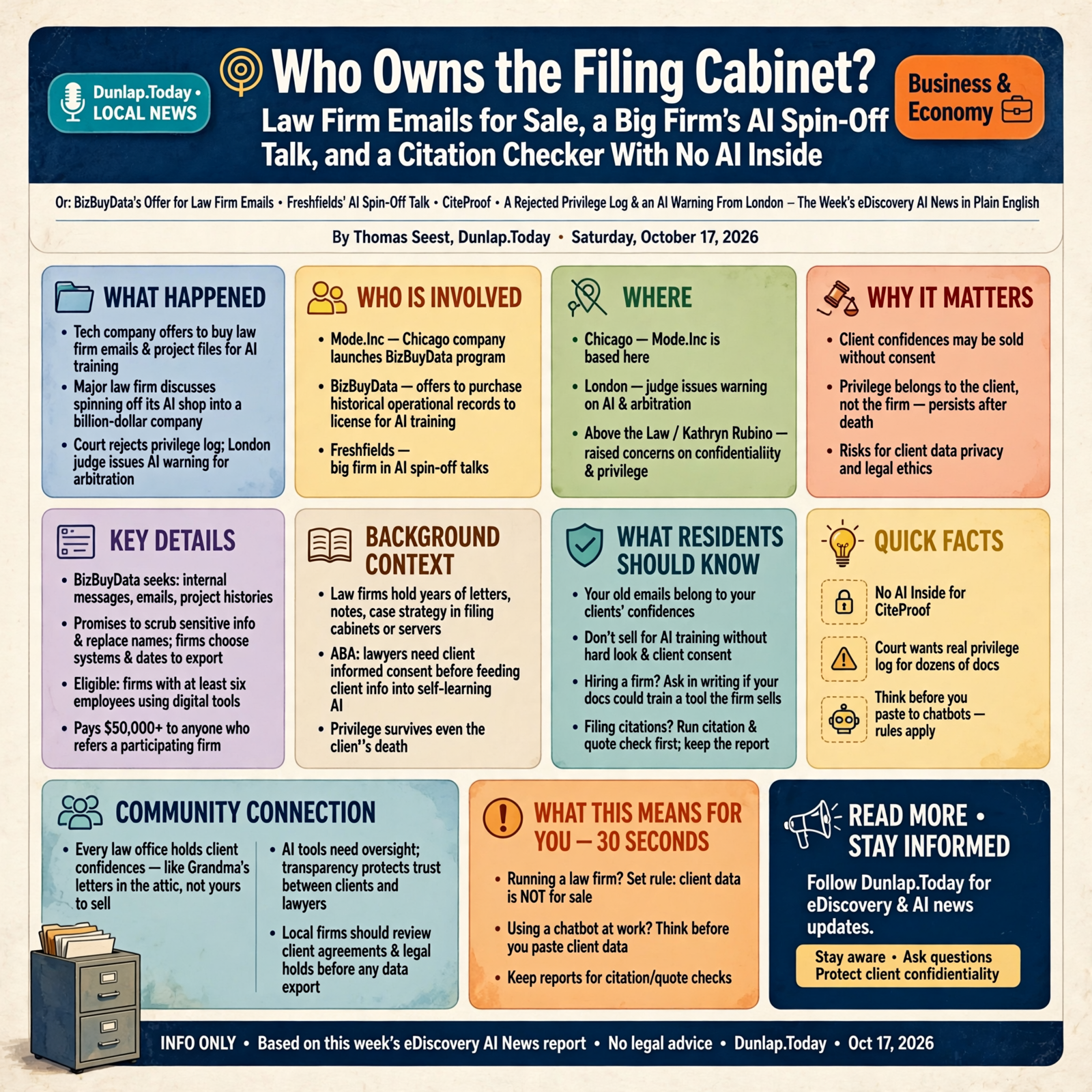
This week, somebody showed up. A tech company is offering to pay law firms for their old emails and project files so AI companies can learn from them. And one of the biggest law firms in the world has been talking about turning its own AI shop into a company worth billions. The question running through this week’s eDiscovery news is simple: who owns what’s in the filing cabinet, and who checks the work that comes out of it?
Here’s this week’s roundup: an offer to buy law firm emails, a big firm’s AI spin-off talk, a citation checker with no AI inside, a court that wanted a real privilege log, a London judge’s warning about AI and arbitration, and what lawyers are pasting into chatbots.
⏱️ What this means for you in 30 seconds
- Running a law firm? Your old emails belong to your clients’ confidences. Don’t sell them for AI training without a very hard look and client consent.
- Hiring a law firm? Ask in writing whether your documents could ever train a tool the firm sells to others.
- Filing anything with citations? Run a citation and quote check first, and keep the report.
- Logging privileged documents? If there are only a few dozen, expect to describe each one with real facts.
- Using a chatbot at work? Think before you paste. Third-party content and client data both carry rules.
🗄️ Somebody Wants to Buy What’s in the Filing Cabinet

A Chicago company called Mode.Inc launched a program this week called BizBuyData. The pitch to law firms: you can earn money by licensing your “historical operational records” to AI companies that are training workplace AI agents. What records? “Internal messages, emails and project histories,” the kind that show “how people work through problems and make decisions over time.”
Mode says it scrubs out sensitive information and replaces names, and that firms choose which systems and dates get exported. Any firm with at least six employees using digital tools can sign up, and Mode pays anyone who refers a participating firm at least $50,000.
Above the Law’s Kathryn Rubino asked the obvious question. In a law office, the emails where lawyers work out strategy are the confidential part. Privilege belongs to the client, not the firm, she pointed out, and swapping a client’s name for a placeholder doesn’t make a strategy memo any less confidential. The ABA has already said lawyers generally need a client’s informed consent before feeding client information into self-learning AI tools, and, she noted, privilege survives even the client’s death.
It’s a little like somebody offering to buy Grandma’s old letters from the attic. They might be worth something, but some of what’s in that box was never yours to sell.
What it means for you: If you run a firm, set a clear rule that client data is not for sale, and check any export against legal holds and client agreements first. If you hire firms, put “no licensing our data for AI training” in your outside counsel guidelines.
🏗️ A Big Firm Talks About Selling Its AI Shop

Emails that leaked to the Financial Times showed that leaders at Freshfields, one of the world’s largest law firms, have discussed turning its AI unit, Freshfields Lab, into a separate company that outside investors could buy into, maybe even take public. The firm’s global managing partner wrote that two Wall Street banks had reached out, and a senior partner guessed the unit would “probably be worth billions.” He also called the talks “very early stage” and said a “big question” is whether the tools would be valuable to others once they used other firms’ data. The FT reported the thread was accidentally sent to the whole firm and then recalled.
A day later, an FT column argued firms should resist the temptation, saying the legal AI business is crowded and unprofitable and the market is smaller than the hype suggests.
Think of a family that’s famous for its barbecue sauce. Selling it at the county fair is one thing. Selling the recipe company to strangers is another, especially if the recipe came partly from the neighbors.
What it means for you: If firm-built AI tools get sold outside the firm, the documents that trained them start to matter a lot. Clients should ask the question now, in writing.
👉 Read more (Global Legal Post) · FT via AFR · FT column (paywalled)
🔎 A Citation Checker With No AI Inside

A new tool called CiteProof checks legal briefs for made-up case citations and misquoted opinions, and it doesn’t use AI to do it. “You cannot reliably catch AI hallucinations with more AI guesswork,” the company told The Register. It looks citations up directly in public court records instead. It won’t tell you whether a case actually supports your argument, just whether it’s real and quoted correctly. Checking whether citations exist is free; adding quote checking costs $49 a brief, with bundle pricing.
Meanwhile, eDiscovery Today’s weekly roundup counted 2,199 AI hallucination cases and counting, up 19 this week. And legal tech writer Nicole Black warned that local counsel, the lawyer who sponsors an out-of-state attorney, can share the blame when that attorney files AI-invented cases. Her advice: read the filings yourself, and charge for the time.
It’s like having somebody count the change before you leave the register. It takes a minute, and it saves a lot of embarrassment.
What it means for you: Add a citation and quote check to every filing, keep the report in the file, and if your name goes on it, read it.
👉 Read more (The Register) · eDiscovery Today · NY Daily Record (Nicole Black)
📋 The Court Wanted a Real List

When lawyers hold back documents as privileged, they usually have to list them in a privilege log. For big cases, courts sometimes allow a shortcut: group documents into categories instead of describing each one. In Glaxo Group v. Transpire Bio, a federal court in Florida said no to that shortcut when only 46 documents were at issue. It ordered a document-by-document log with specific facts for each claim, and said vague subject descriptions weren’t good enough.
It’s like a teacher who’ll accept “I read chapters one through ten” from a big class, but wants a real book report when there are only three kids in the room.
What it means for you: If AI helps draft privilege log entries, make sure each one states real facts, not boilerplate. And when the count is small, plan on going one by one.
🌍 A London Judge Worries About AI and Who Enforces What
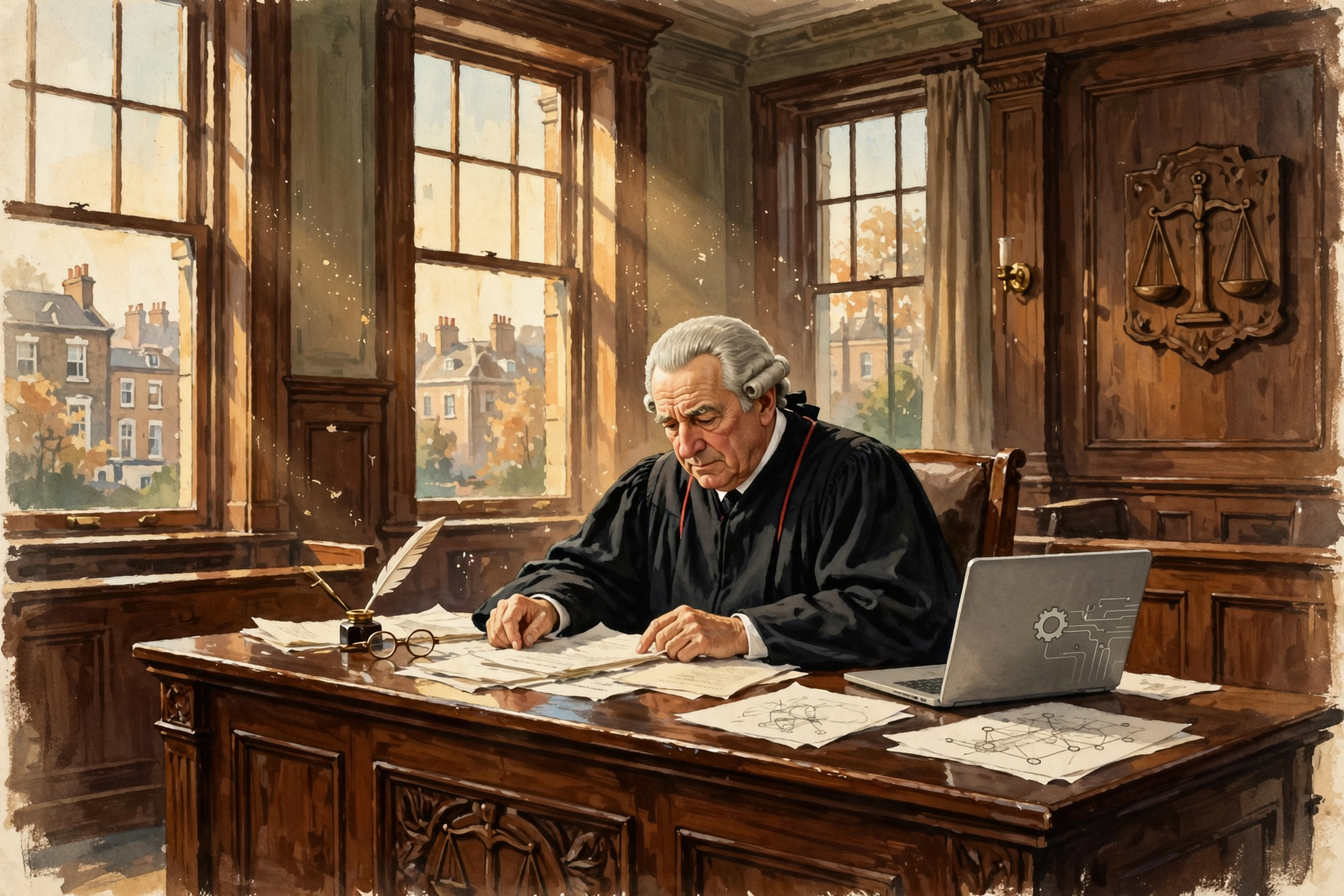
Sir Geoffrey Vos, England’s master of the rolls, told the International Chamber of Commerce that courts can’t hand decisions over to AI without a law allowing it, but arbitrators can use AI however the parties agree. He expects people to use AI to predict outcomes and to feel pressure “to settle at the level predicted by the machine.” Because countries are moving “at very different speeds” on AI, he warned, someone could argue that enforcing an award where AI played a big role goes against their country’s public policy. He called for an international conversation about good practice.
It’s a bit like a referee using instant replay in one league but not the next one over. Sooner or later somebody argues the call doesn’t count.
What it means for you: If you’re in an arbitration, settle early on whether and how AI may be used, and what records get kept, so nobody fights about it later.
👉 Read more (Law Society Gazette)
📋 Think Before You Paste

A UK survey by the Copyright Licensing Agency of 562 legal professionals found 74% use generative AI at work, and nearly half of those copy outside material into their prompts every week. But only 2% correctly answered two basic questions about what they’re allowed to copy and share, even though 72% said they felt confident about it. (Worth knowing: the CLA sells copyright licenses.)
Over in the UK, the solicitors’ regulator also proposed writing “check the AI’s work against primary sources” right into the competence standard every solicitor must meet, with supervisors responsible too.
It’s like borrowing a neighbor’s recipe for the church cookbook. Ask first, and taste it before you serve it.
What it means for you: Give your team a short, plain list of what may and may not be pasted into AI tools: client data, protected material and other people’s content.
👉 Read more (Law Society Gazette) · UK Legal AI Brief on the SRA proposals
🧰 New Tools on the Workbench

- Lucio Research. A free one-month beta of a legal research agent that shows every source it considered, including the ones it set aside. The company says it often reviews 800 to 1,500 sources in under three minutes. Bar & Bench
- Friday’s connector for Claude and ChatGPT. A French law-practice software company now lets lawyers work with matter files from inside Claude or ChatGPT, and says sensitive details are swapped for placeholders before anything is sent. Available Oct. 20. Friday (in French)
- Legal AI scoreboards. An independent account on X posted a redesigned legal AI benchmark, and Percipient’s lawyer-voted Certera leaderboard updated on Oct. 16. Good for a shortlist, not a substitute for testing on your own documents. X post · Certera
🧭 Quick Hits for the Desk Drawer

- A conflict fight in an AI copyright case. DeviantArt asked a California federal court to disqualify Crowell & Moring from representing a photo company suing over AI training, saying the firm once advised DeviantArt on its own AI tool. Crowell’s general counsel says the firm has done no work for DeviantArt’s parent, Wix, since July 2024. A hearing is set for Dec. 7. Bars Across
- Training the next lawyers. Paul, Weiss is backing a five-year AI initiative at Columbia Law School with new courses and hands-on training. Paul, Weiss
- “Lawyers are done”? Not so fast. Litigator Rob Freund pushed back on X against predictions that AI will wipe out lawyers, saying he expects more attorney jobs in 10 years, not fewer. X post
- AI records follow the usual rules. A Womble Bond Dickinson article says courts are treating AI chats like any other evidence: discoverable if relevant, limited if the request is out of proportion. In one Delaware case, a CEO’s ChatGPT conversations, obtained in discovery, were relied on to show the firings in that case were financially motivated. National Law Review
- One judge’s AI rulebook. An Illinois judge requires lawyers to disclose when AI helped answer interrogatories, bars witnesses from using AI in depositions, and wants 90 days’ notice before AI-generated evidence comes in at trial. JD Supra
- Faster review, more checking. Lawyers Weekly found that AI speeds up document review but shifts the work to checking and defending the results. Lawyers Weekly
- In-house does more itself. One general counsel said AI let her team do in under 10 minutes a 50-state survey that outside counsel had quoted at $110,000. ABA Journal
✅ Your Front-Porch eDiscovery AI Checklist

- ✅ Write down that client data is not for sale or licensing for AI training without general counsel review and client consent.
- ✅ Check any outgoing dataset against active legal holds and client confidentiality terms.
- ✅ Ask outside counsel whether your documents could train a tool they sell to others.
- ✅ Run a citation and quote check on every filing, and keep the report.
- ✅ If your name is on a filing as local counsel, read it before it goes in.
- ✅ Make AI-drafted privilege log entries state real facts, and go document by document when the count is small.
- ✅ Give your team a plain list of what may and may not be pasted into AI tools.
Practical rule: Before anything leaves the filing cabinet, whether it’s going to an AI company or into a court filing, know whose it is and make sure somebody checked it.
— Dunlap.Today
📚 Plain-English AI Glossary

- Attorney-client privilege: The rule that keeps private conversations between a lawyer and client out of court. It belongs to the client.
- Work product: Materials lawyers prepare for a case, like strategy notes, that are usually protected from the other side.
- Privilege log: A list of documents a party is holding back as privileged, with enough description for the other side to test the claim.
- Categorical privilege log: A shortcut log that groups documents into categories instead of listing each one.
- AI training data: The documents and text an AI system learns from.
- Spin-off: When a company turns one of its units into a separate business, often so outside investors can buy in.
- Hallucination: When an AI tool confidently makes something up, like a court case that doesn’t exist.
- Local counsel: A lawyer licensed in the court’s state who sponsors and works with an out-of-state lawyer on a case.
- MCP connector: A standard plug that lets an AI assistant reach outside data, like a law firm’s matter files.
❓ Frequently Asked Questions

Can a law firm sell its old emails to an AI company?
That’s exactly the question being asked. Much of what’s in a law firm’s email is the client’s confidential information, and privilege belongs to the client. Removing names may not be enough. Any firm thinking about it should talk to its ethics counsel and its clients first.
Why would a law firm spin off its AI unit?
To raise outside money and sell its tools to other firms and companies. The catch, as one Freshfields partner noted, is whether those tools work as well once they’re using other people’s data, and what happens to the client documents behind them.
Does a citation checker replace reading the cases?
No. A checker like CiteProof can tell you whether a case exists and whether a quote matches. It can’t tell you whether the case actually supports your argument. You still have to read it.
What did the Florida court say about privilege logs?
With only 46 documents at issue, the court said a categorical log wasn’t good enough and ordered a document-by-document log with specific facts for each claim.
🔗 Other Resources

- CiteProof pricing and free tier
- Glaxo v. Transpire privilege log order (Midpage)
- Copyright Licensing Agency: Copy, Paste, Prompt research
- National Law Review: Reconstructing AI-assisted decisions
- Law360: Crowell faces DQ bid (paywalled)
🌄 No Need to Worry, Just Stay in the Know

None of this means you need to lock the filing cabinet and throw away the key. AI tools can do a lot of good, and a well-kept record is often your best friend in a dispute. It just means remembering that what’s in the cabinet belongs to the people who trusted you with it, and that somebody should always check the work before it goes out the door.
We’ll keep watching what matters for eDiscovery providers and their clients. Read Dunlap.Today and sign up for our newsletter for plain-English updates.


0 Comments