
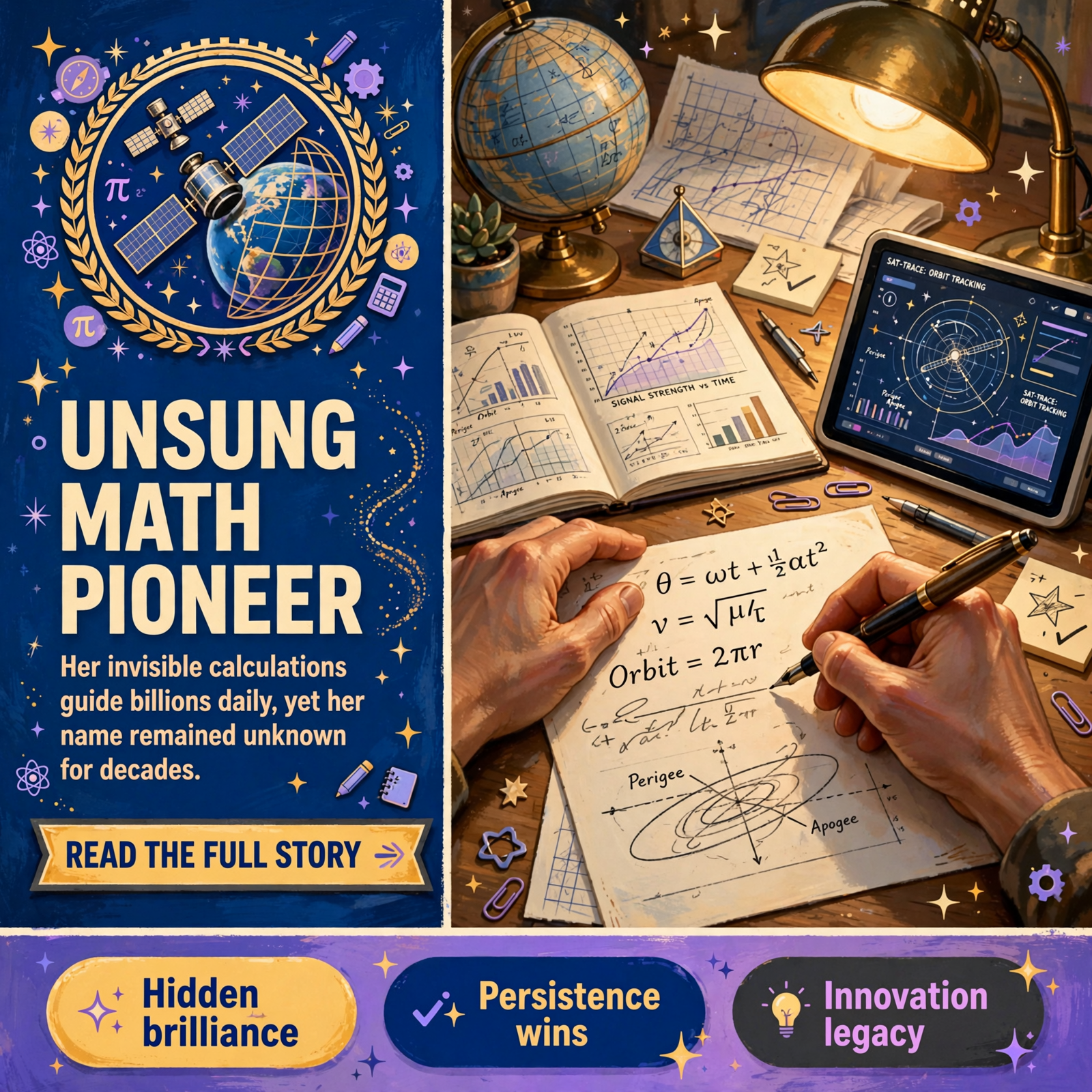
🛰️ Dr. Gladys West, Mathematician Who Made GPS Possible, Dies at 95
The passing of Dr. Gladys West marks the end of a remarkable life whose contributions shaped how millions of people navigate the world every day. Her story-of persistence, brilliance, and decades of unrecognized achievement-carries lessons about innovation, equity, and the power of individual determination that resonate far beyond the field of mathematics.
📍 A Life Built on Precision and Purpose
Dr. Gladys West, born in 1930 in Dinwiddie County, Virginia, grew up in a sharecropping family with limited options. She understood early that education was her pathway forward. After finishing at the top of her high school class, she earned a scholarship and pursued mathematics-a field where few Black women were welcomed, and fewer still were recognized for their contributions. 🎓
For decades, West worked in satellite geodesy, a specialized field that required her to take raw data from orbiting satellites and use it to compute, correction by correction, the true irregular shape of the Earth. The work was painstaking and mathematical: the Earth is not a perfect sphere or even a neat ellipsoid, but a lumpy thing with gravitational highs and lows. Understanding that precise shape was essential to making GPS work.
Without her model, modern GPS-the technology that tells your phone where you are, guides emergency responders to homes, enables precision agriculture, and powers countless other systems-would not exist. Yet for most of her career, her name remained unknown outside specialized circles. She retired in 1998, her contributions largely unremarked.
⭐ Recognition Came Late, But It Came
In 2018, when West was in her eighties, her sorority mentioned her biography at a function. Someone recognized what was in it. The Air Force inducted her into its Space and Missile Pioneers Hall of Fame. She earned a PhD in her seventies. The recognition, though delayed, affirmed what her work had always demonstrated: that her contributions were foundational to modern technology. ✨
💡 Why This Matters
Dr. West’s story speaks to several truths that matter to communities everywhere. First, it reminds us that innovation often happens quietly, in the work of individuals whose names we never learn. Second, it illustrates how systemic barriers-racism, sexism, and the invisibility of women and people of color in STEM fields-can delay recognition of genius. Third, it shows that persistence and excellence can eventually break through those barriers, even if it takes decades.
For readers in rural and small-town communities, West’s journey from a sharecropping family to foundational scientific achievement offers another lesson: that background does not determine destiny, and that education and determination can lead anywhere. Her early life in rural Virginia mirrors the experiences of many families in the Sequatchie Valley and surrounding regions who have worked the land and sought better opportunities for their children through schooling.
🌍 The Invisible Foundation of Modern Life
Every time someone in this region uses GPS to navigate, locate a business, call for help, or track a delivery, they are benefiting from Dr. West’s mathematical model. Her work is embedded in the infrastructure of modern life so completely that most people never think about it. That invisibility-the way foundational contributions can go unnoticed-is part of what makes her story important to tell and remember.
The technology she helped create has transformed agriculture, emergency response, transportation, and countless other fields. In rural areas especially, GPS has made it easier for farmers to manage land precisely, for emergency services to reach people quickly, and for small businesses to operate efficiently. West’s contribution to that capability is real, even if her name was not on the GPS device in your vehicle.
🧠 A Model for Recognizing Hidden Contributions
Dr. West’s life raises important questions for communities and institutions: How many other contributors-in science, business, community service, and civic life-go unrecognized because of bias, geography, or simply the way history is recorded? What systems could we build to ensure that excellence is noticed and honored in real time, not decades later? How can schools, workplaces, and community organizations actively seek out and celebrate the contributions of people from all backgrounds?
Her late-life recognition also suggests that it is never too late to honor achievement. The Air Force’s decision to induct her into the Space and Missile Pioneers Hall of Fame, and the public attention that followed, gave her the recognition she had earned long before. That recognition, though overdue, mattered-not just to her, but as a signal to others that their work, no matter how long it takes, can be seen and valued.
📚 What Her Story Teaches
For young people in the region considering careers in science, technology, engineering, and mathematics, Dr. West’s example is powerful: excellence is possible, barriers are real but not insurmountable, and the work you do-even if it is not immediately celebrated-can change the world. For educators and mentors, her story is a reminder to actively encourage and support students from all backgrounds, especially those whose families may not have connections to STEM fields.
For community leaders and organizations, her life suggests the importance of creating pathways to education and opportunity, and of recognizing and celebrating achievement when it happens. The Sequatchie County Youth Association, local schools, and community organizations play roles in helping young people see possibilities beyond their immediate circumstances-roles that matter deeply when we consider how many potential innovators and leaders might otherwise be overlooked.
🔮 A Legacy That Continues
Dr. Gladys West died on October 5, 2026, at age 95. Her death marks the end of a life lived with purpose and precision. But her legacy-the mathematical model that makes GPS possible, the example of persistence and excellence, and the reminder that recognition matters-continues. Every time someone uses GPS, they are using her work. Every young person who sees her story and decides to pursue science or mathematics is carrying her legacy forward.
Her life also serves as a call to action: to build systems that recognize excellence more quickly, to create pathways to opportunity for people from all backgrounds, and to tell the stories of contributors whose work has shaped our world. In doing so, we honor not just Dr. West, but all the people whose contributions have been overlooked, and we create a foundation for a future where that happens less often.
💭 Questions Worth Considering
- What contributions in your own community might be going unrecognized or undervalued?
- How can schools and community organizations better support young people from all backgrounds in pursuing careers in science and technology?
- What systems could help ensure that excellence is noticed and honored in real time, rather than decades later?
- How does Dr. West’s story change the way you think about the technology you use every day?
🤔Source
Marcus Muhammad, Mayor of the City of Benton Harbor – A tribute post about Dr. Gladys West, the mathematician whose work on satellite geodesy made GPS possible, who passed away at 95.



0 Comments