
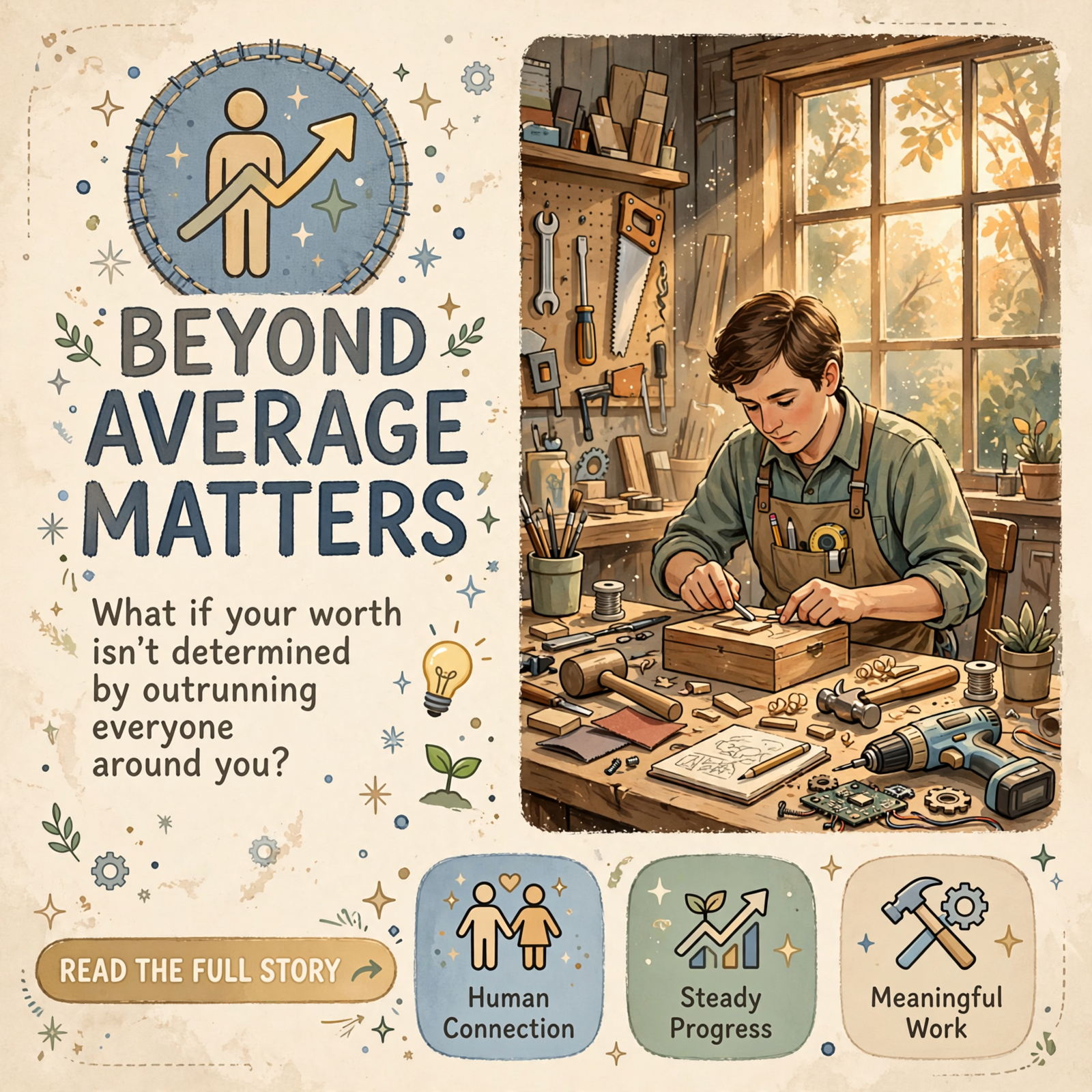
When Did Being Average Become an Insult?

The Human Advantage: Finding Our Place in a World Where Intelligence Is No Longer Scarce
Somewhere along the way, we turned the word average into an insult.
We did not merely want our children to learn.
We wanted them to be above average.
We did not merely want to do our jobs well.
We wanted to outperform our coworkers.
We did not merely want a comfortable home.
We wanted one at least as nice as the house down the road.
We did not merely want enough.
We wanted a little more than whoever happened to be standing beside us.
🏫 At school, we learned about class rankings.
💼 At work, we learned about performance rankings.
🏡 In our neighborhoods, we learned about keeping up with the Joneses.
📱 Then social media arrived and gave us several billion Joneses to keep up with.
And now artificial intelligence has entered the room.
Suddenly, the competition appears to include something that can write faster, calculate faster, summarize faster, research faster, analyze faster and increasingly create things that once required years of human training.
That leaves ordinary people with an uncomfortable question:
If I am no longer better than average at what I do, what am I worth?
I think that may become one of the defining human questions of the AI age.
🏫 We Started Keeping Score Early
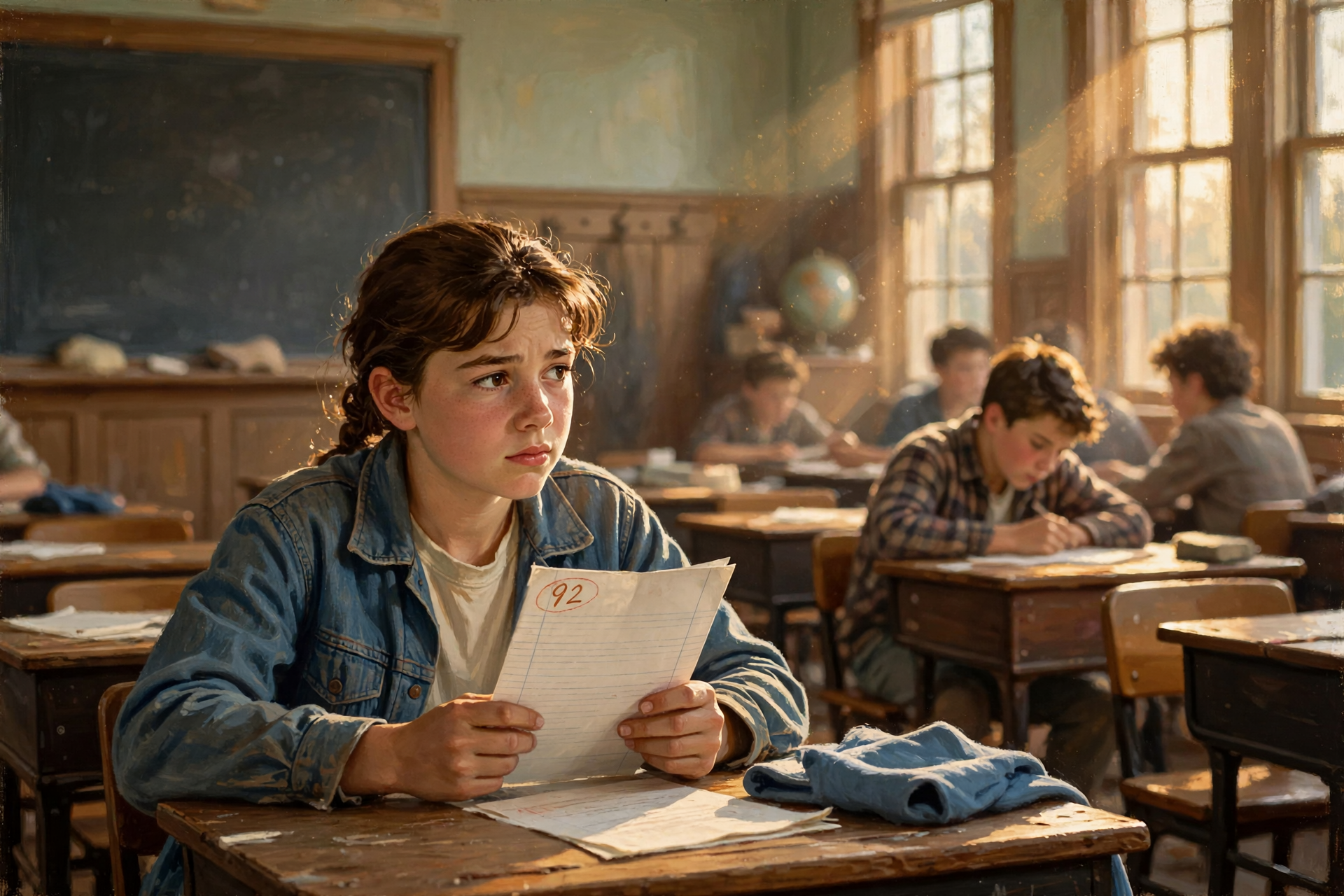
Think back to school.
You got a test back.
Maybe you scored a 92.
That should have told you something simple:
You understood about 92 percent of the material being tested.
But that usually wasn’t the next question.
The next question was often:
“What did everybody else get?”
Then:
“What was the class average?”
Then perhaps:
“What did Johnny get?”
Suddenly, 92 wasn’t simply 92 anymore.
If everybody else got 75, you felt pretty smart.
If everybody else got 98, that same 92 suddenly didn’t feel so impressive.
The knowledge had not changed.
The comparison had.
We learned a powerful lesson without anybody necessarily saying it out loud:
Your performance matters partly because of where it places you relative to somebody else.
Then we carried that lesson into adulthood.
💼 School Ended. The Ranking System Didn’t.
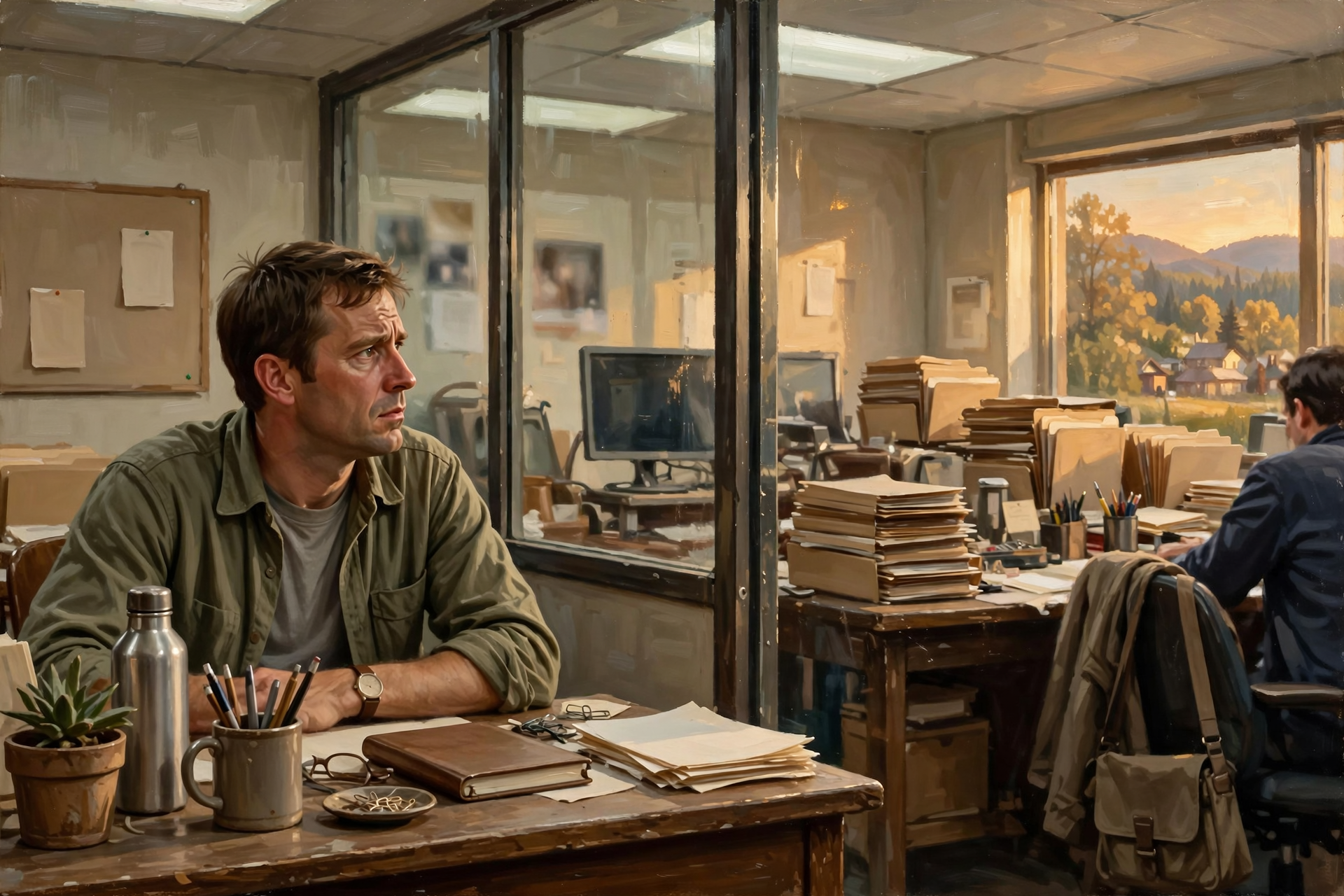
At work, the grades changed names.
They became:
- 📊 performance reviews
- 💵 salaries
- 📈 sales rankings
- 🏆 employee awards
- 🪜 promotions
- 🎯 quotas
- 💼 job titles
- ⭐ customer ratings
We learned to look sideways.
Who got promoted?
Who got the raise?
Who has the corner office?
Who bought the new truck?
Who seems to be doing better?
There is nothing inherently wrong with competition.
Competition can push us.
It can make businesses better.
It can encourage craftsmanship.
It can challenge people to improve.
But somewhere between healthy competition and constant comparison, something important gets lost.
We start believing our value is determined by our position on a scoreboard.
🏡 Keeping Up With the Joneses Used to Be Easier

There was a time when the Joneses actually lived nearby.
You might have compared yourself with twenty families in your community.
Maybe somebody bought a shiny new Buick.
Maybe somebody added a room to the house.
Maybe somebody’s kid became a doctor.
You saw their successes, but you usually saw some of their struggles too.
You knew the Buick needed repairs.
You knew their basement flooded.
You knew their kid had problems just like everybody else’s kid.
Then television widened our comparison group.
Then the internet widened it again.
Then social media handed us something human beings had never experienced before:
The ability to compare our ordinary Tuesday afternoon with the carefully selected best moments of millions of other people’s lives.
🌴 Somebody was always on vacation.
💰 Somebody was always making more money.
🏆 Somebody was always accomplishing something.
💪 Somebody was always healthier.
🏠 Somebody always had a nicer kitchen.
Our village of comparison became the entire planet.
🤖 Then AI Changed the Competition Again

Artificial intelligence adds something completely new.
Now the thing we compare ourselves with does not sleep.
It does not get tired.
It does not have to drive to work.
It does not forget where it left its glasses.
It can consume enormous amounts of information and produce answers almost instantly.
You may spend two hours drafting a letter.
AI may produce a competent draft in seconds.
You may spend years learning how to use spreadsheets.
AI may increasingly build the spreadsheet for you.
You may spend years learning how to program.
AI can already produce surprisingly useful software.
That can feel threatening if we continue using the old scoreboard.
If the contest is:
Who can produce the most words?
The machine wins.
If the contest is:
Who can calculate faster?
The machine wins.
If the contest is:
Who can read the most information?
The machine wins before breakfast.
But perhaps that is because we entered ourselves into the wrong competition.
🔨 A Carpenter Doesn’t Compete With a Nail Gun
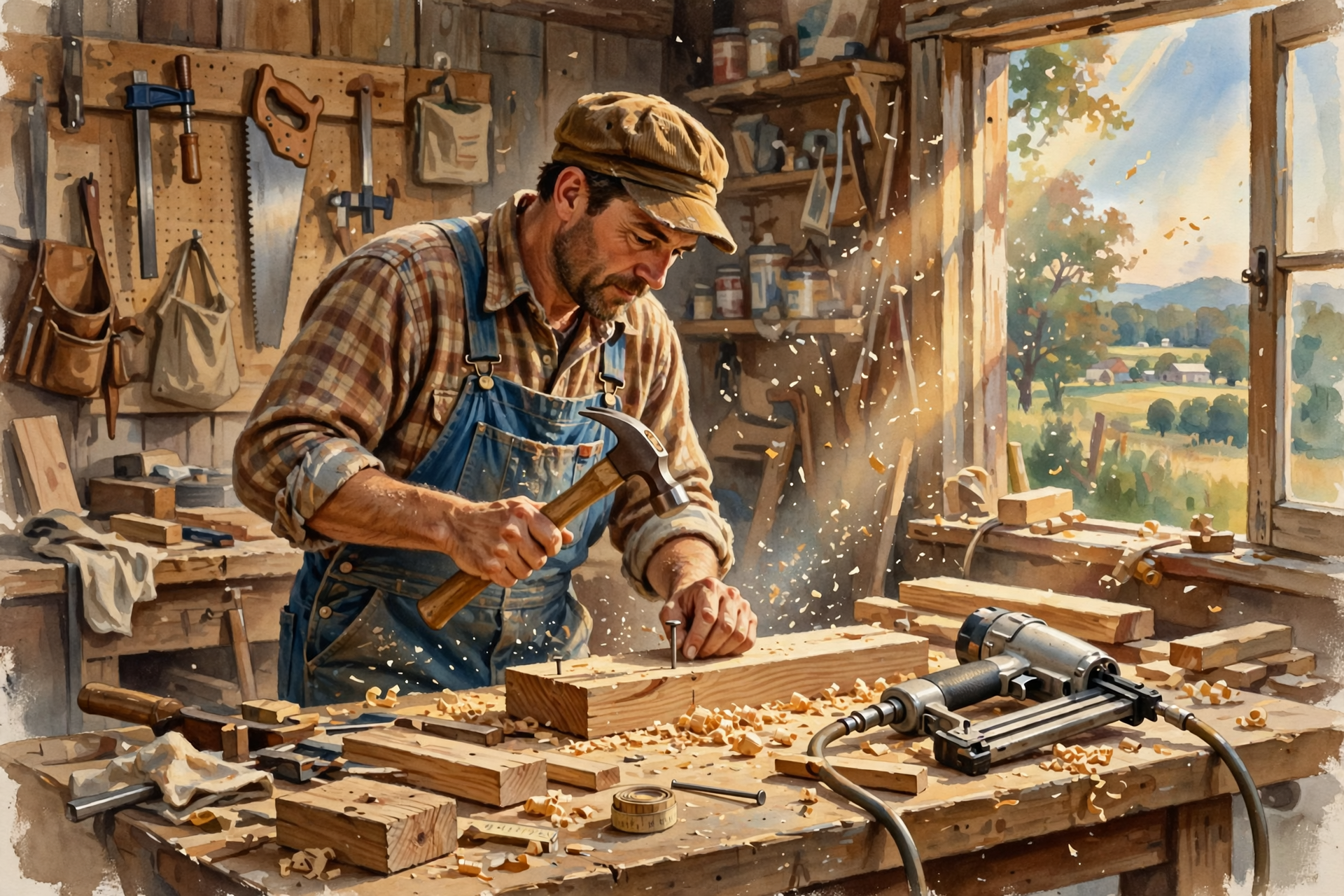
Imagine a carpenter standing beside a pneumatic nail gun.
The carpenter picks up a hammer.
The nail gun fires five nails.
The carpenter gets frustrated.
“I’ll never keep up with that thing.”
That would sound ridiculous.
The nail gun was not invented to humiliate the carpenter.
It was invented to help the carpenter build.
We understood this when machines primarily replaced muscle.
A backhoe can dig faster than a man with a shovel.
Nobody expects a construction worker to feel personally inadequate because of it.
A chainsaw cuts faster than a handsaw.
A tractor pulls more than a farmer.
A pickup truck travels faster than a horse.
Those tools expanded human capability.
Artificial intelligence feels different because the territory it enters is territory we traditionally associated with human identity:
- 🧠 thinking
- ✍️ writing
- 🎨 creativity
- 📚 knowledge
- 💻 programming
- 📊 analysis
- 🗣 communication
That makes the transition emotionally harder.
But perhaps the principle is still the same.
The machine is not your identity. It is your tool.
📉 The Trouble With Telling Everyone to Be Above Average

There is also a rather obvious problem with our obsession with being above average.
Everybody can’t be.
That’s sort of how averages work.
Yet we have created an enormous self-improvement industry around the idea that ordinary isn’t good enough.
You must:
- make more money
- build a bigger business
- develop more skills
- be more productive
- wake up earlier
- exercise harder
- learn faster
- optimize everything
Apparently we’re all supposed to become CEOs, marathon runners, investment experts, professional chefs, public speakers and Instagram models before lunch.
That sounds exhausting.
Then AI comes along and says:
“By the way, I can do several of those things too.”
Maybe that isn’t a reason to panic.
Maybe it’s a reason to finally ask whether we have been measuring human beings correctly.
❤️ Ordinary Humans Do Extraordinary Things Every Day

Our communities do not survive because everybody is exceptional.
They survive because ordinary people do dependable things.
Somebody opens the store in the morning.
Somebody teaches the children.
Somebody repairs the water line.
Somebody drives the ambulance.
Somebody cooks lunch.
Somebody checks on an elderly neighbor.
Somebody answers the phone.
Somebody keeps a promise.
Somebody notices when something isn’t right.
None of those acts necessarily make national news.
Most never become social media posts.
Yet remove enough ordinary dependable people from a community and watch how quickly everything falls apart.
Maybe ordinary deserves more respect.
🤝 Intelligence May Become Cheap. Trust Won’t.

Here is where the AI age gets interesting.
What happens when intelligence becomes incredibly inexpensive?
Suppose nearly everyone eventually has access to powerful tools that can help them:
- write professionally
- analyze finances
- create advertising
- design websites
- research complicated subjects
- translate languages
- build software
- create images
- prepare presentations
If those abilities become common, they become less useful as signals that distinguish one person from another.
Something else becomes more valuable.
Trust.
Can I count on you?
Judgment.
Do you know when the technically correct answer won’t work here?
Experience.
Have you seen this problem before?
Character.
Will you do what you said you would do?
Empathy.
Do you understand what this situation means to another human being?
Connection.
Do I actually know you?
Ironically, artificial intelligence may increase the economic value of very human qualities.
🏘️ The Small-Town Advantage

That may matter especially in communities like ours.
Imagine two people trying to solve a problem.
One is younger and comfortable asking AI for help.
The other has worked in the valley for forty years.
The AI gives the technically correct answer.
The older person looks at it and says:
“That ain’t gonna work here.”
Why?
Because he knows the mountain.
He knows the weather.
He knows what floods.
He remembers who installed the old system.
He knows why somebody did something strange thirty years ago.
AI has information.
The younger person has a powerful new tool.
The older person has context.
Put all three together and something more powerful appears:
Human + Human + AI.
That may be a far more useful model for the future than:
Human vs. AI.
📏 Maybe We Need a Different Measuring Stick
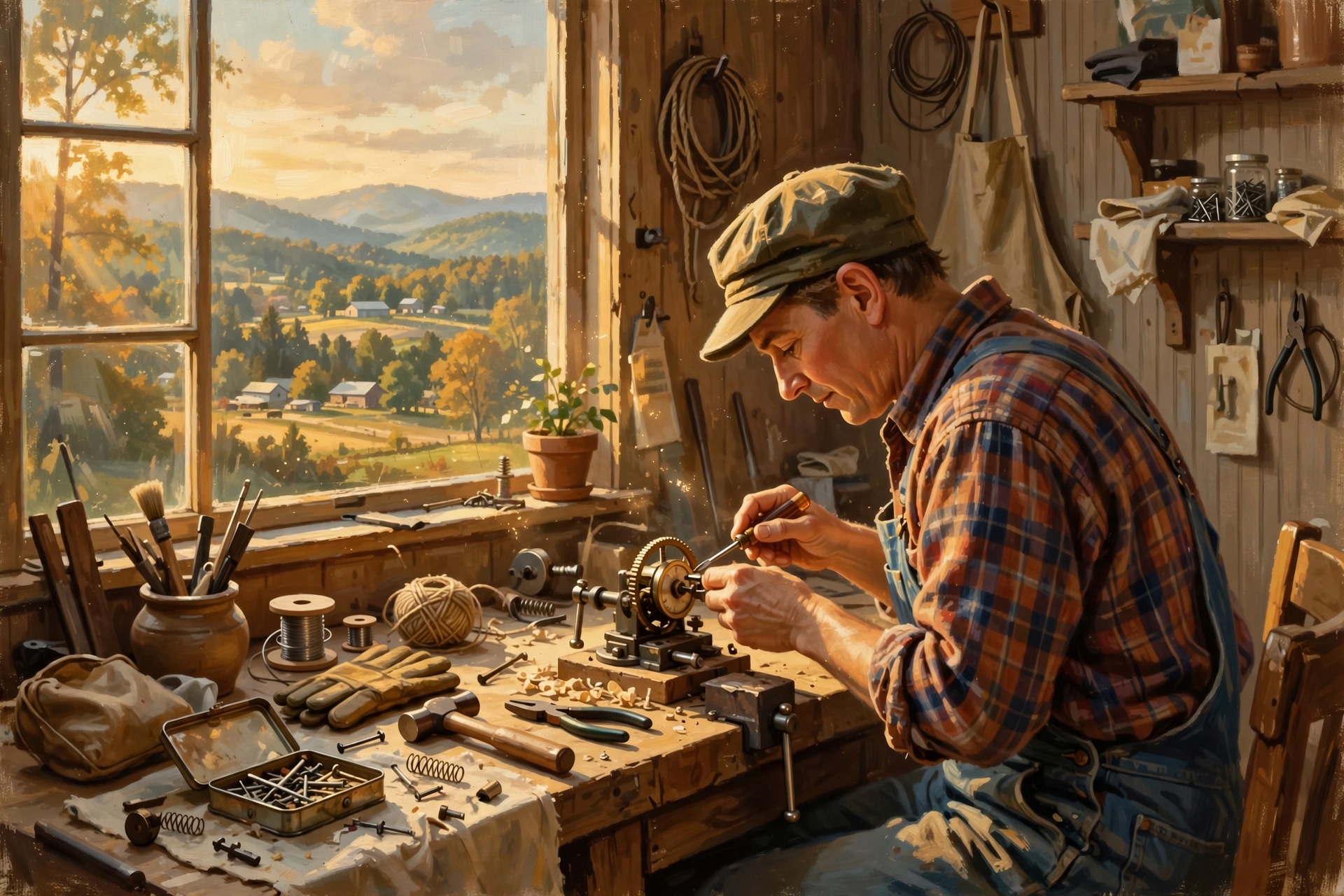
Instead of asking:
“Am I better than my coworker?”
Maybe ask:
“Am I more capable than I was yesterday?”
Instead of:
“Can I outperform AI?”
Ask:
“Can AI help me solve a problem I couldn’t solve yesterday?”
Instead of:
“Am I above average?”
Ask:
“Am I useful?”
“Am I dependable?”
“Am I learning?”
“Am I helping somebody?”
“Am I becoming better at being me?”
Those are competitions we can actually win.
🐘 One Bite at a Time

This connects to another lesson we are going to talk about a lot around here.
How do you eat an elephant?
One bite at a time.
You do not have to become an artificial intelligence expert this week.
You do not have to understand every model, every tool, every acronym or every prediction about the future.
You don’t need to keep up with Silicon Valley.
You don’t even need to keep up with your neighbor.
Pick one problem.
Ask for help.
Solve it.
Tomorrow, solve another one.
Yesterday something took you three hours.
Today it took two.
Yesterday you didn’t understand something.
Today you understand a little more.
Yesterday you couldn’t write the letter.
Today you and AI wrote it together.
That’s progress.
You don’t need to worry about how fast everybody else is eating their elephant.
🌅 Perhaps Average Was Never the Problem

There is nothing wrong with ambition.
There is nothing wrong with trying to improve.
There is nothing wrong with being excellent at something.
But perhaps we should stop telling people their worth depends upon outrunning everybody around them.
Artificial intelligence may eventually become better than nearly all of us at many tasks.
That does not make human beings worthless.
It may simply force us to distinguish between what humans can produce and what humans are worth.
Those were never the same thing.
Maybe the great opportunity of the AI age isn’t figuring out how to become more machine-like.
Maybe it is rediscovering the things machines make us appreciate about being human.
You don’t have to be better than everybody else.
You don’t have to be better than AI.
You need to find something worthwhile to contribute—and keep getting a little better at contributing it.
That seems like a much healthier race to run.
💬 What Do You Think?
Did you grow up feeling pressure to be above average?
Does artificial intelligence make that pressure feel stronger—or does having AI available as a tool actually make you feel more capable?
We want to hear how people across different generations are experiencing this transition.
The future isn’t only being built in Silicon Valley. It’s being figured out around kitchen tables, workplaces, classrooms and communities like ours.
🤖 THE HUMAN ADVANTAGE
Finding Our Place in a World Where Intelligence Is No Longer Scarce
Artificial intelligence is changing how we work, learn, compete and communicate. But perhaps the bigger question isn’t what happens to AI. It’s what happens to us.
This Dunlap.Today series explores how ordinary people can remain useful, connected, confident and unmistakably human in the age of artificial intelligence.
Next in The Human Advantage:
Keeping Up With the Joneses Was Easier When the Joneses Lived Next Door.


0 Comments