
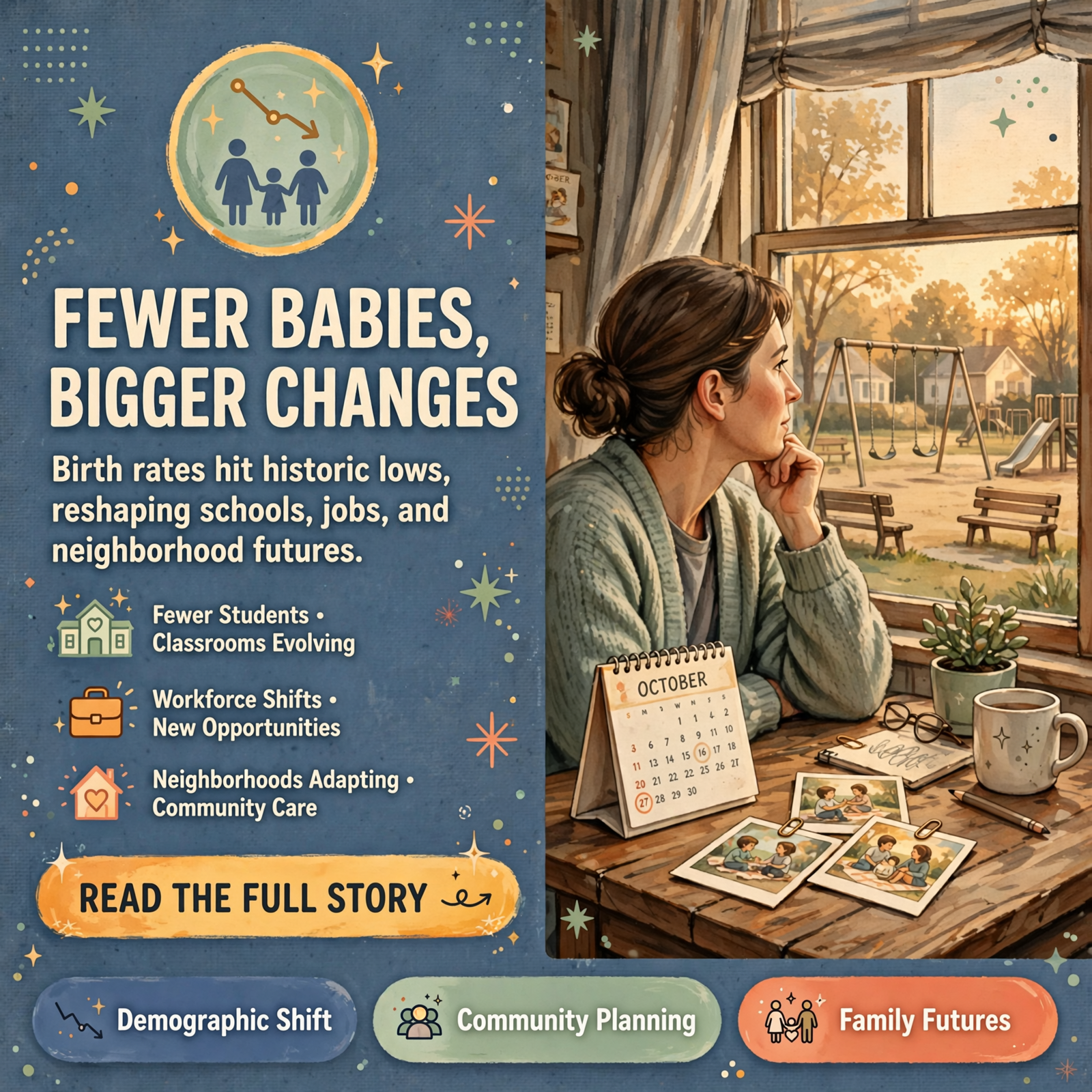
📊 U.S. Fertility Rates Hit Historic Low – What It Means for Communities
New data from the Centers for Disease Control and Prevention reveals a dramatic shift in American family patterns that extends far beyond national headlines. The decline in birth rates across the country reflects changing decisions about parenthood, timing, and family size – trends that ripple through schools, workplaces, housing markets, and the social fabric of communities everywhere.
📉 The Numbers Tell a Striking Story
In 2007, the U.S. total fertility rate stood at about 2.12 children per woman – roughly the level needed for one generation to replace itself. By 2024, that rate had fallen to around 1.63. The decline accelerated in 2025: the CDC recorded just over 3.6 million births and the lowest general fertility rate in the national series dating back to 1909. The shift is not isolated to one region or demographic group – Census Bureau data show fertility has declined nationally while retaining substantial geographic variation across states.
⏰ Why This Matters Locally
Declining fertility rates reshape communities in ways that may not be immediately obvious. Fewer children affect school enrollment, which influences funding, staffing, and the viability of educational programs. They change the demand for childcare services, pediatric healthcare, and family-oriented businesses. They alter the composition of neighborhoods and the intergenerational relationships that have traditionally anchored community life. Over time, they influence workforce size, tax bases, and the balance between working-age adults and retirees – challenges that affect everything from local services to property values.
For rural and smaller communities in particular, declining birth rates can accelerate population loss and economic pressure. Understanding these trends helps residents and local leaders anticipate changes and plan accordingly.
👨👩👧👦 The Shift in Family Timing
One significant driver of the overall decline is postponement of parenthood. Between 2014 and 2024, the share of women without children rose sharply through their 20s and early 30s – even as childlessness declined among women approaching 50. This suggests that many women are delaying motherhood rather than forgoing it entirely, but the timing shift has real consequences: it affects when families buy homes, when they need schools and childcare, and when they build roots in a community.
💭 Community Questions Worth Considering
- How might changing enrollment patterns affect local schools and the services they provide over the next 5-10 years?
- What opportunities exist for communities to attract and retain young families, or to adapt services as demographics shift?
- How are local businesses – from childcare centers to family restaurants to housing developers – preparing for these demographic changes?
- What role might intergenerational mentorship and community connection play in helping younger adults navigate decisions about family and parenthood?
🔮 What Happens Next
Fertility rates are unlikely to reverse quickly. Communities that understand these trends now can begin planning: schools may need to reimagine their role and size; housing markets may shift; workforce development becomes more critical; and the relationship between younger and older residents takes on new importance. Local leaders, educators, business owners, and residents who pay attention to these patterns will be better positioned to adapt and thrive.
🌍 A Broader Pattern
The U.S. fertility decline reflects patterns seen across developed nations – women pursuing higher education and careers, access to contraception, economic uncertainty, and changing cultural attitudes toward parenthood all play roles. The geographic variation shown in CDC data suggests that local factors – cost of living, job availability, cultural values, and community support systems – also shape family decisions. This is not a uniform national story; it plays out differently in different places.
For communities in the Sequatchie Valley and surrounding areas, these national trends offer a moment to reflect: What kind of community do we want to be? How do we support families at every stage? How do we build connections across generations? And how do we plan for a future that may look different from the past?
🤔Source
The World in Maps – An informational post sharing statistics and a map regarding declining U.S. fertility rates.




0 Comments