
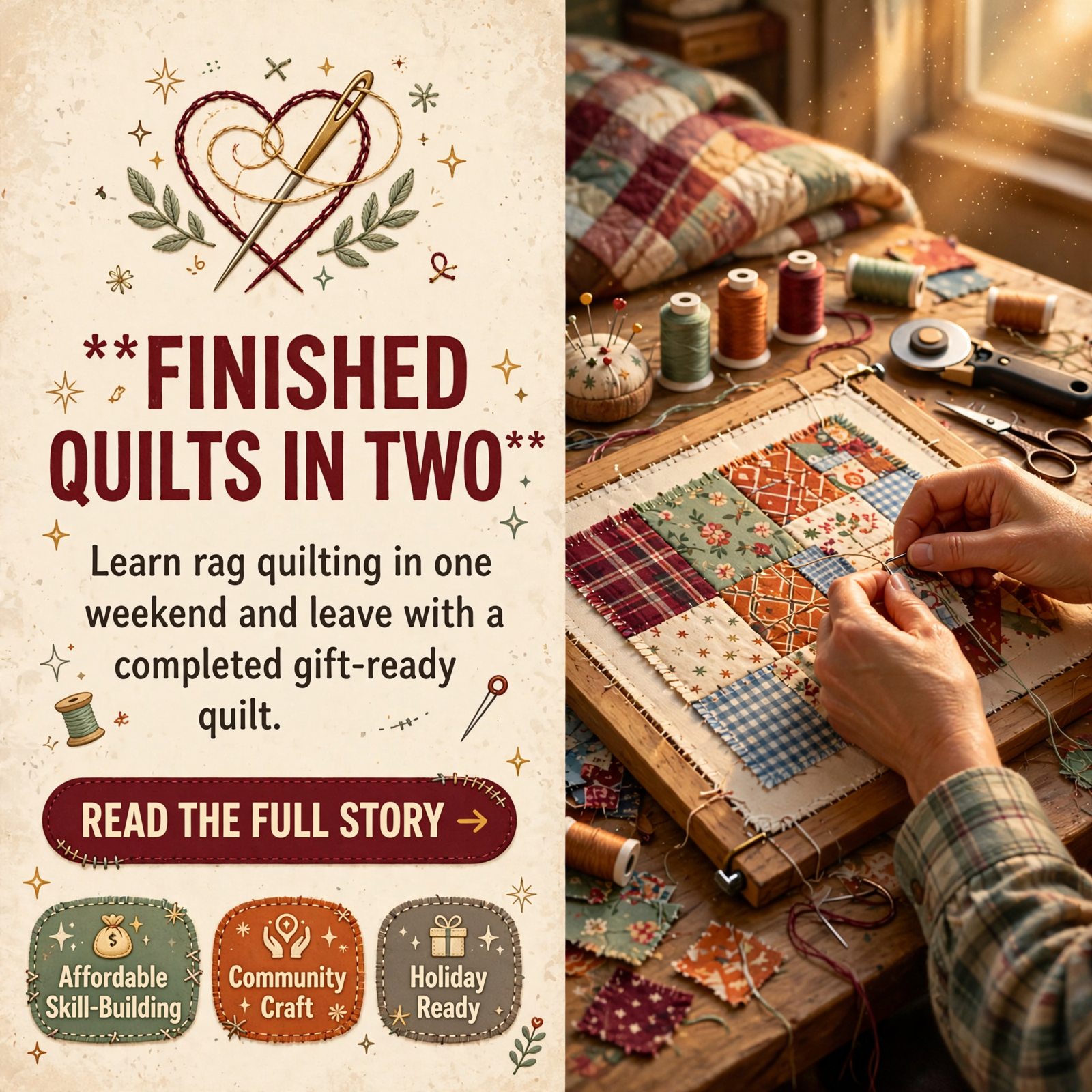
🧵 Rag Quilt Workshop Launches in Sequatchie County – Get Holiday Gifts Ready in Two Sessions
Agricultural Extension Services is hosting a two-part rag quilt workshop designed to help local crafters get ahead of the holiday gift rush. The hands-on classes, held at the Sequatchie County Fair Building, offer an affordable way to create a finished quilt in just two full days of instruction.
📍 What’s Happening
Agricultural Extension Services is offering an adult rag quilt workshop on October 10th and 17th, from 10 a.m. to 3 p.m., in the quilt room at the Sequatchie County Fair Building. The $10 fee covers instruction in a technique that transforms fabric scraps into a finished quilt measuring approximately 52″ x 60″. Limited to 10-12 participants, the workshop fills a gap for quilters who want structured guidance and community learning in a single weekend format. ✨
💡 Why This Matters
For many people in Sequatchie County, quilting represents both a practical craft and a meaningful way to create gifts that carry personal value. A two-session workshop removes barriers to entry-no need to commit to a semester-long class or figure out techniques alone. The $10 cost makes skill-building accessible, and the structured format means participants leave with a completed project rather than an unfinished pile of fabric. For those who already quilt, the workshop offers a chance to learn a specific technique and connect with others who share the craft. For beginners, it’s an invitation to discover whether quilting might become a lasting hobby or tradition.
❤️ Community Connections
Agricultural Extension Services has long served Sequatchie County as a trusted source for practical education in agriculture, family life, and community skills. This rag quilt workshop reflects the Extension’s broader mission: translating university research and expertise into real-world learning opportunities that strengthen local life. The workshop also taps into a quiet but persistent tradition in rural Tennessee-quilting as both craft and social practice. By hosting the class at the Sequatchie County Fair Building, the Extension connects the workshop to a familiar community gathering place, making participation feel natural and accessible rather than formal or intimidating.
🎯 What Residents Should Know
Session dates and times: October 10th and 17th, 10 a.m.-3 p.m.
Location: Sequatchie County Fair Building, quilt room
Cost: $10
Spots available: 10-12 participants (limited enrollment)
What to bring: Participants should bring their own sewing machine (if available), fabric, thread, rotary cutter, cutting mat, quilting ruler, fabric scissors, pins, marking pencil, and painter’s tape. The workshop requires 12 yards of fabric total per person: 6 different flannel fabrics (1 yard each) and 6 yards of solid flannel for backing. Agricultural Extension Services will provide extra sewing machines for those who need them, though supply is limited. 🧵
How to sign up: Contact Kailee Flowers, Family & Consumer Sciences Agent, at (423) 949-2611 or kflowe12@utk.edu. If you’re missing supplies, email Kailee-she may be able to help or advise on alternatives.
🗓️ What Happens Next
The first session begins October 10th. Participants will cut and begin assembling their quilt squares. The second session on October 17th will focus on finishing techniques and completing the project. After the workshop ends, participants will have a finished, wearable quilt-ideal for holiday gift-giving or personal use. Agricultural Extension Services may offer additional workshops based on interest and feedback from this session.
🌟 Opportunities for Connection
This workshop offers several ways to strengthen community ties. For experienced quilters, it’s a chance to refine technique and meet others who share the craft. For people new to quilting, it’s a low-pressure introduction with expert guidance and peer support. For those looking to give meaningful handmade gifts, the workshop provides both the skill and the community context-knowing you made something with neighbors and local instruction adds emotional weight to a gift. For families or friends interested in learning together, the workshop accommodates multiple participants, turning a craft class into a shared experience.
💭 Community Questions Worth Considering
- How might a finished quilt made in this workshop become part of a family tradition or holiday memory?
- Are there quilters in your circle who might enjoy attending together, or who could mentor someone new to the craft?
- What role does hands-on learning and skill-building play in strengthening community identity and self-sufficiency in Sequatchie County?
- How might this workshop inspire other Extension-led classes in traditional crafts or practical skills that residents have expressed interest in learning?
🧵 Community Threads: The Extension-to-Crafter Pipeline
Agricultural Extension Services operates as a quiet but essential bridge between university research and everyday life in rural communities. By offering affordable, accessible workshops in practical skills-quilting, gardening, food preservation, family wellness-the Extension strengthens local capacity and self-reliance. This rag quilt workshop exemplifies that role: it takes a traditional craft, pairs it with structured instruction, and delivers it in a community space at a price point that welcomes participation across income levels. For residents who attend, the workshop becomes more than a class-it’s an affirmation that their county values skill-building, creativity, and the kind of knowledge that gets passed down and shared.
🧵 Community Threads: Quilting as Local Culture
Quilting carries deep cultural meaning in Appalachian and rural Tennessee communities. Quilts represent resourcefulness (using scraps), creativity (designing patterns), patience (the time required), and connection (often made as gifts or in group settings). By hosting a rag quilt workshop, Agricultural Extension Services honors and sustains that cultural practice. Participants who complete the workshop may inspire others-family members, friends, neighbors-to explore quilting themselves. Over time, workshops like this one help ensure that traditional skills and the community bonds they create don’t fade but instead evolve and find new practitioners among younger generations or newcomers to the area.


0 Comments