
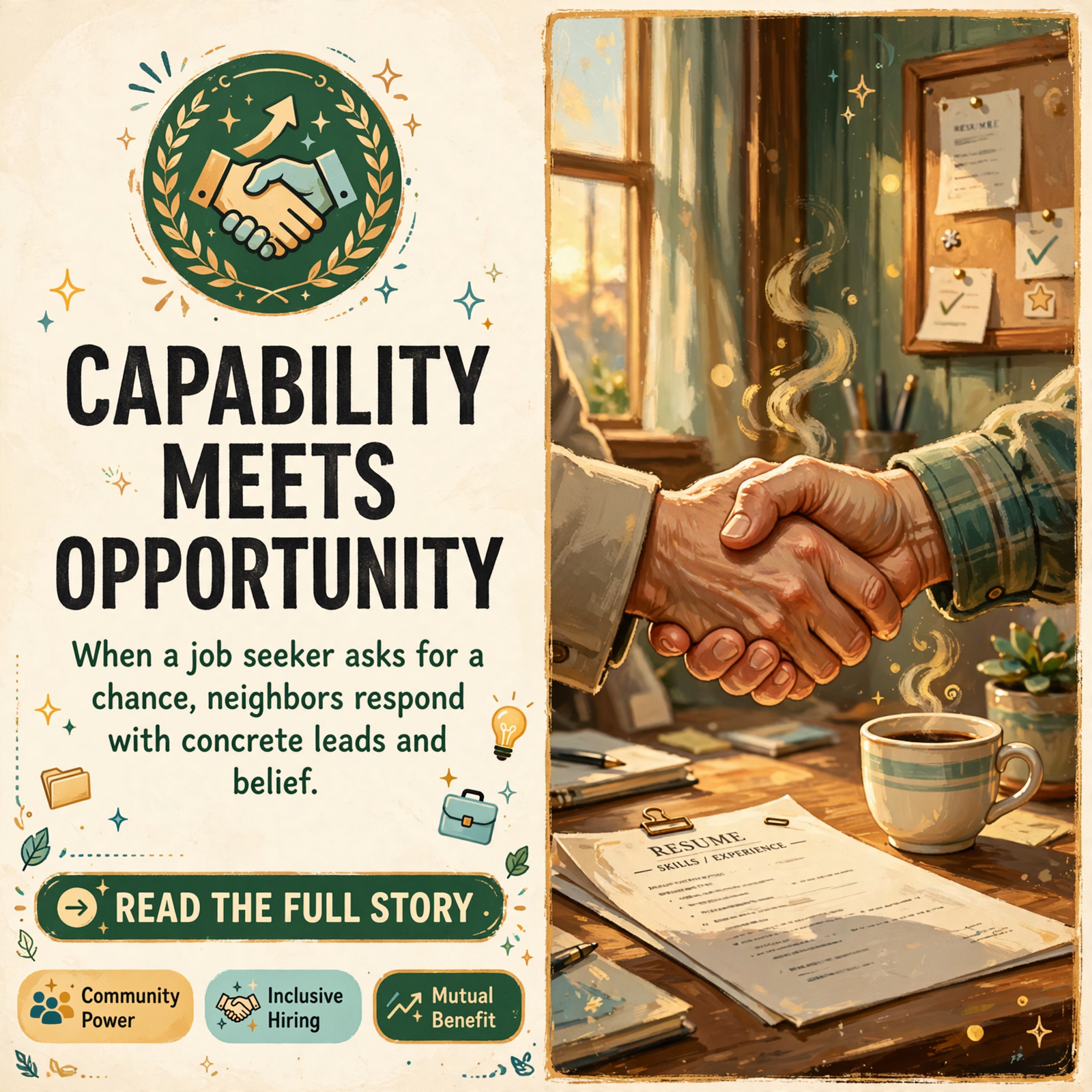
🤝 Local Job Seeker Reaches Out: Wheelchair User Seeks Opportunity to Prove Work Ethic
A community member recently posted a straightforward appeal in a local group: looking for work, willing to prove themselves, and asking for a chance. The post sparked immediate responses from neighbors who recognized both the determination behind the request and a potential connection to local opportunity.
📍 What’s Happening
William Pritchett posted a job inquiry, emphasizing that despite using a wheelchair, he works with dedication and is eager for an employer willing to give him a genuine opportunity. The post was direct and honest-a request for a chance to demonstrate capability rather than a complaint about barriers. 🙏
Within hours, community members responded with a specific suggestion: the Cooperative Response Center (Dunlap), a professional services organization in the area. Multiple commenters noted that the organization is actively hiring, turning a general plea into a concrete lead.
💡 Why This Matters
Employment is one of the most direct paths to independence, dignity, and economic stability. For people with disabilities, finding employers willing to look past assumptions and focus on actual capability can be the difference between opportunity and exclusion. When a job seeker is willing to be vulnerable and ask for a chance, and when community members respond with specific, helpful information, something important happens: barriers begin to shift. 💪
This exchange also reflects a broader community value-neighbors helping neighbors find pathways forward, not through pity, but through practical connection and belief in capability.
🤝 Community Connections at Work
What made this post meaningful wasn’t just the request itself, but the response. Community members who knew about hiring opportunities stepped in with concrete information. This is how local networks strengthen: someone asks, someone else knows, and a connection forms. The Cooperative Response Center‘s active hiring status became visible to someone who needed to know about it-exactly the kind of informal but powerful community intelligence that social networks can provide. ✨
For employers in the area, this moment also reflects something worth noting: people with disabilities are actively seeking work and willing to prove themselves. The question is whether local businesses are ready to hire based on capability rather than assumption.
👥 Human Impact
Employment affects far more than a paycheck. It shapes daily routine, social connection, sense of purpose, and economic independence. For someone using a wheelchair, finding an employer who focuses on what you can do-rather than what you cannot-can transform not just work life, but overall quality of life and community belonging. 🌟
At the same time, employers who hire people with disabilities often report that they gain dedicated, reliable employees and a broader perspective on problem-solving and workplace culture. This is not charity; it is mutual benefit.
📢 What Residents Should Know
If you or someone you know is seeking employment and has received a suggestion about a local organization that is hiring, the next step is typically to reach out directly. The Cooperative Response Center, located in Dunlap, was named by community members as an active employer. Job seekers interested in exploring opportunities are encouraged to contact them directly to learn about available positions and application processes.
Community members who know of job openings at their workplaces can also play a role by sharing that information in local groups and networks-exactly as happened in this post. 📣
🔄 What Happens Next
The immediate next step is up to William Pritchett: whether to follow up on the lead provided by community members. Beyond that, this moment raises a broader question for the area: How many other job seekers are waiting for someone to believe in them? How many local employers are ready to hire based on capability? How can community networks continue to bridge those gaps?
💭 Questions Worth Asking
- How can local employers and job seekers connect more systematically, beyond social media posts?
- What barriers do people with disabilities face in the local job market, and how can the community address them?
- Are there other job seekers in the area with similar stories who might benefit from community support?
- How can local organizations make their hiring processes and accessibility features more visible to potential applicants?
- What role can community networks play in matching capability with opportunity?
🌱 Long-Term Community Impact
When a community consistently connects people with opportunity-regardless of disability status-several things shift over time. Employment rates rise. Economic independence increases. Social isolation decreases. Employers discover that hiring based on capability expands their talent pool. And perhaps most importantly, the community’s culture begins to reflect a belief that everyone has something to contribute. 💼
This single post and its responses are a small moment, but they reflect a larger pattern: neighbors helping neighbors find pathways forward, and community members willing to share information that matters. That pattern, repeated across many moments and many people, shapes the kind of place a community becomes.
🧵 Community Threads: The Neighbor-to-Neighbor Network
The Informal Job Market: Much of how people find work in small communities happens through personal networks and word-of-mouth-someone knows someone, or sees a post, and shares information. This post shows that thread in action. When community members know about hiring and share it freely, they become part of an invisible but powerful employment infrastructure. The strength of that network often determines who gets opportunities and who doesn’t.
Capability Over Assumption: William Pritchett’s post directly challenged a common assumption: that wheelchair use means reduced work capacity. His willingness to state his capability clearly, and community members’ willingness to respond with concrete opportunity rather than sympathy, reflects a thread of mutual respect and practical thinking. Over time, when this happens repeatedly, it changes how a community thinks about disability and employment.
The Role of Local Organizations: The Cooperative Response Center‘s active hiring status became visible through this exchange. Local organizations that are hiring, growing, or changing often rely on community networks to reach potential employees. When those organizations are known to be inclusive and opportunity-focused, they become anchors in the community’s employment ecosystem.
🤔Source
William Pritchett – A wheelchair user is looking for a job and asking for an opportunity to prove themselves.

0 Comments