
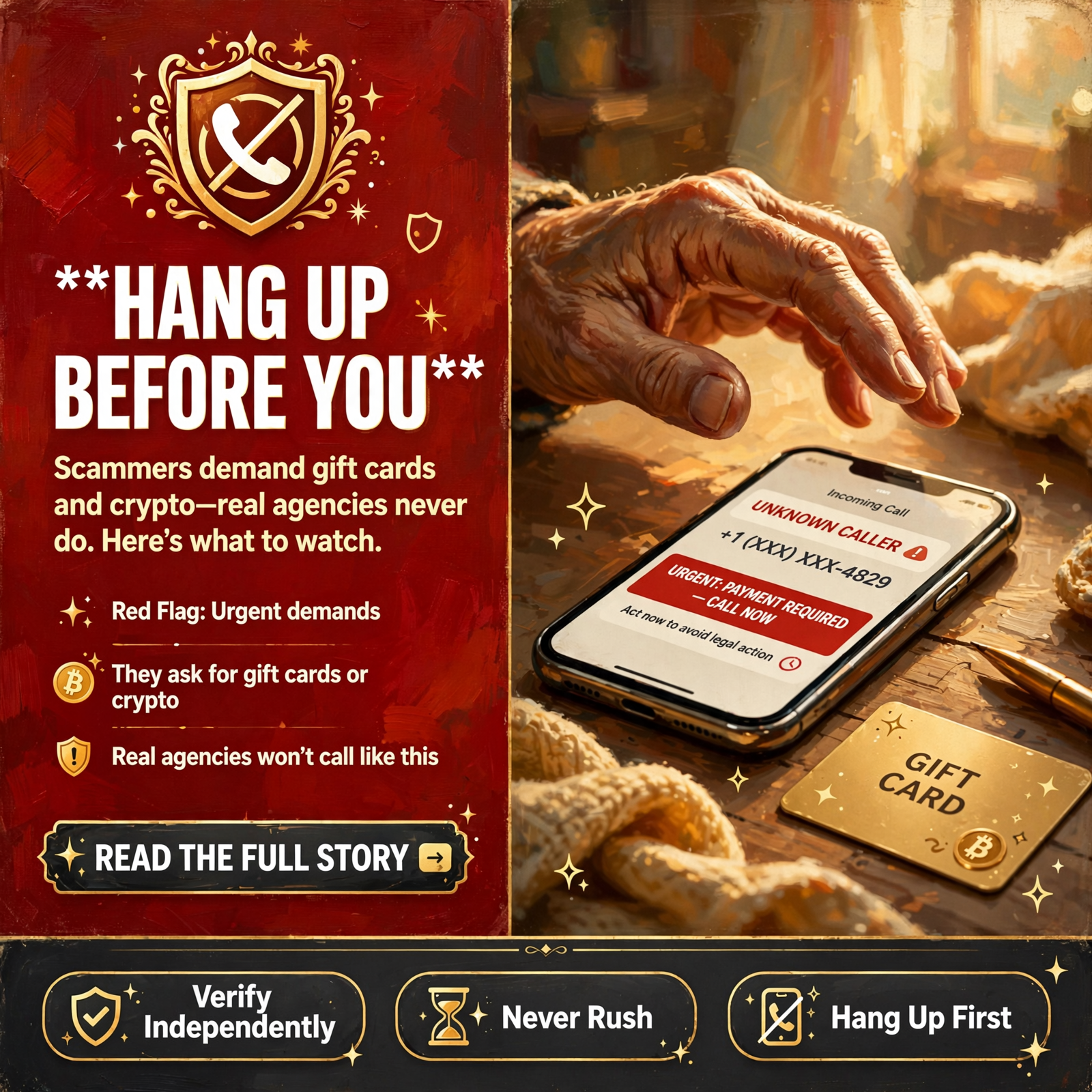
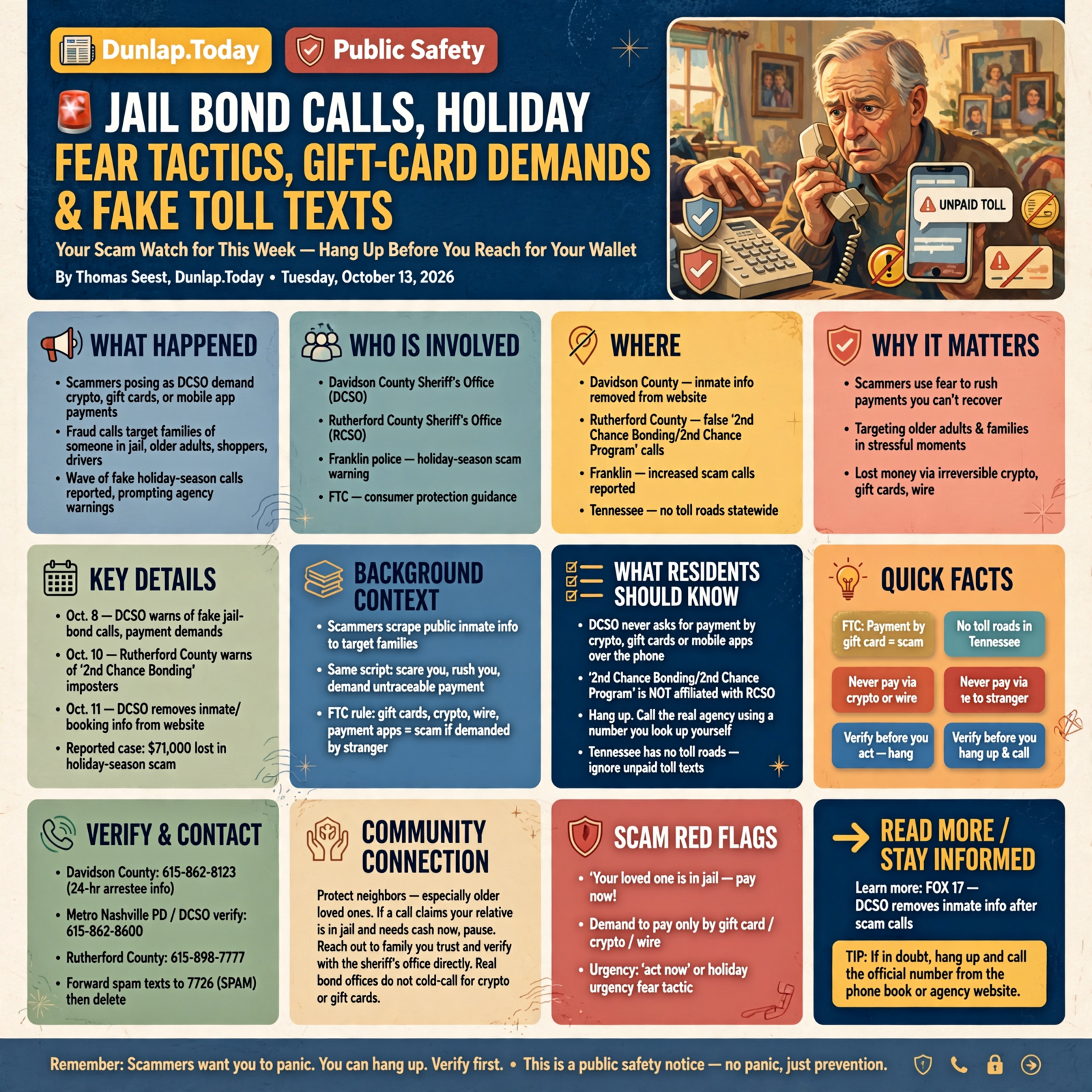
🚨 Jail Bond Calls, Holiday Fear Tactics, Gift-Card Demands and Fake Toll Texts: Your Scam Watch for This Week

Or: When a Stranger Says Pay Now With Crypto, Gift Cards or a Wire — Hang Up Before You Reach for Your Wallet
By Thomas Seest, Dunlap.Today · Tuesday, October 13, 2026
Scammers change their costume every week, but they keep the same script: scare you, rush you, then tell you how to pay in a way you can’t get back. This week’s batch is aimed at families with a loved one in trouble, older folks who answer the phone, shoppers, and anybody who drives. None of it needs a panic response — just a calm hang-up and a number you look up yourself.
Here’s what’s on the line: fake jail-bond and “rehab” calls that pushed Davidson County to take inmate info off its website, a holiday-season fear-call warning from Franklin police after a $71,000 case, the FTC’s simple rule that gift cards, crypto, wires and payment apps demanded by a stranger equal a scam, and those stubborn “unpaid toll” texts — even though Tennessee has no toll roads.
⏱️ What this means for you in 30 seconds
- Families of someone in jail: Davidson County Sheriff’s Office never asks for payment by crypto, gift cards or mobile apps over the phone. Rutherford County says a “2nd Chance Bonding/2nd Chance Program” pitch is not affiliated with the sheriff. Verify at 615-862-8600 (Metro Nashville PD / DCSO verify) or 615-898-7777 (Rutherford).
- Anyone who answers the phone: Franklin police say holiday-season scam calls are rising. Hang up. Call the real agency on a number from the phone book or its website — not caller ID.
- Payment tell: If they say you can only pay by gift card, cryptocurrency, wire, bank transfer or a payment app, the FTC says that’s a scam.
- Drivers: Tennessee has no toll roads. An “unpaid toll” text is fake. Don’t click. Forward to 7726 (SPAM) and delete.
🚔 “Your Loved One Needs Bond — Pay Now in Crypto”

On Oct. 8, the Davidson County Sheriff’s Office warned residents about callers posing as DCSO employees and demanding payment by cryptocurrency, gift cards or mobile apps. DCSO said flatly that it never asks for payments over the phone.
By the weekend of Oct. 11, the problem was bad enough that DCSO told FOX 17 it had removed active inmate and recent booking information from its website. Officials said scammers had automated a way to scrape that public info and use it against arrested people and their families. Arrestee information in Davidson County is still available by calling the 24-hour number 615-862-8123. Suspicious calls can be checked with DCSO or Metro Nashville Police at 615-862-8600.
Rutherford County Sheriff’s Office posted a related warning on Oct. 10. Callers using the name “2nd Chance Bonding” or “2nd Chance Program” have promised help getting an incarcerated loved one into rehab while falsely claiming to work for RCSO. The sheriff’s office says that company does not work for RCSO. If you’re unsure, call 615-898-7777 before you send money or share personal information.
It’s the old “Cousin Billy is in a jam” story — except Cousin Billy never called, and the stranger on the line wants irreversible money first.
What it means for you: If someone calls about a relative in jail, hang up before you open a crypto app or walk to the store for gift cards. Call the jail or sheriff yourself on a number you find independently. Ask the family member you trust to help you check. Real bond offices don’t cold-call for crypto.
👉 Read more (FOX 17: DCSO removes inmate site after bond scams)
🍂 Holiday Season Means More Fear Calls — Franklin Police Are Already Seeing It

Franklin police posted a holiday scam advisory on Tuesday, Oct. 6, saying they are fielding scam reports nearly every day and expect the problem to worsen as the holidays approach. Callers pose as law enforcement or government officials and claim residents face arrest warrants, missed jury duty or unpaid fines. The pressure tool is the same every time: fear plus urgency.
“Scammers often use fear and urgency to pressure people into acting before they have time to think,” Police Chief Deb Faulkner said. “If someone calls demanding money or sensitive personal information, hang up and verify the claim independently.”
Franklin’s red-flag list includes unsolicited asks for money, bank or credit card numbers, Social Security numbers, gift cards, cryptocurrency, cash or jewelry. The department’s five steps: hang up; never send money or buy gift cards at a caller’s direction; don’t trust caller ID; contact the agency on a number you find yourself; talk with a trusted family member or friend before doing anything.
The advisory follows a September case in which an 83-year-old Franklin man lost $71,000 after callers posing as FBI agents kept him on the phone for days — sometimes for six hours at a stretch — and directed him to wire money from his bank. Williamson County Sheriff’s Office has also repeated jury-duty scam alerts (Sept. 23 and Oct. 5), stressing that courts and law enforcement will never require payment through gift cards, cryptocurrency, payment apps or wire transfers.
What it means for you: Think of a holiday fear call like a stranger banging on the porch at supper and demanding you hand over the pie money before dessert. You’d ask who’s there and call a neighbor first. Same rule here. Share Franklin’s five steps with parents and grandparents before Thanksgiving travel and Christmas shopping heat up. Report targets to Franklin Police at 615-794-2513 if you’re in that area, or your local department.
👉 Read more (Franklin Beacon: holiday scam warning after $71K fraud)
💳 The One Tell That Almost Never Lies: How They Ask You to Pay

On July 22, the Federal Trade Commission published a plain rule that fits every story above. Someone contacts you unexpectedly and says you have to pay to fix a problem or claim a prize — then insists the only way to pay is by bank transfer, wire transfer, cryptocurrency, a payment app or a gift card. Reports to the FTC show that’s a scam.
The FTC said people reported the largest losses — more than $4 billion in total last year — to scams paid with bank transfers and cryptocurrency. Many involved impostors posing as a government agency, a well-known business, or both. The story changes. The payment method stays hard to reverse on purpose.
FTC gift-card guidance is just as blunt: only scammers tell you to buy a Google Play, Apple, Amazon or similar card and read them the numbers off the back. No real business or government agency collects that way. If you already did it, report the card company right away with the card and store receipt, then file at ReportFraud.ftc.gov.
What it means for you: You don’t need to memorize every new scam name. Memorize the payment tell. Gift cards for a “fine,” crypto for a “bond,” a wire to “protect your money” — that’s the barn door slamming. Hang up. Call your bank or the real agency on a number from your statement or their real website. Prefer a credit card when you do buy something online, because you can dispute charges.
👉 Read more (FTC: how someone asks you to pay) · FTC: gift card scams
🛣️ “Unpaid Toll” Texts Keep Coming — Tennessee Has No Toll Roads

If your phone buzzes with a “final notice” about an unpaid toll, EZ Pass balance or parking/toll violation with a link or QR code, delete it. TDOT has said plainly: there are no toll roads in Tennessee. The Tennessee Attorney General’s Consumer Protection Division warned about the same phishing texts, and the Tennessee Supreme Court and Administrative Office of the Courts warned in April 2026 about texts and emails that fake an outstanding parking or toll ticket and pretend to come from the state courts.
Chief Justice Jeff Bivins said state courts do not send text messages or emails about past-due tickets. The TBI advice is simple: ignore it, don’t click or scan, report it at ic3.gov, and delete it. The AG’s office points people to the FTC tips: don’t click unexpected links, check any real toll agency only through a number or site you already know, report junk texts (forward to 7726 / SPAM), and file complaints at ic3.gov when useful.
These texts have been circulating for more than a year and still show up in weekly scam roundups. They’re like roadside produce signs for a farm that doesn’t exist — painted pretty, but there’s no orchard behind them.
What it means for you: Valley drivers on U.S. 127, State Route 111 or I-24 don’t owe a Tennessee toll, because there isn’t one. Don’t click. Don’t scan the QR code. If you’re worried about a real ticket, look up your county court clerk or the agency yourself — never through the text.
👉 Read more (TN AG: toll road balance texting scams) · TDOT / WSMV: no toll roads in Tennessee · TN Supreme Court: ticket scam alert
✅ Your Front-Porch Scam Checklist

- ✅ Hang up on any caller who demands gift cards, crypto, a wire, a payment app or cash handed to a “courier.”
- ✅ Never trust caller ID. Look up the sheriff, court or utility on their real website or your bill.
- ✅ Jail or bond story? Call the jail yourself. Davidson verify: 615-862-8600. Rutherford: 615-898-7777.
- ✅ Talk with a trusted relative before sending money — especially before the holidays.
- ✅ Unpaid-toll texts: don’t click; forward to 7726; delete. Tennessee has no toll roads.
- ✅ Already paid? Call your bank or card company now, report the gift-card company, then file at ReportFraud.ftc.gov.
The practical rule: Real agencies will let you hang up and call them back on a number you find yourself. Scammers won’t.
— Dunlap.Today
📚 Plain-English Glossary
- Impersonation scam: A stranger pretends to be a sheriff, court, FBI agent, bank or store to scare you into paying or sharing personal information.
- Cryptocurrency (crypto): Digital money that’s hard to reverse once sent. Legitimate local agencies don’t collect bonds or fines this way over the phone.
- Gift-card payment demand: Being told to buy store cards and read off the numbers. The FTC says only scammers collect that way.
- Smishing: Phishing by text message — fake links or QR codes meant to steal logins or card numbers.
- Spoofed caller ID: Technology that makes a scam call look like it’s coming from a local or official number.
❓ Frequently Asked Questions

Would the real sheriff’s office ever call and ask for gift cards or crypto?
No. Davidson County Sheriff’s Office says it never asks for payments over the phone by cryptocurrency, gift cards or mobile apps. Rutherford County says the “2nd Chance Bonding/2nd Chance Program” callers are not affiliated with the sheriff. Hang up and verify at the numbers above.
Why did Davidson County remove inmate info from its website?
DCSO told FOX 17 that scammers had automated a way to use public booking information against arrestees and their families. Active inmate and recent booking pages were taken down. You can still get arrestee information by calling 615-862-8123.
Are holiday scams really worse than the rest of the year?
Franklin police say they already get scam reports nearly every day and expect more as the holidays approach, when people are busy and more likely to act fast. Fear-and-urgency calls about warrants, jury duty or fines are the pattern they’re watching.
Is there any situation where I should pay a fine with a gift card?
No. The FTC says no real business or government agency will tell you to pay with gift cards. Same goes for crypto, wires and payment apps demanded by an unexpected caller.
I keep getting unpaid-toll texts. Should I worry about my tags?
Not because of the text. Tennessee has no toll roads. Don’t click the link. Forward the text to 7726 and delete it. If you think you might have a real ticket, look up your county court clerk yourself.
I already sent money. What now?
Contact your bank, wire service or gift-card company immediately and say it was fraud. Then report it at ReportFraud.ftc.gov and, for internet-related schemes, ic3.gov. AARP’s Fraud Watch Network Helpline is free at 877-908-3360, Monday through Friday, 7 a.m. to 7 p.m. Central.
🔗 Other Resources

- FOX 17: DCSO bond/inmate scam coverage
- Franklin Beacon: holiday scam warning
- FTC: how someone asks you to pay
- FTC: avoiding gift card scams
- Report a scam: ReportFraud.ftc.gov
- FBI Internet Crime Complaint Center (IC3)
- Tennessee AG: Scams, Schemes & Swindles
- BBB Scam Tracker
- AARP Fraud Watch Network Helpline (877-908-3360)
🌄 Real Help Lets You Call Back

Here’s the calm takeaway: every real agency on this list will survive a hang-up. The sheriff’s office, the court, the FTC advice desk — they all want you to verify on a number you trust. Only the scammer needs you to stay on the line, keep it secret, and pay in a way that vanishes.
Share this with a neighbor who picks up unknown numbers, or a grandparent before the holiday phone tree gets busy. We’ll keep watch and bring you what’s new. Read Dunlap.Today and sign up for our newsletter for plain-English scam alerts and Valley news.



0 Comments