

When Everyone Has Superpowers, Not Everyone Will Be a Superhero

There was a time when being a sophisticated criminal required a certain amount of sophistication.
You needed skills. Connections. Equipment. Sometimes an entire organization.
If you wanted to impersonate somebody convincingly, you probably needed a talented impersonator. If you wanted to forge a photograph, you needed specialized equipment or editing skills. If you wanted to conduct an elaborate cyberattack, you generally needed someone who understood computers considerably better than the average person.
Artificial intelligence is changing that equation.
Today, many capabilities that once required specialized knowledge, substantial money, or an entire team are becoming available to ordinary people sitting at ordinary computers, asking questions in ordinary English.
That’s wonderful if you’re trying to start a business, learn a new skill, or solve a complicated problem.
It’s considerably less wonderful if you’re trying to steal somebody’s retirement savings.
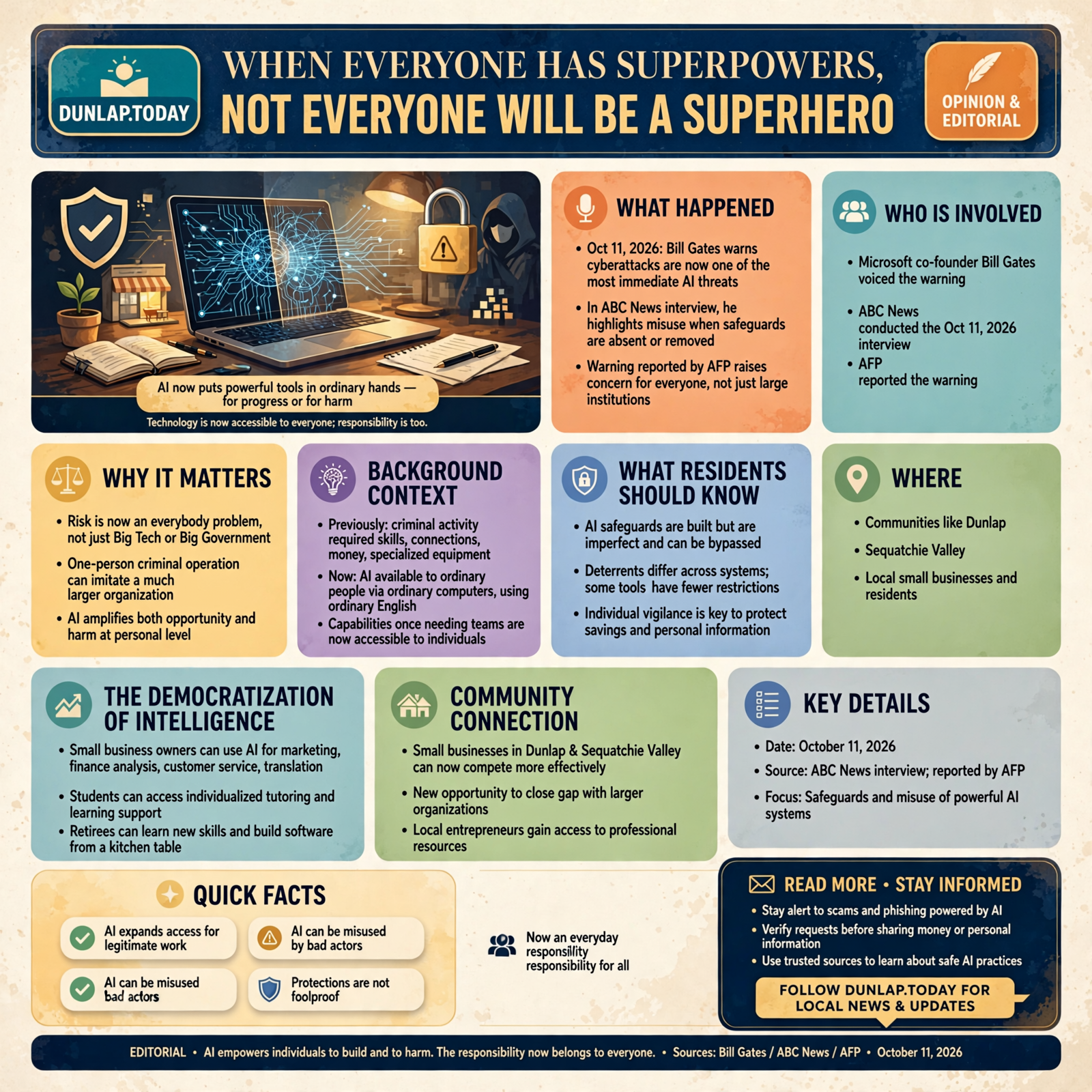
Microsoft co-founder Bill Gates recently warned that cyberattacks could become one of the most immediate threats associated with artificial intelligence. In an October 11, 2026, interview with ABC News, he emphasized the danger of people deliberately misusing powerful AI systems, particularly when safeguards are absent or removed.
His warning, reported by AFP, raises an important issue. But I think there’s another dimension that deserves more attention.
This isn’t just a Big Tech problem, a Big Government problem, or a Big Business problem anymore.
It’s becoming an everybody problem.
Because the same technology that can help a one-person business compete with a corporation can also help a one-person criminal operation imitate something much larger.
And while we’re busy wondering whether artificial intelligence will eventually become smarter than human beings, we might be overlooking something considerably closer to home.
Human beings are already quite capable of making bad decisions.
Now we’re giving them better tools.
The Democratization of Intelligence Has a Catch

One of the most exciting things about artificial intelligence is that it reduces the advantages historically enjoyed by large organizations.
A small business owner can use AI to write marketing materials, analyze financial information, improve customer service, translate documents, and research competitors.
A student can receive individualized tutoring. A retiree can learn new skills. Someone who has never written a line of computer code can begin building useful software.
Work that previously required expensive consultants or specialized employees may now be within reach of an individual working from a kitchen table.
That’s an extraordinary development.
For communities like Dunlap and the Sequatchie Valley, it could be particularly important. Our small businesses and entrepreneurs have often competed against organizations with considerably more money, more employees, and better access to professional services.
Artificial intelligence offers a chance to narrow that gap.
But here’s the catch.
AI doesn’t ask whether you’re a good person before making you more capable.
AI providers build safeguards to discourage harmful uses, and those safeguards matter. But systems differ, protections are imperfect, and determined criminals can seek out tools with fewer restrictions.
A person trying to build a legitimate business and a person trying to manufacture a convincing scam may benefit from some of the same underlying technological advances.
Artificial intelligence can democratize capability.
It cannot guarantee character.
Remember When Scams Were Easier to Recognize?

Most of us remember the emails supposedly coming from a foreign prince, a distant millionaire relative, or a mysterious international lottery.
The grammar was terrible. The spelling was worse. The story usually involved a remarkable fortune that could be yours if you would just send a little money first.
Those messages were sometimes almost entertaining.
Not particularly convincing, perhaps, but entertaining.
Artificial intelligence changes the economics of that kind of deception.
A scammer no longer needs to be a skilled writer to produce a professional-looking message. AI can help draft persuasive language, correct mistakes, translate messages, and personalize communications for different audiences.
Instead of sending the same awkward email to thousands of strangers, a dishonest person may be able to create messages that appear to come from a familiar business, a local organization, or someone the recipient already knows.
The FBI has specifically warned that generative AI allows criminals to produce more believable fraudulent communications while reducing the time and effort required to create them.
Its December 2024 public warning describes criminals using AI-generated text, photographs, audio, and video to support financial fraud.
That doesn’t mean every convincing message is fraudulent or that every scammer is now a technological genius.
It means some of the clues we once relied upon are becoming less reliable.
The Nigerian prince may finally have hired a decent editor.
Except now the editor might be artificial intelligence.
What Used to Require a Team May Now Require a Subscription

Think about how technology has changed ordinary business operations.
Years ago, producing a professional advertisement might have required a graphic designer, a photographer, a copywriter, and perhaps an advertising agency.
Today, a small business owner can accomplish much of that work using readily available AI tools.
That’s a remarkable opportunity.
Now consider the other side.
Producing convincing false messages, realistic fictional photographs, fabricated business identities, or imitation voices also used to require varying degrees of effort and expertise.
AI can reduce those requirements.
Importantly, there are limits. Sophisticated attacks against secure computer systems still often require substantial technical expertise, specialized information, and considerable resources. AI is not a magic button that turns an inexperienced person into an elite hacker.
But it can make certain parts of a criminal operation easier.
In an assessment of AI and cybersecurity, the United Kingdom’s National Cyber Security Centre found that AI can lower barriers for less-skilled attackers, particularly in information gathering and social engineering.
Social engineering is simply the practice of manipulating people into revealing information, transferring money, or taking some other action they would normally avoid.
In other words, the criminal doesn’t necessarily have to defeat the computer.
Sometimes it’s easier to convince the person sitting in front of it to open the door.
And artificial intelligence can help make the invitation sound more convincing.
Why This Matters in Small-Town America

When people hear the words cybersecurity threat, they often imagine someone targeting a major bank, a government agency, or a multinational corporation.
Those organizations certainly face serious threats.
But criminals don’t have to target the largest organizations to make money.
Sometimes a smaller target is simply more convenient.
The Local Business Owner
Imagine operating a small construction company, repair shop, or wholesale business.
You receive an email that appears to come from a supplier you’ve worked with for years. The message says the supplier has changed banks and asks you to send the next payment to a different account.
The language is professional. The logo looks correct. The message mentions a real invoice.
Everything seems reasonable.
Except the bank account belongs to someone else.
Business email compromise, the practice of impersonating legitimate business communications to redirect money or obtain information, existed long before modern AI.
But AI can help criminals create more convincing messages and impersonations.
That makes a familiar business procedure, paying an invoice, a potential point of vulnerability.
The Family Emergency
Now imagine receiving a telephone call from someone who sounds exactly like your grandson.
He’s upset. There’s been an accident. He needs money immediately.
He begs you not to tell anyone.
You recognize the voice.
Or at least you think you do.
AI voice cloning can produce speech resembling a real person. Scammers may use recordings or other available audio to imitate someone the victim knows.
The FBI has documented this type of impersonation in family emergency scams.
And there’s something especially troubling about it.
For generations, recognizing a loved one’s voice was one of the ways we knew whom we were talking to.
We’re entering a world where hearing someone’s voice is no longer enough to establish that person’s identity.
The Local Community
Consider what happens when someone creates a realistic photograph of an incident that never occurred.
Maybe it’s a supposed emergency downtown, a fabricated announcement involving a local business, or a false photograph of a community figure.
Put that image on social media with an alarming headline and watch what happens.
People share it. Friends comment. Someone calls a relative. Another person posts a warning.
By the time anyone verifies the information, the story may already have reached thousands of people.
The problem is not that artificial intelligence invented misinformation.
People have been spreading rumors since long before the first computer, newspaper, or printing press.
Small towns certainly didn’t need AI to invent gossip.
What AI changes is the ease with which a false story can be packaged to look believable.
A convincing photograph used to provide some reassurance that an event actually occurred.
Today, it may only prove that someone knows how to create a convincing photograph.
The Numbers Suggest This Is Already a Real Problem

We don’t have to rely entirely on predictions about what criminals might do in the future.
There’s already measurable evidence of AI-related fraud.
According to the FBI’s 2025 Internet Crime Report, released in April 2026, its Internet Crime Complaint Center received 22,364 complaints involving artificial intelligence.
Those complaints accounted for approximately $893 million in reported losses.
Across all reported internet crime categories, the FBI recorded more than one million complaints and nearly $21 billion in losses during 2025.
It’s important to understand what those figures mean.
The $893 million represents reported losses in complaints involving AI. It does not mean AI independently caused every dollar of those losses, and it is not the total cost of all cybercrime.
But it demonstrates something significant.
AI-related deception is no longer merely a theoretical concern discussed at technology conferences.
People are already losing real money.
And these are only the incidents reflected in reports submitted to the FBI. Not every victim reports a scam.
For someone who loses their savings or a small business that sends money to a fraudulent account, the fact that the incident never makes national headlines doesn’t make the consequences any smaller.
We Are Entering an Age When Appearance Is Not Proof

Here’s the larger cultural change I think deserves attention.
For years, we’ve been taught to look for signs that something is legitimate.
Does the email sound professional? Does the website look polished? Does the caller sound familiar? Is there a photograph? Does the business have good reviews?
Those clues were never foolproof.
But they helped.
Artificial intelligence is making many of those signals easier to manufacture.
A professionally written message proves less than it used to.
A realistic photograph may be entirely artificial.
A friendly voice may not belong to the person you think you’re speaking with.
And a business website that looks as though it cost thousands of dollars may have been assembled in an afternoon.
None of this means we should assume everything is fake.
That would be an exhausting way to live.
But it does suggest we need to change the way we establish trust.
We need to move from trusting something because it looks authentic to verifying it through an independent source.
That’s a much more useful habit than trying to become an expert at spotting AI-generated content.
After all, the technology will continue to improve. Trying to identify every fake photograph by counting fingers is not a particularly promising long-term strategy.
The Good Guys Get Better Tools, Too

Before anyone decides to unplug the computer, throw away the smartphone, and return to communicating by carrier pigeon, there’s another important part of this story.
Artificial intelligence is not exclusively an advantage for criminals.
The same capabilities that allow criminals to automate portions of their work can help legitimate organizations improve their defenses.
AI can assist with detecting unusual account activity, examining suspicious messages, identifying patterns across large amounts of information, and helping security personnel investigate potential threats.
Small businesses can also use AI to understand security recommendations, document procedures, train employees, and evaluate common vulnerabilities.
A business that previously couldn’t afford a dedicated security department may now have better access to information and assistance.
Of course, AI security tools aren’t infallible. They can make mistakes, overlook threats, or produce false alarms. Sensitive business information also needs appropriate protection.
But the larger point remains.
We should not think of AI as something the criminals have discovered while everyone else stands helplessly by.
It’s a technology that can strengthen both sides.
The challenge is learning how to use it responsibly and effectively.
Seven Practical Things Every Family and Business Can Do

Fortunately, we don’t have to understand every technical detail of artificial intelligence to protect ourselves from many common scams.
- Verify unexpected money requests independently. If a supplier changes payment instructions or a relative urgently requests money, contact them through a telephone number or communication method you already know is legitimate. Don’t simply reply to the suspicious message.
- Establish a family verification phrase. Agree on a private phrase or question that can help confirm someone’s identity during an unusual emergency call. Keep it out of public posts and don’t treat it as your only protection.
- Slow down when someone creates urgency. Criminals often want you frightened, excited, or rushed. An insistence that you must act immediately is a reason to investigate, not a reason to skip verification.
- Require a second check before changing business payment information. A simple callback to a known supplier telephone number can prevent expensive mistakes. Larger payments may deserve approval from a second person.
- Protect important accounts. Use strong, unique passwords and multifactor authentication or passkeys where available. Many ordinary account compromises still begin with stolen credentials rather than sophisticated AI attacks.
- Verify alarming local information before sharing it. An extraordinary photograph or surprising announcement should be checked against reliable, independent sources, especially when it could damage someone’s reputation or cause unnecessary panic.
- Talk about scams before someone becomes a victim. Discuss these techniques with family members, employees, and neighbors without making anyone feel foolish. Criminals succeed by exploiting ordinary human emotions and trust.
If fraud has already occurred, contact the affected financial institution promptly. The FBI also accepts internet crime reports through its Internet Crime Complaint Center.
None of these precautions requires expensive equipment or a computer science degree.
Mostly, they require us to develop a few new habits.
The Real Question Isn’t Whether AI Will Become More Intelligent

There’s enormous public debate about whether artificial intelligence will eventually develop capabilities beyond human control.
Those questions deserve serious attention.
But they aren’t the only important questions.
We also need to ask what happens when powerful capabilities become inexpensive enough and easy enough for millions of people to use.
That’s a change in the distribution of power.
And history suggests that whenever a powerful technology becomes widely available, human beings find both productive and destructive ways to use it.
The printing press helped spread knowledge. It also made propaganda easier to distribute.
Telephones brought families and businesses closer together. They also created new opportunities for fraud.
The internet transformed education, commerce, and communication. It also created entirely new categories of crime.
Artificial intelligence continues that pattern, but with an important difference.
It doesn’t merely distribute information or connect people.
It can help people perform tasks that once required substantial knowledge, experience, or professional assistance.
That makes it an unusually powerful equalizer.
But equalizing capability does not equalize intentions.
The same technology that helps someone start a legitimate business can help someone construct a fraudulent one.
The same system that assists a student with writing can assist a scammer with deception.
And the same tools that help people communicate across languages can help dishonest people reach victims they otherwise could not have approached convincingly.
Artificial intelligence isn’t creating human dishonesty.
It’s changing what dishonest people can accomplish.
Wisdom From the Front Porch

There’s an old-fashioned piece of wisdom that may be more useful in the AI age than ever before.
Just because somebody sounds convincing doesn’t mean they’re telling the truth.
That was good advice when the conversation happened across a fence, at the general store, or around the kitchen table.
It’s still good advice when the conversation happens through an email, a smartphone, or an artificial intelligence system.
We shouldn’t allow fear of criminal misuse to blind us to the extraordinary opportunities AI creates.
For entrepreneurs, students, retirees, and small-town businesses, these tools can provide access to capabilities that were simply unaffordable a few years ago.
That’s something worth celebrating.
But we should also recognize that technology doesn’t automatically make people honest, responsible, or considerate of their neighbors.
It makes them more capable.
What they do with that capability remains a human decision.
Artificial intelligence may turn out to be one of the greatest equalizers in human history.
But when everyone has superpowers, not everyone is going to be a superhero.
Some people will use those powers to create opportunities, solve problems, and improve lives.
Others will use them to deceive, manipulate, and steal.
Our job isn’t to reject the technology because some people misuse it.
It’s to become a little wiser about how we use it, how we protect ourselves, and whom we trust.
Because the computer doesn’t have to become a criminal for us to have a problem.
Human beings figured out how to do that long before computers were invented.


0 Comments