
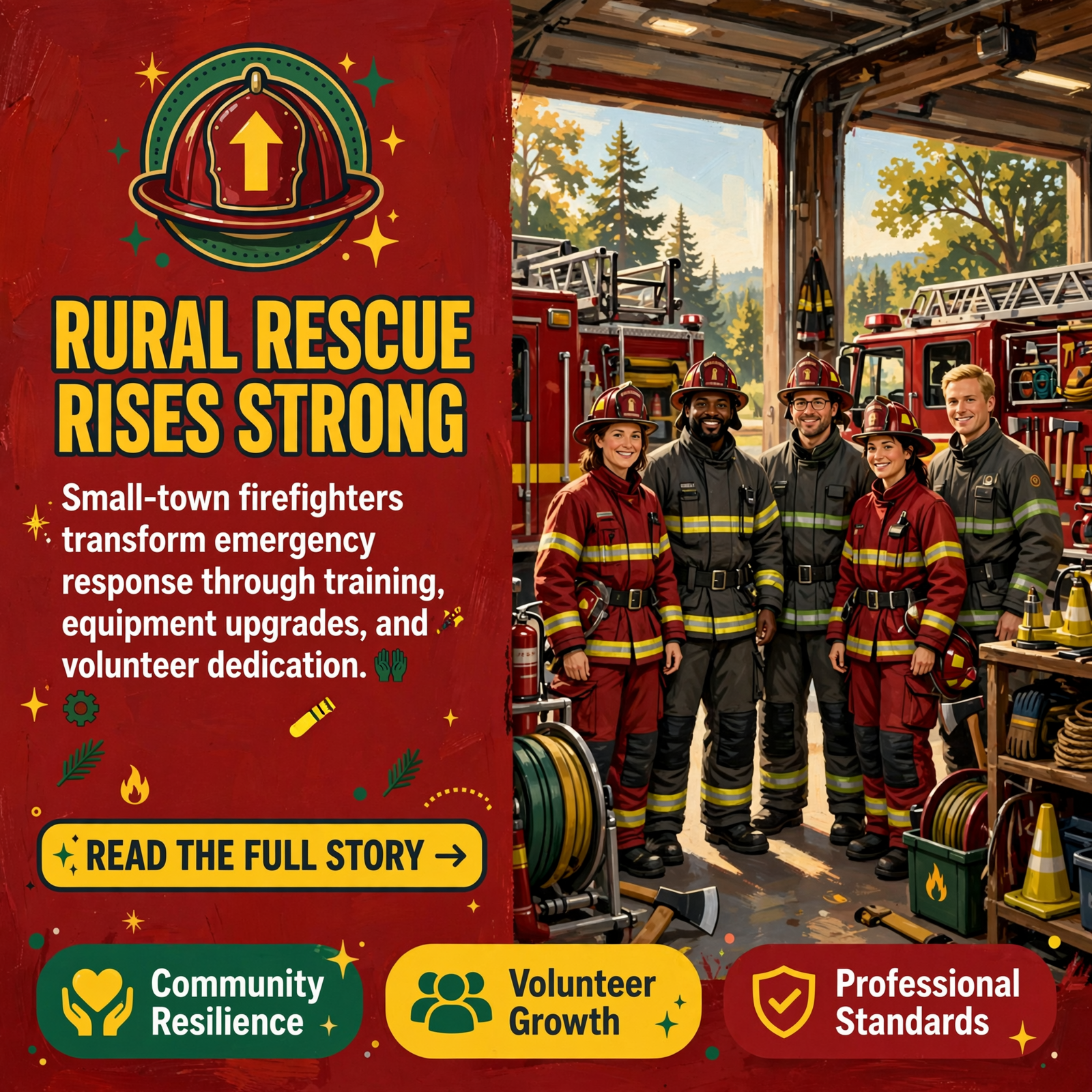
🚒 Fall Creek Falls Fire Department Marks Major Progress After 18 Months of Training, Equipment Upgrades, and Volunteer Growth
In Van Buren County’s Spencer area, the Fall Creek Falls Fire Department has undergone significant transformation over the past year and a half, strengthening its capacity to respond to emergencies across the region. The department’s progress reflects a broader commitment to building reliable emergency services in smaller, rural counties where volunteer firefighting remains the backbone of community protection.
📋 Source Reflection: A Department in Transition
The Fall Creek Falls Fire Department recently shared a comprehensive update on its progress, highlighting both the concrete gains made and the ongoing challenges ahead. The department’s message was clear: transformation is possible in a small volunteer service, but it requires sustained effort, community support, and the willingness of individuals to give their time without compensation. 🙏
💪 Why This Matters to the Community
Emergency response capability directly affects the safety and quality of life for residents, families, and visitors across the region. When a fire department strengthens its training standards, upgrades its equipment, and expands its medical response capacity, it reduces response times, improves survival rates, and increases the likelihood that emergencies are handled by personnel who meet or exceed state standards. For a county as small as Van Buren, these improvements represent a significant investment in community resilience. 🏘️
The department’s progress also signals something deeper: that rural communities can build modern, capable emergency services even without the resources of larger urban departments. This matters because it demonstrates that volunteer-driven infrastructure, when supported by grants, community backing, and dedicated individuals, can close gaps that might otherwise leave residents underserved.
👥 The People Behind the Progress: Training and Personnel Growth
At the heart of the department’s transformation are the volunteers themselves. The Fall Creek Falls Fire Department now has 6 firefighters who meet or exceed Tennessee’s minimum training standards-16 hours of Introduction to Firefighting and 64 hours of Basic Firefighter training, plus required live-fire training at Tennessee Fire Academy. Among this fully trained group are 1 AEMT (Advanced Emergency Medical Technician) and 1 Critical Care Paramedic, expanding the department’s ability to provide advanced medical care during emergencies. ⚕️
Beyond the fully certified personnel, the department is actively building its bench. One firefighter has completed all state minimum training except live burn and is awaiting the next available date. Four firefighters have completed their 16-hour Introduction course and are waiting for a 64-hour Basic Firefighter class. One new member is preparing to begin the 16-hour Introduction course. This pipeline of training represents a deliberate effort to grow capacity and ensure continuity as volunteers’ work schedules shift.
Perhaps most significantly, five firefighters have completed First Responder training and are scheduled to take the National Registry examination to obtain their medical license. Once licensed by the state, medical response will begin-a milestone that will substantially expand the department’s emergency capabilities. 🚑
Every one of these individuals has chosen to volunteer their time. That choice-to give up weekends, spend evenings at the station, attend training, and respond to emergencies-is the foundation of the department’s progress.
🔧 Equipment Upgrades: Building a Modern Fleet on a Rural Budget
The department has made significant improvements to its apparatus and equipment, demonstrating resourcefulness in a county where budgets are tight. The upgrades include:
- Engine Upgrade: Replaced a 1994 fire engine with a 2005 model. The department now operates a 2006 and a 2005 model fire engine-newer apparatus that are more reliable and better equipped for modern firefighting. 🚒
- Tanker Upgrade: Replaced a 1991 manual-transmission tanker carrying 2,500 gallons with a 1995 automatic-transmission tanker carrying 3,000 gallons. The upgrade increases water capacity and expands the pool of available drivers who can operate the tanker.
- Brush Truck Upgrade: Added a new skid unit specifically designed for wildland and brush fire operations, replacing older equipment that worked but was not purpose-built for firefighting. 🔥
The department acknowledges that these are not brand-new apparatus-most volunteer fire departments cannot afford the $800,000 price tag of new equipment, especially in a county as small as Van Buren. Yet the upgrades represent strategic choices: the department now operates some of the newest apparatus in Van Buren County, balancing capability with fiscal reality.
💰 Grant Success: SCBA, PPE, and Self-Sufficiency
A major milestone came with an $80,778 grant from the State Fire Marshals Office. This funding allowed the department to purchase a compressor and cascade system, giving it the ability to fill its own SCBA (Self-Contained Breathing Apparatus) cylinders-a critical capability that reduces dependency on external resources and ensures firefighters have access to properly maintained equipment. The grant also provided new turnout gear for firefighters, replacing older protective equipment. ✨
This grant represents more than money-it reflects recognition from the state that the Fall Creek Falls Fire Department is pursuing professional standards and making strategic investments in safety and capability.
🤝 Community Connections: Volunteers, Supporters, and the Network Behind Progress
The department’s progress did not happen in isolation. It is the result of volunteers giving their time, community members supporting the department, grant organizations recognizing the need, equipment being maintained and upgraded, and a shared mindset that a capable fire department matters. This network-volunteers, community supporters, grant organizations, and the department’s own leadership-represents the invisible infrastructure that holds rural emergency services together. 🌐
For residents in the Sequatchie Valley and surrounding areas who may not think about their local fire department until an emergency occurs, understanding this network is important. It shows that emergency services depend on relationships: between volunteers and their families (who sacrifice time together), between the department and community members (who support through donations or advocacy), and between local services and state agencies (who provide grants and oversight).
❓ What Residents Should Know
The Fall Creek Falls Fire Department is actively recruiting. The department has identified a critical need: more volunteers to fill gaps created by existing volunteers’ work schedules. If you live in the Spencer area or nearby communities and are interested in serving as a volunteer firefighter, the department is actively training new members. The training pipeline is clear-Introduction to Firefighting courses lead to Basic Firefighter certification and beyond. 📢
The department also wants residents to know that medical response capabilities are expanding. Once the five firefighters currently scheduled for National Registry examination are licensed by the state, medical response will begin-a service that will enhance emergency care in the area.
🔮 What Happens Next
Several milestones are worth watching:
- Live Burn Training: One firefighter is awaiting the next available live burn training date to complete state minimum certification.
- Basic Firefighter Classes: Four firefighters are waiting for the next 64-hour Basic Firefighter class to begin.
- National Registry Examinations: Five firefighters are scheduled to take the National Registry examination to obtain their medical license, after which state medical response will begin.
- Recruitment: The department continues to seek new volunteers to strengthen capacity and ensure continuity as existing volunteers’ schedules shift.
The department’s message is clear: the journey is not over. There is still tremendous work to be done, but the trajectory is upward. 📈
💭 Community Questions Worth Considering
- Do you know who your local volunteer firefighters are? Have you thanked them recently for their service?
- If you live in the Spencer area or nearby, have you considered volunteering with the Fall Creek Falls Fire Department? What would it take for you to get involved?
- How can community members support their local fire department beyond volunteering-through donations, advocacy, or simply showing up at community events?
- What other gaps in emergency services exist in your area, and how might community awareness help address them?
🌟 Long-Term Community Impact
The Fall Creek Falls Fire Department’s progress has implications that extend far beyond the department itself. When a rural fire department strengthens its training, equipment, and medical response capacity, it signals to the broader community that professional emergency services are possible in small counties. This can attract new residents, increase property values, and strengthen community confidence in local institutions. 🏡
Over time, a capable fire department also builds institutional knowledge and pride. Firefighters who are well-trained, well-equipped, and supported by their community are more likely to stay engaged, mentor new members, and maintain high standards. This creates a virtuous cycle: better service attracts better volunteers, who attract better support, which enables better training and equipment.
For the Sequatchie Valley region and surrounding communities, the Fall Creek Falls Fire Department’s transformation offers a model: rural emergency services can modernize and professionalize without abandoning the volunteer ethos that makes them possible. 🎯
🔗 Community Threads: The Invisible Network
The Volunteer-Family Relationship: Every firefighter who gives up weekends and evenings is also a family member, a neighbor, a coworker. The department’s progress depends on families who support their loved ones’ service. When a firefighter attends training or responds to an emergency, their family is also making a sacrifice. Understanding this thread helps residents appreciate the true cost of volunteer emergency services.
The Grant-to-Capability Pipeline: The $80,778 grant from the State Fire Marshals Office did not appear randomly. It came because someone in the department pursued it, wrote the application, and made the case that the investment would improve emergency response. This thread connects state agencies, local leadership, and community safety-a relationship that works only when local departments are proactive and strategic.
The Equipment-Readiness Connection: Upgrading from a 1994 fire engine to a 2005 model, or from a 1991 tanker to a 1995 tanker, might seem like small steps. But each upgrade directly affects firefighter safety, response time, and the likelihood of successful emergency outcomes. The thread here connects equipment decisions to human safety-a relationship that matters every time the alarm sounds.
The Training-Certification-Trust Relationship: When firefighters complete state-mandated training and obtain certifications like AEMT or Critical Care Paramedic, they are not just adding credentials to their resume. They are earning the trust of the community they serve. Residents can have confidence that the person responding to their emergency has met professional standards. This thread connects individual commitment to community confidence.
The Recruitment-Continuity Thread: The department’s active recruitment of new volunteers is not just about filling positions. It is about ensuring that the knowledge, relationships, and institutional memory built over the past 18 months do not disappear when experienced volunteers’ schedules change. This thread connects the present to the future-a recognition that sustainable emergency services require constant renewal.
✨ A Message of Gratitude and Commitment
The Fall Creek Falls Fire Department’s update ends with a simple but powerful statement: “Still working. Still training. Still improving. Still serving. Most of all, we are grateful.” 🙏
This is not just a slogan. It reflects a mindset-one that acknowledges progress while remaining humble about the work ahead, that celebrates volunteers while recognizing the need for more, and that expresses gratitude to the community, grant organizations, and supporters who made the transformation possible.
For residents in Van Buren County and the surrounding region, this message is an invitation: to recognize the service of local firefighters, to consider how you might support them, and to understand that emergency services in rural areas depend on a network of relationships, commitments, and choices made by ordinary people who decide to serve.



0 Comments