
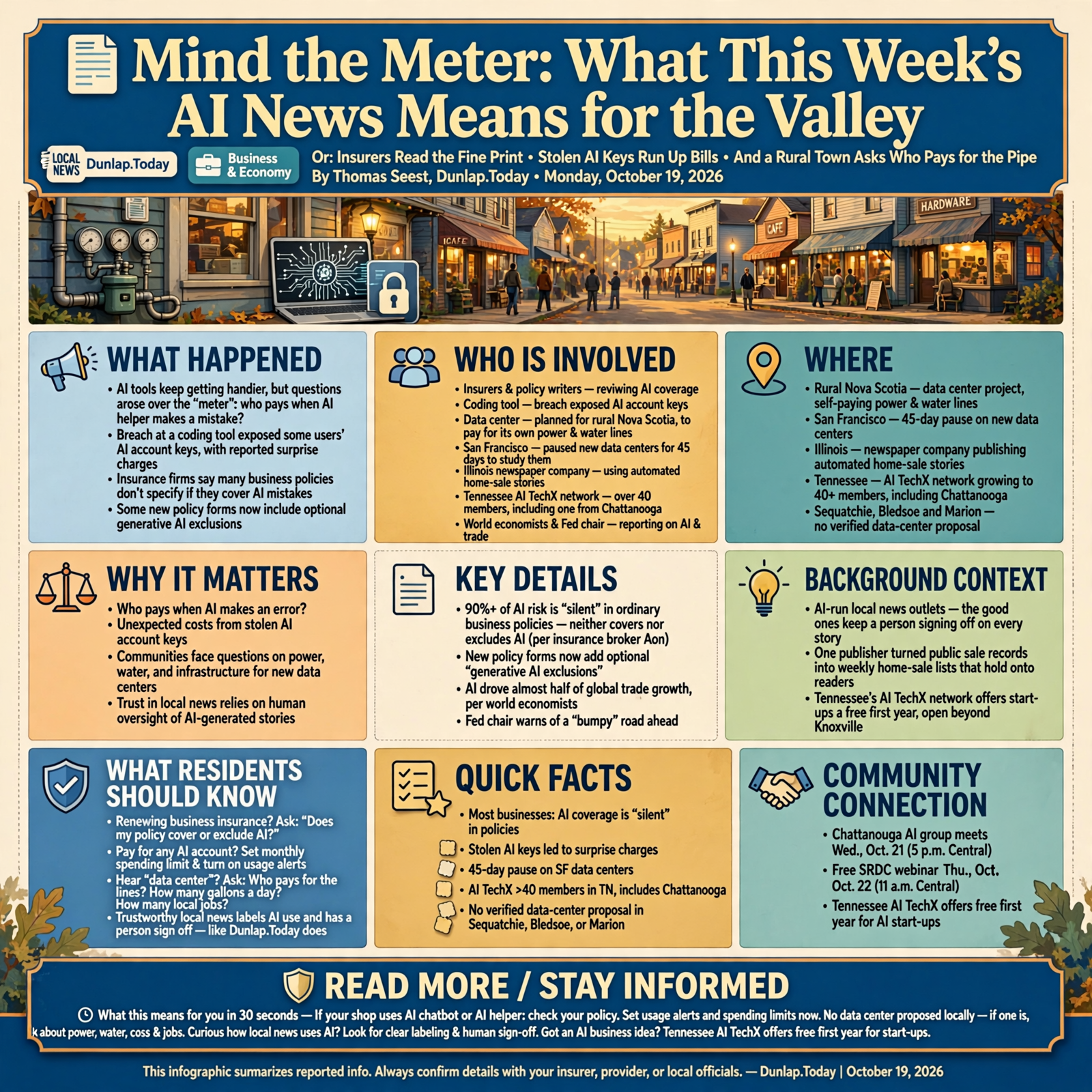
🧾 Mind the Meter: What This Week’s AI News Means for the Valley

Or: Insurers Read the Fine Print, Stolen AI Keys Run Up Bills, and a Rural Town Asks Who Pays for the Pipe
By Thomas Seest, Dunlap.Today · Monday, October 19, 2026
Every house has a meter on the side of it. Most months you never think about it. Then one month the bill comes in high, and suddenly everybody wants to know who left the water running.
That’s the thread running through this week’s AI news. AI tools keep getting handier. But this week the questions were about the meter: Who pays when an AI helper makes a mistake? What happens if somebody steals your AI account? And when a big computer building comes to a small town, who pays for the power and water lines?
Here’s the roundup: insurance companies say many ordinary business policies don’t say whether they cover AI mistakes, and some new policy forms let insurers leave AI out, a breach at a coding tool exposed some users’ AI account keys, and a few reported surprise charges, a data center coming to rural Nova Scotia promises to pay for its own power and water lines, while San Francisco paused new data centers for 45 days to study them, a new report looks at AI-run local news outlets — and the good ones keep a person signing off on every story, an Illinois newspaper company says automated home-sale stories helped it hold onto readers, a Tennessee network for AI start-ups grew to more than 40 members, including one from Chattanooga, and world economists say AI drove almost half of global trade growth, with the Fed chair warning of a “bumpy” road. And Sequatchie, Bledsoe and Marion still show no verified data-center proposal.
⏱️ What this means for you in 30 seconds
- Run a business that uses AI? At your next insurance renewal, ask your agent: “Does my policy cover or exclude AI?”
- Pay for any AI account? Set a monthly spending limit and turn on usage alerts. Five minutes, big peace of mind.
- Hear “data center” again? Nothing’s proposed here. If it ever is, ask: Who pays for the lines? How many gallons a day? How many local jobs?
- Wonder how local news uses AI? The trustworthy ones label it and have a person sign off. That’s how Dunlap.Today works.
- Curious what the house down the road sold for? One publisher turned public sale records into weekly lists readers love.
- Got an AI business idea? Tennessee’s AI TechX network offers start-ups a free first year, and you don’t have to be in Knoxville.
- Want to learn in person or online? Chattanooga AI group meets Wed., Oct. 21 (5 p.m. Central); free SRDC webinar Thu., Oct. 22, 11 a.m. Central.
🛡️ Does Your Business Insurance Cover an AI Mistake? Ask.

The Wall Street Journal reported that insurance companies are struggling to keep up with AI. The biggest AI companies want far more coverage than anyone sells. For regular businesses, the news is simpler: insurance broker Aon found that more than 90% of the AI risk in ordinary business policies is “silent” — the policy neither clearly covers nor clearly leaves out losses caused by AI. And a company that writes the standard forms many insurers use added optional “generative AI exclusions” this year. That means some policies may soon say, in writing, that AI mistakes aren’t covered.
It’s like checking whether your homeowner’s policy covers the new woodstove before the first cold snap — not after.
What it means for you: If your shop uses an AI chatbot to answer customers or an AI helper to write invoices, it’s worth one question at your next renewal: “Does my policy cover or exclude AI?” Look for the words “generative AI exclusion.” No need to call tomorrow — just put it on the renewal list.
👉 Read more (Pivot News, summarizing The Wall Street Journal)
⛽ Put a Limit on Your AI “Card” — Like You Would a Gas Card
OpenCode, a tool computer programmers use to write code with AI, warned users on Oct. 17 that someone broke into an old system it was shutting down. The company says the account “keys” that 1.4% of its users had stored there may have been exposed. A key is a long password that lets a program use an AI service — and bills the owner for it. A few users reported surprise charges online; one said $400. OpenCode says it is working with the big AI companies and told affected users to cancel their old keys and make new ones.
Think of a fuel card with no daily limit. If somebody copies it, they could fill up every truck in the county. With a limit, a disaster becomes a nuisance.
What it means for you: Most folks will never touch an AI key. But if you or your business pays for any AI account, set a monthly spending limit and turn on usage alerts in the account settings. It takes about five minutes.
💧 A Rural Data Center That Says It Will Pay for Its Own Pipes
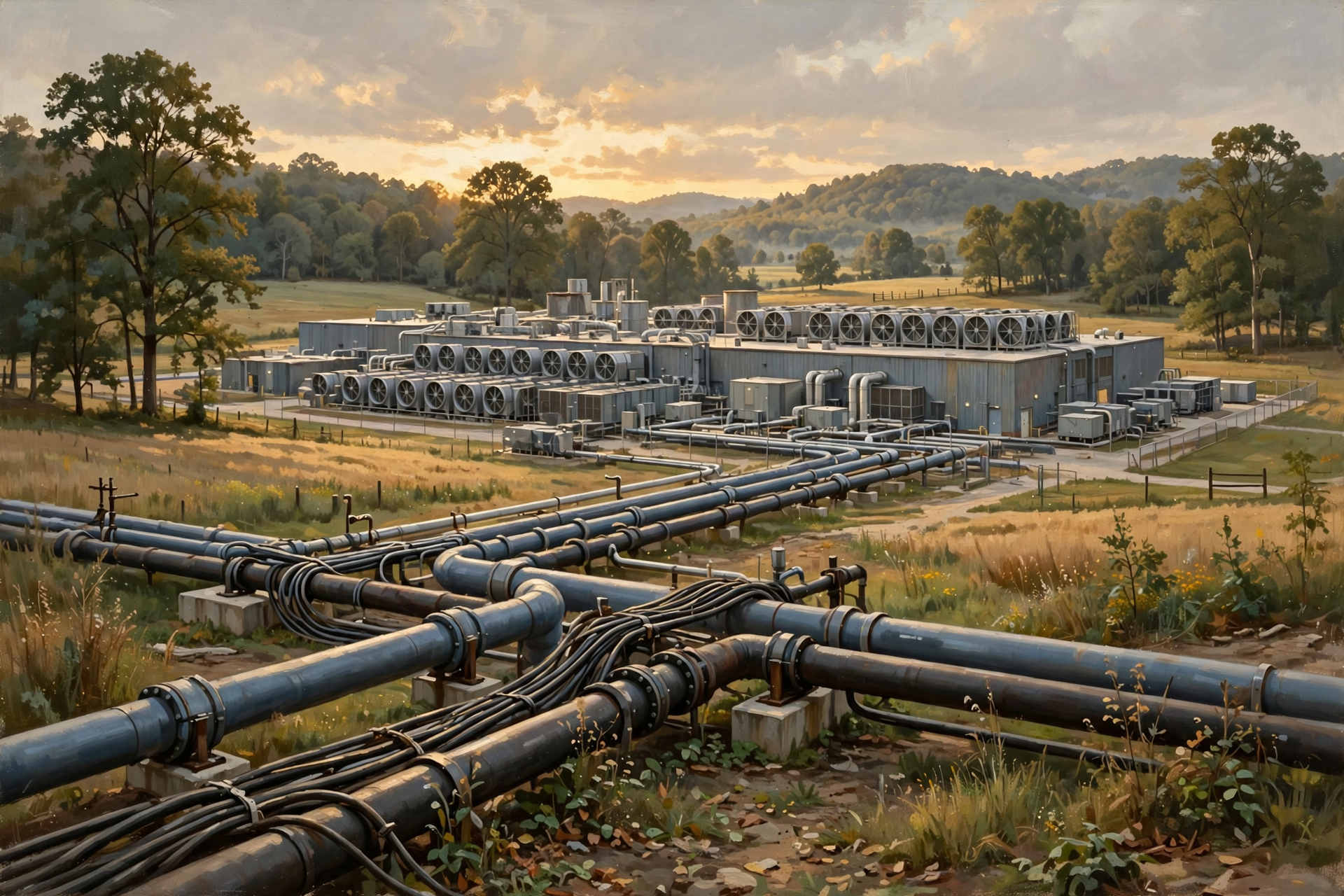
A company called EverWind announced a big data center — a building full of computers that run AI — near the small town of Port Hawkesbury in Nova Scotia, Canada. Anthropic, the company that makes the Claude AI, signed a long-term lease to use it. EverWind says it will pay for the electric lines and water lines itself, so local power customers don’t foot the bill. It says the first phase will use about 100,000 liters of water a day (roughly 26,000 gallons, by our math), growing to about 500,000 liters (roughly 132,000 gallons) if it’s fully built — which the company compares to a large shopping mall. It promises 215 permanent jobs and more than $400 million in local taxes over the years. Those are the company’s own plans and numbers. The county’s top official said the project must answer questions about electricity, water and roads “with clear answers supported by sound technical evidence.” Meanwhile, San Francisco put a 45-day pause on new data centers so city planners can study them.
It’s like a new neighbor asking to tap into your spring. Fair enough — but you ask how much water, and who’s paying for the pipe.
What it means for you: Nobody has proposed a data center in our counties. But if anyone ever does, you now have a ready-made list: Who pays for the power lines? How many gallons a day? How many local jobs? What taxes does the county collect? Asking out loud is just good neighboring.
📰 AI-Run Local News Is Here — the Good Ones Keep a Person in Charge

The Reuters Institute, a journalism research center at Oxford University, looked at news outlets that are run mostly by AI. A database counts about 30 of them around the world. In Tucson, Arizona, a veteran reporter built an AI that listens to town-hall meetings and writes a first draft — and he edits and fact-checks every one before it goes up. “Tucson has one newspaper left,” he said. “It’s about what more I can do.” In Croatia, one AI outlet throws out most of its own drafts — publishing only 20 to 30 of about 100 a day — when they fail checks for fairness and tone. In Montreal, a news brand that went bankrupt came back with one human editor who checks the AI’s work: “use AI to do the easy stuff so that a flesh-and-bone journalist can do the hard stuff.” Every outlet labels what the AI wrote, and every founder admitted the AI makes mistakes.
It’s like a bread machine. It kneads the dough just fine, but somebody still checks whether the loaf is done before it goes on the table.
What it means for you: This is close to how Dunlap.Today works: AI helps gather and draft, and a real person — me — answers for every story. When you read news anywhere, look for who’s responsible. A name you can reach is a good sign.
👉 Read more (Reuters Institute)
🏡 Who Bought the House Down the Road? Computers Are Writing It Up

Shaw Media, a newspaper company that covers 14 counties in northern Illinois, publishes about 130 short stories a day about individual home sales, plus top-ten lists like “most expensive homes sold.” The stories are built from actual sale records using a simple fill-in-the-blanks program, not the chatbot kind of AI, and a person checks them before they go up. The editor said these stories helped the company lose less of its Google search traffic than many other publishers, and they’ve brought in 45 new paying subscribers this year. One note: this report was written by the company that sells the software, so those are its customer’s numbers.
It’s the old “deeds recorded” column from the county paper, brought back with a computer doing the typing.
What it means for you: Plain local facts — who sold, who bought, what got built — are things neighbors always want to know, and they’re things AI search summaries can’t make up. If you’d like to see a weekly “homes sold in Sequatchie County” list here, tell us.
👉 Read more (America’s Newspapers)
🚀 A Free Tennessee Network for AI Start-Ups — Not Just in Knoxville

AI TechX, a program started by the University of Tennessee in Knoxville, connects people building AI businesses with big companies and university researchers. It added 10 start-ups this fall and now has more than 40 members, Teknovation reported on Sunday. One newcomer, IV.ai Solutions, is a Chattanooga health-care company that helps doctors use new technology “without losing the human touch.” Another is building a private, on-the-phone navigation helper for people who are blind. Start-ups don’t have to be tied to the university, can apply any time, and get their first year free. Small-business mentors from SCORE are part of the network. “It’s really about the entire state of Tennessee,” said director Caleb Knight.
It’s like a co-op cattle sale, where small growers get in front of big buyers they’d never meet on their own.
What it means for you: If you’ve got an idea for an AI tool — for farms, shops, churches or health care — Tennessee has a free door to knock on, and it’s open to folks outside Knoxville.
🌎 World Money Experts Say AI Is a Big Part of Growth — With Bumps Ahead

At a big meeting of world finance leaders in Bangkok, the International Monetary Fund’s chief economist said world trade grew 8.3% from 2023 to 2025 — and would have grown only about 4.6% without AI-related products like computer chips and data-center equipment. Federal Reserve Chair Kevin Warsh called AI the “most consequential change” to the world economy in his lifetime, but said the road ahead is “likely to be a very bumpy one.”
It’s like when a road crew comes to town. The diner stays full while they’re building, but nobody plans the menu around the crew staying forever.
What it means for you: This helps explain why AI stocks get so much attention: AI building is now a big piece of the economy. “Bumpy” just means expect ups and downs. It’s background, not a reason to change your plans.
✅ Your Front-Porch AI Checklist

- ✅ Business uses AI? At renewal, ask your agent: “Does my policy cover or exclude AI?”
- ✅ Pay for an AI account? Set a monthly spending limit and usage alerts.
- ✅ Never paste an AI key or password into a site or app you don’t fully trust.
- ✅ Hear a data-center rumor? Ask for the county name and the document — then ask who pays for the lines and how many gallons a day.
- ✅ Reading news online? Look for a real person responsible and an honest label when AI helped.
- ✅ Have an AI business idea? Look up AI TechX — the first year is free.
- ✅ Mark your calendar: Chattanooga Generative AI Working Group, Wed., Oct. 21, 5–7 p.m. Central; SRDC AI to Answers webinar, Thu., Oct. 22, 11 a.m. Central.
Practical rule: Before you plug anything in — an AI tool, an account or a data center — ask what it costs, who pays, and where the shut-off is.
— Dunlap.Today
📚 Plain-English AI Glossary

- Exclusion (insurance): A line in a policy that says what it will not pay for.
- “Silent” coverage: When a policy doesn’t say either way whether it covers something — which can lead to arguments after a claim.
- API key: A long secret code that lets a program use an AI service. Whoever has it can run up charges on your account.
- Spending limit (cap): A setting that stops charges once you hit a dollar amount you choose.
- Data center: A large building full of computers that run websites and AI programs.
- Megawatt: A measure of electric power; one megawatt is very roughly enough to power several hundred homes.
- AI-native newsroom: A news outlet built from the start around AI tools that gather and draft stories.
- Start-up: A young company trying to grow a new idea into a business.
❓ Frequently Asked Questions

Does my business insurance cover AI mistakes?
Maybe — many policies don’t say either way. Some insurers can now add an exclusion that leaves AI out. The simple step is to ask your agent at your next renewal and look for the words “generative AI exclusion.”
I use ChatGPT on my phone. Do I need to worry about the key breach?
The breach involved a programmers’ tool, OpenCode, and the users it notified. Most everyday users never handle an AI key. If you pay for any AI account, setting a monthly spending limit and alerts is still a smart habit.
How much water does a data center use?
It depends on the design. The Nova Scotia company says its first phase would use about 100,000 liters (roughly 26,000 gallons) a day, using a closed cooling loop. Those are the company’s estimates. Any proposal near here should come with its own numbers in writing.
Is a data center coming to Sequatchie County?
As of the evening of Oct. 18, 2026, we found no verified data-center proposal in Sequatchie, Bledsoe or Marion counties. Memphis and Shelby County votes on data-center pauses are still pending.
Does Dunlap.Today use AI?
Yes, to help gather information and draft. A person reviews what’s published and is responsible for every story. If you spot a mistake, tell us and we’ll fix it.
Can someone outside Knoxville join AI TechX?
Yes. Teknovation reports that start-ups don’t have to be university-affiliated, can apply any time of year, and get a year of membership at no cost.
What time are this week’s AI learning events?
The Chattanooga Generative AI Working Group meets Wednesday, Oct. 21, 6–8 p.m. Eastern (5–7 p.m. Central) at The Enterprise Center on Georgia Avenue. The Southern Rural Development Center’s free “AI to Answers” webinar is Thursday, Oct. 22, 11 a.m.–noon Central.
🔗 Other Resources

- Pivot News: Insurers say AI coverage doesn’t exist at the scale needed (WSJ summary)
- The Wall Street Journal: AI runs into its next big obstacle — insurance
- Notebookcheck: OpenCode users urged to replace their AI keys
- Global News: Nova Scotia data center to power Anthropic’s Claude
- San Francisco Standard: City pauses new data centers for 45 days
- Reuters Institute: Inside the rise of AI-native newsrooms
- America’s Newspapers: Shaw Media’s automated real-estate stories
- Teknovation: AI TechX adds 10 Tennessee start-ups
- Dawn: IMF on AI’s risks and benefits for the world economy
- Chattanooga Generative AI Working Group (Oct. 21)
- SRDC: AI to Answers webinar (Oct. 22)
🌄 Keep Learning — and Keep an Eye on the Meter

Nothing in this week’s news calls for worry. Insurance companies are sorting out the fine print, and a single question to your agent puts you ahead of the game. A breach at one tool reminded us that a spending limit is cheap protection. A rural community far away showed how to ask a big project good, plain questions. And the best AI-run newsrooms are proving what we already believe here: a real person should answer for the news you read.
Pick one thing to try this week — maybe set a spending limit on an AI account, or jot “ask about AI” on your insurance renewal — and save the rest for another evening. The more you learn, the easier it is to enjoy what these tools can do while keeping an eye on the meter. We’ll keep watching what matters for the Sequatchie Valley so you don’t have to. Read Dunlap.Today and sign up for our newsletter for plain-English updates.



0 Comments