

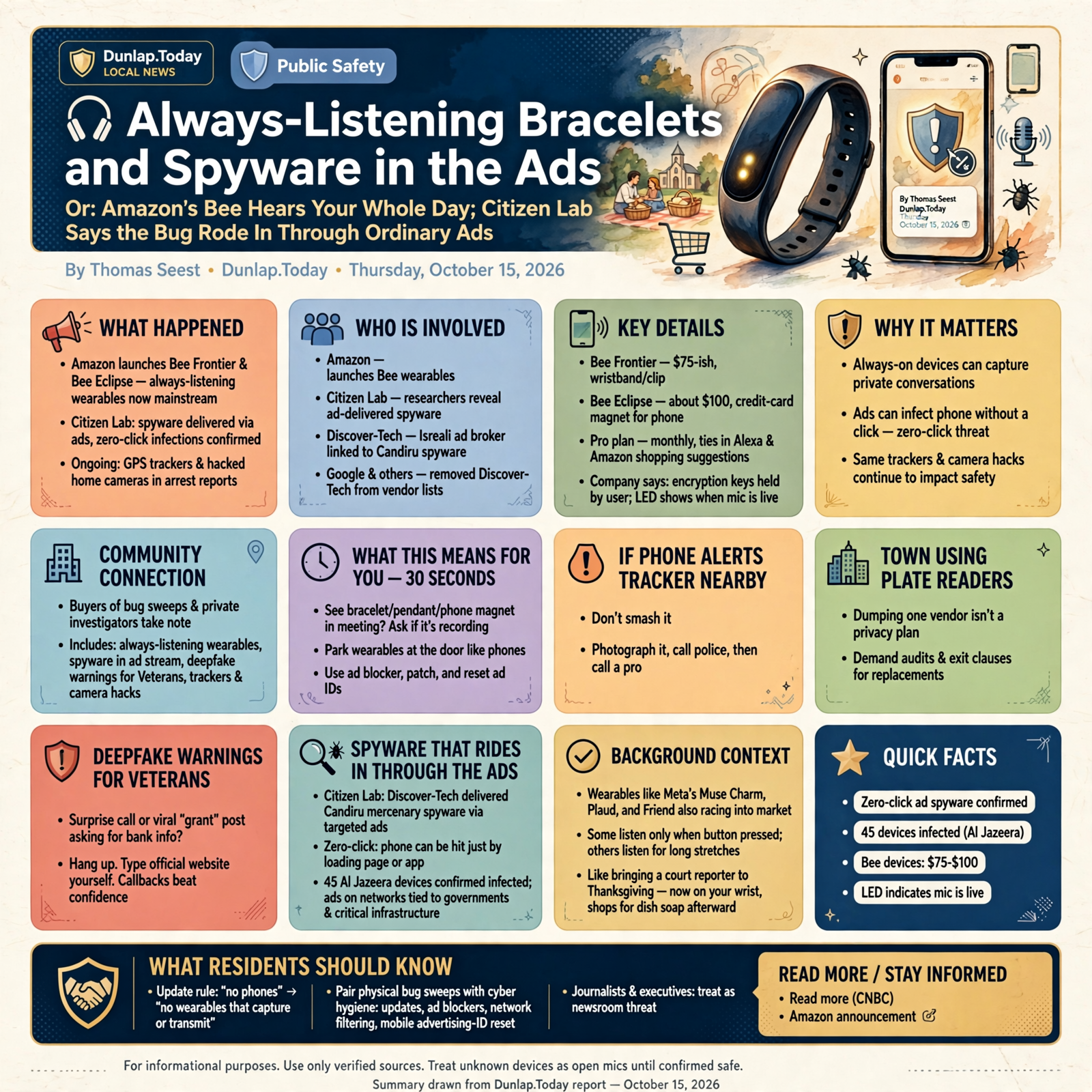
🎧 Always-Listening Bracelets and Spyware in the Ads

Or: Amazon’s Bee Hears Your Whole Day; Citizen Lab Says the Bug Rode In Through Ordinary Ads
By Thomas Seest, Dunlap.Today · Thursday, October 15, 2026
Picture Cousin Billy at the church picnic with a fancy new bracelet. It looks like a fitness band. It can also listen to the whole table, jot down who promised to bring the potato salad, and whisper shopping tips later—while a little light tries to warn you it’s on.
This week, Amazon made that bracelet a mainstream product. Researchers also showed that spyware can hitch a ride inside the ads on your phone. And on the street, the same old GPS trackers and hacked home cameras kept showing up in arrest reports.
Here’s the roundup for folks who buy bug sweeps and the private investigators who do the work: always-listening wearables, spyware in the ad stream, Flock politics from Richmond to Congress, deepfake warnings for Veterans, and the same old trackers and camera hacks that still ruin lives.
⏱️ What this means for you in 30 seconds
- Seeing a bracelet, pendant, or phone magnet in a meeting? Ask if it’s recording. Park wearables at the door like phones.
- Browsing without an ad blocker? Researchers say some ads can infect a phone without a click. Patch. Block. Reset ad IDs.
- Phone says a tracker is nearby? Don’t smash it. Photograph it, call police, then call a pro.
- Town using plate readers? Dumping one vendor isn’t a privacy plan. Demand audits and exit clauses for whoever replaces them.
- Surprise call or viral “grant” post asking for bank info? Hang up. Type the official website yourself. Callbacks beat confidence.
🎧 When the Bracelet Takes Notes for You

Amazon launched Bee Frontier ($75-ish) and Bee Eclipse (about $100)—a wristband/clip and a credit-card magnet for your phone. When they’re on, they listen to conversations, throw away the raw audio after processing, and spit out summaries, to-dos, and “memories.” A monthly Pro plan ties in Alexa and Amazon shopping suggestions. The company says only you hold the encryption keys and an LED shows when the mic is live.
Meta’s Muse Charm pendant and gadgets like Plaud and Friend are racing into the same aisle. Some start when you press a button. Others are built to listen for long stretches.
It’s a little like bringing a court reporter to Thanksgiving—except the court reporter fits on your wrist and shops for dish soap afterward.
What it means for you: Update the old “no phones” rule to “no wearables that capture or transmit.” Receptionists should know what a Bee and a Charm look like. Until you see the light yourself, treat them as open mics.
👉 Read more (CNBC) · Amazon announcement
🧪 Spyware That Rides in Through the Ads

Citizen Lab says Israeli ad broker Discover-Tech helped deliver Candiru mercenary spyware through targeted ads—zero-click, meaning the phone can get hit just by loading a page or app. Researchers confirmed infections on at least 45 Al Jazeera devices and found the firm’s ads showing up on networks tied to governments and critical infrastructure. Google and others kicked Discover-Tech off their vendor lists after the report.
It’s like finding out the billboard on Main Street was also a trapdoor.
What it means for you: Modern eavesdropping often walks in through software. Pair any physical bug sweep with basic cyber hygiene: updates, ad blockers, network filtering, and a mobile advertising-ID reset. Journalists and executives should treat this as a newsroom threat, not just a spy-movie plot.
👉 Read more (Ars Technica / Citizen Lab)
🚘 Plate Cameras: Richmond Out, Congress In, Washington Still Writing Checks

Richmond Mayor Danny Avula said the city won’t renew Flock when the contract ends mid-2027—then left the door open to other plate-reader vendors after community listening. Rep. Rashida Tlaib introduced the Get the Flock Out of Our Communities Act to cut federal money for automated mass surveillance, including ALPRs and face recognition. In Washington state, Snohomish County paid $35,000 to settle a Flock image records fight; one requester’s attorney has collected more than $335,000 across 16 towns and counties.
It’s the neighborhood watch with a searchable filing cabinet—and the filing cabinet keeps ending up in court.
What it means for you: Vendor brand wars aren’t a privacy policy. If your town or campus buys any AI plate reader, put case codes, audits, data limits, and a removal clause in the contract before the first camera goes up.
📍 Trackers That Ping Your Phone, Cameras That Spy From Inside

In Clearwater, Jeffrey Lewis allegedly admitted planting a GPS tracker in his estranged wife’s Kia after she got a phone alert that a strange device was nearby. In St. Petersburg, Kyre Wright faces aggravated stalking charges after police say he hacked into an ex-partner’s apartment security camera, threatened her, and posted a private photo. Ohio’s tracking-device law—freshly amended—spells out when licensed PIs may use trackers (property-owner consent, legitimate investigative purposes, no protection-order end-runs).
What it means for you: Phones are getting better at spotting nearby trackers. Preserve the device for police. And if you sell investigations in Ohio (or advise clients who do), read the consent rules before any tracker leaves the bag. Smart-home cameras need password and 2FA checkups the same day as a sweep.
👉 Clearwater case · Ohio tracker statute
👓 Glasses, Courts, and the Employee Handbook

Beyond last week’s Europe headlines, Paris opened a criminal probe into smart glasses allegedly used to film women without consent; German advocates challenged Meta glasses sales; U.S. courts from Maryland to Illinois tightened eyewear rules; Canadian defense sites banned AI glasses even when “off”; and Sydney councils barred them from pools and change rooms. SHRM and Fisher Phillips told HR to rewrite policies by what a device does—records, streams, feeds AI—not by brand name, and to watch NLRA and ADA traps on blanket bans.
What it means for you: Bring a one-page wearable policy to every corporate client. Park devices at the door. Train managers to spot ordinary-looking frames—and bracelets—that aren’t ordinary.
👉 Biometric Update roundup · SHRM
📞 Deepfakes, Watermarks, and the Callback Rule

VA warned Veterans after fake “grant program” posts used AI-looking materials to redirect benefits. Google’s SynthID watermarking system made TIME’s Best Inventions list—useful when the generator cooperates, not a magic lie detector when the mark is missing. The durable advice hasn’t changed: stop, check on a channel you already trust, then act.
What it means for you: Detectors and watermarks support a report. Callbacks and code words stop a scam.
👉 VA advisory · SynthID / TIME
🧰 Sweeps Still Have to Find What Doesn’t Transmit

Professional TSCM guides this week repeated the lesson: consumer wand apps miss burst transmitters, hardwired mics, and store-and-forward recorders. Real work still means physical search, spectrum tools, NLJD, and thermal—plus a plan for what to do if you find something (hint: don’t smash it in the room).
What it means for you: If someone sells you a ten-minute gadget walk, you bought a demo, not a sweep. Ask whether the quote covers non-transmitting devices and wearables sitting in plain sight.
— Dunlap.Today
📚 Plain-English AI Glossary

- Always-listening wearable: A bracelet, pendant, pin, or phone magnet that captures conversation audio (continuously or on a long session) so AI can summarize it.
- Zero-click spyware: Malware that can infect a device without the user tapping a link—sometimes just by loading a page or ad.
- ALPR: Automatic license-plate reader—roadside cameras that log plates (and often vehicle “signatures”) into searchable databases.
- SynthID / watermark: An invisible signal baked into AI media at creation so later tools can check if that generator marked it.
- TSCM / bug sweep: A professional search for hidden mics, cameras, trackers, and other surveillance gear—physical and electronic.
- NLJD: Non-linear junction detector—gear that can find electronics even when they’re powered off and not transmitting.
❓ Frequently Asked Questions

Is Amazon Bee illegal?
No—but recording laws still apply. In all-party-consent states, listening in on a private conversation without everyone’s OK can be a crime. Meeting hosts and employers can ban the devices even where personal use is legal.
Can an ad really infect my phone without a click?
Researchers say yes in some mercenary-spyware campaigns. You’re not helpless: keep devices updated, consider ad blockers, and reset mobile advertising IDs. High-risk users may need professional mobile forensics.
Should my town dump Flock?
That’s local politics. If you keep any ALPR vendor, demand case codes, audits, data limits, and a removal plan. Dumping one brand without policy is just rearranging cameras.
Do watermarks prove a video is fake or real?
A SynthID hit suggests a cooperating AI tool marked it. A missing watermark proves almost nothing—attackers and unmarked generators exist. Use watermarks as one clue, not the whole case.
Do I still need a physical bug sweep if I have an AI camera app?
Yes. Apps miss silent recorders, hardwired mics, and devices that aren’t transmitting while you scan. Wearables sitting in plain sight also aren’t “found” by an RF wand alone.
✅ This Week’s Counter-Surveillance Checklist

- ✅ Add bracelets, pendants, and phone magnets—not just glasses—to meeting device rules
- ✅ Patch phones, enable ad blocking where appropriate, and reset mobile ad IDs for high-risk clients
- ✅ Practice the tracker alert: photograph, call police, preserve evidence, then call a sweep pro
- ✅ Require audits and exit language for any plate-reader system you advise on
- ✅ Rehearse Stop–Check–Act for money, benefits, or secret-sharing requests
- ✅ Budget for a real sweep (RF + physical + non-transmitting search), not a gadget demo
Practical rule: If a bracelet, a pair of ordinary-looking glasses, a surprise voice, or a viral “official” post is asking you to trust it with money or secrets—verify on a channel you already control.
Sources
Know about an upcoming event or story in the Sequatchie Valley? Submit it here.




0 Comments