
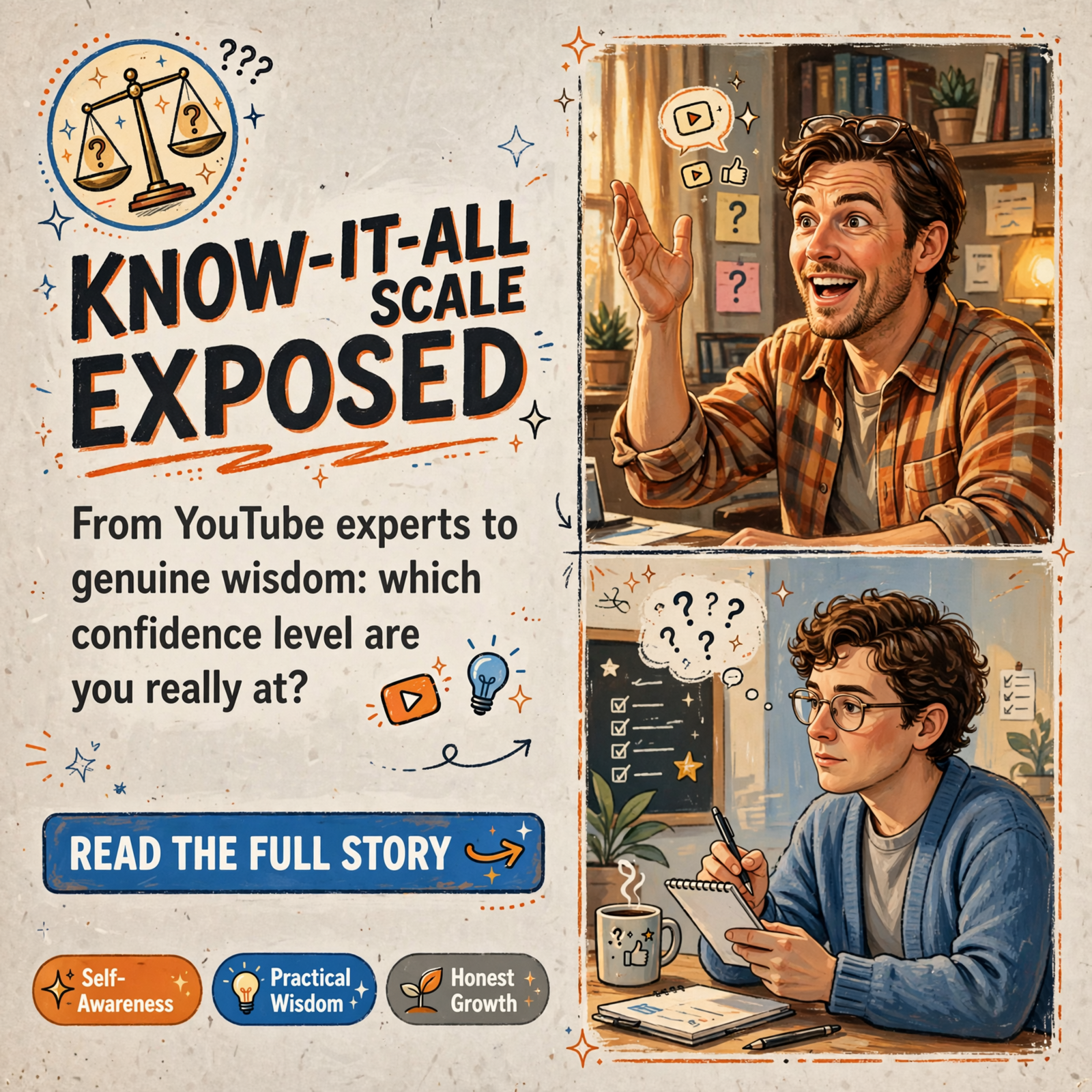
🧠 The Know-It-All Scale: 10 Levels of Human Expertise, From Clueless to Genuinely Wise

Or: From the YouTube Apprentice to the Walking Encyclopedia: Which Kind of Expert Are You?
By Dunlap.Today | Humor & Human Nature
There was a time when becoming an expert required years of study, practical experience, and perhaps a certificate hanging crookedly on an office wall.
Nowadays, all you need is an internet connection, a confident expression, and the ability to begin a sentence with, “Actually…”
We live in a remarkable age. Within five minutes of opening Facebook, you can encounter experts in automotive engineering, constitutional law, weather forecasting, international economics, nutrition, and the proper way to cook a pork chop.
Occasionally, all six experts are the same person.
And there’s a decent chance he’s never cooked a pork chop.
This got us thinking here at Dunlap.Today: Surely there must be a way to classify the various levels of human expertise.
So, after conducting absolutely no formal research, consulting no recognized authorities, and relying almost entirely on personal observation, we’ve developed the world’s first entirely unofficial Know-It-All Scale.
Which, naturally, makes us qualified to explain it.
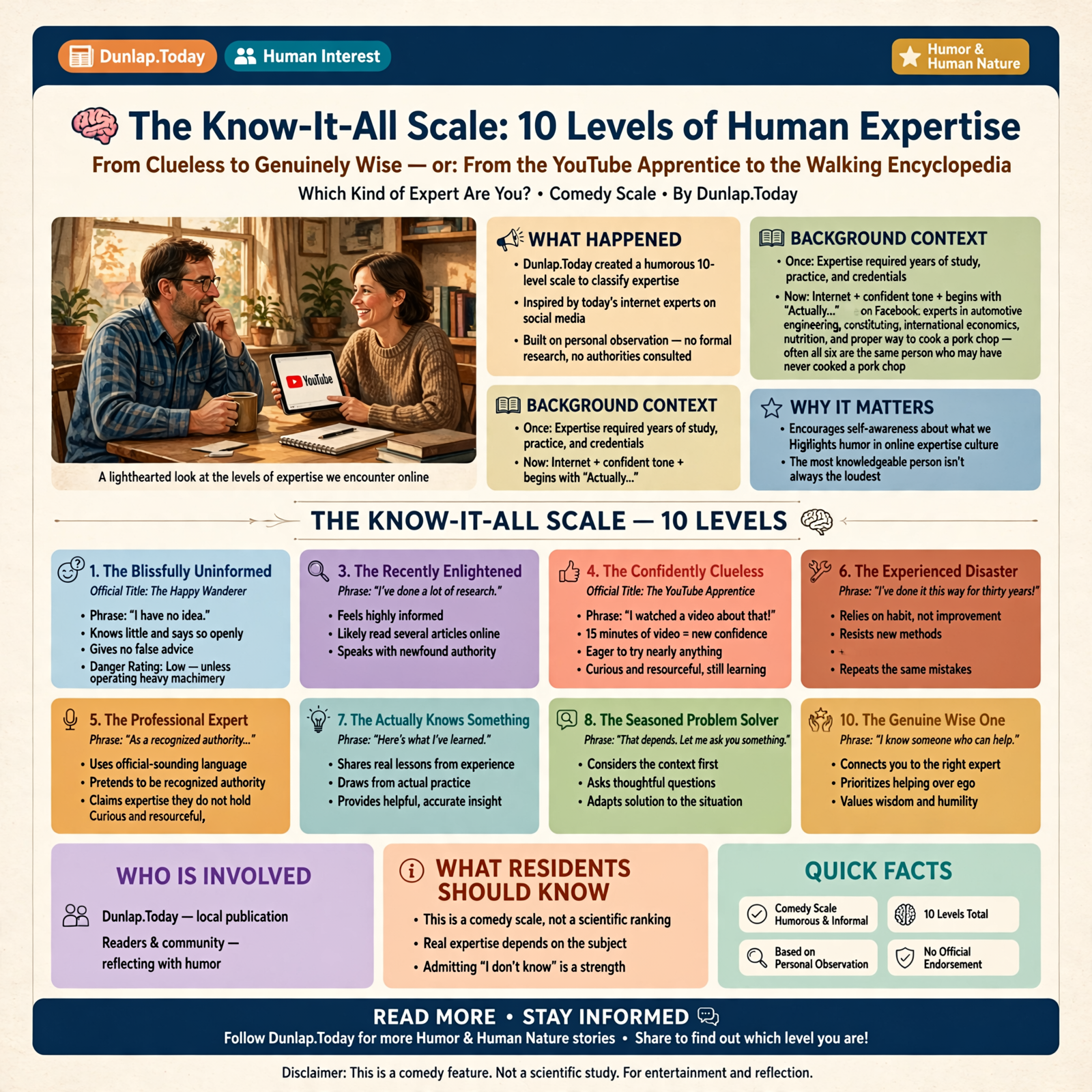
📋 The Know-It-All Scale in 30 Seconds
- Level 1: The Blissfully Uninformed — “I have no idea.”
- Level 2: The Enthusiastic Beginner — “I watched a video about that!”
- Level 3: The Recently Enlightened — “I’ve done a lot of research.”
- Level 4: The Confidently Clueless — “Everybody knows that!”
- Level 5: The Professional Expert Impersonator — “As a recognized authority…”
- Level 6: The Experienced Disaster — “I’ve done it this way for thirty years!”
- Level 7: The Actually Knows Something Person — “Here’s what I’ve learned.”
- Level 8: The Seasoned Problem Solver — “That depends. Let me ask you something.”
- Level 9: The Humble Authority — “I could be wrong, but here’s the evidence.”
- Level 10: The Genuine Wise One — “I know someone who can help.”
Important: This is a comedy scale, not a scientific ranking. In real life, expertise depends on the subject, and the person who knows the most isn’t necessarily the person who talks the most.
😊 Level 1: The Blissfully Uninformed

Official Title: The Happy Wanderer
Signature Phrase: “I have no idea.”
This person knows remarkably little about the subject under discussion and is perfectly comfortable admitting it.
Ask them how to rebuild a transmission, and they’ll say, “I don’t know. You might ask somebody who works on transmissions.”
Simple. Refreshing. Almost revolutionary.
The Happy Wanderer may possess very little expertise, but they’re already ahead of several people farther up our scale in one important respect: They’re unlikely to give you terrible advice with complete confidence.
They also possess a rare modern talent: The ability to survive an entire conversation without pretending to know something.
Danger Rating: Low, unless they’re operating heavy machinery.
📱 Level 2: The Enthusiastic Beginner

Official Title: The YouTube Apprentice
Signature Phrase: “I watched a video about that!”
Armed with fifteen minutes of instruction and an impressive collection of new vocabulary, this individual is prepared to attempt nearly anything.
Replace a kitchen faucet? Certainly.
Repair a washing machine? Probably.
Rewire the house? Well, there was a second video that looked promising.
The YouTube Apprentice is often genuinely curious, eager to learn, and surprisingly resourceful.
Unfortunately, the video occasionally leaves out the part where you turn off the water.
There’s usually a moment, somewhere around the third trip to the hardware store, when enthusiasm begins to collide with reality.
But give these folks credit. At least they’re trying to learn something new.
And occasionally, against all reasonable expectations, they succeed.
Danger Rating: Moderate. Keep a mop nearby.
🔍 Level 3: The Recently Enlightened

Official Title: The Overnight Specialist
Signature Phrase: “I’ve done a lot of research.”
By “research,” this person generally means they read three articles, watched two videos, and found a gentleman on the internet who agreed with them.
They are now ready to explain the entire subject to anyone within earshot.
The Overnight Specialist’s greatest achievement is discovering a topic on Tuesday and correcting people who’ve worked in the field for thirty years by Thursday.
Every complicated issue has a remarkably simple solution.
Coincidentally, it’s the one they discovered yesterday.
If you offer information that challenges their conclusion, they’ll usually respond with, “You need to do your own research.”
Which is an interesting suggestion coming from someone whose entire education on the subject began during a commercial break.
Danger Rating: Elevated, particularly at family reunions.
❗ Level 4: The Confidently Clueless

Official Title: The Walking Exclamation Point
Signature Phrase: “Everybody knows that!”
Here we encounter a fascinating phenomenon: Confidence increasing in direct proportion to the absence of supporting information.
Questions are treated as challenges. Disagreement is interpreted as ignorance. New information is considered an unnecessary complication.
This individual can explain why the economy is failing, the weather has changed, your lawn mower won’t start, and the local football coach should be fired.
All before breakfast.
There is no subject too complicated to be settled with a sufficiently loud declaration.
And the louder the declaration, the less likely you’ll be invited to ask whether any of it is actually true.
The Walking Exclamation Point doesn’t really participate in discussions.
He delivers conclusions.
Frequently at a volume that can be heard from the next county.
Danger Rating: High. Avoid asking follow-up questions unless you’ve packed a lunch.
🎓 Level 5: The Professional Expert Impersonator

Official Title: The Certified Something-Or-Other
Signature Phrase: “As a recognized authority in this field…”
This individual has discovered that expertise is much easier to acquire if you concentrate on the appearance of expertise rather than the substance.
There are impressive titles, mysterious certifications, professionally designed websites, and photographs taken in front of bookshelves.
Some of the books may even have been opened.
The Certified Something-Or-Other has three different logos, a motivational slogan, and a consultation fee.
What they don’t necessarily have is a demonstrated ability to solve the problem they’re being paid to solve.
To be fair, plenty of legitimate experts have websites, credentials, and consultation fees. The distinction isn’t whether somebody looks professional.
It’s whether there’s anything behind the presentation.
A good question to ask is, “Can you show me something you’ve actually accomplished?”
A real professional will often be delighted to answer.
The impersonator may instead offer to sell you a premium membership.
Danger Rating: Potentially expensive. Ask for examples of actual work before reaching for your wallet.
🔧 Level 6: The Experienced Disaster

Official Title: The Thirty-Year Wrong-Way Veteran
Signature Phrase: “I’ve been doing it this way for thirty years!”
Experience is valuable. But experience and learning are not quite the same thing.
Some people have thirty years of experience.
Others have one year of experience repeated thirty times.
The Thirty-Year Wrong-Way Veteran has mastered a particular method and sees absolutely no reason to reconsider it, even when the results have been questionable since 1996.
New tools are unnecessary. Updated information is suspicious. Change is something that happens to other people.
Nevertheless, this person may know many useful things, including exactly how to fix machinery that hasn’t been manufactured since the Carter administration.
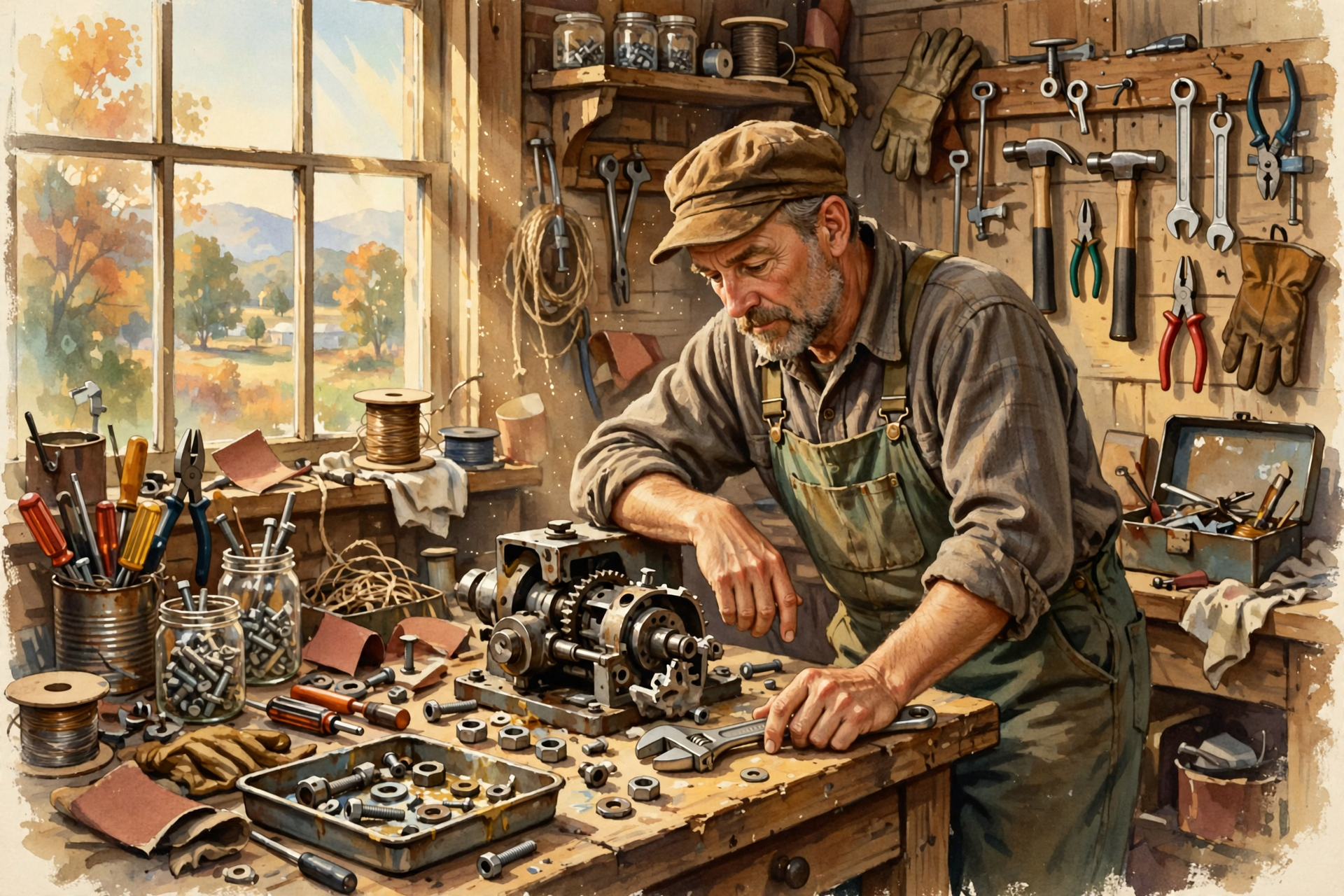
And there’s something admirable about a fellow who can keep a forty-year-old tractor running with two wrenches, a screwdriver, and a piece of baling wire.
Just don’t assume the same technique will work on a modern electric vehicle.
Danger Rating: Depends on whether you’re asking about an old tractor or a new computer.
🛠️ Level 7: The Actually Knows Something Person

Official Title: The Competent Human Being
Signature Phrase: “Here’s what I’ve learned from doing it.”
At last, we’ve encountered someone who can back up an explanation with something more substantial than volume, enthusiasm, or a certificate printed on expensive paper.
They’ve done the work. They’ve made mistakes. They’ve corrected them.
And, importantly, they can usually explain why something works instead of merely insisting that it does.
These are the folks who actually fix things, build things, grow things, teach things, and keep communities functioning.
You’ll find them in machine shops, classrooms, farms, kitchens, garages, offices, and just about everywhere real work gets done.
They generally don’t introduce themselves as experts.
They’re too busy working.
In small communities, these are often the people everybody else quietly depends on.
They may not have a social media following.
But when something important breaks, they have something better.
A telephone that rings.
Danger Rating: Low. You might actually learn something.
🚜 Level 8: The Seasoned Problem Solver
Official Title: The Been-There-Fixed-That Specialist
Signature Phrase: “That depends. Let me ask you a couple of questions.”
This is where genuine expertise becomes interesting.
The Seasoned Problem Solver doesn’t rush to give an answer, because years of experience have taught them that the obvious answer is sometimes spectacularly wrong.
They ask questions.
They examine the circumstances.
They consider alternatives.
And sometimes, after a thoughtful pause, they announce, “Well, there’s more than one way to handle that.”
This can be terribly disappointing if you were hoping for a simple answer in seven seconds.
But it’s wonderful if you were hoping for a solution that actually works.
These are the people who can look at a situation that has everybody else scratching their heads and say, “Before we spend any money, let’s check one thing.”
And frequently, that one thing turns out to be the entire problem.
Danger Rating: Very low, although you may have to explain the problem twice.
📚 Level 9: The Humble Authority

Official Title: The Walking Encyclopedia With Good Manners
Signature Phrase: “I could be wrong, but here’s what the evidence suggests.”
These are the people who possess deep knowledge and have somehow managed to avoid becoming unbearable about it.
They can explain complicated subjects in language ordinary human beings understand.
They don’t need to embarrass someone else to demonstrate their intelligence.
And when presented with better evidence, they can perform an almost supernatural feat.
They can change their minds.
Imagine that.
They understand that knowing a great deal about one thing doesn’t automatically make them authorities on everything else.
A brilliant mechanic can still be a terrible cook. A wonderful teacher might struggle with plumbing. And an excellent accountant may know absolutely nothing about convincing a stubborn mule to move.
Real expertise has boundaries.
The Humble Authority knows where those boundaries are.
And here’s the really unusual part.
When somebody else has a better idea, they don’t feel threatened.
They feel fortunate.
Danger Rating: Exceptionally low. May cause unexpected personal growth.
🏆 Level 10: The Genuine Wise One

Official Title: The Person Who Knows When to Call the Plumber
Signature Phrase: “That’s outside my expertise. I know someone who can help.”
At the top of our entirely imaginary scale sits a remarkable individual.
This person combines knowledge, experience, curiosity, good judgment, and the willingness to admit uncertainty.
They understand something the rest of us often overlook: The goal isn’t to be the smartest person in the room.
The goal is to get the right answer.
Sometimes that means explaining something.
Sometimes it means listening.
Sometimes it means asking a question nobody else thought to ask.
And occasionally it means looking at a complicated plumbing problem, putting down the wrench, and reaching for the telephone.
The Genuine Wise One doesn’t confuse knowing something with knowing everything.
That’s precisely what makes them wise.
And there’s another wonderful quality about these people.
They tend to make everybody around them a little smarter, without making anybody feel a little smaller.
Danger Rating: Almost nonexistent, unless they recommend a plumber who charges by the minute.
🤔 The Great Confidence Problem

Now, you might have noticed something peculiar about our scale.
The people in the middle frequently sound more certain than the people at the top.
That’s because confidence and competence are not the same thing.
Confidence is how strongly somebody believes they are right.
Competence is how well they can demonstrate it.
And those two qualities don’t always travel together.
Someone can be completely sincere and completely mistaken.
Someone else can possess impressive credentials and still make a poor decision.
And a person without a single fancy title might understand a particular problem better than anybody else in the county.
Consider the fellow who’s been repairing tractors for forty years.
He might not know the technical name for every component, but he can diagnose an engine problem by listening to it for thirty seconds.
Meanwhile, somebody with three impressive abbreviations after their name may be searching the internet for instructions on opening the hood.
That doesn’t mean education is worthless.
It means education, practical experience, curiosity, and judgment work best when they cooperate.
What it means for you: Don’t mistake certainty for accuracy. A confident answer can be right, wrong, or somewhere in between. Look for understanding, results, and a willingness to consider new information.
🤖 And Then Along Came Artificial Intelligence

Just when humanity was beginning to master the art of sounding knowledgeable without necessarily being knowledgeable, we invented machines that could do it faster.
Artificial intelligence can be an extraordinary tool. It can explain complex ideas, organize information, compare alternatives, and help people discover things they otherwise might never encounter.
It can also deliver an incorrect answer in a tone so polished and reassuring that you practically want to thank it for being wrong.
In other words, we’ve managed to automate the Walking Exclamation Point.
With better grammar.
And the computer doesn’t even need a coffee break.
Fortunately, the solution is largely the same whether you’re talking to a computer, a consultant, your brother-in-law, or the gentleman holding court at the coffee shop.
Ask how the conclusion was reached.
Look for evidence.
Consider what might have been overlooked.
And don’t confuse a beautifully presented answer with a correct one.
Artificial intelligence can help you think through a problem. It shouldn’t eliminate the need to think.
After all, a machine that can produce ten thousand words in fifteen seconds can still be wrong in every single paragraph.
That’s quite an accomplishment.
Some of us humans need an entire afternoon to manage the same thing.
✅ The Dunlap.Today Five-Question Expert Detector

Before trusting somebody’s confident pronouncement, try our simple five-question test.
- Can they explain it clearly? Real understanding often makes complicated subjects easier to understand, not harder.
- Can they show evidence or results? A successful track record is more useful than an impressive-sounding title alone.
- Can they admit uncertainty? Be cautious around anyone who has never encountered a question they couldn’t answer.
- Can they consider another viewpoint? A willingness to listen is not a sign of weakness.
- Do they know when they’re outside their expertise? Sometimes the smartest answer is, “You need to talk to somebody else.”
Of course, these questions aren’t foolproof.
Some very persuasive people can pass all five while selling you a bridge they don’t own.
Which is why a little independent verification never hurts.
Practical rule: Trust people who can demonstrate what they know, explain what they don’t know, and recognize the difference.
🪞 So, Where Do You Rank?

Here’s the uncomfortable part.
Most of us have occupied several levels of this scale.
Sometimes in the same afternoon.
We might be a Level 9 when discussing something we’ve spent decades studying, a Level 2 when attempting to install a new gadget, and a Level 4 when arguing about the proper temperature for grilling hamburgers.
And there’s a special category we haven’t even included: The person who becomes an expert immediately after something goes wrong.
You’ll recognize them by their signature phrase:
“Well, I could have told you that was going to happen.”
Oddly enough, they almost never do.
Here’s the conclusion we’ve arrived at after carefully developing our ridiculous little scale.
The wisest people aren’t necessarily those with the most answers. They’re often the ones who know which questions to ask, which answers to question, and when somebody else knows more than they do.
And if you ever meet somebody who claims to be a perfect Level 10 in every subject?
Congratulations.
You’ve probably just met a Level 4 with a very nice business card.
😂 Share the Laugh — And the Wisdom

Know somebody who always has an answer? Have a relative who can fix anything? Or perhaps a friend who begins every conversation with “Actually…”?
Share this article with them. Better yet, ask your friends and family where they think they land on the Know-It-All Scale.
Just be prepared.
There’s a very good chance the person who confidently announces they’re a Level 10 has already answered the question for you.
And maybe the next time somebody offers an opinion with absolute certainty, we can all remember to ask one little question.
“How do you know?”
Not to embarrass them.
Not to start an argument.
But because curiosity is how the rest of us keep learning.
Know a friend, family member, or local business owner who would appreciate a good laugh and a little common sense? Share this story with them. We could all use a reminder that being curious is more valuable than pretending to know everything.
From all of us at Dunlap.Today: Stay curious, keep learning, and remember that it’s perfectly acceptable to say, “I don’t know.”
Unless, of course, somebody asks whether you want another piece of pie.
Then the correct answer is obvious.
❓ Frequently Asked Questions

Is the Know-It-All Scale a real scientific ranking?
No. It’s an entirely invented humor scale intended to illustrate differences between confidence, experience, expertise, and wisdom. It shouldn’t be mistaken for a psychological assessment.
Does having a degree or certification make someone an expert?
Formal education and recognized credentials can provide important evidence of knowledge and training, but they aren’t the only considerations. Demonstrated competence, practical experience, continuing education, and the ability to evaluate evidence also matter.
Can someone be knowledgeable and still be wrong?
Absolutely. Genuine expertise doesn’t guarantee that every judgment will be correct. One characteristic of a trustworthy expert is the willingness to reconsider a conclusion when better information becomes available.
Can somebody without formal education be a genuine expert?
Certainly. In many fields, years of practical work and demonstrated accomplishments can produce considerable expertise. Different subjects require different kinds of qualifications, and practical skills are often best judged by actual results.
Why do some people sound more confident than others?
Confidence can come from personality, experience, familiarity, social expectations, or even misunderstanding. It isn’t a reliable measure of how accurate a person’s claims are.
Where does artificial intelligence rank on the scale?
That depends on the question, the AI system, and how its answer is verified. AI may provide remarkably useful information in one situation and a confidently incorrect response in another. It’s best treated as a tool whose outputs sometimes need independent checking.
What’s the easiest way to recognize genuine wisdom?
Look for people who ask thoughtful questions, explain their reasoning, recognize uncertainty, respect other people’s knowledge, and are willing to change their minds when the facts warrant it.
🏡 A Final Thought From the Front Porch

Somewhere in the Sequatchie Valley right now, somebody is quietly fixing a problem that three other people have spent the morning explaining.
They’re probably not announcing their expertise.
They’re not filming a motivational video.
And they may not even realize how much they know.
They’re simply doing what knowledgeable, capable people have always done.
Figuring things out, helping their neighbors, and getting on with the job.
Maybe that’s a pretty good example for the rest of us.
We don’t all need to be experts in everything.
We just need to keep learning, share what we know, admit what we don’t, and appreciate the people around us who know things we haven’t figured out yet.
And if somebody asks you to rate your own expertise on our ten-point scale?
You might want to think carefully before answering.
Because the person who confidently announces they’re a Level 10 has probably just provided some pretty convincing evidence that they aren’t.
— Dunlap.Today
Editor’s Note: The Know-It-All Scale is a humorous invention, not a scientific assessment. Any resemblance to actual relatives, coworkers, consultants, social media personalities, or the person writing this article is entirely possible.
Know about an upcoming event or story in the Sequatchie Valley? Submit it here.



0 Comments