
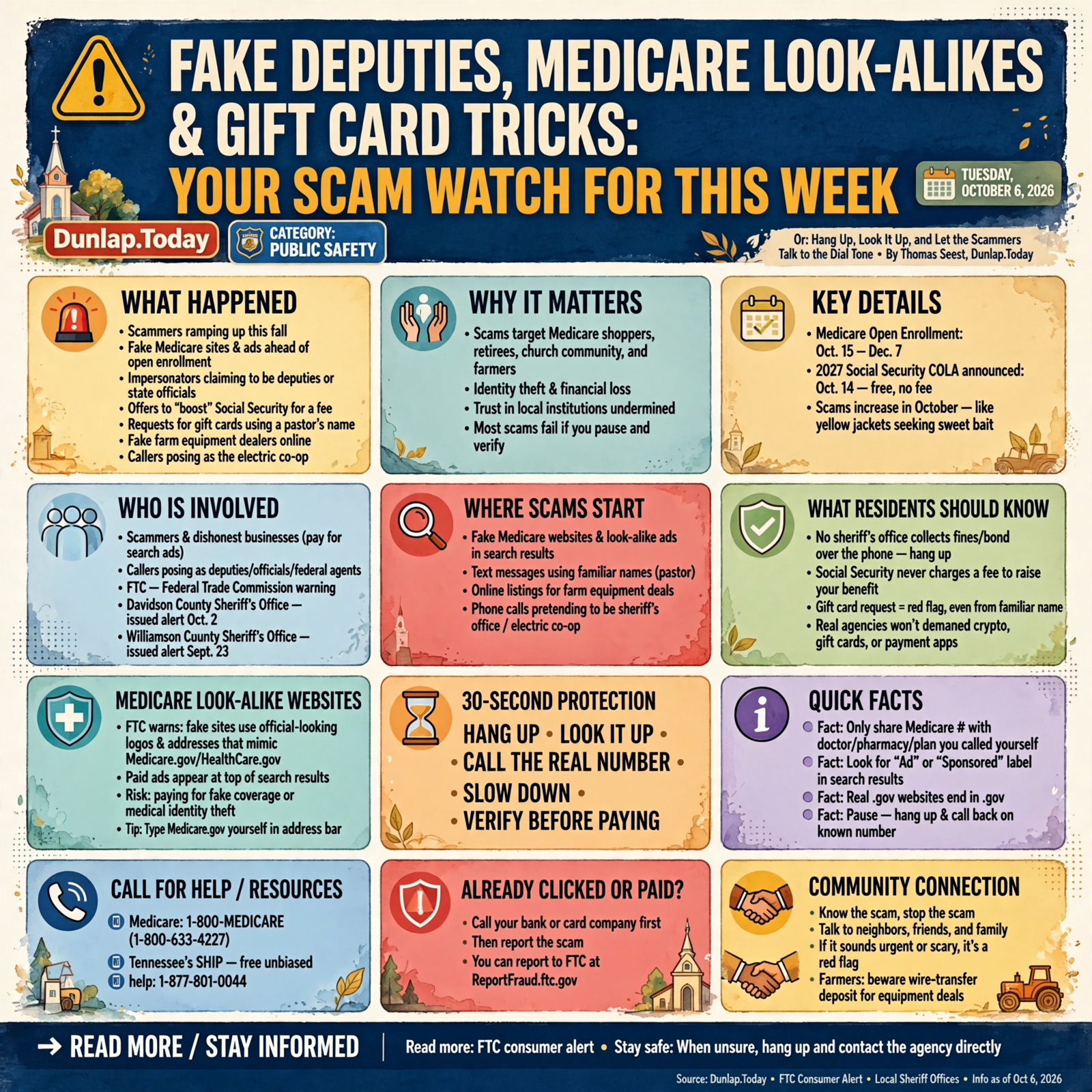
🚨 Fake Deputies, Medicare Look-Alikes and Gift Card Tricks: Your Scam Watch for This Week

Or: Hang Up, Look It Up, and Let the Scammers Talk to the Dial Tone
Scammers are a lot like yellow jackets in October. They get busier this time of year, they show up where the sweet stuff is, and the best defense is knowing where they nest.
Here’s the good news: almost every scam on this week’s list falls apart the second you hang up and call the real number yourself. You don’t have to be a computer whiz. You just have to slow down.
Here’s what’s making the rounds: fake Medicare websites and ads popping up ahead of open enrollment, callers pretending to be deputies or state officials, offers to “boost” your Social Security check for a fee, gift card requests from someone using a pastor’s name, fake farm equipment dealers online and a Valley reminder about callers pretending to be the electric co-op.
⏱️ What this means for you in 30 seconds
- Medicare shoppers: Open enrollment starts Oct. 15. Type Medicare.gov yourself instead of clicking a search ad.
- “You missed jury duty”: No sheriff’s office collects fines or bond money over the phone. Hang up.
- Retirees: Social Security never charges a fee to raise your benefit. The real 2027 raise is announced Oct. 14, for free.
- Church folks and friends: A text asking you to buy gift cards, even from a familiar name, is a red flag. Call the person directly.
- Farmers: A great tractor deal that wants a wire-transfer deposit is a warning sign.
- Already clicked or paid? Call your bank or card company first, then report it. Our FAQ below walks you through it.
🩺 Medicare Look-Alike Websites Are Fishing Ahead of Open Enrollment
Medicare open enrollment runs Oct. 15 through Dec. 7. On Sept. 28, the Federal Trade Commission (FTC) warned that health insurance scams pick up during this season, and many start with a simple online search.
The FTC says scammers and dishonest businesses sometimes pay to show up at the top of search results. They use web addresses that look a lot like government ones, plus official-looking logos, so you think you’re on the real Medicare.gov or HealthCare.gov. If you use the link or phone number in one of those ads, the FTC says, you could end up paying for a plan that isn’t real health insurance, or handing over enough information for medical identity theft.
What it means for you: Think of search ads like the first booth at the flea market. It’s not always the best deal, it’s just the one that paid for the spot. Type Medicare.gov into the address bar yourself, or call 1-800-MEDICARE (1-800-633-4227). Look for the little “Ad” or “Sponsored” label and scroll past it, and make sure the address ends in .gov. Only share your Medicare number with your doctor, your pharmacy or a plan you called yourself. For free, unbiased help comparing plans, call Tennessee’s SHIP program at 1-877-801-0044.
👉 Read more (FTC consumer alert)
🚔 “This Is the Sheriff’s Office. You Missed Jury Duty.” No, You Didn’t.

The oldest trick in the book is wearing a new badge. On Oct. 2, the Davidson County Sheriff’s Office in Nashville warned of callers posing as its employees and demanding payment by cryptocurrency, gift cards or payment apps. The Williamson County Sheriff’s Office posted a similar alert on Sept. 23 about fake officers, court officials and federal agents claiming you missed jury duty, have a warrant or are about to have your bank account seized. It said some scammers even send official-looking papers with real judges’ names.
Closer to home, the Sequatchie County Sheriff’s Office warned earlier this year about callers claiming to be from the office about missed jury duty, citations and warrants. The Marion County Sheriff’s Office has issued similar warnings. Both said they don’t take payments over the phone.
It’s not just sheriffs. On Sept. 21, the Tennessee Department of Safety and Homeland Security warned of a new automated robocall scam using its name. The department said it will never ask for money through automated calls.
Nationally, the FBI said on Sept. 17 that it received nearly 61,000 complaints about law enforcement and government impersonation scams from January 2025 through July 2026.
What it means for you: Real deputies don’t call you up to collect a fine any more than the mailman calls ahead to ask for your house key. The FBI says scammers often fake the caller ID, act urgent and tell you not to tell anyone. That secrecy is your clue. Hang up, look up the agency’s number yourself, and call it. In Marion County, the sheriff’s office invites you to call 423-942-2525 to check.
👉 Read more (FBI public service announcement) · Tennessee Department of Safety warning (WSMV)
👵 Nobody Can “Boost” Your Social Security Check for a Fee

With the 2027 Social Security raise due to be announced Oct. 14, scammers are trying to get ahead of it. On Sept. 21, the Social Security Administration’s Office of the Inspector General warned about calls, ads, letters, texts and social media messages offering to “boost,” “unlock” or “maximize” your benefits for an upfront fee.
The inspector general says these offers are usually after your personal information and bank account details. Social Security does not raise benefits in exchange for money. Your benefit is calculated by law, based on your work record, and it isn’t negotiated over the phone.
A related warning came from Cumberland County, just up U.S. 127 in Crossville. The sheriff’s office there said on Oct. 2 that a caller posing as a Social Security “federal agent” talked a senior into handing cash to couriers “for safekeeping.” Deputies, working with the TBI, arrested a courier. The sheriff’s office reminded everyone that real federal agencies never use cash pickups.
What it means for you: Your Social Security raise is like the morning sunrise. It comes on its own and nobody can sell it to you. If you have questions, hang up and call Social Security at 1-800-772-1213, or check your own my Social Security account at ssa.gov/myaccount. And if anyone ever asks you to withdraw cash and hand it to a courier, that’s a scam every time.
👉 Read more (SSA Office of the Inspector General)
⛪ “Can You Pick Up Some Gift Cards for Me?” Check With the Pastor First

On Oct. 1, the Cumberland County Sheriff’s Office warned that scammers were using the name of a local pastor to ask people to buy gift cards and send the card numbers, PINs or photos. Once the scammer has those numbers, the money can be spent.
It’s a trick that works anywhere folks trust each other, which is exactly why it travels to small towns. Scammers borrow a familiar name, a church, a boss or a friend, and add a little “I’m in a meeting, can you help me quick?” pressure.
What it means for you: A real pastor will ask you to fill the casserole dish, not buy a stack of gift cards. The sheriff’s office says to call the person or church using a number you already know is right, and not to trust the name, photo or number shown in the message. If you already sent gift card numbers, contact the card company right away and ask whether the money can be stopped. Keep your receipts and the messages.
👉 Read more (Cumberland County Sheriff’s Office release via 102.5 WOW Country)
🚜 That Too-Good Tractor Deal Online Might Not Have a Tractor Behind It

On Sept. 15, the FTC warned about scammers pretending to be farm equipment businesses. It often starts with a social media ad or a search result for a tractor at a good price, sometimes using the name of a dealer you know. The “seller” sends a purchase agreement and invoice, asks for thousands of dollars, usually by wire transfer, and sets a delivery date. The tractor never shows up.
What it means for you: Buying equipment is like buying a cow. You want to see it, and you want to know who’s selling it. Before you pay, search the company’s name plus “scam” or “complaint.” Scroll past paid ads to find the dealer’s real website and phone number, then call them yourself. The FTC says never to send money to anyone who will only take wire transfers, gift cards, cryptocurrency or payment apps. Your local dealer down the road is still a fine place to start.
👉 Read more (FTC consumer alert)
💡 Valley Reminder: SVEC Won’t Call and Threaten to Cut Your Power

This one isn’t brand-new, but it’s worth repeating as heating season starts. Sequachee Valley Electric Cooperative (SVEC) says scammers sometimes call members and small businesses, threatening to disconnect service unless they pay right away over the phone. The calls may come from an automated system or a local-looking number.
SVEC says it will not call and threaten immediate disconnection or demand payment over the phone. It does make automated courtesy reminder calls when a payment hasn’t been made. Anyone who comes to your door from SVEC should have an ID badge, SVEC clothing and the logo on their vehicle.
What it means for you: A courtesy reminder is like your neighbor hollering that you left your truck lights on. A threat to cut your power in 30 minutes unless you read off your bank card is a scam. Hang up and call your local SVEC office or 888-421-7832. Small business owners, share this with whoever answers your phone.
👉 Read more (SVEC: Beware of Scams)
✅ Your Scam Watch Checklist for This Week

- ✅ Shopping for Medicare? Type Medicare.gov yourself and skip the “Sponsored” results.
- ✅ Got a call about jury duty, a warrant or a fine? Hang up and call the agency’s real number.
- ✅ Remember: no one can sell you a bigger Social Security check.
- ✅ Asked to buy gift cards? Call the person back on a number you already know.
- ✅ Buying equipment online? Search the name plus “scam” and call the dealer yourself.
- ✅ SVEC threat call? Hang up and call 888-421-7832.
- ✅ Pick a family code word for emergencies, and talk with older relatives about these tricks.
- ✅ Forward scam texts to 7726 (it spells SPAM) and report scams at ReportFraud.ftc.gov.
Practical rule: If they called you, rushed you, and want gift cards, wire, crypto or cash, it’s a scam. Hang up and call the real number yourself.
— Dunlap.Today
📚 Plain-English Scam Glossary

- Phishing: A fake email or message meant to trick you into clicking a link or sharing personal information.
- Smishing: Phishing by text message.
- Spoofing: Faking a caller ID or email address so it looks like it’s coming from someone you trust.
- Impostor scam: When someone pretends to be a government agency, a business, a family member or a friend to get your money.
- Robocall: An automated, prerecorded phone call.
- Sponsored result: A paid ad that shows up at the top of a search page.
- Medical identity theft: When someone uses your Medicare or insurance information to get care or bill for services in your name.
- Wire transfer: Sending money electronically, often very hard to get back once it’s gone.
- Cryptocurrency: Digital money like Bitcoin. Scammers like it because payments are hard to trace or reverse.
❓ Frequently Asked Questions

What do I do if I already clicked or paid?
Don’t be embarrassed. Scammers fool smart people every day. Act fast, in this order. 1) Stop all contact with the scammer. 2) Call your bank, credit union or card company using the number on the back of your card, and ask them to stop or reverse the payment. If you paid with a gift card, call the number on the back of the card. If you used a payment app or wire service, report it to that company right away. 3) If you gave out your Social Security number, go to IdentityTheft.gov for a step-by-step recovery plan. 4) If you gave someone access to your computer, run a security scan and change your passwords. 5) Report it to ReportFraud.ftc.gov and your local sheriff’s office.
I only clicked a link but didn’t type anything. Am I in trouble?
Probably not, but play it safe. Close the page, don’t enter any information, and run your phone or computer’s security update. If you typed a password, change it, and turn on two-step verification if the account offers it.
The caller ID said it was the sheriff’s office. Isn’t that proof?
No. The FBI says scammers often spoof real phone numbers and use real officers’ names. Hang up and call the office back using a number you look up yourself.
How can I tell a real Medicare website?
The official site is Medicare.gov, and real government sites end in .gov. You can also call 1-800-MEDICARE (1-800-633-4227) or Tennessee SHIP at 1-877-801-0044 for free help.
Should I answer calls from numbers I don’t know?
You don’t have to. Let them go to voicemail. A real business or agency will leave a message, and you can call back on the number you know is right. Signing up at DoNotCall.gov (888-382-1222) cuts down on sales calls, so a sales call after that is more likely to be a scam.
Who in Tennessee can I report a scam to?
Your local sheriff’s office or police department, the Tennessee Division of Consumer Affairs in the Attorney General’s office (615-741-4737), the FTC at ReportFraud.ftc.gov and the FBI at ic3.gov.
Is there someone I can just talk to about it?
Yes. AARP’s Fraud Watch Network Helpline offers free help at 877-908-3360, Monday through Friday, 8 a.m. to 8 p.m. Eastern (7 a.m. to 7 p.m. Central).
🔗 Other Resources

- FTC: Report a scam at ReportFraud.ftc.gov
- FTC: What to do if you were scammed
- IdentityTheft.gov: Report identity theft and get a recovery plan
- Tennessee Division of Consumer Affairs: File a complaint
- Tennessee Attorney General: Phone and internet scams
- FBI Internet Crime Complaint Center (IC3)
- Social Security: Protect yourself from scams
- Medicare.gov: Spotting and reporting Medicare fraud
- Senior Medicare Patrol (1-877-808-2468)
- AARP Fraud Watch Network Helpline (877-908-3360)
- National Do Not Call Registry
- SVEC: Beware of scams
🌄 Slow Down, Check It Out, Sleep Easy

None of this means you need to be afraid of your phone. Scammers count on hurry and worry. Take those away, and their tricks fall flat as a fallen cake.
Share this with a neighbor, a parent or the folks at your church. One phone call to a friend might save them a world of trouble. We’ll keep watch and bring you the latest. Read Dunlap.Today and sign up for our newsletter for plain-English scam alerts and Valley news.



0 Comments