
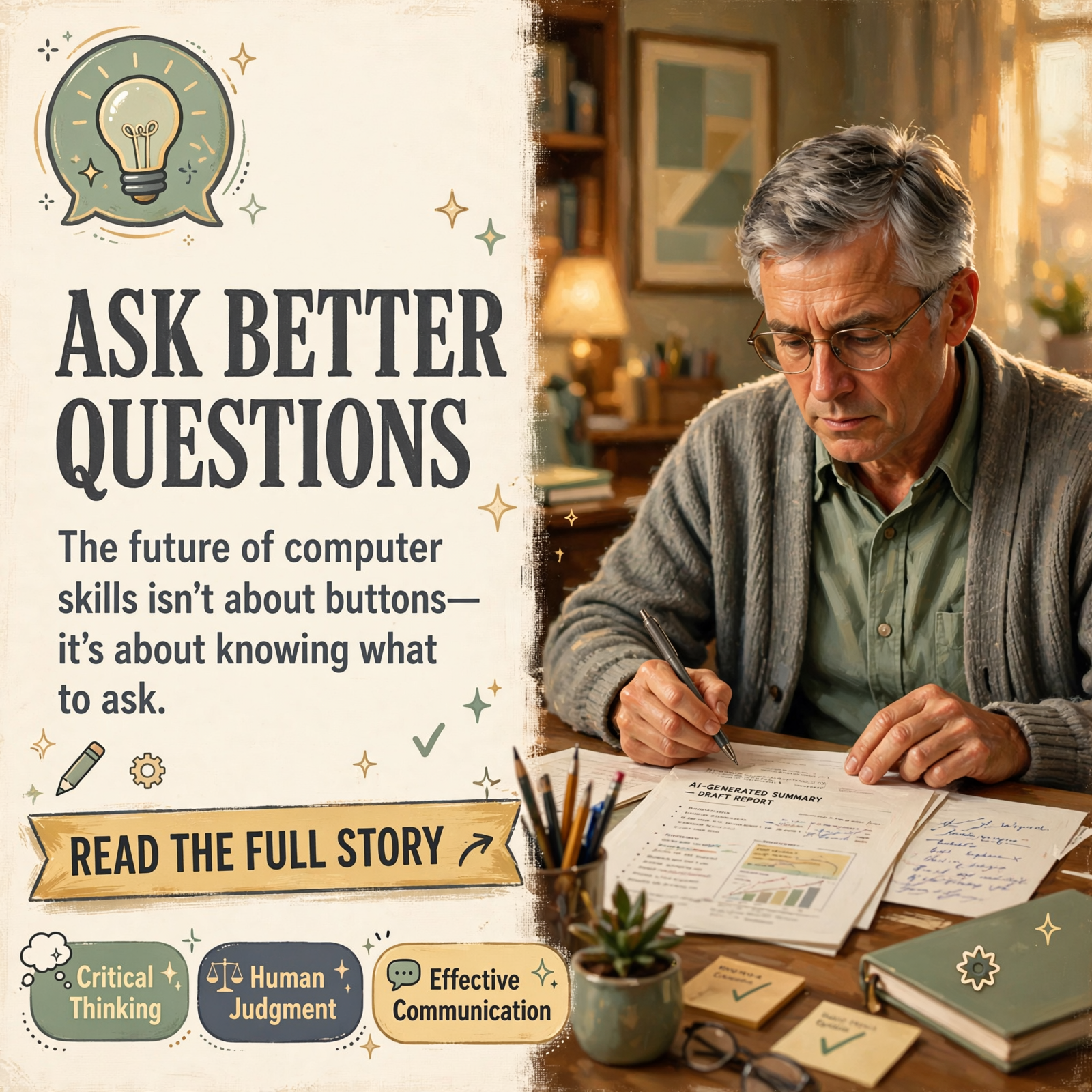
The New Computer Skill May Be Knowing How to Ask for Help

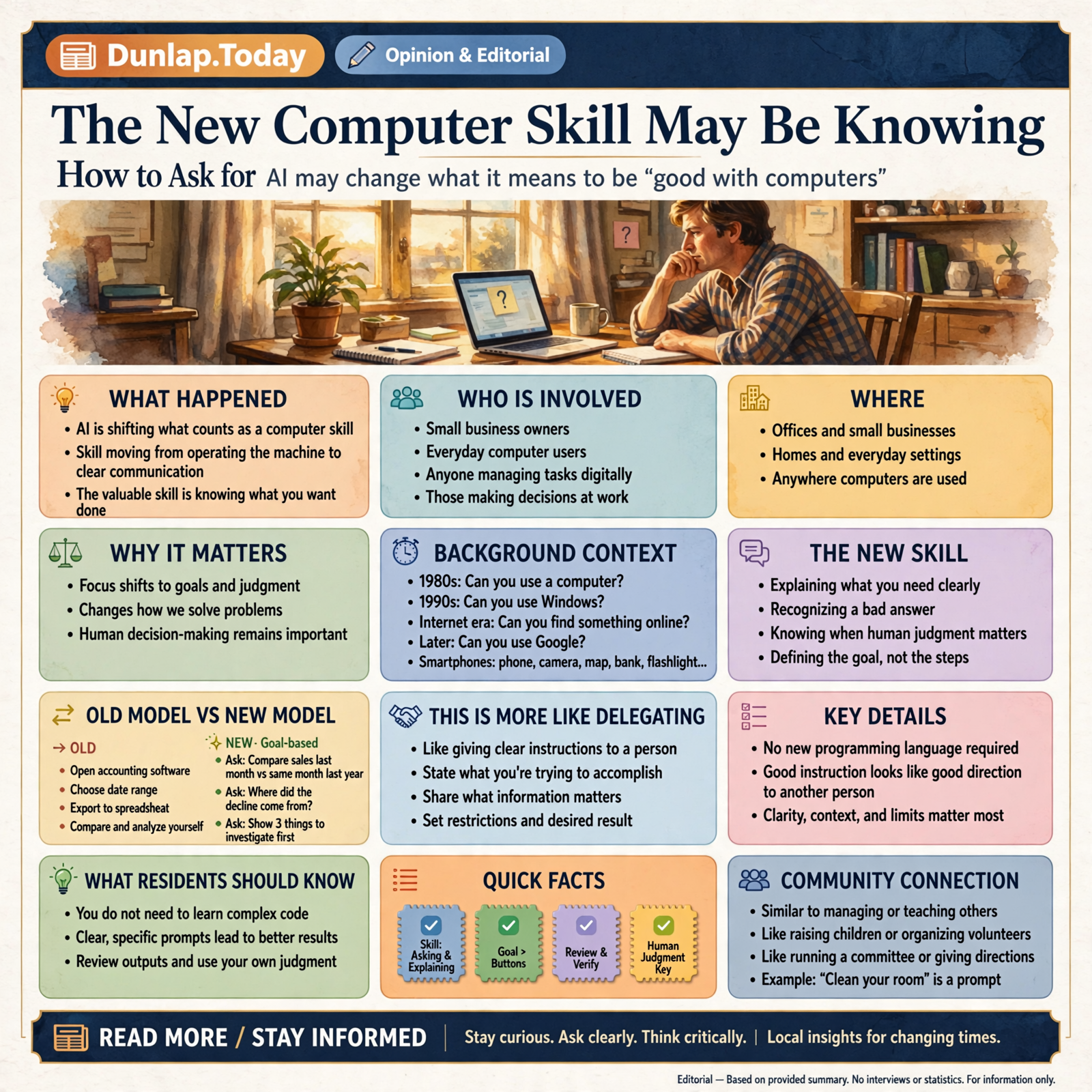
For decades, computer skills meant knowing which buttons to push. Artificial intelligence may change that. The valuable skill may increasingly be knowing what you want done, explaining it clearly, recognizing a bad answer and knowing when human judgment still matters.
There was a time when being “good with computers” meant something fairly specific.
You knew which program to open.
You knew where the files were.
You understood folders.
You could install a printer without calling your nephew.
And if you could make a spreadsheet do something besides display a collection of empty little boxes, people around the office occasionally regarded you as some sort of wizard.
Computer skill was mostly about learning how to operate the machine.
Artificial intelligence may be changing that definition.
The next important computer skill may have surprisingly little to do with computers.
It may be knowing how to explain what you need.
We’ve Been Through This Before
Every generation of technology creates a new dividing line between people who know how to use it and people who don’t.
In the 1980s, the question might have been:
“Can you use a computer?”
In the 1990s:
“Can you use Windows?”
In the early days of the internet:
“Can you find something online?”
Later:
“Can you use Google?”
Then smartphones arrived and we all had to learn that the device in our pocket could simultaneously be a telephone, camera, map, newspaper, bank, flashlight, alarm clock and highly efficient method of losing 45 minutes watching somebody restore an old lawn mower.
Artificial intelligence introduces a different sort of skill.
The machine can increasingly figure out how to operate itself.
Now the human has to figure out what to ask it to accomplish.
Knowing the Answer May Matter Less Than Knowing the Goal

Suppose you own a small business and want to know why sales were weaker last month.
The old computer model required you to know which report to run.
You might need to open accounting software, choose the correct date range, export the numbers, put them into a spreadsheet, create a comparison and decide what the numbers meant.
The new model may eventually allow you to say:
“Sales were down last month. Compare them with the same month last year, tell me where the decline came from, and show me the three things I should investigate first.”
Notice what happened.
You didn’t tell the computer exactly which buttons to press.
You told it what problem you were trying to solve.
That is a very different skill.
This Is More Like Delegating Than Programming

People sometimes hear about “prompt engineering” and imagine that they will need to learn some mysterious new computer language.
For most ordinary users, that probably isn’t the important part.
A good instruction to an AI often looks remarkably similar to a good instruction to another person.
You explain:
- what you’re trying to accomplish,
- what information matters,
- what restrictions apply,
- what the finished result should look like,
- and what you don’t want it to do.
In other words, you’re delegating.
If you’ve ever managed employees, taught somebody a trade, raised children, organized volunteers, run a church committee or tried to explain to a teenager exactly what you meant by “clean your room,” you already understand the basic problem.
The instructions matter.
“Clean Your Room” Is a Prompt

Consider two instructions.
Instruction One:
“Clean your room.”
Depending on the teenager involved, this can apparently mean transferring everything from the floor to the bed.
Instruction Two:
“Put the dirty clothes in the hamper, throw away the trash, put the clean clothes in the dresser, make the bed and vacuum the floor. Come get me before you move anything you’re unsure about.”
Same goal.
Very different instructions.
AI works much the same way.
The better you describe the desired outcome, the constraints and the stopping points, the better chance you have of getting useful work.
That’s not really a computer skill.
It’s a communication skill.
Experience May Suddenly Become a Technological Advantage

This creates an interesting possibility.
Older workers and experienced professionals are sometimes assumed to be at a disadvantage whenever new technology arrives.
That assumption may not hold as strongly with AI.
Someone who has spent 30 years running a business may not know the newest software shortcut.
But that person may know something much more valuable:
what good work looks like.
An experienced carpenter knows when a measurement doesn’t make sense.
An experienced bookkeeper recognizes a number that looks wrong.
An experienced mechanic hears something in an engine that a beginner doesn’t.
An experienced nurse recognizes when the patient’s story doesn’t quite match the numbers.
An experienced salesperson knows when a customer’s polite answer really means “no.”
An experienced farmer knows that the instructions in a manual and what actually happens in a muddy field are occasionally distant relatives.
Artificial intelligence can produce information remarkably quickly.
Experience helps determine whether that information deserves to be trusted.
The Computer Can Be Confident and Wrong at the Same Time

This may be the most important skill of all.
Artificial intelligence can give you an incorrect answer that sounds every bit as polished as the correct one.
That can be unsettling.
We’re accustomed to uncertainty looking uncertain.
A person who doesn’t know something may hesitate, stumble or say:
“I’m not sure.”
A computer may produce three beautiful paragraphs, five bullet points and a professional conclusion while being wrong somewhere in the middle.
That means the human job doesn’t disappear when AI enters the picture.
It changes.
Instead of doing every part of the work yourself, you may increasingly supervise the work.
Research Is Already Showing This Shift

Microsoft’s 2026 Work Trend Index surveyed 20,000 workers using artificial intelligence across 10 countries.
When researchers asked which human skills were becoming more important as AI handled more work, two rose to the top:
- quality control of AI output, cited by 50% of respondents, and
- critical thinking, cited by 46%.
Perhaps more telling, 86% said they treat AI output as a starting point rather than a final answer.
That’s an important distinction.
The successful AI user isn’t necessarily the person who believes the computer.
It may be the person who knows how to challenge it.
There May Be a New Digital Divide

We’ve talked for years about the “digital divide.”
Usually that meant access to computers or high-speed internet.
Those problems still matter.
But another divide may be forming.
On one side will be people who use AI mainly as a fancy search box:
“Tell me something.”
On the other side may be people who learn to use it as a capable assistant:
“Help me accomplish something.”
The difference could become significant.
One person asks AI to write an email.
Another person says:
“Review these five customer messages, identify the two that need my attention today, draft replies for the routine ones and tell me which promises we’ve already made to each customer.”
Same technology.
Different level of delegation.
The Best Users May Ask Better Questions, Not Know More Answers
There’s an old saying that a good lawyer never asks a witness a question without knowing where the answer is likely to lead.
AI introduces something similar.
Useful users learn to ask questions that expose uncertainty.
Instead of:
“Is this a good idea?”
Try:
“What are the strongest arguments against this idea?”
Instead of:
“Which option should I choose?”
Try:
“What would have to be true for each option to be the best choice?”
Instead of:
“Write my business plan.”
Try:
“Help me identify the assumptions in this business plan that could cause it to fail.”
That’s not prompt engineering.
That’s thinking.
You Don’t Need to Sound Like a Computer

One unfortunate side effect of AI becoming popular is that the internet is now full of elaborate instructions telling people that every request needs to sound like a government contract written by a committee of robots.
For most everyday tasks, it doesn’t.
You can simply explain yourself.
Instead of:
“Generate synergistic optimization strategies for household expenditure reduction.”
You can say:
“Here’s what we spent last month. Show me where we’re wasting money without telling me to stop buying everything we enjoy.”
The second version may actually be more useful.
Good AI systems are increasingly designed to understand ordinary language.
The goal isn’t to learn how to talk like the computer.
The goal is to make the computer understand you.
Context Matters More Than Fancy Words

If you ask:
“Help me advertise my business.”
the AI has very little to work with.
If you say:
“I run a small heating and air-conditioning business serving rural customers within 30 miles. Most of our customers come from referrals. We don’t want aggressive sales language. Help me explain our spring tune-up service in a friendly way that sounds like a neighbor, not a national chain.”
the computer understands much more.
You haven’t used any special technical terminology.
You’ve supplied context.
Context may become one of the most valuable currencies in working with AI.
Knowing When Not to Use AI May Be a Skill Too

The temptation with every new tool is to use it everywhere.
We bought electric knives to cut bread.
Somebody eventually put internet access in a refrigerator.
Humanity has demonstrated repeatedly that just because we can add technology to something doesn’t mean the something was begging for technology.
AI will be no different.
There will be tasks where using AI saves enormous time.
There will be tasks where it adds complexity.
There will be decisions where AI can gather information but shouldn’t make the final choice.
And there will be moments where the most efficient technology remains:
Pick up the phone and talk to somebody.
Knowing the difference is judgment.
Small Businesses May Have the Most to Gain

This change could be particularly important to small businesses.
A large corporation can afford specialists.
A small company often cannot.
The owner may simultaneously be the salesperson, purchasing department, customer-service manager, estimator, scheduler and person who remembers that the toilet paper is almost gone.
AI can potentially absorb some of the research, organization and preparation wrapped around those responsibilities.
But the owner still has to know:
- what should be delegated,
- what good output looks like,
- what needs verification,
- what requires approval,
- and what should remain entirely human.
That makes judgment more valuable, not less.
The Person With the Most Knowledge May Become a Better Manager of Machines

This is one reason I wouldn’t write off experienced workers in the age of AI.
Consider somebody who has spent 40 years doing a particular job.
They may possess thousands of tiny lessons they can’t easily explain.
They know which customer is likely to pay late.
They know which supplier’s “two-day delivery” occasionally means next Thursday.
They know which machine noise means nothing and which machine noise means shut it down.
They know which shortcut is harmless and which one eventually causes trouble.
That accumulated judgment is valuable when supervising artificial intelligence.
The machine can potentially perform more of the routine work.
The experienced person can spend more time directing, evaluating and handling exceptions.
That’s not guaranteed to happen.
Businesses can certainly use technology badly.
But it represents a much more interesting future than the simple idea that computers replace everybody.
Young People Have an Advantage Too

None of this means younger workers don’t have an advantage.
They often experiment more freely with new tools and carry fewer assumptions about how work “has always been done.”
That matters.
The strongest combination may be obvious:
technological curiosity plus real-world experience.
A younger worker may discover a new way to accomplish something.
An experienced worker may know whether accomplishing it that way is actually a good idea.
Put those together and you have something considerably more valuable than either generation arguing about which one understands the future.
Perhaps We Should Teach Judgment Alongside Technology

If AI becomes a normal part of education and work, teaching people which button to push won’t be enough.
We may need to teach:
- how to define a problem,
- how to provide useful context,
- how to verify information,
- how to recognize uncertainty,
- how to compare competing answers,
- how to protect private information,
- and how to remain responsible for the final result.
Those sound suspiciously like thinking skills.
Which may be one of the stranger outcomes of artificial intelligence:
A machine capable of producing answers could make good human questions more valuable.
So What Should You Do Today?

You don’t need a course in artificial intelligence.
You don’t need to memorize a dictionary of technical terms.
And you certainly don’t need to start describing yourself as a “prompt engineer” because you asked a computer to rewrite an email.
Instead, practice something simpler.
The next time you use AI, don’t merely ask it for an answer.
Explain what you’re trying to accomplish.
Tell it what matters.
Tell it what constraints exist.
Ask it what you may have overlooked.
Then inspect the result.
If something looks wrong, ask why.
If something matters, verify it.
And remember that the computer producing the work doesn’t relieve the human of responsibility for deciding whether the work is any good.
The Machine May Know More. You Still Need to Know Better.

For decades, computer literacy meant knowing how to operate the machine.
The next generation may require something different.
You may not need to know which menu contains the command.
You may need to know what outcome you want.
You may not need to remember every fact.
You may need to recognize whether the fact makes sense.
You may not need to perform every step.
You may need to know which steps shouldn’t be delegated.
That’s why the new digital divide may not simply separate people who use artificial intelligence from people who don’t.
It may separate people who know how to direct it from people who merely accept whatever it gives them.
And there’s some good news hidden in that.
If you’ve spent a lifetime learning how things really work, you may already possess one of the most valuable AI skills there is.
Judgment.
AI, In Plain English is a Dunlap.Today series explaining new technology without assuming you have a computer science degree—or particularly want one. We focus on what changed, what it means for ordinary people, what could go right, what could go wrong and whether you actually need to do anything about it.



0 Comments