
🖥️ The Ferranti Pegasus: How a 1956 British Mainframe Changed Computing History
While the Sequatchie Valley and surrounding communities today enjoy instant access to computing power that would astound mid-century engineers, the story of how that revolution began-in Manchester, England, in 1956-offers a fascinating window into the birth of the modern computer age. The Ferranti Pegasus was not a personal device or a sleek machine; it was a room-filling installation that marked a turning point in how organizations could process information.
📍 A Landmark Delivery in Manchester
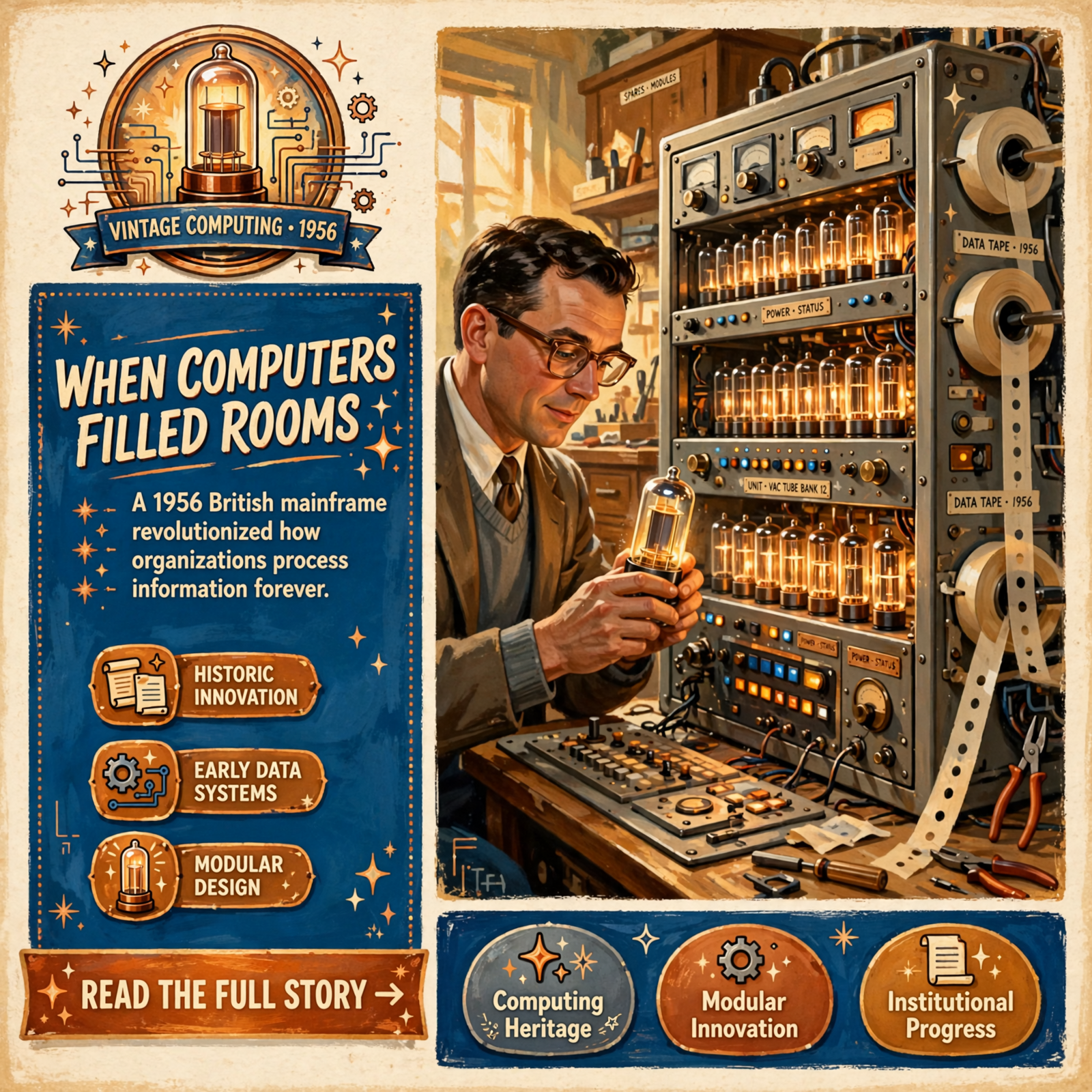
In 1956, Ferranti Ltd. delivered the first Ferranti Pegasus mainframe computer in Manchester, England. Unlike the compact devices we know today, Pegasus was a complete installation: cabinets full of electronics, control panels, paper-tape readers, and a teleprinter. It used approximately 6,000 vacuum tubes and thousands of diodes-technology that generated significant heat, consumed substantial power, and required regular maintenance. Yet despite its bulk and complexity, Pegasus was remarkably user-friendly for its era. Programmers could work in a relatively logical way, and engineers could replace faulty components quickly, a significant advantage over earlier computer designs.
⚙️ Technical Innovation That Enabled Mass Production
What made Pegasus truly significant was its modular construction. The electronics were housed in replaceable “packages”-small circuit modules that could be built, tested, and repaired independently. This design approach allowed Ferranti to manufacture Pegasus more efficiently than many earlier computers and helped it become one of the first British computers to be produced in series. About 38 Pegasus I and II systems were sold, with the later Pegasus II offering improved circuitry, more drum storage, and additional peripheral equipment.
The machine’s memory system was ingenious for its time. Fast main memory used magnetostrictive nickel delay lines-electrical pulses converted into sound waves traveling through nickel wire, then read back as electrical signals when they reached the end. For larger but slower storage, Pegasus used a magnetic drum holding about 25 kilobytes of data. Programs and data were entered on punched paper tape, and output came through a teleprinter. By today’s standards, a modern smartphone would outperform it before Pegasus had even finished warming up.
💼 Why This Matters: The Bridge from Manual to Electronic
For many organizations in the 1950s and 1960s, Pegasus represented their first computer-a transformative moment. Universities, banks, aircraft manufacturers, research institutions, and engineering companies used Pegasus to calculate structural designs, scientific tables, administrative data, and technical projects. It marked the transition from tables and mechanical calculating machines to electronic data processing. Understanding this history helps us appreciate how recent the digital revolution truly is and how quickly computing has evolved.
🔗 Community Threads: The Relationship Between Innovation and Accessibility
The Accessibility-Innovation Thread: Pegasus succeeded not just because it was technically advanced, but because its modular design made it accessible to engineers and maintainers. This principle-that good technology must be repairable and understandable-remains relevant today. Communities that value local expertise and hands-on problem-solving benefit when technology is designed with maintenance and adaptation in mind, not just initial performance.
The Institutional Adoption Thread: Pegasus was adopted by institutions-universities, banks, research centers-that needed to process complex information. These organizations became early adopters of electronic computing because they had problems that manual methods could not solve efficiently. Today, similar institutional relationships drive technology adoption in communities: schools, local government, and businesses adopt new tools when they solve real problems. Understanding how Pegasus fit into institutional workflows helps us think about how new technologies might serve our own communities.
🌍 Long-Term Community Impact: Why Computing History Matters Locally
The story of Pegasus is part of a larger narrative about how technology becomes embedded in everyday life. The principles that made Pegasus successful-modularity, repairability, user-friendly design, and institutional support-shaped how computing evolved. For communities in the Sequatchie Valley and surrounding areas, this history is a reminder that technological change is not inevitable or automatic; it depends on decisions made by engineers, manufacturers, and organizations about what matters: efficiency, accessibility, reliability, and human need.
The transition from mechanical calculation to electronic computing took decades and involved thousands of decisions about design, manufacturing, and adoption. Today, as communities consider how to integrate new technologies-whether in schools, local businesses, or civic infrastructure-the lessons from Pegasus remain relevant: good technology is designed for the people who use it and maintain it, not just for performance metrics.
💭 Questions for Reflection
- How did the shift from mechanical to electronic computing change the kinds of problems organizations could solve?
- What role did modularity and repairability play in making Pegasus successful, and how does that principle apply to technology choices today?
- Why might understanding computing history help communities make better decisions about adopting new technologies?
- How did institutional adoption-by universities, banks, and research centers-drive the acceptance of early computers?
- What can we learn from Pegasus about the relationship between technical innovation and practical accessibility?
📚 A Milestone Worth Remembering
The Ferranti Pegasus is now a less well-known milestone in British computer history, overshadowed by more famous early computers. Yet its story-of thoughtful engineering, modular design, and institutional adoption-offers valuable lessons about how technology becomes part of our world. For readers interested in computing history, vintage technology, or the relationship between innovation and community need, Pegasus represents a pivotal moment when electronic computing transitioned from laboratory curiosity to practical tool.




0 Comments