
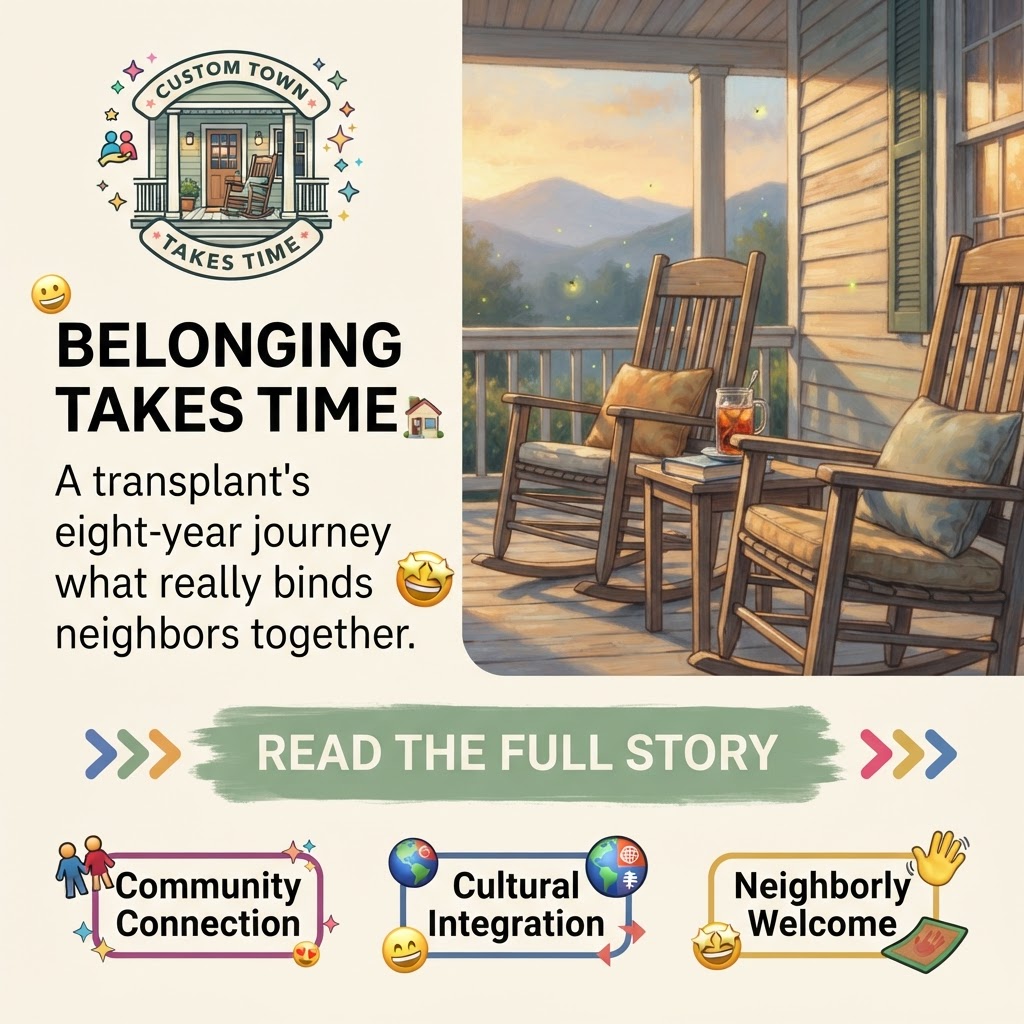
🤠 A Yankee’s Eight-Year Journey to Belonging in the Sequatchie Valley
In the Sequatchie Valley, where newcomers and longtime residents often find themselves navigating different cultural rhythms, one transplant’s reflective essay captures a universal truth about what it really means to become part of a Southern community—and how language, while important, may matter far less than the daily choices that bind neighbors together.
💭 Why This Resonates Locally
The Sequatchie Valley has long been a destination for people seeking a slower pace, closer community ties, and a different way of life. Whether drawn by the mountains, the sense of belonging, or simply a desire to escape the rush of urban centers, newcomers arrive with open hearts and sometimes bewildered expressions. This essay—a humorous yet deeply honest reflection on eight years of cultural adaptation—speaks directly to that experience. It’s a story many valley residents recognize, whether they’re the transplant learning to say “y’all” or the longtime neighbor patiently waiting for it to stick. 🏔️
❤️ What the Essay Really Reveals About Community
On the surface, this is a funny piece about struggling to adopt a regional dialect. But beneath the humor lies something more profound: a meditation on what it actually takes to become part of a community. The author discovers that mastering Southern speech patterns matters far less than mastering Southern values—the wave to a stranger, the help offered before it’s requested, the willingness to sit through a long story just to hear what isn’t being said. These are the real languages of the Sequatchie Valley, and they’re learned through presence, not pronunciation. 🤝
The essay captures something essential about how communities absorb newcomers. It’s not about demanding conformity or perfect accent adoption. It’s about showing up, paying attention, and gradually understanding that neighbors, church communities, and local traditions operate on a different clock and different values than what many transplants grew up with. The author’s neighbors—”patient saints,” as he calls them—embody this valley tradition of gentle welcome without judgment. 🙏
🌄 The Deeper Threads of Valley Life
Several community threads emerge from this reflection:
The Porch Culture and Neighborliness: The essay celebrates the Sequatchie Valley tradition of front-porch wisdom, waving at strangers, and knowing neighbors by name before formal introduction. This isn’t quaint nostalgia—it’s a functioning social infrastructure that many valley residents depend on for connection, support, and a sense of belonging. For newcomers, learning to participate in this culture often matters more than learning the dialect. 🏡
Church and Spiritual Community: References to church bells marking the week and “bless your heart” as an art form point to the role of faith communities in shaping valley culture. Churches in the Sequatchie Valley often serve as anchors for both longtime residents and newcomers, offering a place where cultural integration happens naturally through shared worship and service. ⛪
Food as Cultural Bridge: The reverence for biscuits, sweet tea, and the distinction between “dinner” and “supper” reflects how food traditions carry cultural meaning in the South. These aren’t just meals—they’re expressions of values, hospitality, and identity. For newcomers, learning to participate in these food traditions often opens doors to deeper community connection. 🍽️
The Pace of Life: The author’s observation that “the valley taught my soul to grow” speaks to something many valley residents experience: a deliberate slowing down that allows for deeper relationships and more intentional living. This shift from measuring distance in miles to measuring it in minutes reflects a fundamental reorientation toward what matters. ⏰
🤔 Questions Worth Considering
This essay invites reflection on several community-level questions:
- How do communities in the Sequatchie Valley successfully integrate newcomers, and what role do patient, welcoming neighbors play in that process?
- What cultural values matter most to valley residents—and are they things that can be taught, or must they be experienced over time?
- How do longtime residents balance maintaining local traditions with welcoming people from different backgrounds and regions?
- What does it mean for a community’s identity when newcomers adopt some cultural markers (like dialect) but not others (like pace of life or neighborliness)?
✨ A Reflection on Belonging
Eight years into his Sequatchie Valley life, the author has learned something that many longtime residents already know: becoming part of a community isn’t primarily about sounding like you belong. It’s about acting like you belong—showing up, paying attention, helping without being asked, and gradually understanding that the real language of the South is written in actions, not words. 🌟
For the Sequatchie Valley, this essay is a gentle reminder of something worth protecting: the capacity to welcome newcomers not by demanding they become identical copies of longtime residents, but by inviting them into a way of life that, over time, transforms them from the inside out. Whether they ever master “y’all” may matter far less than whether they learn to wave at strangers, sit through long stories, and understand that family is bigger than blood. 💚
🤔Poem
The Last Yankee Stand: A Ballad Against “Y’all”
I came down South with open hands,
To learn the ways of gentler lands.
I traded haste for slower pace,
And found a smile on every face.
I’ve learned that tea is brewed with pride,
And sugar’s poured with both hands tied.
I’ve found that every porch’s worth
Could cure most sorrows known on Earth.
I’ve waved at strangers passing by,
Though neither one could tell me why.
I’ve learned that neighbors know your name
Before you’ve even staked your claim.
I’ve watched the church bells mark the week,
Heard wisdom from the old folks speak.
I’ve learned that biscuits rank above
Most worldly things, save faith and love.
I’ve even found, to my surprise,
That fireflies outshine city skies.
The mountains taught me how to slow;
The valley taught my soul to grow.
I’ve come to treasure every season,
Though none of it obeys much reason.
I’ve sat through stories half a day
Just to hear what folks didn’t say.
I’ve picked up “reckon,” “might could,” too,
And “fixin’ to” has settled through.
I scarcely blink at “bless your heart,”
Though that’s an art form set apart.
Yet one small word defeats me still—
A stubborn climb, a steeper hill.
That word is “Y’all.”
Now understand, I bear no grudge.
It’s not my place to sit in judgment.
Indeed, it’s clever—short and neat—
A linguistic work that’s hard to beat.
It gathers many into one,
Makes grammar seem almost good fun.
It welcomes kin and friend alike,
With one small word both warm and light.
But every time I try it out,
It tumbles forth wrapped up in doubt.
The tongue resists.
The jaw revolts.
My Midwestern ancestors rise from their sensible graves wearing sensible shoes and quietly whisper:
“Thomas… we don’t do that.”
I can say “all of you.”
I can say “everyone.”
I can even muster an awkward, “you folks.”
But “Y’all?”
It hangs in midair like a cowboy hat balanced upon a Presbyterian accountant.
It simply doesn’t fit.
I’ve practiced privately.
I tried before a mirror once.
The mirror frowned.
The cats left the room.
Even the coffee tasted disappointed.
My neighbors, patient saints that they are, continue their campaign.
They’ll smile and say,
“You’ll get there eventually.”
Eight years have passed.
At this rate, I’ll master it sometime around the year 2087, assuming my vowels survive.
The funny thing is this:
I’ve discovered that becoming Southern has precious little to do with pronunciation.
It’s waving at the fellow whose truck you don’t recognize.
It’s stopping to help before anyone asks.
It’s measuring distance in minutes instead of miles.
It’s believing supper deserves more respect than dinner.
It’s understanding that family often includes people who share neither your blood nor your last name.
Those things…
Those I’ve learned.
Perhaps “y’all” isn’t merely spoken.
Perhaps it’s earned.
And until that glorious day arrives, I’ll continue sounding like a tourist ordering sweet tea with impeccable grammar and suspiciously northern vowels.
The South has adopted me far better than I’ve adopted its favorite contraction.
Still…
If you’ll excuse me—
Or should I say…
all of you…
I’m fixin’ to keep trying.
Though I reckon there are some battles a Yankee was simply born to lose.
📰Other Stories
- 🏞️ Sequatchie Valley Residents Search for Hidden Local Treasures Worth Supporting
- 🏞️ A Moment of Pride in the Sequatchie Valley’s Natural Beauty
- 🚐 Local Service Business Relocates to New Location in Sequatchie Valley
- ✨ A Closer Look at Disney’s Grand Californian Hotel & Spa — What Makes It a Destination Worth Considering
- 🔑 Limited-Edition Sequatchie Valley Medallion Keychain Connects Local Businesses Through QR Code Network
- 🐦 Simple Dreams: Why Backyard Birdwatching Resonates in the Valley
- 📚 Sequatchie County Public Library Wraps Summer Reading Program with Community Celebration


0 Comments