
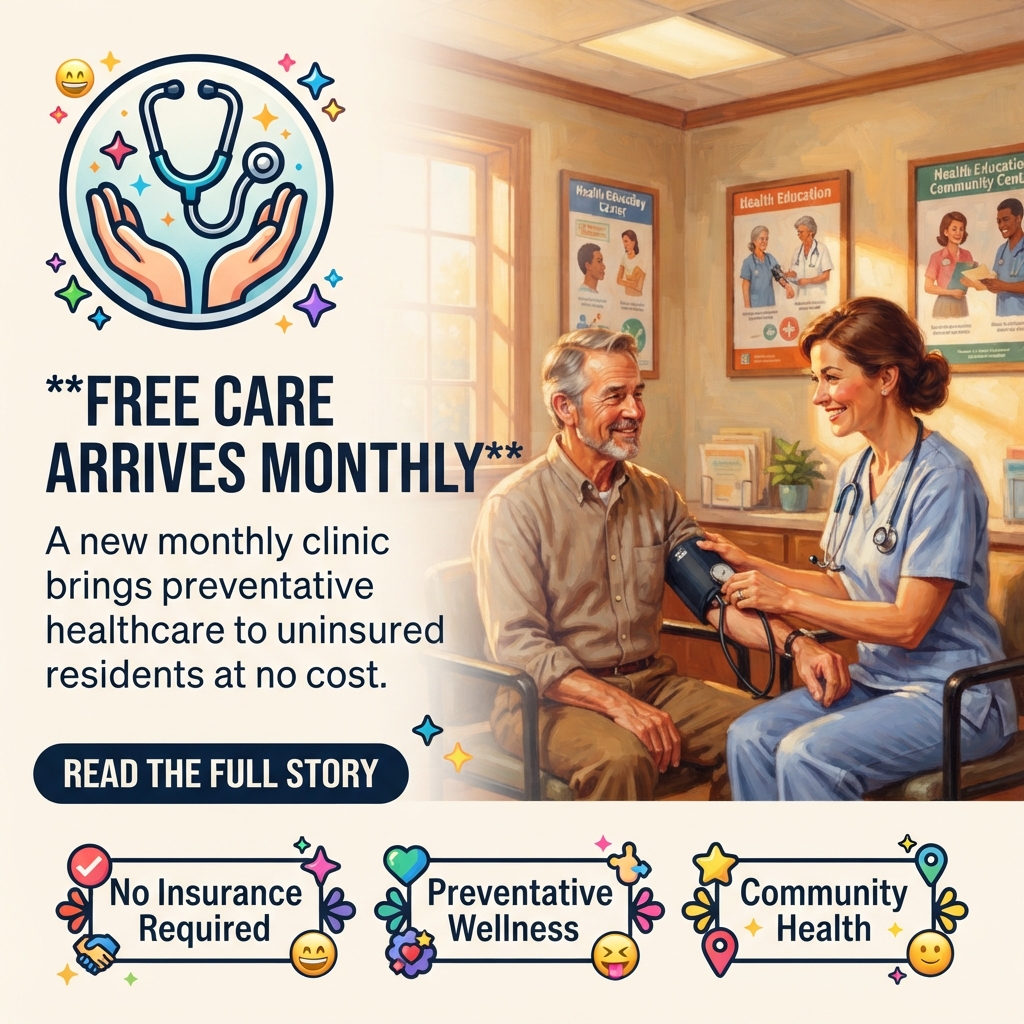
🏥 Free Primary Care Clinic Opens Monthly in Dunlap — No Insurance or Payment Required
As healthcare access remains a challenge across rural Tennessee, Sequatchie County is gaining a new resource: a monthly free clinic offering preventative care, wellness exams, and chronic disease management at no cost to residents. The clinic, operated by MobileMOC in partnership with the University of Tennessee at Chattanooga, launches this month at Lewis Chapel Community Center in Dunlap.
📍 What’s Available and When
The clinic opens its doors on the fourth Monday of each month, starting July 28, 2026, from 10:00 a.m. to 12:00 p.m. at Lewis Chapel Community Center (4760 Henson Gap Road, Dunlap, TN 37327). Services include annual wellness exams, preventative screenings, sick visits, chronic disease management, diagnostic testing, blood pressure screenings, cholesterol screenings, memory screenings, and pap smears. 🩺
The clinic explicitly welcomes uninsured residents and those without the ability to pay. Insurance is not required, and there is no payment requirement. For residents who need transportation assistance to reach the clinic, the team offers local transportation support—a detail worth noting in a county where distance and mobility can be barriers to care. ✨
❤️ Why This Matters for Sequatchie County
Access to primary care is foundational to community health. Rural counties often face shortages of primary care providers, and uninsured or underinsured residents may delay or skip preventative care due to cost. A monthly free clinic addresses both barriers at once: it brings care directly to a community gathering space and removes financial obstacles. For families living paycheck to paycheck, this can mean the difference between catching a health problem early and facing a crisis later. 💙
The clinic’s focus on preventative screenings—blood pressure, cholesterol, memory—reflects an understanding that many chronic diseases can be managed or prevented with early detection. For older adults and caregivers in Sequatchie County, this represents an opportunity to monitor health without fear of unexpected bills.
🤝 Community Connections
The partnership between MobileMOC and the University of Tennessee at Chattanooga signals a bridge between higher education and rural community health. UTC’s College of Nursing is involved, suggesting that nursing students or faculty may be part of the care team—a model that strengthens both the clinic’s capacity and the educational experience of future healthcare providers. 🎓
Lewis Chapel Community Center serves as the host site, positioning the clinic within an existing community gathering place. This choice matters: residents already know the location, and the center’s role as a community hub may reduce stigma or hesitation about seeking care. Community centers often host multiple services and events, so the clinic becomes part of a broader network of local resources.
🗓️ What Residents Should Know
To schedule an appointment: Call 423-425-1657. When you call, let the team know if you need transportation assistance. 📞
Clinic details:
- Location: Lewis Chapel Community Center, 4760 Henson Gap Road, Dunlap, TN 37327
- Date & Time: Fourth Monday of each month, 10:00 a.m.–12:00 p.m. CST
- Cost: Free (no insurance required, no payment required)
- Transportation: Available upon request
The clinic is actively seeking to fill remaining appointment slots for the July launch, so calling soon is advisable if you’re interested in attending. 📣
🌟 Opportunities for Connection and Support
The clinic’s announcement includes an explicit invitation for community members to share the news with friends, family, and neighbors who might benefit. This peer-to-peer sharing model recognizes that word-of-mouth is often how rural residents learn about new services. If you know someone without regular access to healthcare—whether due to cost, transportation, or insurance status—passing along the clinic information could open a door to preventative care. 🚪
Community organizations, churches, senior centers, and local nonprofits may also find value in sharing this resource with the populations they serve. For organizations supporting older adults, caregivers, or low-income families, the clinic represents a concrete resource to recommend.
📈 What Happens Next
The clinic is scheduled to operate on a recurring monthly basis, with the first session on July 28, 2026. Residents who attend can expect to learn whether follow-up care, additional testing, or referrals to specialists are needed. The clinic’s ongoing presence—month after month—suggests a commitment to sustained service rather than a one-time event. 🔄
As the clinic establishes itself, community feedback and attendance patterns will likely shape how the service evolves. Questions about whether hours might expand, whether additional clinic sites might open in other parts of Sequatchie County, or how the clinic might partner with other local health initiatives remain to be seen.
💭 Questions Worth Considering
As this clinic launches, residents might reflect on a few broader questions:
- How many uninsured or underinsured residents in Sequatchie County currently lack access to regular preventative care, and how might a monthly clinic begin to address that gap?
- What barriers—beyond cost—keep some residents from seeking healthcare, and how might a community-based clinic help overcome them?
- How can local organizations, churches, and community groups help ensure that residents who would benefit most from this clinic learn about it?
- If the clinic proves successful, what would it take to expand services to other communities within Sequatchie County or increase frequency?
🏘️ Long-Term Community Impact
A sustained free clinic can influence community health outcomes over time. Early detection of high blood pressure, high cholesterol, and other chronic conditions allows for management before complications arise—reducing emergency room visits, hospitalizations, and long-term health costs. For individuals, this means better quality of life and fewer health crises. For the community, it means a healthier workforce, fewer missed work days due to illness, and stronger family stability. 💪
The clinic also signals that healthcare access is a community priority. When residents see that local organizations and educational institutions are investing in free primary care, it reinforces the message that health matters and that no one should be left behind due to inability to pay. Over time, this can build trust in healthcare systems and encourage preventative behaviors across the community.
🧵 Community Threads
Education and Healthcare Partnership: The involvement of UTC’s College of Nursing weaves together higher education and rural health. This thread strengthens both: the clinic gains clinical capacity and expertise, while nursing students gain real-world experience serving an underserved population. This partnership models how universities can be anchors for community health, not just distant institutions. 🎓
Community Spaces as Health Hubs: By locating the clinic at Lewis Chapel Community Center, the service becomes embedded in an existing community gathering place. This thread connects healthcare to the broader fabric of community life—where residents already gather for other events, meetings, and services. It normalizes healthcare access as part of community participation. 🏛️
Peer Networks and Word-of-Mouth: The clinic’s call for community members to share the news with friends and neighbors activates an invisible thread of trust and connection. In rural communities, people often rely on trusted neighbors and family members for information about services. By encouraging this sharing, the clinic taps into existing social networks that are often more effective than formal advertising. 🤲
Transportation as Community Care: The offer of local transportation assistance recognizes that distance and mobility are real barriers in Sequatchie County. This thread connects the clinic to the broader challenge of rural connectivity—and suggests that community members may be willing to help neighbors access care. It’s a small detail that reflects understanding of how rural life actually works. 🚗

0 Comments