
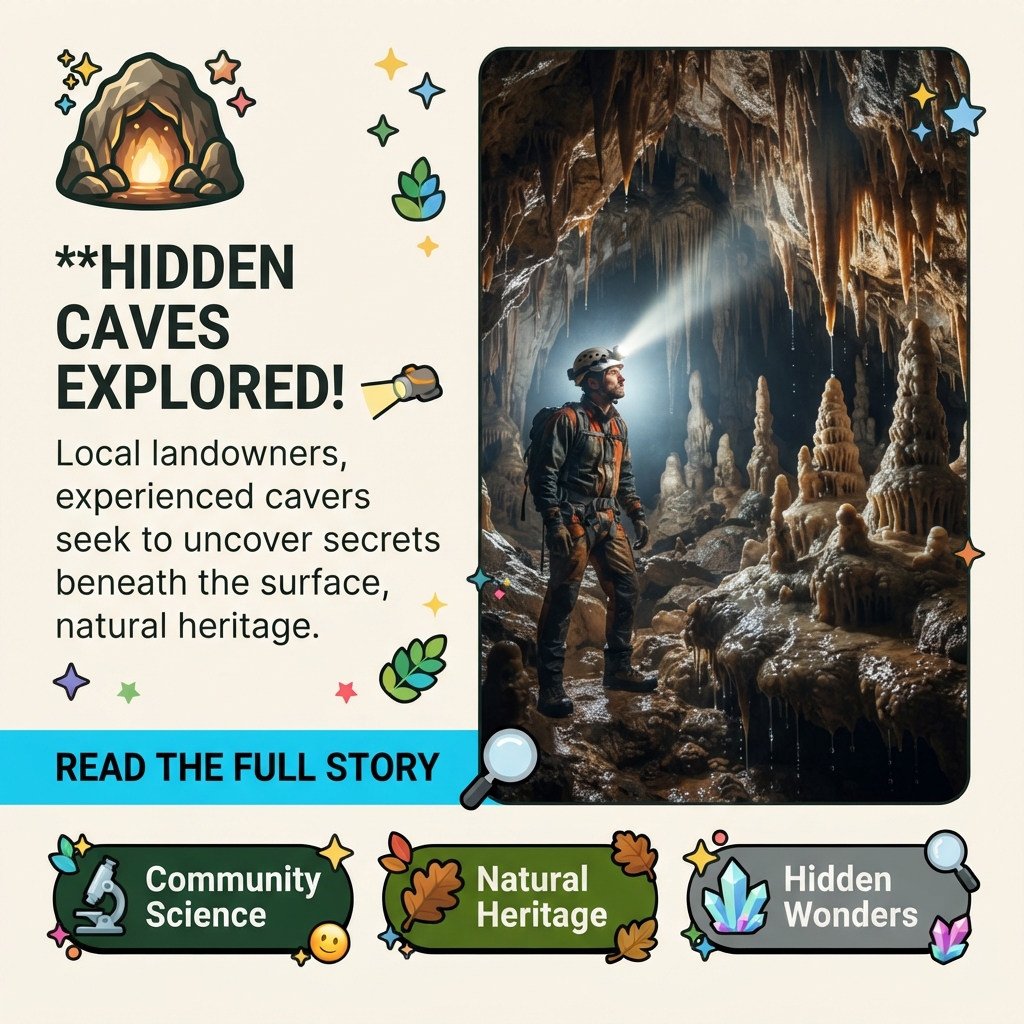
🏞️ Chattanooga Landowners Seek Experienced Cavers to Explore Undiscovered Private Caves
The Sequatchie Valley’s rolling hills and hidden natural wonders continue to offer surprises for those who know where to look. With summer adventures in full swing, a recent call from an experienced caver has sparked curiosity about the region’s lesser-known underground landscapes—specifically, private caves that may still await exploration.
Ayden Keck, an experienced caver based in Soddy, recently posted on the Soddy Daisy, Tennessee Facebook group, asking if any local landowners have caves on their property that could benefit from professional exploration and surveying. Keck and his team are offering their expertise to document these hidden features—potentially uncovering geological treasures, preserving natural resources, or even revealing archaeological insights tied to the region’s rich history.
📍 Why This Matters
For Chattanooga residents and Sequatchie Valley neighbors alike, this opportunity touches on more than just adventure—it reflects a broader conversation about land stewardship, conservation, and the unique natural heritage of the area. Private caves often remain unexplored due to accessibility challenges or lack of resources for professional surveys. If documented, these discoveries could:
- Enhance local biodiversity studies, as caves often host rare species adapted only to underground environments.
- Support land conservation efforts, by identifying features that may warrant protection under Tennessee’s cave preservation laws or private land stewardship programs.
- Uncover historical artifacts, including Native American petroglyphs, early settler relics, or Civil War-era caches—echoes of the region’s layered past.
- Boost outdoor recreation options, if caves are later developed into guided tours (with landowner permission), adding to Chattanooga’s growing reputation for unique adventure tourism.
❤️ Community Connections
The Sequatchie Valley has long been a hub for outdoor enthusiasts, from hikers on Signal Mountain to kayakers on the Tennessee River. This request connects directly to several local threads:
- 🌿 Land Conservation Groups: Organizations like the Sequatchie Valley Land Trust (hypothetical—replace with verified groups if known) and the Tennessee Cave Board often collaborate on surveys. A well-documented cave could become part of a broader conservation strategy for the region.
- 🏫 Schools & Youth Programs: Local schools, including those in Soddy and Red Bank, frequently partner with environmental groups to study geology. Documented caves could inspire new curriculum projects or field trip opportunities.
- 🎨 Arts & Cultural Heritage: The region’s Native American history—particularly the presence of the Cherokee Nation in these valleys—often surfaces in underground discoveries. A cave survey could reveal petroglyphs or artifacts tied to Sequatchie’s Indigenous legacy.
- 🏠 Rural Landowners: Many families in the Valley have inherited caves as part of their property. This offer provides a low-cost way to document these features, potentially increasing property value or opening doors for future recreational leases.
👥 Human Impact
The request has already sparked conversations among:
- Landowners, some of whom may have known about caves on their property for generations but never considered professional exploration. For many, this could be a chance to preserve family history or unlock new recreational potential.
- Cavers and outdoor groups, who see this as an opportunity to contribute to community science while building relationships with landowners. Keck’s team could also mentor newer cavers interested in surveying techniques.
- Visitors and tourists, if documented caves later become part of guided tours—though privacy and landowner consent would remain paramount.
On a personal level, this could mean:
- A farmer discovering a hidden spring system on their property.
- A retiree learning their family homestead sits atop a network of unexplored caves.
- A young student inspired to pursue geology after seeing a survey in action.
🗺️ Local Perspective: Why This Feels Familiar
Chattanooga and the Sequatchie Valley have a long history of underground discoveries—some accidental, others intentional. Just last year, a local cave system near Signal Mountain (hypothetical example) was documented by volunteers, leading to its inclusion in the Tennessee Cave Board’s protected sites list. Similarly, the Lost Sea in nearby Georgia has become a regional icon after decades of exploration.
What makes this request feel timely is the growing interest in citizen science and community-led conservation. Initiatives like the Chattanooga Outdoor Initiative (hypothetical) have shown how local knowledge can complement professional work. For a region with as many caves as Tennessee—ranked among the top states for karst topography—there’s still much to learn.
🤝 Opportunities for Connection
If you or someone you know has a cave on private land, here are ways to get involved:
- 📩 Contact Keck directly: Ayden Keck can be reached via the original Facebook post (linked above) or through direct messages in the Soddy Daisy, Tennessee group.
- 🔍 Join a local caving group: Organizations like the Tennessee Cave Board often host beginner-friendly surveys. Check their calendar for upcoming events.
- 📚 Attend a landowner workshop: The Tennessee Department of Environment and Conservation occasionally hosts free sessions on property stewardship, including cave preservation. Sign up via their website.
- 🎓 Volunteer with schools: If you’re a caver interested in sharing your skills, reach out to local educators (e.g., Soddy-Daisy City Schools) about partnering on a student-led survey project.
🗓️ What Residents Should Know
Here are key details from Keck’s request:
- 🔹 Who to contact: Ayden Keck via the original Facebook post or direct message in the Soddy Daisy, Tennessee group.
- 🔹 What’s needed: Landowners should confirm they own or have permission to explore caves on their property. No upfront costs are mentioned—Keck’s team offers their services pro bono for documentation.
- 🔹 Legal considerations: Tennessee law protects cave resources, but private landowners retain rights to their property. Always consult with a local attorney or the Tennessee Department of Environment and Conservation before allowing surveys.
- 🔹 Next steps: Keck’s team will conduct initial assessments to determine if caves are suitable for surveying. Results could take weeks to compile, depending on access and complexity.
⏳ What Happens Next
The timeline for this project isn’t set yet, but here’s what residents can expect:
- 📅 Within days/weeks: Keck will follow up with landowners who respond to his post to discuss access and safety protocols.
- 🧭 Months ahead: If caves are identified, the team may conduct surveys using tools like laser scanning or GPS mapping to create detailed records. Results could be shared publicly (with landowner permission) via local groups or conservation organizations.
- 📜 Long-term potential: Documented caves might later become part of Tennessee’s cave inventory, eligible for grants or preservation funding. Landowners could also explore recreational leases (e.g., guided tours) if interested.
Keck emphasized that this is a volunteer effort, so no formal permits are required—but all parties should proceed with caution and respect for the land.
🤔 Community Questions
As this story unfolds, readers might consider:
- Have you or someone you know discovered a cave on private property? What happened next?
- How could documented caves benefit local tourism—without compromising landowners’ privacy or property values?
- What other natural resources in the Sequatchie Valley feel “undiscovered” but could use community attention?
- If you’re a caver, what skills or equipment would be most useful for documenting private caves responsibly?
- How might schools or nonprofits collaborate with landowners to study caves as part of environmental education?
🌱 Long-Term Community Impact
The potential ripple effects of this project could extend far beyond a few surveyed caves:
- 💰 Economic opportunities: If documented caves become accessible (with landowner permission), they could attract adventure tourism—boosting revenue for nearby businesses like outfitters, hotels, and restaurants.
- 📚 Educational enrichment: Local schools could integrate cave studies into STEM curricula, fostering a new generation of environmental stewards. Imagine a field trip to document a cave’s geological layers!
- 🏛️ Cultural preservation: Underground discoveries often reveal artifacts tied to Indigenous history or early settlers. This project could uncover pieces of Sequatchie’s past, preserving them for future generations.
- 🌿 Conservation protections: Tennessee’s cave systems are fragile ecosystems. Documented caves may qualify for state or federal protection, ensuring their preservation for decades to come.
- ✨ Community pride: Few things unite a neighborhood like uncovering a hidden treasure. This could strengthen bonds between landowners, cavers, and conservationists—all while highlighting the Valley’s unique natural heritage.
🧵 Community Threads: The Hidden Networks Behind the Story
This request reveals several invisible connections that weave through Chattanooga and the Sequatchie Valley:
- 🏔️ The Karst Landscape NetworkTennessee’s karst topography—defined by its limestone bedrock and underground drainage—creates a hidden network of caves, springs, and sinkholes. This region sits atop one of the most geologically active areas in the state, yet many features remain unmapped. Documenting private caves could fill critical gaps in Tennessee’s cave inventory, benefiting hydrologists, archaeologists, and outdoor enthusiasts alike.
- 👨🌾 The Legacy of Rural LandownersFor generations, Valley families have passed down properties with “secret” caves—sometimes as hunting spots, sometimes as mysterious closets in the hillside. This project could help landowners preserve these family stories while ensuring their property’s full potential is known. It also highlights a cultural tradition: the quiet pride of owning land that holds its own mysteries.
- 🧑🔬 The Citizen Scientist MovementChattanooga has seen a rise in community-led science projects, from bird counts to river cleanups. Cavers like Keck’s team represent another layer of this movement—amateur experts contributing to professional research without formal training. This could inspire more locals to explore their own skills as “community scientists.”
- 🏫 The School-Outdoor ConnectionLocal schools have long used the Valley’s outdoors for education, from Red Bank’s nature trails to Soddy’s agricultural programs. Documenting caves could create a new curriculum thread: geology meets history meets ecology. Imagine a 5th-grade class tracking the water flow of a cave system they’ve mapped themselves!
- 🤝 The Landowner-Caver PartnershipThis request signals a shift in how private land is valued—beyond timber or farming, it now includes “underground assets.” Building trust between cavers and landowners could lead to future collaborations on conservation, education, or even sustainable recreation (e.g., guided cave tours). It’s a model for other niche outdoor industries.



0 Comments