
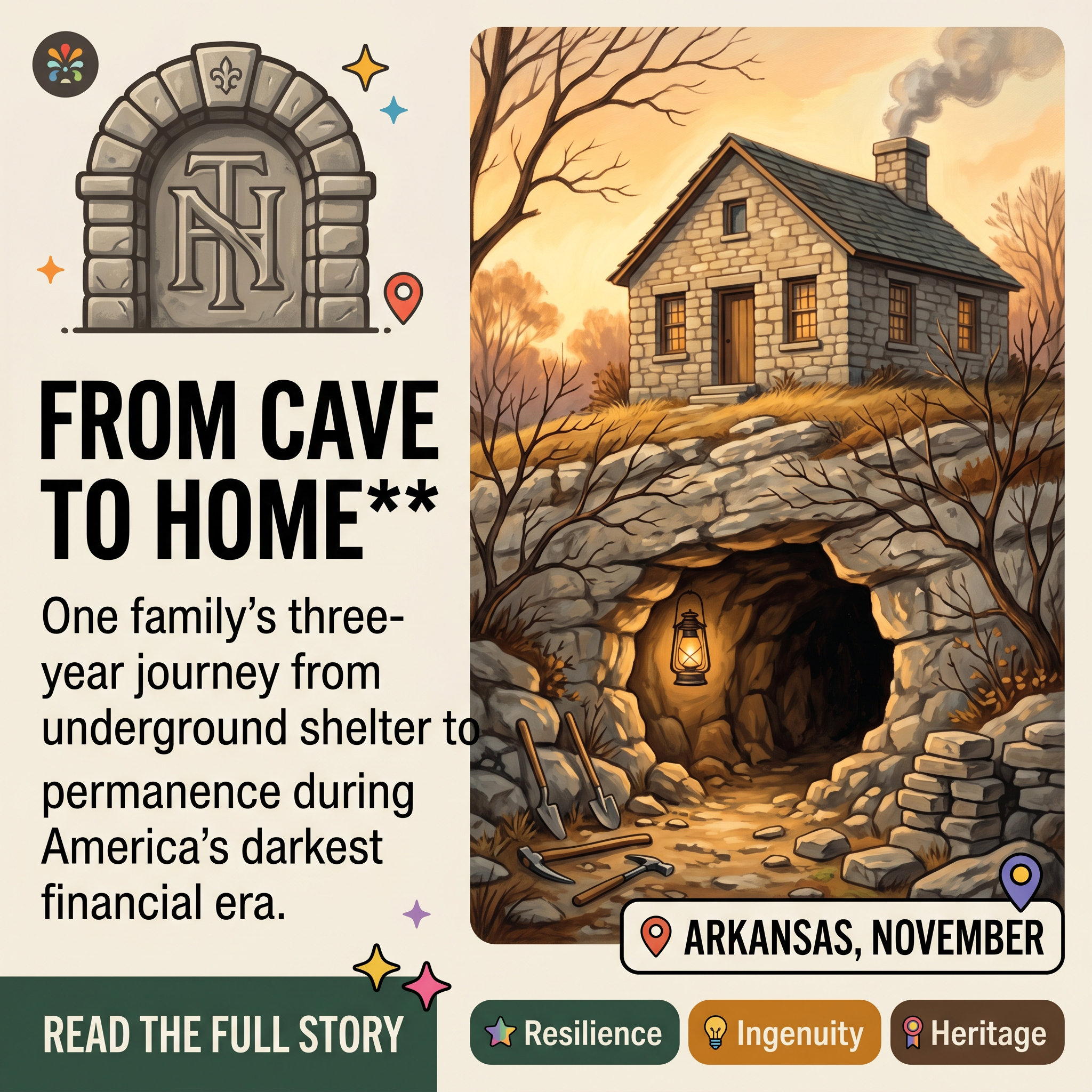
🏔️ Depression-Era Resilience: How an Arkansas Family Built a Home from a Hillside Cave, 1931–1934
Stories of hardship and ingenuity from the Great Depression era continue to resonate across rural communities like the Sequatchie Valley, where families have long relied on resourcefulness and the land itself to survive economic upheaval. 🌄 This remarkable account of the Walker family’s three-year journey from underground shelter to finished stone home offers a powerful reminder of the determination that shaped Appalachian and Ozark communities during America’s darkest financial period.
When the stock market crashed in 1929, the Walker family of the Ozark region in Arkansas faced a fate shared by thousands: the bank foreclosed on their farm, leaving Samuel Walker, his wife, and five children—ranging in age from 4 to 14 years old—homeless as winter 1931 approached. 💔 With no savings and no prospects for immediate housing, the family faced the cold months with nothing but uncertainty.
Samuel Walker, a skilled stone mason at age 42, remembered an old limestone shelter carved naturally into a nearby hillside—roughly 20 by 25 feet, dry inside, and maintaining a steady temperature near 55°F year-round. 🪨 He approached the new landowner with a bold proposal: allow the family to shelter inside the cave through the winter, and in exchange, he would construct a retaining stone wall. The owner agreed, and the Walkers moved underground.
🛠️ Three Winters of Labor and Adaptation
That first winter, the family made do with packed dirt floors and old quilts hung as makeshift doors. During daylight hours, Samuel cut timber and gathered stone; at night, working by lantern light, he carefully shaped rock by hand. ✨ His first project was the retaining wall, followed by a fireplace and shelves carved directly into the stone interior—each piece a step toward permanence.
Winter 1932 found the family still unable to afford a proper house, so they remained in the cave while Samuel continued expanding the underground space, opening more room within the hillside. 🏠 By winter 1933, with the family still sheltered below, Samuel began the painstaking work of constructing a small stone house above ground, placing each block one at a time after long days of labor.
Spring 1934 finally brought completion. The house stood finished—a modest but solid structure built entirely from Samuel’s skill and determination. 🎯 In May 1934, the family moved into their new home. That first night, the youngest child—now seven years old—struggled to fall asleep, saying the house felt too large and too quiet. The family had grown so accustomed to the close stone walls and steady cool air beneath the hill that open rooms and silence felt foreign.
💡 Legacy of Survival and Ingenuity
Samuel kept the cave afterward, using it to store vegetables and supplies—a practical extension of the shelter that had sustained his family through three winters. 🥔 Many years later, in 1988, one of his grandsons discovered Samuel’s old journal. The final sentence reportedly read: “The house stands finished. The cave carried us through. Sometimes shelter comes from the hardest places.”
The Walker family’s story stands as a testament to the resourcefulness and resilience that defined rural America during the Great Depression. 📖 In an era when government aid was minimal and community support often meant the difference between survival and destitution, families like the Walkers drew on their skills, their land, and their determination to build something lasting from nothing.
Related Businesses
Oak & Stone LLC
Specializes in masonry and custom stonework, directly relevant to Samuel Walker’s skilled stone mason work and the stone house construction featured in the article.
Newson Stone & Masonry
Provides stonework and masonry services, matching the core craft Samuel Walker used to build the family’s stone home during the Depression era.
Dunlap Building Stone
Supplies authentic Tennessee mountain stone products, the same material Samuel Walker hand-shaped and used to construct the retaining wall and stone house.
Real Stone Veneers of Tennessee
Natural stone veneer and building stone supplier in Dunlap, relevant to the Depression-era stone construction methods and materials discussed in the Walker family story.
American Home Heroes
Veteran-owned construction company emphasizing craftsmanship and resilience, echoing the determination and skilled labor Samuel Walker demonstrated building his family’s home.
Faith & Farmhouse
Provides homestead goods and farm support for rural families, relevant to the Depression-era rural survival and agricultural resilience themes central to the Walker family narrative.



0 Comments