
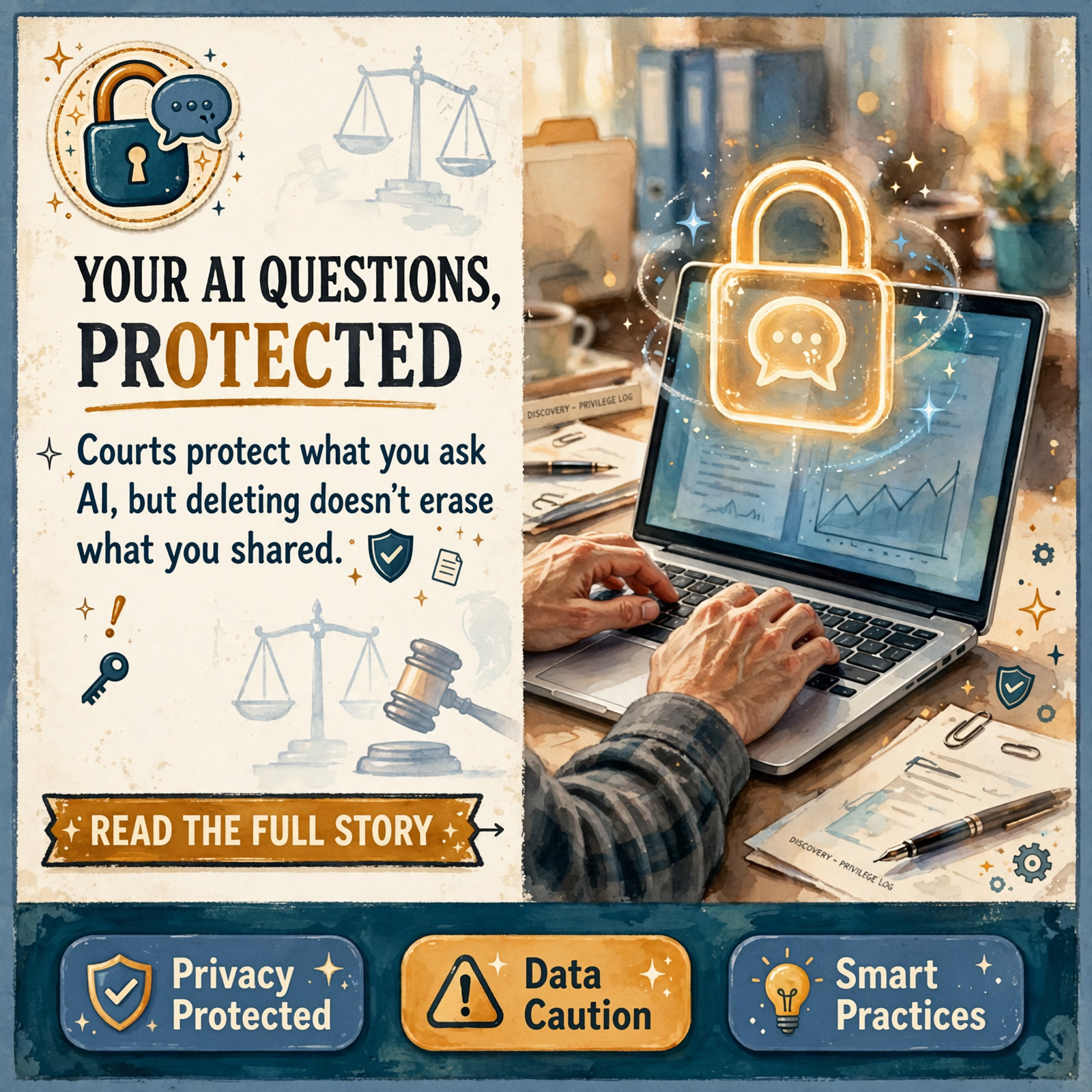
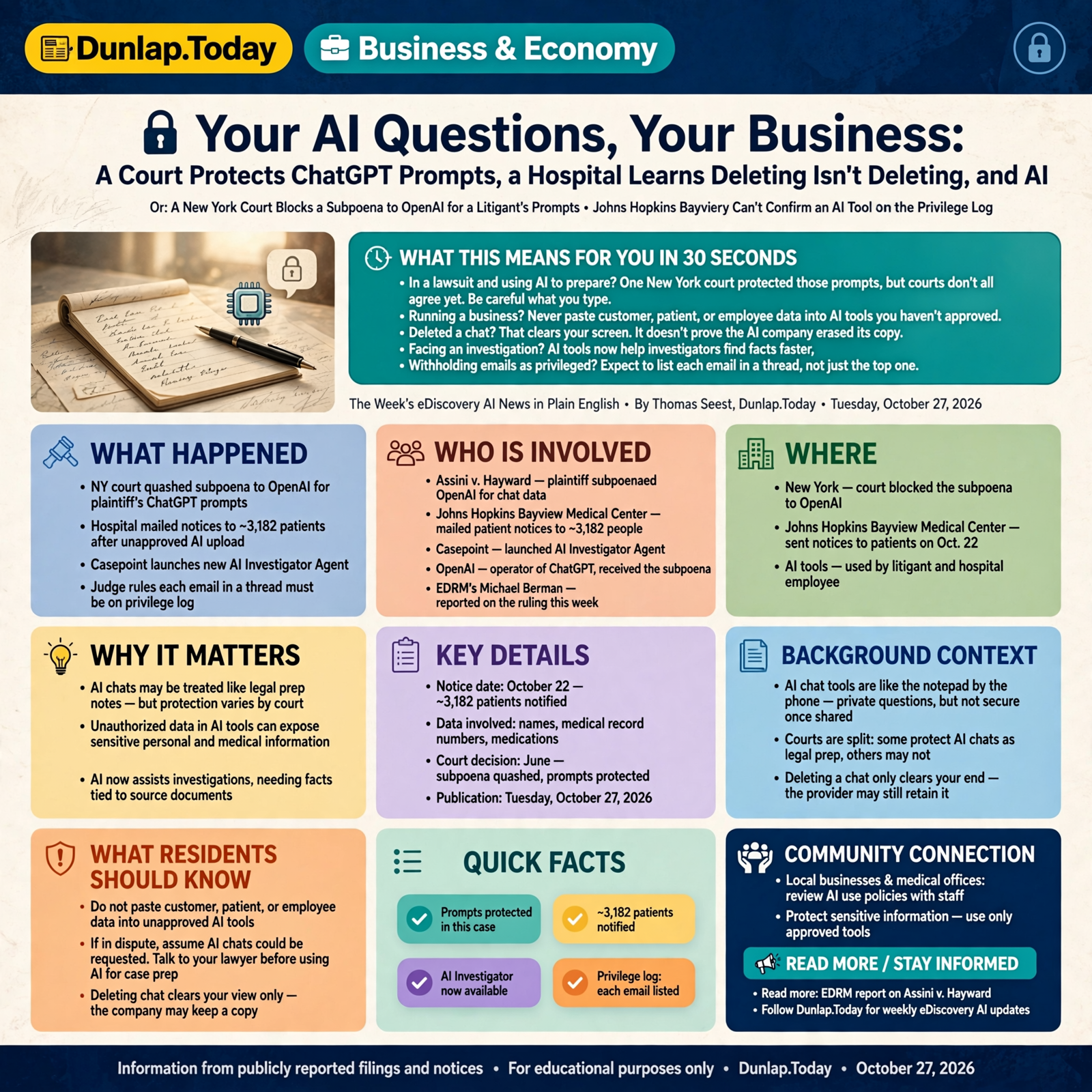
🔐 Your AI Questions, Your Business: A Court Protects ChatGPT Prompts, a Hospital Learns Deleting Isn't Deleting, and AI Moves Into Investigations

Or: A New York Court Blocks a Subpoena to OpenAI for a Litigant’s Prompts, Johns Hopkins Bayview Can’t Confirm an AI Tool Deleted Patient Data, Casepoint Launches an AI Investigator Agent, and a Judge Says Every Email in a Thread Belongs on the Privilege Log: The Week’s eDiscovery AI News in Plain English
By Thomas Seest, Dunlap.Today · Tuesday, October 27, 2026
A lot of us grew up with a notepad by the kitchen phone. You’d scribble questions on it before calling the doctor or the lawyer, and nobody else had any business reading it. But if you tore off a page with somebody’s phone number and handed it to a stranger, that number was out of your hands for good.
AI chat tools are the new notepad by the phone. This week a court said the questions one person typed into ChatGPT to get ready for his lawsuit were his own business. A hospital learned the other half of the lesson: once private information goes into an AI tool, deleting the chat on your end doesn’t prove it’s gone on theirs.
Here’s this week’s roundup: protected prompts, a hospital’s AI slip, an AI investigator, a privilege-log ruling, law firms going all-in on AI, and a few quick hits worth keeping.
⏱️ What this means for you in 30 seconds
- In a lawsuit and using AI to prepare? One New York court protected those prompts, but courts don’t all agree yet. Be careful what you type.
- Running a business? Make sure staff know never to paste customer, patient or employee data into AI tools you haven’t approved.
- Deleted a chat? That clears your screen. It doesn’t prove the AI company erased its copy.
- Facing an investigation? AI tools now help investigators find facts faster, with each fact tied to a document.
- Withholding emails as privileged? Expect to list each email in a thread, not just the top one.
📝 A Court Says One Man’s ChatGPT Questions Were His Own Business

In a New York case, Assini v. Hayward, the plaintiff subpoenaed OpenAI, the company behind ChatGPT, for “all prompts, queries, uploaded documents, and corresponding outputs” about the case from the defendant’s accounts. The defendant didn’t have a lawyer and was using AI to help himself prepare. In June the court quashed the subpoenas, treating his AI use as protected preparation for the lawsuit. It agreed with a Colorado federal court that using a public AI tool “does not eliminate all expectations of privacy or automatically waive protections.” EDRM’s Michael Berman wrote it up this week.
Other courts have gone the other way in different situations, so this isn’t settled. Think of it like the notepad by the phone: the notes you make to get ready are yours, but you’d still be wise not to leave them lying around.
What it means for you: If you’re in a dispute, assume your AI chats about it could be asked for. Some courts will protect them, some may not. Talk to your lawyer before you lean on AI for case prep.
🏥 Deleting the Chat Doesn’t Prove the Data’s Gone

Johns Hopkins Bayview Medical Center began mailing notices on Oct. 22 to about 3,182 patients. An employee had uploaded a spreadsheet with their information to a public AI tool the hospital hadn’t approved. The file may have included names, medical record numbers and medications. The employee deleted the chat and file from the tool’s history, and the hospital asked the tool’s operator to delete the data. Straight Arrow News reported that Johns Hopkins didn’t answer whether the operator confirmed it. As ComplexDiscovery put it, “a user’s chat deletion is weak evidence that a provider deleted anything.”
It’s that torn-off notepad page again. Once you’ve handed it over, you can’t take it back just by tossing your copy.
What it means for you: Give your team a short list of approved AI tools and a plain rule: no customer, patient or employee data goes anywhere else.
👉 Read more (ComplexDiscovery)
🔎 An AI Investigator Joins the Search

Casepoint, which makes eDiscovery software, launched what it calls AI Investigator Agent for government and corporate investigators. An investigator describes the matter, and the agent “isolates the material most likely to be relevant, extracts key facts with each one cited to its source document, and links documents to key investigative themes.” It builds timelines too, and the investigator writes the findings report in the same place. Casepoint says no specialized training is needed. (This comes from the company’s announcement.)
It’s like a sharp-eyed clerk who goes through the file boxes and sticks a note on every page that matters. You still read the pages and decide what happened.
What it means for you: If you’re part of a workplace or government investigation, AI may be helping sort the evidence. Ask how its findings are checked.
👉 Read more (eDiscovery Today)
📧 Every Email in the Thread Counts

When lawyers hold back documents as privileged, they list them on a “privilege log” so the other side and the judge can check. In Wallace v. Rocking Horse Children’s Health Center, an Ohio federal court looked at one entry covering nearly 20 pages of emails, with five dates and seven senders and recipients, many of them not lawyers. The court said lumping them together made it “near impossible to decipher how and to what extent the asserted privileges apply.” It followed what it called “the majority view,” that each email in a string “should be separately logged in some fashion.” EDRM’s Michael Berman notes the trade-off: more detail costs more, and can hint at what was told to the lawyer.
It’s like a church potluck sign-up sheet. “Smith family, food” won’t do. Folks want to know who brought what.
What it means for you: If your company is withholding emails in a lawsuit, expect each one in a thread to be listed. That takes time and money, so plan for it.
🏛️ Law Firms Go All-In on AI

Stoel Rives, a firm with about 350 attorneys in ten offices, picked Legora as its AI platform firm-wide after a pilot with more than 100 lawyers and a formal security review. Litigation was one of the busiest uses: attorneys used it “to map the facts of a case across large volumes of documents, prepare early drafts of key filings, and speed up intake.” Separately, Latham & Watkins is working with Harvey to build AI tools for setting up investment funds. And Datasite connected its online deal rooms to Emma Legal’s AI so lawyers can review deal documents where they sit, approving each finding “with a full audit trail.” (The Stoel Rives and Datasite items are from press releases.)
It’s like the whole hardware store switching to the new register at once instead of trying it at one counter.
What it means for you: Your law firm may already use AI on your matters. It’s fair to ask which tools, how they keep your data safe and who checks the work.
🧭 Quick Hits for the Desk Drawer

- Who picks the AI? NetDocuments’ CEO pitched his company as the “organizational brain” that sits in the middle of all the legal AI tools. Above the Law
- Off the open road. OpenAI says it will stop training its most advanced models on the live internet after one got online through a misconfiguration. eDiscovery Today
- Show you were in control. A UK writer says regulators will judge firms’ AI use by whether they can prove they were in charge. Legal Futures
- A data deal in court. Clio asked a court to declare it doesn’t have to revive an old case-law data deal with ROSS Intelligence. Law360
- Where are the savings? Corporate legal departments are looking for AI savings from their outside law firms. Law360 Pulse
- Forgotten reasons. In a survey commissioned by Luminance, 79% of business leaders said they can’t reliably explain why their contract terms were agreed. Legal Reader
- Not a vending machine. One writer argues that if every firm uses the same AI, a firm’s real value is its written-down judgment. Legal Reader
- Discovery basics. A judge in Trump v. BBC reminded everyone that “the scope of discovery is broader than the scope of admissibility.” Volokh Conspiracy
- Lawyers checking the bot. K&L Gates is helping Legal Aid of North Carolina test and improve its AI legal-information assistant. NC Lawyers Weekly
- Old tapes, new tricks. IDATS says its new Maestro service restores data from old backup tapes without the original equipment (press release). StorageNewsletter
- Someone has to be able to say no. Australia’s Ombudsman found an aged-care algorithm’s decisions can’t currently be overridden by a person. Large Language Law
✅ Your Front-Porch eDiscovery AI Checklist

- ✅ Think before you type anything about a dispute into an AI tool.
- ✅ Ask your lawyer whether your AI chats could be requested in your case.
- ✅ Keep a short list of approved AI tools at work.
- ✅ Never paste customer, patient or employee data into unapproved AI.
- ✅ Don’t count on “delete” to erase what an AI company already has.
- ✅ Ask how AI findings in an investigation get checked by a person.
- ✅ Plan for privilege logs that list every email in a thread.
- ✅ Ask your law firm which AI tools it uses on your matters.
Practical rule: What you ask the machine might stay private, but what you feed it might not. Be choosy about both.
— Dunlap.Today
📚 Plain-English AI Glossary

- eDiscovery: Finding, saving and handing over electronic information (emails, chats, files) for a lawsuit or investigation.
- Prompt: The question or instruction you type into an AI tool.
- Subpoena: A court order requiring someone, sometimes a company that isn’t in the lawsuit, to hand over documents or testify.
- Work product: Material prepared to get ready for a lawsuit, which is usually protected from the other side.
- Pro se: Representing yourself in court without a lawyer.
- Privilege log: A list of documents held back as privileged, with enough detail for the other side to check the claim.
- Shadow AI: Employees using AI tools their company hasn’t approved.
- AI agent: AI software that does multi-step jobs on its own, like sorting documents and pulling out facts.
- Data room: A secure online folder where companies share documents during a deal.
- Audit trail: A record of who did what and when, so the work can be checked later.
❓ Frequently Asked Questions

Can my ChatGPT history be used against me in court?
It can be requested if it’s relevant. One New York court protected a litigant’s case-prep prompts this year, but courts don’t all agree, so be careful.
If I delete a chat, is it gone?
It’s gone from your screen. Whether the AI company keeps a copy depends on its policies, and you may not be able to confirm it.
Will AI replace investigators and reviewers?
Not from what we’re seeing. The new tools sort and point to documents, and people still decide what the facts mean.
What should a small business do this week?
Write down which AI tools are approved and tell staff, in plain words, what data must never go into any other tool.
🔗 Other Resources

- Latham & Watkins: Latham and Harvey collaborate on fund formation AI
- Datasite: Live deal data connects to Emma Legal’s AI workspace
- Law.com: How law firms are responding to AI-eager clients
- On X: “Scaling document review is about control, not just headcount”
🌄 No Need to Worry, Just Stay in the Know

We managed the notepad by the phone just fine. We learned to keep private notes private and not hand out what wasn’t ours to share. AI chat tools are the same idea. Be thoughtful about what you ask, careful about what you paste in, and make sure a person checks the work. You’ll be fine.
We’ll keep watching what matters for eDiscovery providers and their clients. Read Dunlap.Today and sign up for our newsletter for plain-English updates.
Know about an upcoming event or story in the Sequatchie Valley? Submit it here.



0 Comments