
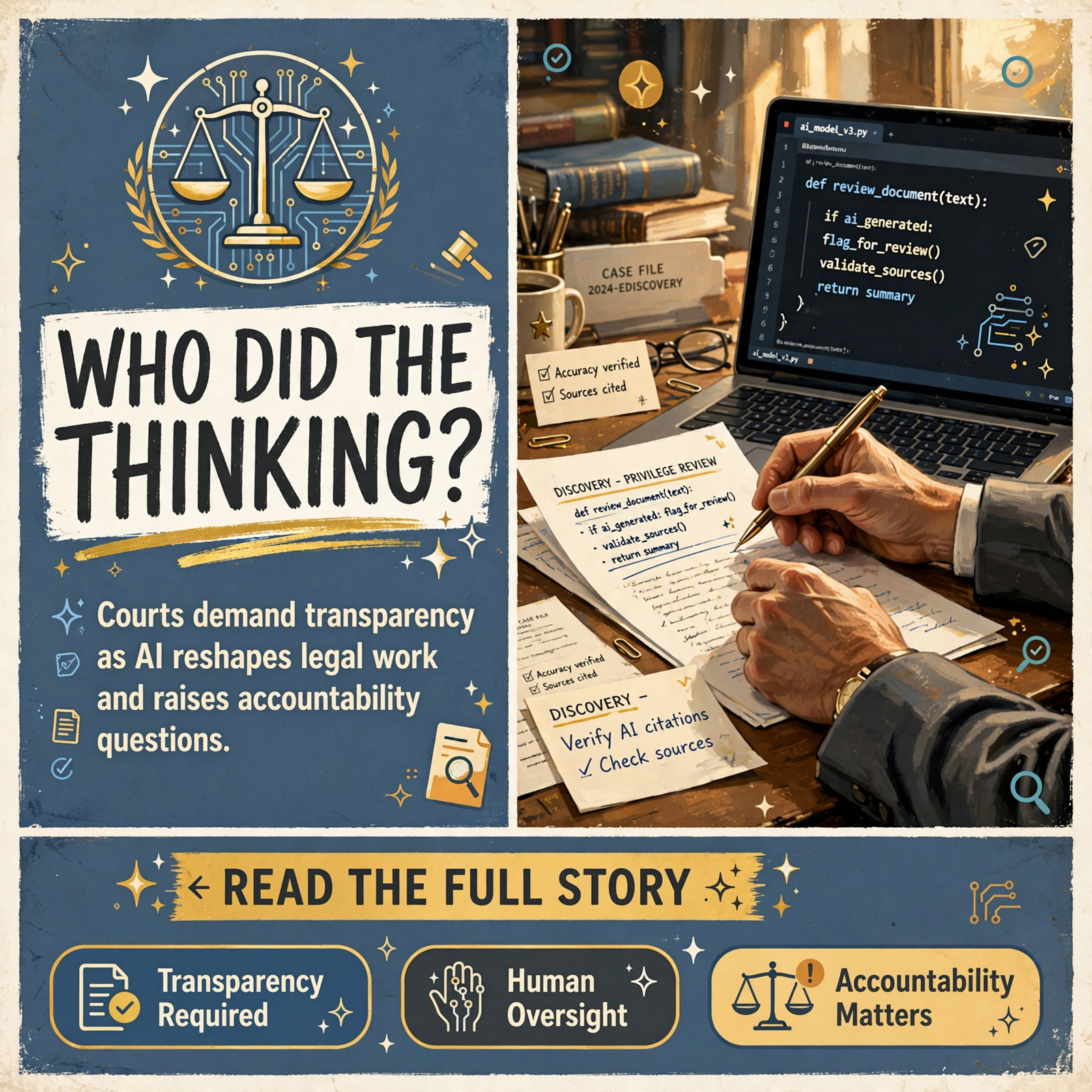
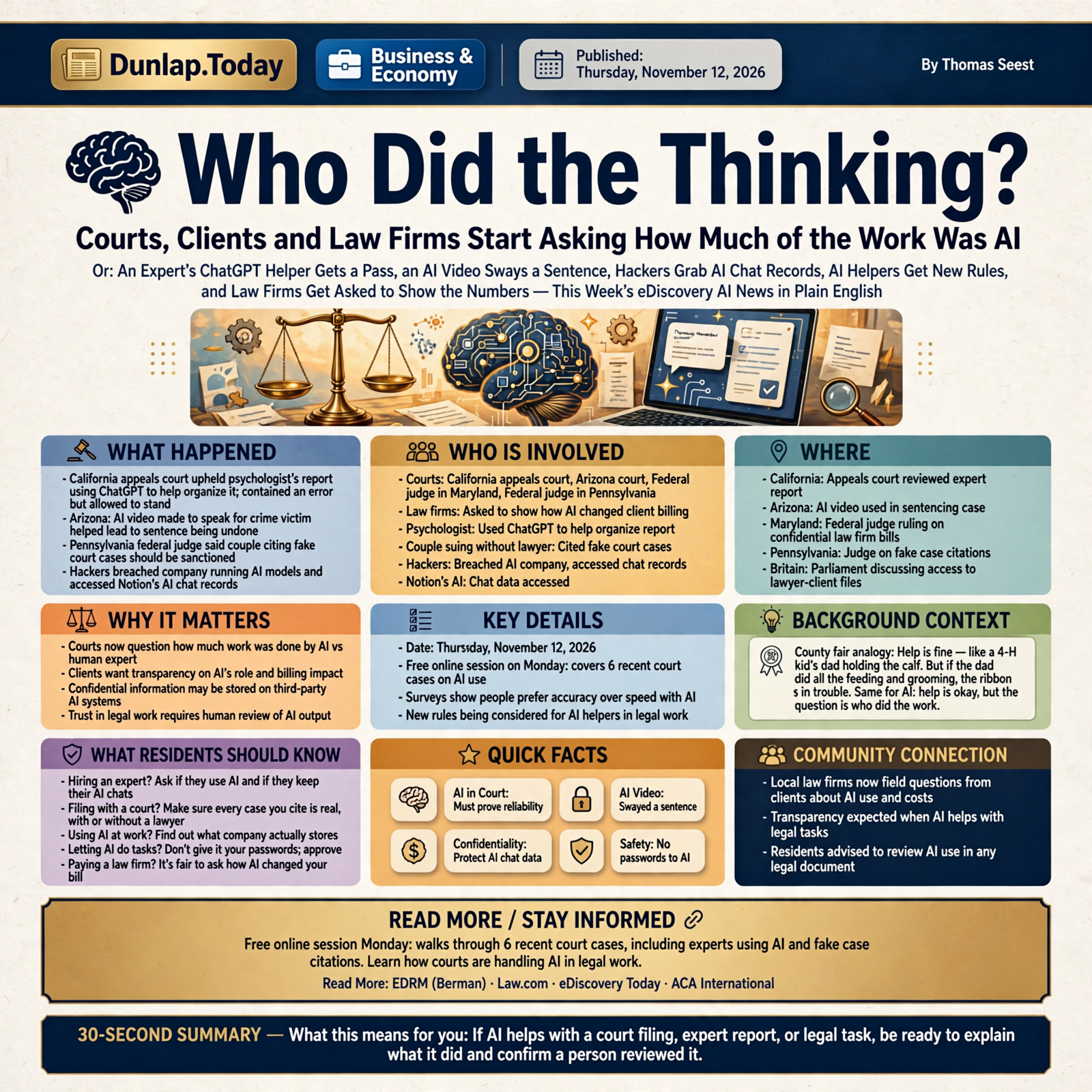
🧠 Who Did the Thinking? Courts, Clients and Law Firms Start Asking How Much of the Work Was AI

Or: An Expert's ChatGPT Helper Gets a Pass, an AI Video Sways a Sentence, Hackers Grab AI Chat Records, AI Helpers Get New Rules, and Law Firms Get Asked to Show the Numbers: This Week's eDiscovery AI News in Plain English
By Thomas Seest, Dunlap.Today · Thursday, November 12, 2026
At the county fair, nobody minds if a 4-H kid’s dad helped hold the calf still. But if the judges find out Dad did all the feeding and grooming, the ribbon’s in trouble. Help is fine. The question is who did the work.
That’s this week’s eDiscovery story. A court looked hard at how much an expert leaned on ChatGPT. An AI video swayed a sentence. Survey takers said they want accuracy over speed. And people are asking law firms to show what all that AI spending actually does for clients.
Here’s the rundown: AI in the courtroom, keeping confidential things confidential, keeping the work in one place, new rules for AI helpers, big AI lawsuits, and what AI means for law firm people and budgets.
⏱️ What this means for you in 30 seconds
- Hiring an expert? Ask whether they use AI and whether they keep their AI chats.
- Filing anything with a court? Make sure every case you cite is real, with or without a lawyer.
- Using AI tools at work? Find out what company actually stores your chats.
- Letting AI do tasks on its own? Don’t give it your passwords, and approve what it does.
- Paying a law firm? It’s fair to ask how AI changed your bill.
⚖️ AI in the Courtroom

A California appeals court let a psychologist's report stand even though she used ChatGPT to help organize it and it contained an error. The court warned that if AI actually came up with an expert's opinion, that would need special proof that it's reliable.
In Arizona, a video made with AI to speak for a crime victim helped lead to a sentence being undone. Everyone knew it was AI, and it still had an effect.
A free online session on Monday will walk through six recent court cases, including ones about whether an expert's AI use can be demanded in a lawsuit.
A couple suing without a lawyer kept citing court cases that don't exist, even after two courts warned them. A federal judge in Pennsylvania said they should be sanctioned.
It's like the pie contest at the church supper. Using Grandma's recipe card is fine. Buying the pie at the store and calling it yours isn't, and somebody always asks.
What it means for you: If AI helped with anything that goes to a court, from an expert report to a list of cases, be ready to explain what it did and show that a person checked it.
👉 Read more (EDRM (Berman)) · Read more (Law.com) · Read more (eDiscovery Today) · Read more (ACA International)
🔒 Keeping Confidential Things Confidential

A federal judge in Maryland found a way for a law firm's detailed bills to be shown to the other side without giving up the confidentiality of what's in them.
Some members of Britain's Parliament want regulators to be able to see lawyers' confidential client files when checking for money laundering. A court recently said they can't without the client's okay.
Hackers broke into a company that runs AI models for other businesses and took some chat records from people using Notion's AI. It's a reminder that your AI chats may sit on computers you've never heard of.
You keep the deed in the lockbox, not on the kitchen table. And you'd want to know if the bank moved the lockbox to another town.
What it means for you: Know where your confidential records and AI chats are stored, including the companies behind your AI tools, and use the legal tools that protect them when you have to share.
👉 Read more (EDRM (Berman)) · Read more (Legal Futures) · Read more (TechCrunch)
🗂️ Keeping the Work in One Place

A lawyer at an eDiscovery company warns that using lots of separate AI tools on one case can leave the evidence and the work scattered, which makes it harder to explain and costs more.
Trial lawyers shared tips for handling digital evidence: learn the tools you use, agree on the rules with the other side early, and train your team more than once.
Two eDiscovery companies won industry awards for their AI tools. One says its AI helpers log every decision and need a person's approval before moving on.
A big survey found most legal workers now use AI, but it hasn't caused job cuts yet. People said getting it right matters far more than getting it fast.
If the receipts are in the truck, the glove box and three coat pockets, tax time gets long. One shoebox makes it easy.
What it means for you: Keep AI work tied to the case file, write down the rules for handling evidence early, and pick tools that log what the AI did and who approved it.
👉 Read more (Artificial Lawyer (Cimplifi)) · Read more (EDRM (Nextpoint)) · Read more (PR Newswire (Casepoint)) · eDiscovery Today (Epiq) · Read more (eDiscovery Today (Relativity))
🤖 New Rules for AI Helpers

A group in Estonia says AI helpers shouldn't get to use a person's own logins, because afterward nobody can tell whether the person or the AI did something.
A consultant says before letting AI helpers work on their own, law firms should ask: can someone check it, is someone responsible, and is it worth it after the checking?
A company that makes AI for injury and employment law firms says its AI can now update case files, file documents and suggest deadlines in the programs firms already use, with staff approving each step.
A company that tracks government rules around the world will feed that information into Thomson Reuters' legal AI assistant.
You might let the neighbor boy mow your yard, but you don't hand him your checkbook. And you still walk out and look before you pay him.
What it means for you: Give AI helpers only the access they need, never your own logins, and have a person approve anything that sends, files or changes records.
👉 Read more (ComplexDiscovery) · Read more (Legal Futures (Stridon)) · Read more (Business Wire) · Read more (GlobeNewswire (CUBE))
🏛️ Big Lawsuits About AI

Four advocacy groups sued five big AI companies in California, asking a judge to stop them from building more powerful AI until it's proven safe. No judge has ruled yet.
Job seekers in Massachusetts are suing over AI interview tools, saying they act like lie detectors. A federal appeals court will decide how much proof they need before they can dig into how the tools work.
When the creek floods the road, folks end up at the courthouse asking who should have built the culvert. The paperwork everybody kept becomes the story.
What it means for you: Companies that build or use AI should keep their safety records and tool settings in order, because lawsuits are starting to ask for them.
👉 Read more (Public Citizen) · AP · Read more (National Law Review (Pierce Atwood))
💼 Law Firm People and Budgets

Law firm money managers say AI is starting to pay off in small, specific jobs, but a lot of staff are worried or worn out on the subject.
A new scale rates how good lawyers are at using AI, from not using it at all to building tools for the whole firm. Meanwhile, firms say they still hire mainly for good judgment.
A legal tech news site asks whether big law firms' huge AI announcements actually make anything better or cheaper for their clients, and says firms should show the numbers.
When the co-op bought the new combine, members asked one thing at the annual meeting: is harvest cheaper now? That's a fair question.
What it means for you: AI is paying off in small, specific jobs. Clients can fairly ask firms to show what it saved them.
👉 Read more (Thomson Reuters Institute) · Read more (Non-Billable) · Law.com · Read more (Artificial Lawyer)
✅ Checklist for this week

- ✅ Ask experts whether they use AI and require them to keep prompts and outputs for the matter
- ✅ Add GenAI use and AI review tools to your ESI protocol
- ✅ Check every citation in every filing, including ones from co-counsel or the other side
- ✅ Consider a Rule 502(d) order before sharing privileged material
- ✅ Map the subprocessors behind your AI tools and what they keep
- ✅ Keep AI work product tied to the review platform with an audit trail
- ✅ Don’t give AI agents your personal logins; require approval for actions
- ✅ Measure checking time when you pilot any AI tool
Practical rule: Let AI help with the work, but make sure you can show who did the thinking and who checked it.
— Dunlap.Today
📚 Plain-English AI Glossary
- Expert witness: A specialist, like a doctor or engineer, hired to give an opinion in a court case.
- Novel scientific technique: A new method that a court won’t accept until someone shows it’s reliable.
- Rule 502(d) order: A federal court order saying that sharing privileged material in a case doesn’t give up that protection.
- Attorney-client privilege: The rule that keeps most conversations between you and your lawyer confidential.
- Subprocessor: A company working behind the scenes for the company you actually hired, like a host for its AI.
- ESI protocol: An agreement in a lawsuit about how digital evidence will be collected, reviewed and handed over.
- AI agent: An AI tool that takes actions on its own, like filing documents or sending messages, not just answering questions.
- Pro se: Representing yourself in court without a lawyer.
❓ Frequently Asked Questions

Can an expert witness use ChatGPT?
In one California case, a court allowed an expert’s report where AI helped organize it. But the court said if AI actually came up with an expert’s opinion, that would need special proof it’s reliable. Expect lawyers to ask experts about it.
Can a video made with AI be used in court?
In Arizona, an AI-made victim statement was used at sentencing and later helped undo the sentence. Courts are still working out the rules, and the influence of such videos is part of the debate.
If I represent myself, can I use AI to write my court papers?
You can, but you’re responsible for every case you cite. A Pennsylvania judge said people who kept citing made-up cases after warnings should be sanctioned.
Are my AI chats safe from hackers?
Not always. A breach at a company that runs AI for other businesses exposed some Notion AI chat records. Ask your AI provider who stores your chats and for how long.
Is AI making legal work cheaper?
Some firms report savings on specific tasks, and a big survey found most organizations say AI saved them money. But firms still mostly bill by the hour, so ask how AI shows up on your bill.
Other Resources

- EDRM: Expert’s use of AI as a “thought partner” (Gillespie analysis)
- EDRM: Sua sponte Rule 502(d) order for billing records
- Relativity: AI in Legal 2026 Research Data (via eDiscovery Today)
- ComplexDiscovery: Kratt Nation paper on AI agent limits
- EDRM November 2026 case law webinar (Nov. 16)
Got an eDiscovery or legal AI question from the porch? Send it our way. We’ll keep translating the jargon into plain English.
Know about an upcoming event or story in the Sequatchie Valley? Submit it here.




0 Comments