

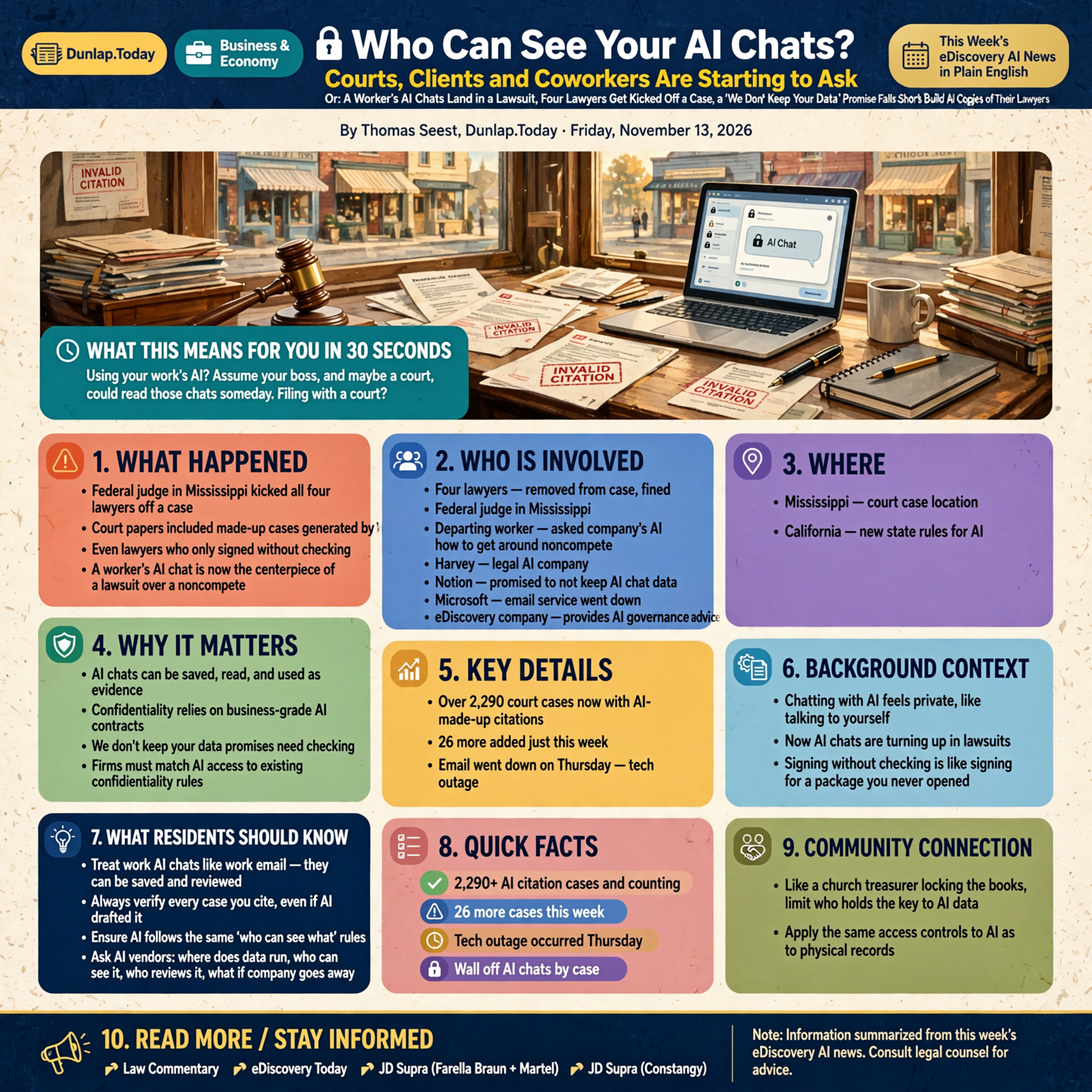
🔐 Who Can See Your AI Chats? Courts, Clients and Coworkers Are Starting to Ask

Or: A Worker's AI Chats Land in a Lawsuit, Four Lawyers Get Kicked Off a Case, a 'We Don't Keep Your Data' Promise Falls Short, Microsoft Goes Dark, and Firms Build AI Copies of Their Lawyers: This Week's eDiscovery AI News in Plain English
By Thomas Seest, Dunlap.Today · Friday, November 13, 2026
On the old party lines, everybody knew the rule: when you picked up the phone, you talked like Mrs. Henderson down the road might be listening. Because she usually was.
That’s this week’s eDiscovery story. Chats with AI feel private, like talking to yourself. But this week those chats turned up in a lawsuit, sat on a computer that promised not to keep them, and raised questions about who inside a law firm gets to see what the AI wrote.
Here’s the rundown: AI chats and fake citations in court, who gets to see what, keeping the work running when tech fails, new AI tools for lawyers, new California rules, and what AI means for law firm people.
⏱️ What this means for you in 30 seconds
- Using your work’s AI? Assume your boss, and maybe a court, could read those chats someday.
- Filing anything with a court? Check every case you cite, even if someone else wrote it and you just sign.
- Buying an AI tool? Ask who stores your chats, including the companies behind it, and get it in writing.
- Running a law firm? Make sure your AI follows the same ‘who can see what’ rules your files do.
- Got a deadline? Have a backup plan for when email goes down, like it did Thursday.
⚖️ AI Chats and Fake Citations in Court
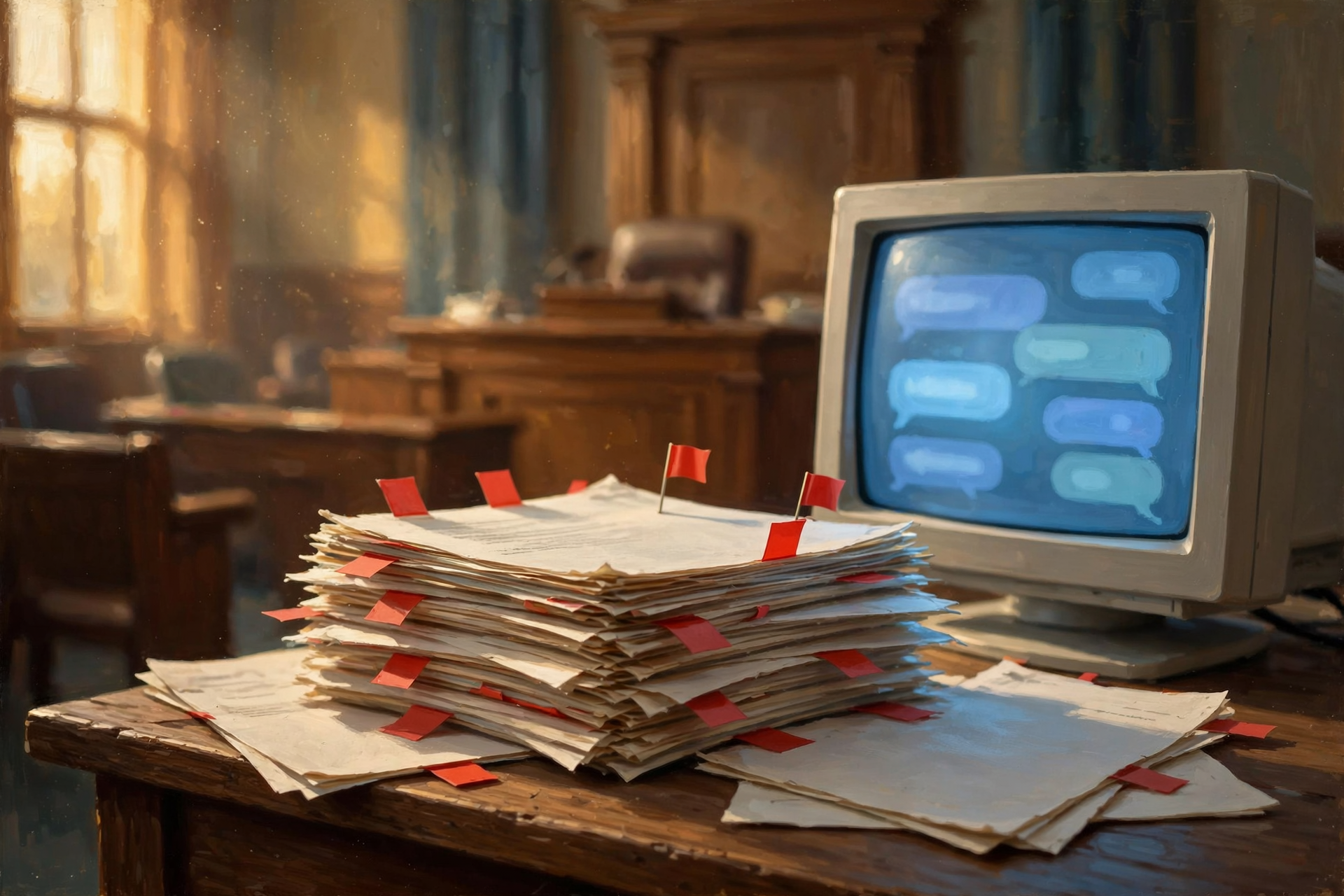
A federal judge in Mississippi kicked all four lawyers off a case after both sides turned in court papers with made-up cases from AI. Even the lawyers who only signed without checking were fined.
The running count of court cases where AI made up legal citations is now over 2,290, with 26 more added just this week.
A company says a departing worker asked the company's AI how to get around his noncompete, and the AI told him not to. Now those chats are the centerpiece of a lawsuit.
It's like signing for a package without looking in the box. If it turns out to be a box of rocks, the delivery slip still has your name on it.
What it means for you: If your name is on it, check it. And treat chats with a work AI like work email: they can be saved, read and used as evidence.
👉 Read more (Law Commentary) · Read more (eDiscovery Today) · Read more (JD Supra (Farella Braun + Martel)) · JD Supra (Constangy)
🔒 Who Gets to See What

Lawyers at a big firm say courts mostly aren't treating AI use as giving up the confidentiality of legal work, as long as you use business-grade AI with solid contracts.
A company promised it wouldn't keep Notion's AI chat data, but some of it was kept anyway and then stolen. It shows that 'we don't keep your data' promises need checking.
Harvey, a legal AI company, explained how it keeps lawyers who are walled off from a case from seeing AI chats and summaries about that case, not just the original files.
An eDiscovery company says law firms need to make sure their AI tools respect the same 'who can see what' rules the firm already uses, everywhere files are kept.
A tech company says law firms should be able to explain in four sentences where their AI runs, who can see what, who checks its work, and what happens if the AI company goes away.
The church treasurer keeps the books locked up, and only certain folks have a key. You'd want the same rule to apply to the copies, too, not just the ledger.
What it means for you: Use business-grade AI with written promises about privacy, and make sure the AI respects the same access rules as your files. Then check that the promises are kept.
👉 Read more (Bloomberg Law) · Read more (ComplexDiscovery) · Read more (Harvey) · Read more (National Law Review (Epiq)) · Read more (Legal Futures (Moterra))
🗂️ Keeping the Work Running

Microsoft's email and Teams went down for hours Thursday afternoon and into the night. It's a reminder to have a backup plan for important legal deadlines.
An in-house evidence manager says new software and AI only help if your team already has good, written-down ways of doing the work.
Lawyers say when you buy AI software, don't expect a promise that it's always right. Instead, get promises about testing and about not changing the AI without telling you.
Consultants warn that putting AI helpers on a messy process just makes the mess faster, and that a person who rubber-stamps everything the AI does isn't really checking.
A new tractor won't fix a fence line nobody walked. You still have to know where the posts go.
What it means for you: Get your process written down first, plan for outages, and make sure the people checking AI work are actually checking.
👉 Read more (eDiscovery Today) · Read more (JD Supra (Exterro)) · Read more (JD Supra (BakerHostetler)) · Read more (JD Supra (Ankura))
🤖 New AI Tools for Lawyers

Harvey added features that keep big document reviews up to date as new files arrive, search Teams chats, and help sort and draft email in Outlook.
Avianca, a big Latin American airline, is giving Harvey's legal AI to its whole legal team after a test run.
Some law firms are building AI versions of their lawyers trained on their past work. The big open question is who owns the copy, especially after a lawyer leaves.
A test found that general AI models, used by themselves, do poorly at long, complicated legal tasks. They need lots of added instructions and tools to work well.
A fancy new feed mixer is great, but you still check the ration. And you want to know who owns the recipe card if the hired hand moves on.
What it means for you: New AI features can save time, but they also create new records. Know what they save, where it goes and who owns it.
👉 Read more (Harvey) · Blockchain News · Read more (Harvey) · Read more (Law.com) · Artificial Lawyer · Read more (Artificial Lawyer)
🏛️ New California Rules

New California laws on using AI to watch and discipline workers start next year, and lawyers expect employers to need a lot of help.
When the county changes the burn rules, you'd rather hear it at the co-op in November than from the fire marshal in July.
What it means for you: If your business uses AI to watch or discipline workers, get ready now for California rules that start in 2027, and keep good records.
💼 Law Firm People and AI

More law firms are letting young lawyers count time spent learning AI toward their yearly hour goals.
Most lawyers at big firms now use AI, but only about 3 in 10 say it's truly built into how their team works. Experts say the payoff depends on that.
A survey of college students found they use AI a lot but don't trust it much, and students headed to law school trust it even less.
Buying a new combine doesn't make the harvest better if nobody learns to run it. And the young hands are right to check the gauges.
What it means for you: Firms are paying lawyers to learn AI, but the payoff only comes when everyone uses it the same careful way.
👉 Read more (Law.com) · Read more (Law.com) · Legal Futures (LexisNexis) · Read more (Above the Law)
✅ Checklist for this week

- ✅ Add enterprise AI chat histories to legal holds and departing-employee reviews
- ✅ Make sure hold notices cover personal and public AI tools, too
- ✅ Verify every citation before any lawyer signs, including local counsel
- ✅ Check AI vendor contracts for confidentiality, retention limits and no training on your data
- ✅ Ask whether ‘zero retention’ covers every company behind your AI tool
- ✅ Confirm ethical walls apply to AI chats, tables and drafts, not just documents
- ✅ Write down a backup plan for holds and deadlines during cloud outages
- ✅ Track how often reviewers reject AI output; zero is a red flag
Practical rule: Talk to AI like someone might read it later, and make sure only the right people can.
— Dunlap.Today
📚 Plain-English AI Glossary

- Legal hold: An instruction to keep certain records, like emails or chats, because of a lawsuit or investigation.
- Noncompete: An agreement not to work for a competitor for a set time after leaving a job.
- Local counsel: A lawyer from the area who joins a case alongside out-of-state lawyers and signs court papers.
- Attorney-client privilege: The rule that keeps most conversations between you and your lawyer confidential.
- Work product: Materials prepared for a lawsuit that the other side generally can’t demand.
- Zero data retention: A promise that a company won’t keep what you send to its AI after answering.
- Ethical wall: A rule inside a law firm that blocks certain people from seeing information about a certain case.
- Digital twin: An AI program built to imitate a specific person, using their past work and writing.
❓ Frequently Asked Questions

Can my employer read my chats with the company’s AI?
Often, yes. In one new lawsuit, a company quoted a former worker’s chats with its AI in detail. Lawyers say those chats may belong to the employer and can become evidence.
Does using AI mean my talks with my lawyer aren’t private anymore?
Not automatically. Several recent court decisions treated AI as a tool, not an outsider. But it matters what kind of AI you use and what its contract says, so ask your lawyer before putting sensitive matters into a free chatbot.
What does ‘we don’t keep your data’ really mean?
It means what the contract says, and only for the company that signed it. In one breach, a company behind the scenes kept chat data the app maker said wasn’t supposed to be kept.
Can a lawyer get in trouble for signing papers someone else wrote with AI?
Yes. A Mississippi judge fined and removed local lawyers who signed filings with fake AI citations without checking them.
What should I do when email goes down before a deadline?
Write down when the outage started and ended, use another way to reach the court or the other side if needed, and keep that record. Thursday’s Microsoft outage lasted for hours.
Other Resources

- Bloomberg Law: Courts reject AI waiver rule (Norton Rose Fulbright)
- Harvey: Building ethical wall enforcement into AI
- ComplexDiscovery: What zero retention covers
- BakerHostetler: Negotiating AI SaaS agreements
- eDiscovery Today: The Kitchen Sink for Nov. 13
Got an eDiscovery or legal AI question from the porch? Send it our way. We’ll keep translating the jargon into plain English.
Know about an upcoming event or story in the Dunlap, TN area? Submit it here.



0 Comments