
What in the World Is a Marketing Funnel?

Marketing people love funnels.
They draw them on whiteboards.
They put them into presentations.
They divide them into stages.
They give those stages names.
Then they add acronyms until something very simple begins to sound like it requires an MBA.
It doesn’t.
A marketing funnel is simply a way to describe what we discussed in the last article:
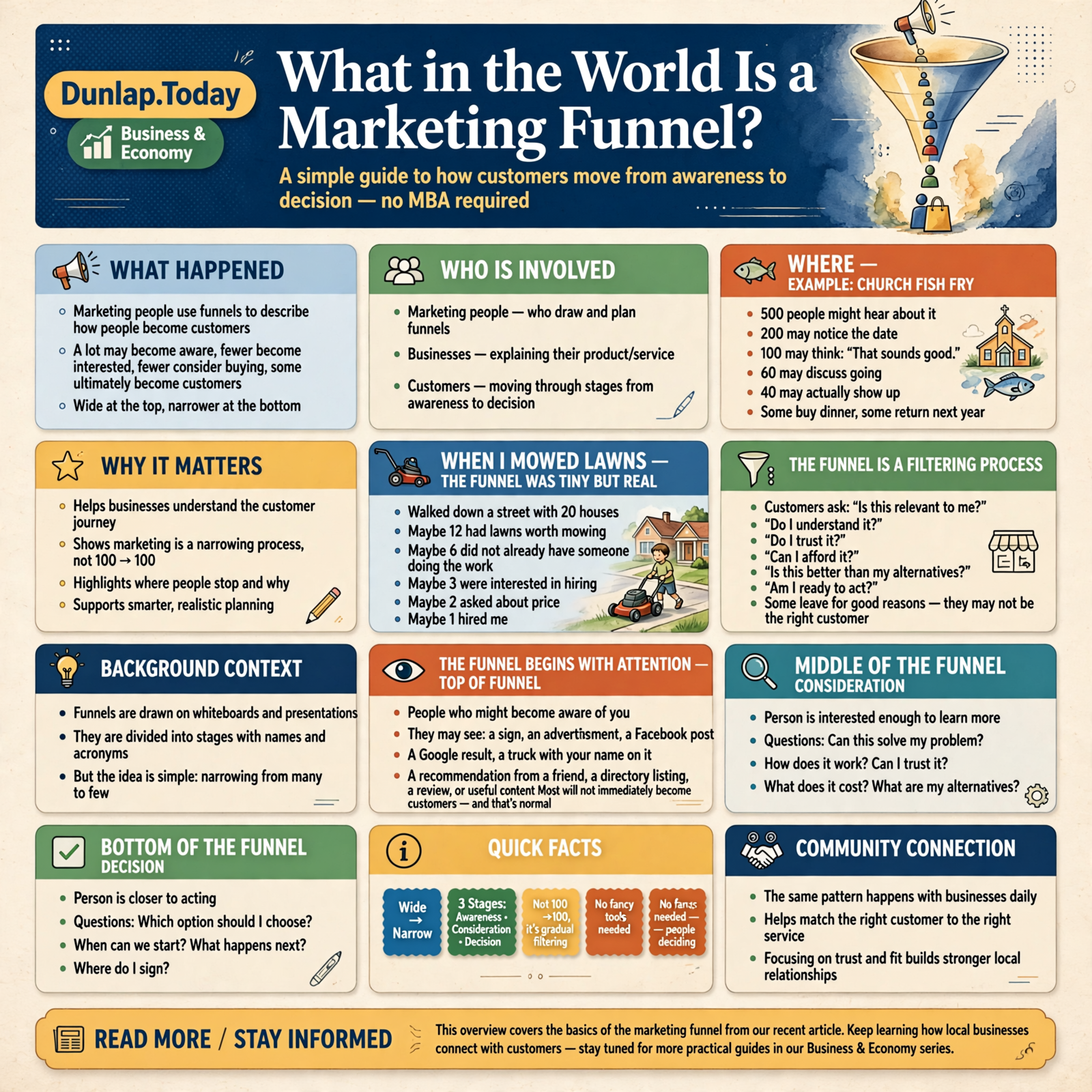
a lot of people may become aware of a business, fewer become interested, fewer seriously consider buying, and some ultimately become customers.
That’s the funnel.
Wide at the top.
Narrower at the bottom.
You Have Probably Seen Funnels Your Entire Life

Imagine a church fish fry.
Five hundred people might hear about it.
Two hundred may actually notice the date.
One hundred may think:
“That sounds good.”
Sixty may discuss going.
Forty may actually show up.
Some may buy dinner.
Some may come back next year.
You just watched a marketing funnel.
Nobody had to call it one.
The same thing happens with businesses.
The Funnel Begins With Attention

At the top of the funnel are the people who might become aware of you.
They may see:
- a sign,
- an advertisement,
- a Facebook post,
- a Google result,
- a truck with your name on it,
- a recommendation from a friend,
- a directory listing,
- a review,
- or a piece of useful content.
Most of those people will not immediately become customers.
That’s normal.
Some do not need what you sell.
Some are not ready.
Some are not a good fit.
Some will forget your name five minutes later.
A funnel helps us understand that marketing is not usually:
100 people see something → 100 people buy.
It is more like:
100 people see something → some care → some investigate → some trust → some act.
When I Mowed Lawns, the Funnel Was Tiny but Real

As a kid mowing lawns, I had a funnel too.
I just didn’t know it.
Imagine I walked down a street with 20 houses.
All 20 homeowners could potentially see me.
Maybe 12 had lawns worth mowing.
Maybe six did not already have somebody doing the work.
Maybe three were interested in hiring someone.
Maybe two asked me about price.
Maybe one hired me.
That’s a funnel.
No website.
No digital advertising.
No CRM.
No analytics dashboard.
Just a narrowing group of people moving toward a decision.
The Funnel Is Really a Filtering Process

Businesses sometimes think the funnel is about pushing people toward a sale.
A healthier way to think about it is filtering.
At each step, people figure out whether there is a match.
The customer asks:
“Is this relevant to me?”
“Do I understand it?”
“Do I trust it?”
“Can I afford it?”
“Is this better than my alternatives?”
“Am I ready to act?”
Some people leave the funnel for perfectly good reasons.
They are not failures.
They may simply not be the right customer.
Top, Middle and Bottom Without the Jargon
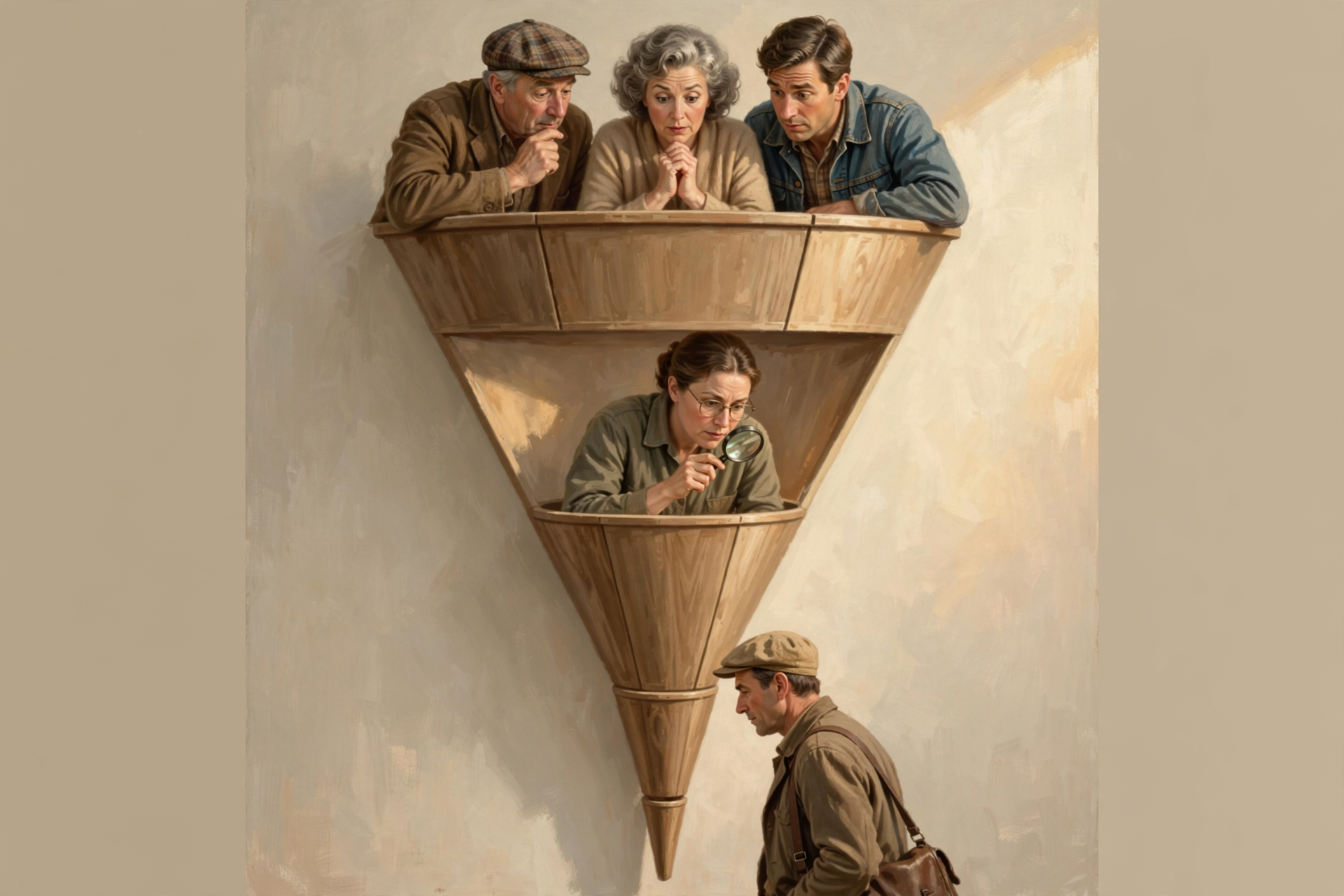
Marketing funnels are often divided into three broad sections.
Top of the Funnel
This is awareness.
People are discovering you.
They may barely know who you are.
The questions are:
- What is this?
- Who are these people?
- Why should I care?
Middle of the Funnel
This is consideration.
The person is interested enough to learn more.
Questions become:
- Can this solve my problem?
- How does it work?
- Can I trust it?
- What does it cost?
- What are my alternatives?
Bottom of the Funnel
This is decision.
The person is closer to acting.
Questions become:
- Which option should I choose?
- When can we start?
- What happens next?
- Where do I sign?
That’s all the terminology really means.
A Funnel Is Not the Same Thing as a Customer Journey

The two ideas overlap, but they are slightly different.
The customer journey looks at the experience from the customer’s point of view.
The funnel looks at the process from the business’s point of view.
The journey asks:
“What is this person thinking and doing?”
The funnel asks:
“How many people are moving from one stage to the next?”
They are two ways of looking at the same broad process.
Why the Funnel Gets Narrower

Suppose 1,000 people see a local restaurant’s Facebook post.
Maybe 200 pause long enough to notice it.
Maybe 75 click through to the menu.
Maybe 30 seriously consider visiting.
Maybe 15 actually go.
That shrinking number is normal.
The useful question is not:
“Why didn’t all 1,000 come eat?”
The useful questions are:
- Did the right people see it?
- Was the message interesting?
- Was the menu easy to find?
- Were the hours accurate?
- Was the location convenient?
- Did reviews inspire confidence?
- Was there a clear reason to visit now?
Funnels help us diagnose where interest disappears.
Some Funnels Are Very Short

An emergency plumber can have an extremely short funnel.
A pipe bursts.
The homeowner searches.
They see a business with strong reviews.
They call.
If somebody answers and can come quickly, the sale may happen within minutes.
The customer’s urgency compresses the funnel.
Other Funnels Can Take Months or Years

Now consider something expensive or unfamiliar.
Solar panels.
A house.
Industrial equipment.
A major software system.
A business acquisition.
The customer may:
- learn,
- research,
- compare,
- wait,
- save money,
- talk to family,
- talk to advisers,
- reconsider,
- and eventually act.
The funnel can be long because the decision carries more risk.
My Solar-Panel Funnel Needed More Education

This is where my childhood solar-panel experience becomes useful again.
If people already understood solar technology, the funnel might have started with:
“Which system should I buy?”
But when the category itself was unfamiliar, the top of the funnel had much more work to do.
The journey might begin with:
What is solar? → Does it work? → Would it help me? → Is it affordable? → Can I trust it? → Which system?
That is a much longer funnel.
Education moves people through it.
Early Personal Computers Had the Same Problem

When early personal computers such as the Atari 800 were new, many people were nowhere near the bottom of the funnel.
They were still asking:
“Why would I want a computer?”
That is a top-of-funnel question.
The market had to be educated.
People needed to see:
- games,
- programming,
- business applications,
- education,
- word processing,
- and eventually printing and communications.
As the category became more familiar, the funnel changed.
Consumers moved from:
“Why would I need a computer?”
to:
“Which computer should I buy?”
That is a major shift.
Marketing Content Should Match the Funnel Stage

This is where the funnel becomes genuinely useful.
Different customers need different information.
A person at the top may need:
- a simple explanation,
- an introduction to the problem,
- a basic educational article,
- or a story that helps them recognize the issue.
A person in the middle may need:
- comparisons,
- FAQs,
- reviews,
- case studies,
- pricing guidance,
- and demonstrations.
A person near the bottom may need:
- a quote,
- availability,
- a warranty,
- financing,
- an appointment,
- or a clear call to action.
Trying to give every customer the same message can be inefficient because they may be asking entirely different questions.
A Top-of-Funnel Customer May Not Be Ready for “BUY NOW!”

Imagine someone who has just heard of heat pumps.
They are still wondering:
“How is a heat pump different from what I have now?”
If the first message they see is:
BUY TODAY! LIMITED TIME OFFER!
the business may be asking for a decision before the customer understands the category.
Education would probably help more.
A Bottom-of-Funnel Customer Doesn’t Need Another History Lesson

The opposite problem happens too.
Someone has already:
- researched the options,
- decided what they want,
- compared businesses,
- and is ready to buy.
They don’t need a 3,000-word introduction.
They need:
price, availability, next step.
Good marketing meets people where they are.
Funnels Help Explain Why “More Traffic” Isn’t Always the Answer

Suppose a website receives 10,000 visitors per month but almost nobody contacts the business.
The reaction might be:
“We need more traffic.”
Maybe not.
The problem may be farther down the funnel.
Perhaps:
- the offer is unclear,
- the site looks untrustworthy,
- prices are confusing,
- contact information is hard to find,
- the wrong audience is visiting,
- or the next step is too difficult.
Sending another 10,000 people into the same broken funnel may simply produce twice as much disappointment.
This Is Where Conversion Rates Come From

Suppose 100 people request estimates.
Twenty-five become customers.
The business converted 25 percent of those estimate requests into customers.
That’s a conversion rate.
The math isn’t complicated.
It simply tells us how many people moved from one stage to another.
You can measure conversion at many points:
- people who saw an ad and clicked,
- website visitors who called,
- calls that became appointments,
- appointments that became estimates,
- estimates that became jobs,
- first-time customers who became repeat customers.
Funnels make those transitions visible.
But Don’t Worship the Numbers

Marketing data is useful.
It can also make people silly.
If the business becomes obsessed with increasing one percentage while ignoring customer quality, profitability or satisfaction, the funnel becomes misleading.
For example, a discount might greatly increase the number of people who buy.
But if those customers are unprofitable, never return and only bought because of the discount, a higher conversion rate may not mean a healthier business.
The purpose of a funnel is to understand the business.
The purpose of the business is not to make the funnel chart prettier.
Your Funnel Can Leak

Marketers sometimes talk about a leaky funnel.
That simply means people are dropping out somewhere they probably should not be.
Examples:
Lots of visibility, little interest: The message may not be relevant.
Lots of interest, few inquiries: Trust or clarity may be weak.
Lots of calls, few appointments: The response process may be poor.
Lots of estimates, few sales: Price, positioning or sales may be the issue.
Lots of customers, few repeat customers: The experience may be weak.
The funnel gives you a map of where to investigate.
Sometimes the Funnel Problem Is Outside Marketing

This is important.
Imagine a contractor generating 50 good leads every week.
But:
- calls go unanswered,
- estimates take a week,
- scheduling is chaotic,
- and nobody follows up.
Marketing may be working perfectly.
Operations are breaking the funnel.
The customer does not care which department caused the problem.
They simply move on.
The Funnel Doesn’t End at the Sale

Traditional funnels sometimes stop when someone becomes a customer.
That is incomplete.
What happens afterward may be even more valuable.
The customer may:
- buy again,
- upgrade,
- subscribe,
- refer somebody,
- leave a review,
- or become an enthusiastic advocate.
This is why modern marketers sometimes prefer circles, loops or flywheels instead of funnels.
The customer doesn’t disappear after buying.
They can feed new customers back into the top.
Mrs. Smith Became Part of My Funnel

Imagine I mowed Mrs. Smith’s lawn.
She was satisfied.
Mrs. Jones asked who did it.
Mrs. Smith said:
“The kid down the street. He does a good job.”
Mrs. Smith just became part of my marketing system.
Her experience created awareness and trust for another customer.
That’s why referrals are so powerful.
They can move someone through several funnel stages almost instantly.
Then, Now & Next: How Funnels Have Changed

Then
In a neighborhood business, the funnel might have been extremely visible.
You saw the houses.
You knocked on doors.
People asked questions.
Some hired you.
Some told their neighbors.
The entire funnel could exist within a few blocks.
Now
A modern funnel can stretch across many channels.
A customer might:
- see a Facebook post,
- search Google two weeks later,
- read reviews,
- visit a website,
- watch a video,
- receive an email,
- ask a friend,
- and finally call.
The business may not even know the customer existed during most of that process.
Next
Artificial intelligence may begin compressing parts of the funnel.
A customer might tell an AI assistant:
“I need a dependable accountant for my small construction business. I want someone who understands job costing and doesn’t require me to drive an hour.”
The AI may help:
- discover businesses,
- compare services,
- evaluate reviews,
- read websites,
- summarize differences,
- and suggest which providers appear to fit.
In other words, a machine may help move the customer through several funnel stages before the business ever hears from them.
That Makes Clear Information More Important, Not Less

If AI systems increasingly help people research businesses, vague marketing becomes a problem.
A business that says:
“We provide innovative solutions for all your needs.”
hasn’t communicated much.
A business that clearly explains:
- what it does,
- who it serves,
- where it works,
- what problems it solves,
- how the process works,
- and what customers can expect,
is easier for both humans and machines to understand.
The future of marketing may reward clarity even more than the past did.
A Simple Funnel for a Local Business

You don’t need expensive software to sketch your own funnel.
Try this:
1. Awareness: How do people first hear about us?
2. Interest: What makes them want to learn more?
3. Understanding: What information do they need?
4. Trust: What makes them comfortable choosing us?
5. Action: What do we want them to do next?
6. Sale: What helps them make the final decision?
7. Experience: Do we deliver what we promised?
8. Return or Referral: What brings them back or causes them to recommend us?
That’s enough to start.
Look for the Biggest Drop-Off

Once the funnel is visible, ask:
Where are we losing the most good potential customers?
If people don’t discover you, work on visibility.
If they discover you but don’t care, work on relevance.
If they care but don’t trust you, work on credibility.
If they trust you but don’t act, reduce friction.
If they contact you but don’t buy, examine the sales process.
If they buy once but never return, examine the experience.
You don’t always need more marketing.
You may need to repair one stage of the funnel.
The Funnel Is a Tool, Not a Law of Nature

Real customers do not politely march through numbered stages.
They jump around.
They forget.
They come back.
They ask friends.
They research competitors.
They change their minds.
They buy unexpectedly.
They disappear for six months and return.
The funnel is a model.
Models simplify reality so we can understand it.
Use it as a map.
Don’t mistake the map for the territory.
The Marketing Lesson

A marketing funnel is not magic.
It is simply a way to understand how people move from:
awareness → interest → understanding → trust → action → customer.
The number of people usually gets smaller as they move through the process.
That’s normal.
Your job is not to force everyone to the bottom.
Your job is to:
- attract the right people,
- help them understand what you offer,
- build legitimate trust,
- make the next step easy,
- and deliver something worth recommending.
A good funnel does not trick people into buying. It helps the right people move toward a useful decision with less confusion and friction.
That’s true whether the funnel begins with knocking on a neighbor’s door, placing an ad in the newspaper, showing someone an Atari 800, appearing in Google search results or being recommended by an AI assistant ten years from now.
The technology changes.
The narrowing path from stranger to customer remains remarkably familiar.
Know Someone Trying to Grow a New Business?

If you know someone who is starting a business, running a newer business, or wondering why plenty of people seem to notice what they offer but very few actually become customers, share this article with them.
Understanding a basic marketing funnel can help a business owner stop treating every marketing problem as an advertising problem and start looking at where customers actually lose interest, confidence or momentum.
If this explanation made funnels feel a little less mysterious, pass it along to someone building a business of their own. Sometimes simply seeing the path from stranger to customer makes the next improvement much easier to find.
Next: Why People Buy From Businesses They Trust

A funnel can bring someone all the way from awareness to serious consideration and still fail at one critical point:
trust.
In the next article in Marketing Without the Mumbo Jumbo, we’ll look at why people choose businesses they trust, how that trust is built, why recommendations and reviews are so powerful, and why one broken promise can undo far more marketing than another advertisement can repair.




0 Comments