
🚨 Someone in China Wants Your Business Name — Or Do They? A Scam Warning for Dunlap Businesses
📅 Published: September 28, 2026
⚠️ Dunlap.Today Scam Watch: If you own a business, manage a website, run a nonprofit, operate a church, or maintain an organization anywhere in the Sequatchie Valley, this is one email you should know how to recognize.
This morning, I received an email that appeared, at first glance, to be an important business warning.
A company identifying itself as a domain-registration service in Shanghai, China, said another company was attempting to register the name “dunlapdirectory” as an Internet keyword and as several Chinese domain names.
The supposed applicant?
Jiazhi Ltd.
The message said there might be a conflict with my business name or trademark and urgently asked whether Jiazhi Ltd. was my distributor or business partner in China.
It sounded official.
It sounded important.
It sounded like something a responsible business owner ought to answer.
And that is exactly why scams like this work.
📨 The Email That Arrived in Dunlap

The message I received claimed:
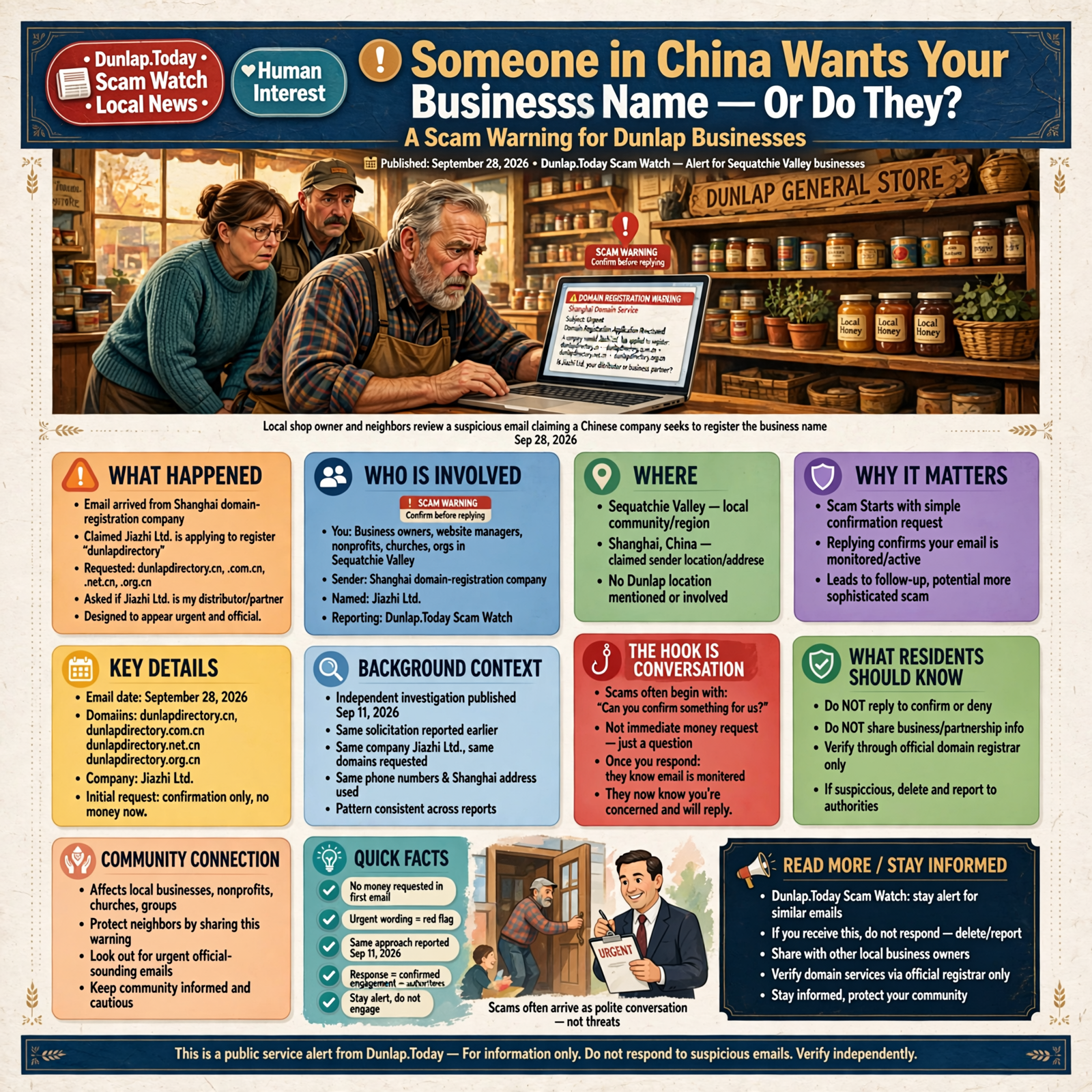
- A Shanghai domain-registration company had received an application on September 28, 2026.
- A company named Jiazhi Ltd. wanted to register “dunlapdirectory.”
- The requested registrations supposedly included dunlapdirectory.cn, dunlapdirectory.com.cn, dunlapdirectory.net.cn and dunlapdirectory.org.cn.
- The sender claimed those registrations might conflict with my business name or trademark.
- I was asked to confirm whether Jiazhi Ltd. was a distributor or business partner.
That last question is important.
The sender was not initially asking me to send money.
He was asking me to respond.
That is often how a sophisticated solicitation begins.
🎣 The Hook Is Conversation
Many people think scams begin with:
“Send us $5,000.”
Better scams frequently begin with something much smaller:
“Can you confirm something for us?”
Once you respond, the sender knows three things:
- ✅ Your email address is monitored.
- ✅ Someone at the business is willing to engage.
- ✅ The subject frightened or concerned you enough to respond.
Now the conversation can move to the next stage.
🔍 Then I Looked Up the Story

This is where the email becomes considerably more interesting.
An independently published investigation dated September 11, 2026 documented essentially the same solicitation.
That message claimed that Jiazhi Ltd. wanted to register another organization’s name as an Internet keyword and as the same collection of Chinese domains.
It also used the same telephone numbers and the same Shanghai address that appeared in the message sent to me.
Another business published its experience on September 18, 2026.
Once again:
- Jiazhi Ltd.
- Chinese domain registrations.
- An alleged business-name conflict.
- An urgent request to confirm whether the applicant was a business partner.
The names being supposedly protected changed.
The basic story did not.
☎️ The Phone Numbers Have History Too
The telephone numbers appearing in this solicitation are especially revealing.
The same Shanghai phone, fax and mobile numbers have appeared in reports of similar domain-registration solicitations going back years.
A 2025 example published by WONTEK documented essentially the same pitch, using another supposed applicant and the same Shanghai contact information.
An Online Threat Alerts report from 2024 documented the same phone numbers, the same address and the same basic claim involving yet another supposedly interested Chinese company.
An archived example from 2016 — later updated with additional examples through 2025 — shows the same style of message continuing for years.
At some point, coincidence starts running out of gas.
🧠 Why This Scam Is So Convincing

This is not a badly spelled email announcing that a distant prince has selected you for an inheritance.
It uses something far more effective:
bureaucracy.
Most business owners already deal with:
- domain registrations,
- licenses,
- trademarks,
- Google listings,
- insurance renewals,
- tax filings,
- website hosting,
- payment processors,
- state registrations,
- and dozens of other administrative obligations.
So when an official-looking email says:
“There may be a problem involving your business name. We need you to confirm something.”
our first instinct is often:
“I’d better deal with this.”
That reaction is what the sender needs.
🚨 Urgency Without an Emergency
The email I received even began by emphasizing that the matter was “very urgent” and asking that it be forwarded to the CEO.
That wording accomplishes two things.
First, it makes an ordinary solicitation appear important.
Second, it attempts to move the message past whoever normally filters email and put it directly in front of the person authorized to spend money.
That is not accidental psychology.
🏷️ But What If Someone Really Does Register My Business Name?

This is where business owners need to separate two different questions.
Question #1: Could Someone Register a Similar Domain?
Possibly.
Domain names operate under registration systems with their own rules, and businesses legitimately choose whether they need defensive registrations in other countries or top-level domains.
Question #2: Does This Particular Email Mean You Have an Emergency?
That is entirely different.
An unsolicited message telling you another company is urgently trying to register several foreign domains should not automatically become your source of truth about your domain portfolio.
If international domain protection genuinely matters to your company, investigate it independently through a registrar you choose.
Do not allow the person creating the fear to simultaneously become the person selling the solution.
🛑 The Most Important Rule: Leave Their World

This may be the most useful rule in the entire Scam Watch series.
When someone contacts you with a frightening claim, do not use their world to verify their claim.
If someone claiming to represent your bank sends you a phone number, don’t automatically call that number.
If someone tells you your Facebook account is being suspended, don’t blindly click the appeal link they supplied.
If someone claims to be from Google, don’t give them control of your Business Profile because their caller ID says Google.
If someone says your domain name is in danger, don’t assume the company warning you is the company you should pay.
🔎 Verify Independently
Instead:
- 🌐 Go directly to your existing domain registrar.
- 🔎 Search the sender’s wording.
- ☎️ Search the telephone number.
- 🏢 Search the claimed business.
- 📍 Search the street address.
- 📧 Search the sender’s domain.
- 👥 Ask someone knowledgeable before responding.
ICANN has documented misleading domain notices as a real form of registration abuse. Such solicitations can be designed to obtain unnecessary payments, induce registrants to switch registrars — commonly called “slamming” — or obtain credentials or authorization codes.
🧩 Look for Patterns, Not Just Bad Grammar

We have trained people for years to look for misspellings and broken English.
That advice is becoming less useful.
Artificial intelligence can now produce near-perfect business correspondence.
The better question is:
Does the situation itself make sense?
Ask:
- Why did this person contact me?
- How did they supposedly discover this problem?
- Why is it suddenly urgent?
- Why does the person warning me also have something to sell me?
- Can I verify the claim without interacting with the sender?
- What happens if I simply do nothing for 24 hours?
Scammers frequently need you to act before you think.
Your greatest defense may simply be slowing the process down.
🏪 Why I Am Publishing This for Dunlap Businesses

I operate the Dunlap.Directory, which exists to make the businesses and organizations of our valley easier to discover.
That also means I spend a lot of time thinking about the digital visibility of local businesses.
Visibility has a downside.
The easier legitimate customers can find your business, the easier marketers, bots and scammers may be able to find it too.
I do not currently have evidence that the sender who contacted me obtained my information from Dunlap.Directory or that he is specifically working through the directory.
But we do have strong evidence that substantially similar solicitations are being sent broadly to businesses and website owners.
That means another business owner in Dunlap, Pikeville, Whitwell, Dayton, Chattanooga or elsewhere in the Sequatchie Valley could eventually encounter one.
And I would rather explain it before somebody pays than afterward.
📣 Please Share This With a Business Owner

This next part matters.
If you know someone who owns or manages a local business, send them this article.
Don’t assume they already know.
Send it to:
- the restaurant owner you know,
- your mechanic,
- the contractor who worked on your house,
- your church administrator,
- your favorite shop owner,
- your accountant,
- your insurance agent,
- the nonprofit director you volunteer with,
- or the friend who just started a business.
Scams work partly because every potential victim encounters them alone.
One business owner receives an alarming email and thinks:
“Has anyone else seen this?”
A community can reverse that advantage.
If hundreds of us recognize the script before it arrives, the script stops being nearly as effective.
Knowledge becomes a neighborhood defense system.
🤝 Don’t Just Share the Article — Start the Conversation
Ask another business owner:
“Have you received anything like this?”
That one question may uncover another scam circulating locally.
And if it does, tell us.
That is how a community warning system gets stronger.
🚨 Introducing Dunlap.Today Scam Watch

This article will not be the last.
Dunlap.Today is launching a continuing series examining scams that target local businesses and residents.
We will look at the scams themselves, but more importantly we will examine how they work.
Upcoming subjects may include:
- 📍 Fake Google Business Profile warnings
- 📘 Fake Facebook Page suspension notices
- 💳 Fraudulent invoices
- 🌐 Domain renewal scams
- 📦 Fake shipping and delivery notices
- 🧑💼 CEO and employee impersonation
- 💰 Payment-redirection fraud
- 🔳 QR-code scams
- 🤖 AI-generated phishing
- 🎙️ Voice-cloning scams
- 📱 Text-message fraud
- 🛒 Marketplace scams
The goal is not to make people afraid of technology.
The goal is to make people harder to fool.
👴👵 And We Need a Senior Scam Watch Too

There is another group deserving its own series.
Our seniors.
Scams targeting older adults frequently use different pressure points than business scams.
Instead of trademarks and domain registrations, they may involve:
- ❤️ family emergencies,
- 🚔 grandchildren supposedly being arrested,
- 🏥 medical emergencies,
- 🏦 bank accounts supposedly being compromised,
- 💵 Social Security or Medicare,
- 🧾 unpaid taxes,
- 💻 fake computer support,
- 🎁 sweepstakes,
- ❤️ romance scams,
- 📦 package delivery messages,
- or increasingly convincing AI-generated voices.
Those scams deserve their own explanations, examples and defenses.
So Dunlap.Today will also begin developing a Senior Scam Watch series that families can share with parents, grandparents, neighbors and friends.
Because sometimes the most valuable thing you can send somebody isn’t another warning saying:
“Be careful.”
It’s an example saying:
“This is exactly what the scam looks like.”
🛡️ The 60-Second Rule

Until the next article, remember this:
If an unexpected message creates fear, urgency or financial consequences, give yourself 60 seconds before doing anything.
Don’t click.
Don’t call.
Don’t pay.
Don’t reply.
Ask:
“Can I verify this another way?”
Those 60 seconds may save you money, protect your business and keep somebody else from becoming the next victim.
📚 Sources & Further Reading

- Secure Techie — September 11, 2026: Investigation documenting the “Jiazhi Ltd.” domain-registration solicitation, including matching phone numbers and Shanghai address.
- Love My Online Marketing — September 18, 2026: Business report documenting another “Jiazhi Ltd.” Chinese-domain solicitation.
- ICANN: Report describing misleading domain notices, unnecessary fees, registrar slamming and credential theft as forms of domain-registration abuse.
- WONTEK — May 2025: Documentation of a substantially similar domain-registration solicitation using the same Shanghai contact information.
- Online Threat Alerts — 2024: Earlier version of the same general solicitation pattern with identical contact details.
📣 HELP WARN THE VALLEY: If this article helped you recognize something you might otherwise have answered, please share it with at least one local business owner.
And if you receive a suspicious message that appears to be targeting businesses or residents in the Sequatchie Valley, save it. These examples can help us teach everyone what to recognize the next time around.
The scammer only needs one person who hasn’t heard the warning.
Our job is to make that person harder and harder to find.




0 Comments