
Sales and Marketing Aren’t the Same Thing

Marketing and sales get mixed together all the time.
Sometimes even businesses treat them as if they were interchangeable.
They aren’t.
They work together, and there is plenty of overlap, but they solve different problems.
A simple way to think about it is this:
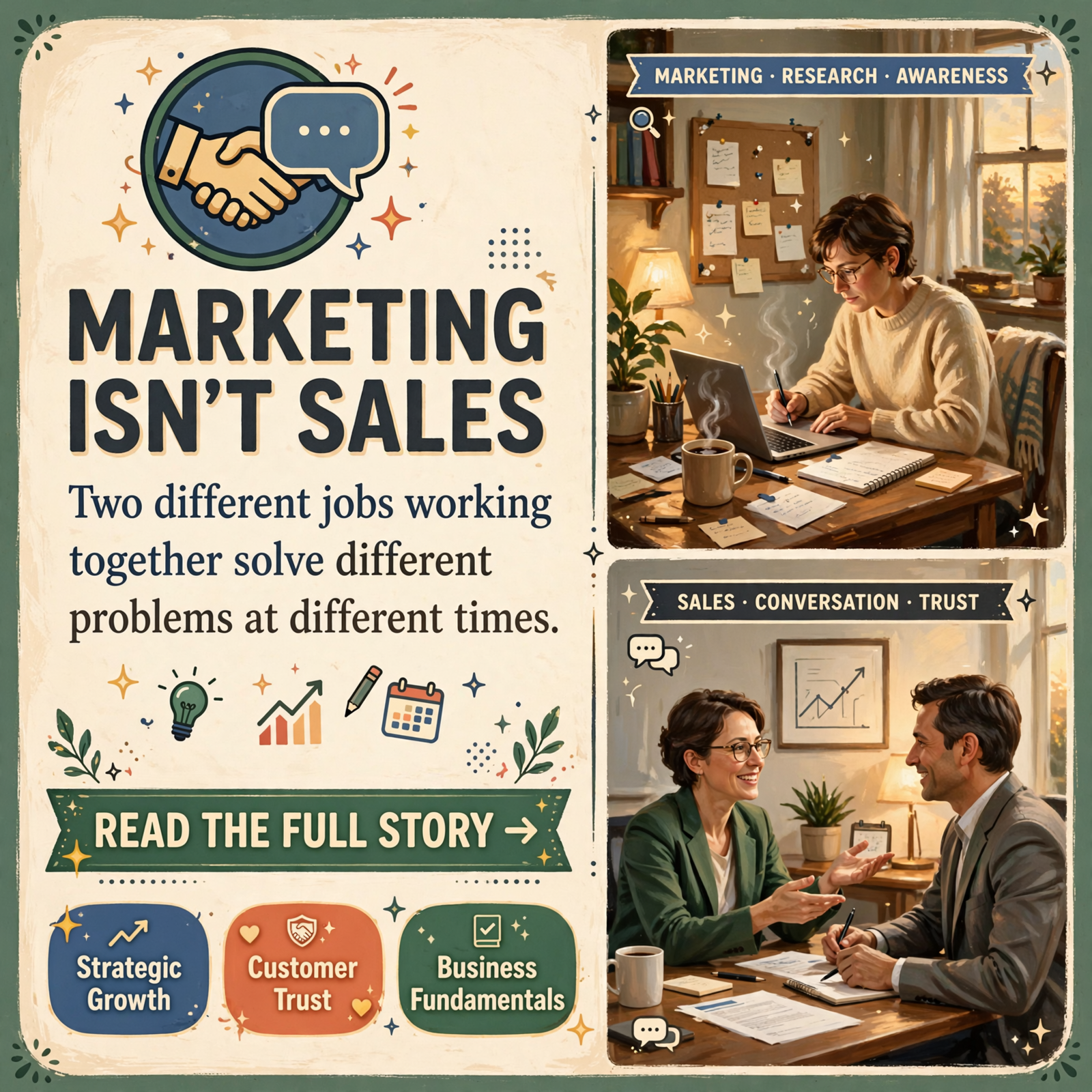
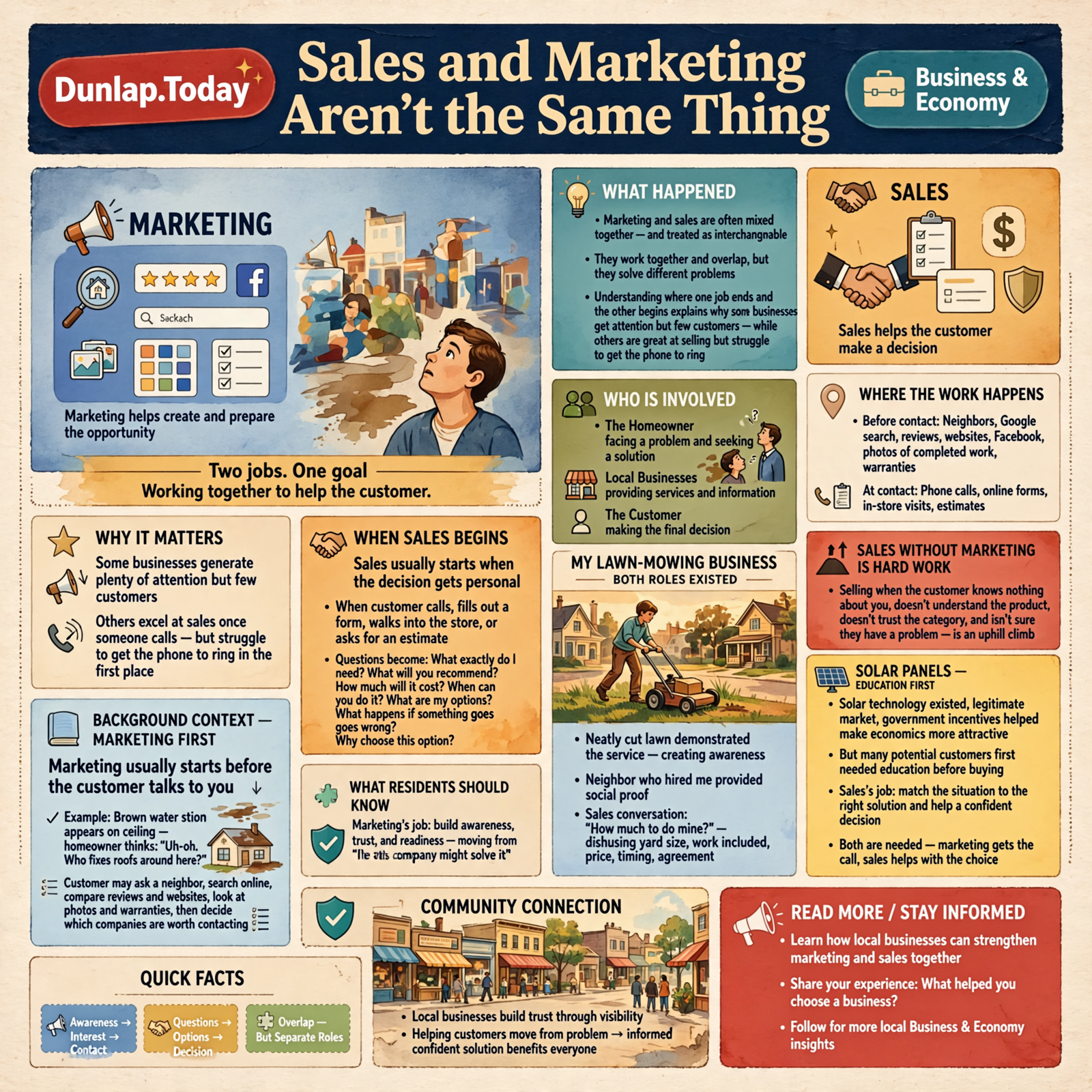
Marketing helps create and prepare the opportunity. Sales helps the customer make a decision.
That sounds simple enough.
But understanding where one job begins and the other takes over can explain why some businesses generate plenty of attention but few customers, while others may be excellent at selling once somebody calls but struggle to get the phone to ring in the first place.
Marketing Usually Starts Before the Customer Talks to You

Imagine somebody wakes up one morning and notices a brown water stain spreading across the ceiling.
They don’t immediately think:
“I would like to participate in a roofing sales process today.”
They think:
“Uh-oh.”
Then perhaps:
“Who fixes roofs around here?”
Before that homeowner ever talks to a contractor, a great deal may happen.
They might:
- ask a neighbor,
- search Google,
- look at reviews,
- visit a few websites,
- check Facebook,
- look at photos of completed work,
- compare businesses,
- read about warranties,
- and decide which companies seem worth contacting.
Much of that is marketing.
The business is helping the customer move from:
“I have a problem”
to:
“I think this company might be able to solve it.”
Only then might the sales conversation begin.
Sales Usually Starts When the Decision Gets Personal

Once the customer calls, fills out a form, walks into the store or asks for an estimate, the conversation changes.
Now the questions may become:
- What exactly do I need?
- What will you recommend?
- How much will it cost?
- When can you do it?
- What are my options?
- What happens if something goes wrong?
- Why should I choose this option instead of another?
This is where sales becomes more visible.
Good sales isn’t simply pressuring somebody until they surrender a credit card.
At its best, sales helps match the customer’s situation with an appropriate solution and helps that person make a confident decision.
My Lawn-Mowing Business Had Marketing and Sales Too

When I was mowing lawns as a kid, I certainly wasn’t thinking about marketing departments and sales departments.
There was just me.
But both jobs still existed.
Suppose somebody saw me mowing a neighbor’s lawn and asked:
“Do you mow other yards too?”
The neighbor’s neatly cut lawn had already done some marketing for me.
It demonstrated the service.
Being visible in the neighborhood created awareness.
The neighbor who hired me provided social proof.
Then came the sales conversation:
“How much would you charge to do mine?”
Now we were discussing:
- the size of the yard,
- what work was included,
- price,
- timing,
- and whether we’d agree to do business.
No funnels.
No CRM software.
No conversion dashboard.
But the process was there.
Sales Without Marketing Is Hard Work

Imagine trying to sell something when the customer knows nothing about you, doesn’t understand the product, doesn’t trust the category and isn’t even sure they have a problem worth solving.
That’s an uphill climb.
This was part of the challenge when I was selling solar panels as a kid.
Solar technology existed.
There was a legitimate market.
There were government incentives helping make the economics more attractive.
But many potential customers first needed education.
Before asking someone to buy, you might have to explain:
- what solar panels were,
- what they could do,
- how they worked,
- whether they made sense locally,
- what they cost,
- what incentives existed,
- and whether this unfamiliar technology could be trusted.
If all of that education has to happen during the sales conversation, selling becomes much harder.
Good marketing can do some of that work beforehand.
Marketing Warms Up the Conversation

Suppose two homeowners call the same solar company.
The first says:
“I don’t know anything about solar. I saw your phone number somewhere. What is this stuff?”
The second says:
“I’ve read your guide about how solar works, watched your video explaining the payback period and looked at several customer installations. I’d like to know whether my house is a good candidate.”
Those are very different sales conversations.
The second customer has already traveled much farther down the road.
Marketing helped them get there.
That’s why educational content can be so powerful.
It doesn’t necessarily close the sale.
It helps create a better-informed person for the sales conversation.
Marketing Can Answer the Repetitive Questions Before Sales Has To

This is especially valuable for small businesses.
If customers ask the same questions repeatedly, those questions can become marketing content.
For example, a tree service might repeatedly hear:
- Do I need to remove this tree?
- Can you just trim it instead?
- Will you haul away the limbs?
- Can the tree fall on my house?
- How much does tree removal cost?
- Do I need permission to remove it?
A good website, article, video or FAQ can answer some of those questions before the customer ever calls.
Then the conversation becomes:
“I’ve looked through your information. Can you come look at my tree?”
That’s a much more productive conversation.
Sales Can Teach Marketing What Customers Actually Care About

The information should also flow in the opposite direction.
Marketing can prepare customers for sales.
But sales can teach marketing what customers are actually thinking.
The people talking directly to prospective customers hear:
- questions,
- confusion,
- objections,
- fears,
- price concerns,
- competitor comparisons,
- and reasons people decide not to buy.
That information is marketing gold.
If ten customers ask the same question, marketing should probably answer it.
If everyone misunderstands the same service, the message probably needs to change.
If customers repeatedly say:
“I didn’t realize you did that.”
you may have a visibility or communication problem.
Marketing and sales should therefore form a loop.
Marketing creates conversations.
Sales learns from conversations.
Marketing uses those lessons to create better conversations.
Marketing Can Generate the Wrong Customer

More leads aren’t automatically better.
This is another reason marketing and sales have to work together.
Suppose a contractor advertises:
CHEAPEST ROOFING IN THE COUNTY!
That advertisement may generate calls.
But what kind of customer is it likely to attract?
Probably someone strongly focused on obtaining the lowest possible price.
If the contractor’s actual business strategy is built around:
- premium materials,
- experienced crews,
- strong warranties,
- careful cleanup,
- and higher service levels,
then the marketing message and the sales reality are fighting each other.
The problem isn’t that the salesperson can’t close enough leads.
The problem may be that marketing is attracting the wrong leads.
Good Marketing Makes Good Sales Easier

Marketing should ideally help answer questions such as:
- Who is this for?
- What problem does it solve?
- Why is it useful?
- What makes this business different?
- Why should I trust it?
- What might it cost?
- What should I expect?
- What do I do next?
Then sales can focus on the individual customer’s circumstances.
That’s a much better use of everyone’s time.
But Sales Still Matters

There is a temptation in modern digital marketing to pretend the entire buying process can be automated.
Sometimes it can.
You don’t need a salesperson to buy a box of printer paper online.
But many purchases are more complicated.
Consider:
- a house,
- a commercial building,
- a major HVAC system,
- a custom manufacturing project,
- a legal service,
- a complicated software system,
- or a large piece of industrial equipment.
The customer may need somebody who can listen, ask questions, understand the situation and help evaluate options.
In those situations, a skilled salesperson can create enormous value.
Not by talking more.
Often by listening better.
Good Sales Is Usually More About Questions Than Speeches

The stereotype of a salesperson is someone who can talk anybody into anything.
That can make people suspicious of sales.
But good selling often works differently.
A good salesperson might ask:
- What are you trying to accomplish?
- What’s happening now?
- What’s causing the biggest problem?
- What have you already tried?
- How quickly do you need this solved?
- What’s most important to you?
- What would a successful outcome look like?
Then the salesperson can determine whether the product actually fits.
Sometimes the right answer should be:
“You don’t need what I’m selling.”
That may cost one sale.
It can also create enormous trust.
The Best Sale May Be the One You Don’t Make

This sounds strange until you think long-term.
Suppose a mechanic tells a customer:
“I could replace that part, but I don’t think that’s your problem.”
The mechanic might lose a repair today.
But what happens the next time that customer needs something?
Trust has increased.
What happens when a neighbor asks:
“Do you know a mechanic you trust?”
That honest non-sale may become one of the best marketing investments the mechanic ever made.
This is where sales, customer service and reputation begin overlapping.
Then, Now & Next: How the Sales Conversation Changes

Then
For many neighborhood businesses, the marketing and sales process happened almost entirely face to face.
You knocked on the door.
You explained what you could do.
The customer asked the price.
You shook hands.
The entire customer journey might happen within ten minutes.
With unfamiliar products such as early solar systems, the conversation became longer because more education was required.
Now
Today, customers often conduct a substantial portion of the sales process before contacting the business.
They can research:
- products,
- prices,
- reviews,
- competitors,
- specifications,
- videos,
- frequently asked questions,
- and alternatives.
A modern customer may enter the sales conversation knowing considerably more than a customer would have known before the internet.
Sometimes they may even know enough to be dangerous.
But they are rarely starting from zero.
Next
Over the next decade, artificial intelligence may increasingly perform some of that research for the customer.
A person may ask an AI assistant:
“I need a new roof. Explain my options, identify reputable local contractors, compare warranties and help me figure out what questions I should ask.”
By the time that customer contacts the business, the AI may already have helped them:
- understand the category,
- establish a budget,
- compare approaches,
- identify likely providers,
- and prepare questions.
That could change the sales conversation substantially.
The salesperson may spend less time providing basic information and more time addressing individual circumstances.
What Happens When the Customer’s AI Talks to the Business?

There is another possibility worth watching.
Today, humans generally contact businesses themselves.
In the future, personal AI agents may handle more of the early interaction.
A homeowner might say:
“Find three contractors who can do this job next week, confirm that they service my area, ask about their warranty and get me approximate prices.”
The customer’s agent might then communicate with business systems or business agents.
If that becomes common, businesses may need to market and sell to two audiences at once:
the human who ultimately needs the solution
and
the software helping that human evaluate the options.
The details are still developing, but the principle isn’t particularly strange.
Businesses have always needed to provide information in ways customers could discover and understand.
Machines may simply become another participant in that process.
Technology Keeps Moving the Boundary Between Marketing and Sales

When I was a kid knocking on doors, marketing and sales could happen almost simultaneously.
Then newspapers, catalogs and direct mail let businesses educate people before the conversation.
Personal computers and early printers made producing sales materials easier.
Websites allowed customers to learn about businesses at any hour.
Search engines helped customers find answers themselves.
Online reviews provided evidence from other customers.
Social media created additional discovery and communication channels.
Automation allowed businesses to follow up at scale.
Now AI can help explain complicated subjects conversationally.
Each technological shift moves some work that used to belong to a salesperson earlier in the customer journey.
But it doesn’t necessarily eliminate selling.
It changes what good selling looks like.
Don’t Ask Sales to Fix a Marketing Problem

This is a common business mistake.
If the phone isn’t ringing, telling the salesperson to “sell harder” may not solve anything.
The problem could be:
- poor visibility,
- weak reputation,
- unclear messaging,
- the wrong audience,
- an unattractive offer,
- bad pricing,
- poor reviews,
- or a product people don’t understand.
Those are largely marketing problems.
And Don’t Ask Marketing to Fix a Sales Problem

The opposite happens too.
A company may generate plenty of qualified inquiries and still fail to turn them into customers.
Perhaps:
- nobody follows up,
- responses take too long,
- estimates are confusing,
- salespeople don’t listen,
- customers can’t get straightforward answers,
- or the process simply feels difficult.
Buying more advertisements won’t necessarily fix that.
It may simply create more opportunities to disappoint people.
The Handoff Matters

A useful way to picture the relationship is:
Marketing → Interest → Conversation → Sales → Customer → Experience → Reputation → Marketing
Notice that it forms a loop.
The customer’s experience affects reviews and referrals.
Those influence future marketing.
Sales conversations reveal what customers care about.
That improves future marketing.
Marketing attracts better-fit customers.
That improves future sales conversations.
The strongest businesses don’t treat marketing, sales and customer service as isolated islands.
They learn from each other.
A Simple Test for Your Business

If you run a business, ask yourself three questions.
1. Before somebody contacts us, what helps them understand why they should?
That’s largely marketing.
2. Once they contact us, what helps them decide whether to buy?
That’s largely sales.
3. After they buy, what makes them want to return or recommend us?
That’s customer experience—and it becomes marketing again.
If one of those sections is weak, pouring more money into another section may not solve the real problem.
The Marketing Lesson

When I was mowing lawns, painting houses, trimming trees or later selling solar panels, I didn’t separate marketing and sales into departments.
There were no departments.
There was a customer, a problem, something I could offer and a conversation.
But looking back, the distinction was already there.
Marketing helped someone become aware of me and understand what I could do.
Sales was the conversation about whether I should do it for them.
Delivery determined whether I’d ever get another chance.
Technology has made every part of that process more sophisticated.
The fundamentals remain surprisingly familiar.
Marketing helps someone become ready for a buying conversation. Good sales helps them make the right decision once that conversation begins.
Neither needs to involve manipulation.
Both work better when the customer actually benefits.
Know Someone Trying to Turn Interest Into Customers?
New business owners often discover that getting attention and actually making a sale are two different challenges.
If you know someone who has recently started a business, is learning how to sell without becoming pushy, or is trying to understand why leads are not turning into customers, consider sharing this article with them.
This series is meant to give people practical marketing and sales fundamentals they can use immediately—without requiring a business degree or a dictionary full of marketing jargon.
Next: The Customer Doesn’t Start With Your Product—They Start With a Problem
In the next article in Marketing Without the Mumbo Jumbo, we’ll look at one of the most important shifts a business owner can make: stop looking at the market entirely through the product you sell and start looking at it through the problem the customer is trying to solve.
A roofer may sell roofs, but the customer may simply want the rain to stay outside.
A restaurant may sell food, but the customer may be trying to answer, “What are we going to eat tonight?”
Understanding that difference changes almost everything that comes afterward.




0 Comments