
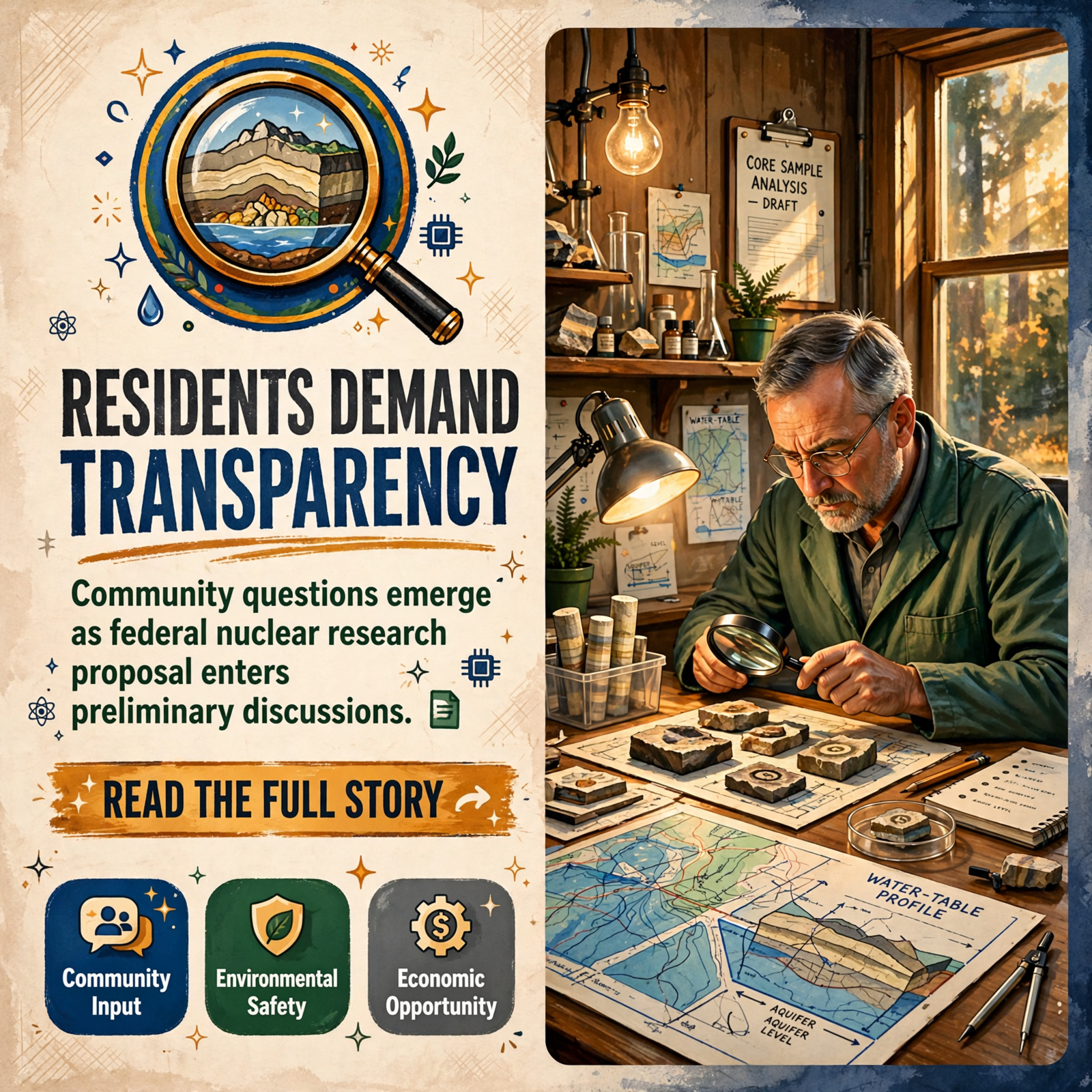
🔬 Rhea County Resident Calls for Transparency on Nuclear Lifecycle Innovation Campus Proposal
A Rhea County resident has raised detailed questions about the Nuclear Lifecycle Innovation Campus initiative after county leadership opened preliminary discussions with state and federal officials. The proposal centers on a primary facility in Oak Ridge near Oak Ridge National Laboratory and Y-12, with potential secondary components under consideration for Rhea County.
📍 What’s Being Proposed
The Nuclear Lifecycle Innovation Campus (NLIC) represents a significant infrastructure initiative involving the U.S. Department of Energy and Tennessee state officials. According to the resident’s analysis of public records and county communications, the primary facility would span thousands of acres in Oak Ridge, with discussions ongoing about whether Rhea County’s geology could accommodate secondary research or material management functions. The resident notes that county commissioners have indicated local core samples suggest the area could theoretically support storage operations, though significant unknowns remain regarding the water table and subsurface conditions.
💡 Why This Matters to Rhea County
For Rhea County residents, this proposal raises fundamental questions about economic opportunity, environmental protection, and community decision-making. A major federal research initiative could bring jobs and investment-but it also involves nuclear materials and geological risks that demand careful evaluation. The resident emphasizes that the conversation is happening early, before decisions are locked in, which creates a window for community input. However, that window also means residents need clear information to understand what’s actually being considered and what protections exist if the county chooses to participate or decline.
The proposal touches on issues that affect property owners, families concerned about water quality, local businesses seeking workforce opportunities, and anyone invested in Rhea County’s long-term future. Understanding the exact scope, timeline, and safeguards is essential before the county moves from preliminary conversations to formal commitments.
🤔 Key Questions the Community Is Asking
The resident has organized concerns into two main categories: the terms of any potential agreement and the structure of community representation in ongoing discussions.
On the “Lab Trade-Off”: The resident asks whether Rhea County has received written guarantees that a full national research laboratory would actually be located in the county, or whether the state has already committed the primary lab to Oak Ridge, leaving Rhea County with only storage or material management functions. This distinction matters enormously-a research facility brings different economic and workforce benefits than a storage operation.
On Legal Protections: If the county continues preliminary conversations, at what point can it opt out without penalty? The resident notes that if federal or state officials decide a lab cannot be placed in Rhea County but still want to use the county’s geology for storage, does the commission have a binding legal mechanism to walk away, or does keeping the door open weaken that protective stance?
On Environmental Testing: Before any invasive testing of Rhea County’s land or water table, the resident asks whether the county will demand independent, third-party hydrological and seismic studies-fully funded by state or federal sources, not county taxpayers. The commissioner’s own caution about “countless unknowns below the water table” underscores why this question matters.
On Representation and Expertise: The resident asks who specifically from county leadership or the Rhea Economic + Tourism Council is currently in direct communication with state and federal officials, and what documentation they’ve received. More broadly, the resident proposes establishing a local nuclear advisory committee with qualified scientists, engineers, and environmental professionals from the community who can attend briefings, ask technical questions, and report back to the public.
On Independent Oversight: Rather than relying solely on state economic development offices, the resident suggests the county invite independent, non-partisan nuclear experts-such as specialists from the American Nuclear Society or independent academic hydrologists-to review the proposal and answer questions in an open public format.
❤️ Community Connections and Representation
The resident’s post reflects a broader pattern in how communities approach major infrastructure decisions: balancing opportunity against risk, and ensuring that decisions are made transparently rather than in closed rooms. The resident explicitly thanks county leadership for bringing the conversation to the public early, while also calling for deeper transparency and more structured community input.
The mention of the Rhea Economic + Tourism Council suggests that economic development organizations are already engaged in these discussions. The resident’s call for a local advisory committee implies that residents with technical expertise-scientists, engineers, environmental professionals-may exist within the community and could contribute meaningfully to evaluating the proposal.
🗓️ What Residents Should Know
The county has agreed to keep the door open for preliminary inquiries, which means this is an early-stage conversation, not a final decision. No formal commitments have been made, and no invasive testing has been authorized. This timing creates an opportunity for residents to ask questions, conduct their own research, and engage with county leadership before major decisions are made.
The resident encourages other Rhea County residents to research how other communities have handled similar proposals, to read official county government posts and public comments, and to ask their own questions of county commissioners. The resident also names specific county officials-Ron Travis (Rhea County Executive), Alex Green, and Ron-Laura Travis-as people residents can contact or attend meetings to address.
➡️ What Happens Next
The immediate next step appears to be county commission review of the questions raised and formal responses addressing transparency, timelines, and decision-making safeguards. The resident is asking the commission to clarify the exact next steps and to establish clearer structures for community input-such as an advisory committee or public briefings with independent experts.
Longer-term, the county will likely need to decide whether to continue preliminary conversations, request independent environmental and geological studies, and potentially negotiate terms with state and federal officials. Each of these steps will likely involve public meetings and opportunities for community input.
🌍 Long-Term Community Impact
How Rhea County handles this decision could shape the county’s economic trajectory for decades. A successful research partnership could bring high-skilled jobs, federal investment, and educational opportunities. Conversely, if the county commits to material storage without the promised research facility, or if environmental risks are underestimated, the long-term costs could outweigh short-term benefits.
The resident’s emphasis on preserving “natural resources along with job opportunities” reflects a common tension in rural economic development: communities want growth, but not at the expense of the environmental and natural assets that define their identity and quality of life. How the county navigates this proposal will signal to residents whether their voices matter in shaping the community’s future.
💬 Questions Worth Considering
- What would a full national research laboratory in Rhea County actually look like-in terms of jobs, facilities, and community presence-compared to a storage or material management operation?
- How can residents access the same briefing materials and technical information that county leadership and economic development officials are receiving?
- What independent expertise exists within Rhea County-among local scientists, engineers, or environmental professionals-that could strengthen community evaluation of the proposal?
- If the county decides to decline participation, what is the relationship between Rhea County and Oak Ridge, and how might decisions in one community affect the other?
- How do residents balance the potential economic benefits of a major federal initiative against the risks and uncertainties that remain unresolved?
🔗 Community Threads: Transparency and Trust in Local Decision-Making
The Early-Engagement Thread: County leadership chose to bring this conversation to the public early rather than negotiate behind closed doors. This reflects a commitment to transparency, but it also places responsibility on residents to engage, ask questions, and hold officials accountable. The resident’s detailed post demonstrates what informed community participation looks like-research, specific questions, and a collaborative tone.
The Expertise Thread: The resident’s call for a local advisory committee with scientists, engineers, and environmental professionals reveals an assumption that expertise exists within the community. If Rhea County residents include people with nuclear, geological, or environmental backgrounds, those individuals could become crucial bridges between technical information and public understanding. Identifying and mobilizing that expertise strengthens the entire community’s ability to evaluate major decisions.
The Regional Relationship Thread: Oak Ridge and Rhea County are geographically close but administratively separate. How decisions about the Nuclear Lifecycle Innovation Campus in Oak Ridge affect Rhea County-and vice versa-suggests that regional coordination and communication between communities may become important. Residents in both areas may benefit from understanding how the proposal affects their neighbors.
The Economic Development Thread: The Rhea Economic + Tourism Council is already engaged in these discussions. The resident’s questions implicitly ask whether economic development organizations are adequately representing community interests or whether they are primarily focused on recruitment. Strengthening the relationship between economic development officials and the broader community-through advisory committees and public briefings-could align economic opportunity with community values.


0 Comments