
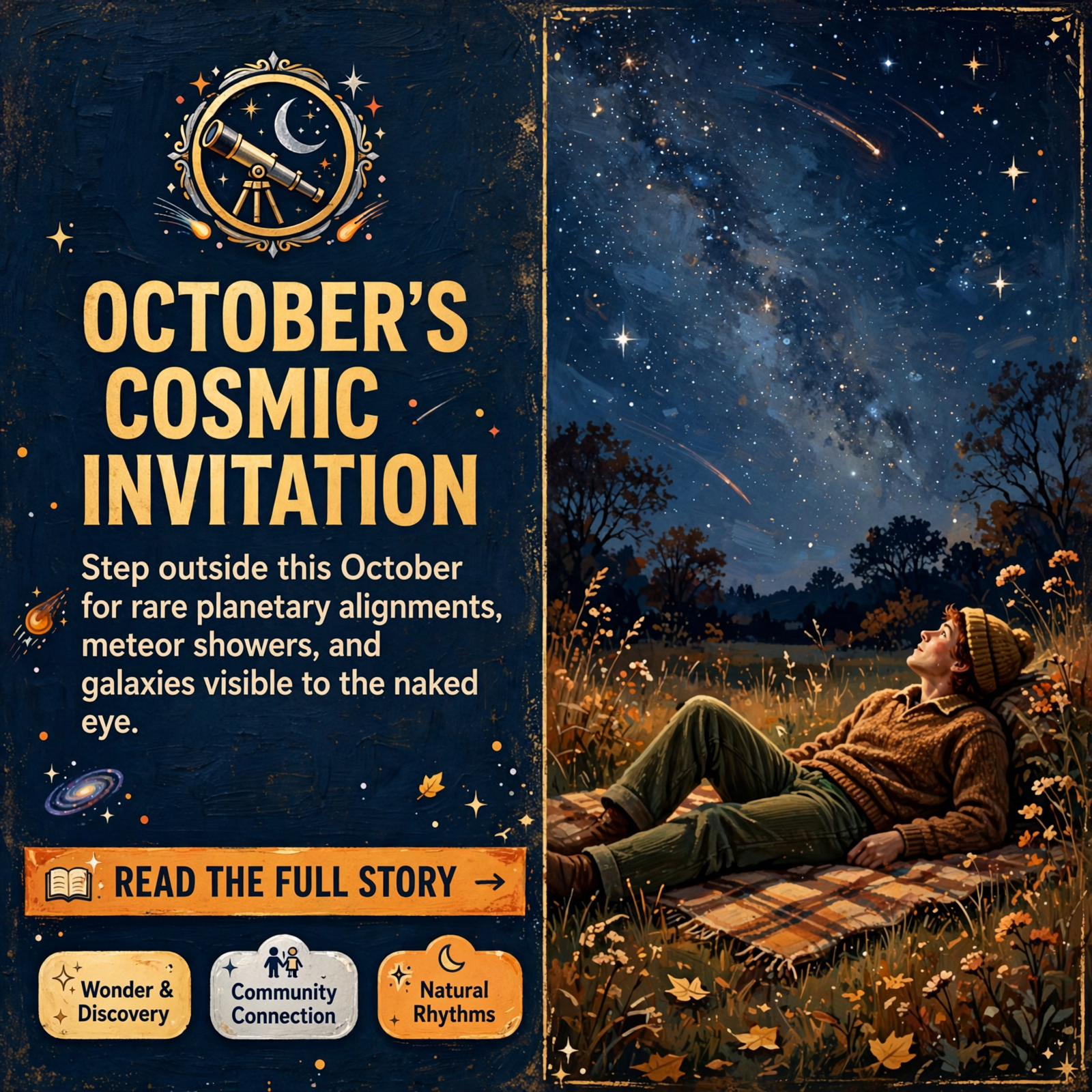
🔭 October’s Night Sky: A Month of Celestial Events Worth Watching
As autumn deepens across the region, the night sky offers a rare lineup of astronomical events-from meteor showers to planetary alignments and distant galaxies. Whether you’re an experienced stargazer or simply curious about the cosmos, October 2026 presents multiple opportunities to step outside and reconnect with the stars above.
📍 What’s Happening in the October Sky
October brings a diverse calendar of celestial activity. Saturn reached opposition on October 4, meaning it sat directly opposite the Sun and was visible all night at its brightest of the year-and it remains bright enough to observe for several more weeks. 🪐
On October 7, a rare dawn alignment will paint the eastern sky before sunrise: a thin crescent Moon will join brilliant Jupiter, reddish Mars, and the star Regulus in a striking line. This finale caps a series of close Moon meetups that began on October 5 with Mars and continued on October 6 with Jupiter. The alignment is visible from both hemispheres, making it a shared moment across the globe.
The Draconid meteor shower peaks on October 8-9, offering a quieter but still worthwhile show-typically about 5 meteors per hour from Comet 21P/Giacobini-Zinner. Unlike most meteor showers, the Draconids are best viewed in the evening rather than before dawn. With the Moon nearly new, the sky will be dark and ideal for observation. ☄️
October 10 brings the Andromeda Galaxy into its best viewing window of the month. Located about 2.5 million light-years away, Andromeda is the farthest object visible to the naked eye. From a dark spot far from city lights, observers can spot a faint, oval smudge marking this distant island of stars. 🌠
The Orionid meteor shower, composed of tiny fragments from Halley’s Comet, peaks on October 21-22. Expect up to about 20 meteors per hour at the peak, fast and bright, appearing after midnight. The Moon will rise late, dimming the faintest meteors but leaving plenty to see. 🔥
October closes with the Hunter’s Moon on October 26-October’s full Moon and the first full Moon after the Harvest Moon. It typically rises around sunset and often glows orange near the horizon, a striking sight that has marked the turning of seasons for generations. 🌕
💡 Why This Matters for Your Community
Stargazing connects people to something larger than themselves-a shared human experience that transcends daily routines and local boundaries. In an era of screens and artificial light, these celestial events invite residents to step outside, slow down, and experience wonder. For families, it’s an opportunity to teach children about science and the natural world. For individuals seeking solitude or reflection, the night sky offers a peaceful escape. For communities, shared stargazing can strengthen bonds and create lasting memories.
The quality of your night sky depends partly on light pollution. Rural and semi-rural areas around the region offer darker skies than urban centers, making October’s events particularly rewarding for those willing to travel to less-developed areas or venture away from streetlights. 🌌
🗓️ What Residents Should Know
Timing matters: Most meteor showers are best viewed after midnight, when your location faces the direction of Earth’s orbital motion. The dawn alignment on October 7 requires an early start-look east before sunrise. Saturn and the Andromeda Galaxy can be observed throughout the evening.
Location is critical: Light pollution dramatically affects what you can see. The farther you travel from city lights, the more stars and meteors you’ll observe. Even a short drive to a rural area or a hilltop can make a significant difference. If you’re near the Cumberland Plateau or in the Sequatchie Valley, higher elevations often offer darker skies than lower valleys.
No special equipment required: All of October’s events are visible to the naked eye. Binoculars or a telescope can enhance the view, but they’re not necessary to enjoy the show.
Weather matters: Clear skies are essential. Check the forecast before heading out, and be prepared to wait for clouds to pass or return on a clearer night.
❤️ Human Impact: Who Benefits
Families with children gain an engaging, free activity that sparks curiosity about science and the universe. Couples and friends find a reason to spend time together outdoors, away from distractions. Educators can use these events to teach astronomy, physics, and Earth science in a real-world context. Photographers and artists may find inspiration in the night sky. Individuals dealing with stress or anxiety often find peace in stargazing-a practice that grounds them in the present moment and reminds them of perspective.
For people who work indoors or spend most of their time in artificial environments, these events offer a rare chance to reconnect with natural rhythms and cycles that have guided human culture for millennia.
🌍 Local Perspective: Why October’s Sky Matters Here
The Sequatchie Valley and surrounding Cumberland Plateau communities sit at an elevation and latitude that make autumn stargazing particularly rewarding. October marks the transition from summer heat to cooler, clearer nights-ideal conditions for extended outdoor observation. The region’s mix of rural areas and small towns means that dark-sky locations are often within a short drive, making these celestial events accessible to residents without requiring long travel.
Historically, communities across the region have marked seasonal changes by observing the night sky. The Hunter’s Moon, in particular, carries cultural significance-it’s the full Moon that traditionally followed the Harvest Moon and marked the time when hunters could pursue game by moonlight. Observing these events connects modern residents to that heritage.
🔗 Community Threads: Invisible Connections
The Outdoor Recreation Network: Stargazing connects to a broader culture of outdoor activity in the region. Residents who enjoy hiking, camping, and nature photography often overlap with those interested in astronomy. Outdoor recreation venues and lodging businesses benefit when visitors seek dark-sky locations for camping trips or weekend getaways. For those planning to travel to a darker location for optimal viewing, nearby campgrounds and RV parks become natural gathering points.
The Education and Curiosity Thread: Schools, libraries, and community organizations often use astronomical events as teaching moments. Parents seeking to engage children in STEM learning may organize family stargazing outings. Local educators can tie these events to curriculum, making science tangible and exciting.
The Seasonal Rhythm Connection: October’s celestial events are part of a larger pattern of seasonal markers that shape community life-harvest festivals, changing weather, and the shift toward winter. Observing these events reinforces the community’s connection to natural cycles and shared rhythms.
✨ Opportunities for Connection
Consider organizing a community stargazing event. Invite neighbors, friends, or family members to gather at a dark-sky location on one of the peak nights. Bring blankets, snacks, and perhaps a telescope or binoculars if you have them. Share what you see and discuss the science behind the events.
If you’re planning a camping or RV trip during October, time it to coincide with one of the major events. Many lodging and recreation businesses in the region welcome visitors seeking outdoor experiences.
Document what you observe-take photos, sketch the sky, or simply journal your thoughts. Sharing your experience with others can inspire them to look up too.
🔭 What Happens Next
October’s celestial calendar is front-loaded: most major events occur in the first three weeks of the month. If you miss the early events, the Orionid meteor shower on October 21-22 and the Hunter’s Moon on October 26 offer second chances. After October, the night sky continues to evolve-November brings its own meteor shower and celestial highlights, so October’s events are just the beginning of autumn’s astronomical season.
🤔 Questions Worth Considering
- How often do you look at the night sky, and what might change if you made it a regular practice?
- Where are the darkest locations near your home, and how far would you be willing to travel for a better view?
- How might sharing a stargazing experience strengthen your connection to family, friends, or neighbors?
- What role does the natural world-including the night sky-play in your sense of community and belonging?
🌌 Long-Term Community Impact
Regular engagement with the night sky can shift how communities think about light pollution, environmental stewardship, and the value of darkness. As more people experience the Milky Way and distant galaxies, support often grows for preserving dark-sky areas and reducing unnecessary outdoor lighting. This awareness can lead to community initiatives-from adopting dark-sky-friendly lighting ordinances to protecting natural areas from overdevelopment.
On a deeper level, stargazing fosters a sense of cosmic perspective-a reminder that we are part of something vast and ancient. This perspective can strengthen community resilience, encourage long-term thinking, and inspire residents to care for the places they call home. When people feel connected to the stars, they often feel more connected to each other and to the land beneath their feet.



0 Comments