
🌱 How Regenerative Farming Brings Biodiversity Back to the Land
Switchgrass Farm in Dunlap is sharing a powerful lesson about what happens when farmers intentionally reverse decades of agricultural simplification. The story spans seven decades-and shows why habitat diversity matters as much to the soil and wildlife as it does to the bottom line.
📉 The Quiet Loss of Life on the Farm
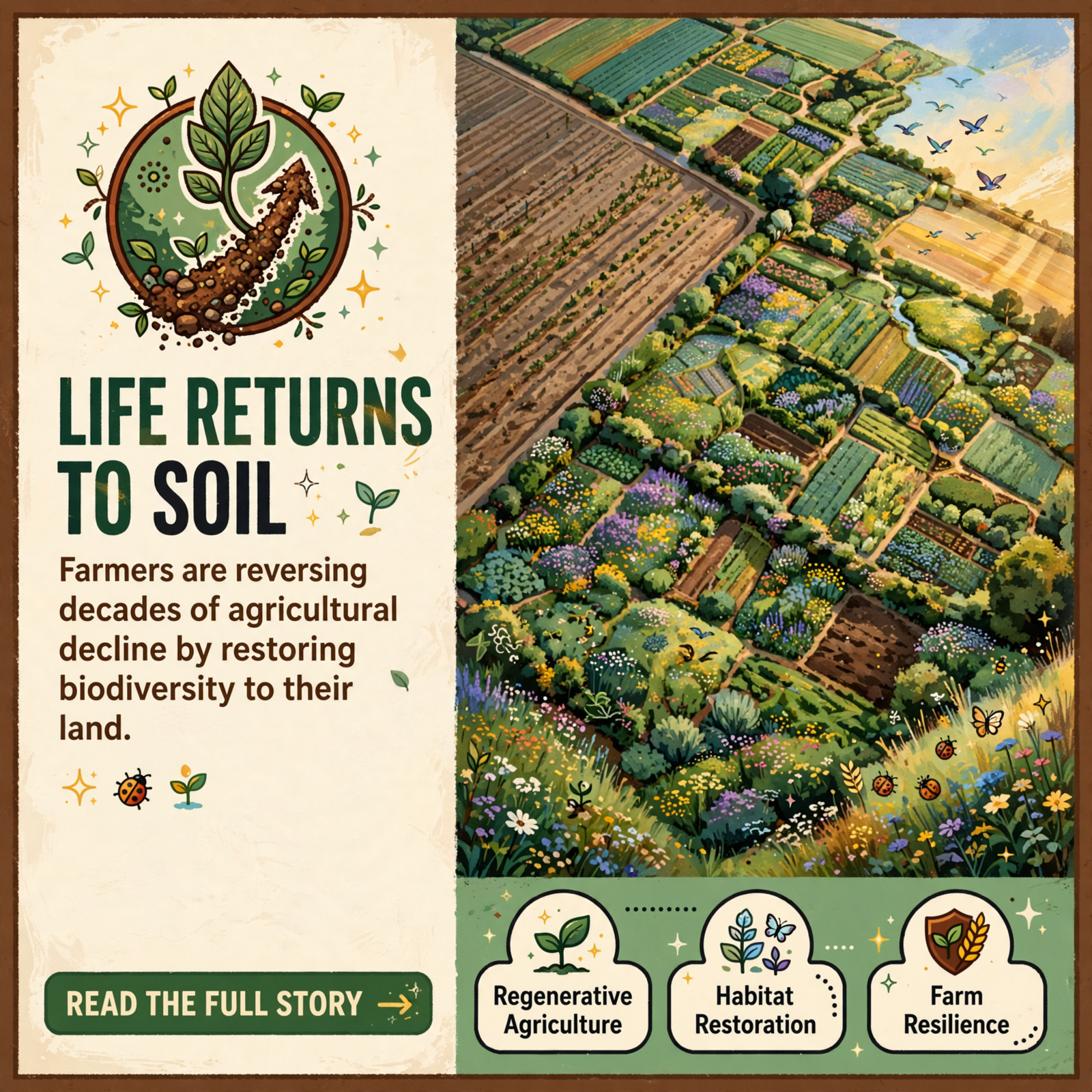
The visual is stark: a single patch of farmland photographed in three eras. In 1950, it was a mosaic of paddocks, hedgerows, ponds, and woodland-teeming with life. By 1980, larger fields and fewer edges had already cost the land half its species. By 2020, one crop stretched edge to edge, with only a handful of species remaining. 🌾
Nobody set out to clear the life from the landscape, the post notes. It happened quietly, one efficiency at a time-the logical result of farming practices designed to maximize yield and minimize labor. But that trajectory is not inevitable.
⭐ Farmers Running the Picture in Reverse
Switchgrass Farm highlights real examples of regenerative agriculture turning that decline around. Martin Royds increased plant species on his farm from 5 to 80 and counted 50 bird species in a single survey. Di and Ian Haggerty at Prospect Pastoral let native perennials return to their fields, where they now grow up through the crop on their own. A CSIRO study found that trees planted on just 1.7% of farm area created 716 hectares of new threatened species habitat. 🦅
💡 Why Diversity Pays
Biodiversity on a farm is not just beautiful-it works. Native species and diverse habitats provide free pest control, pollination, shelter for livestock, and soil that holds water better. These are tangible benefits that improve farm resilience and reduce input costs. 🌿
🎓 Teaching Regenerative Practices
Switchgrass Farm is part of a broader educational effort through Smartsoil, which teaches pasture cropping, grazing management, and cover cropping techniques. The organization is also building Smartsoil GXL, a tool designed to record and measure the biodiversity that returns to regenerative farms-giving farmers data to prove the value of their work. 📊
The message is simple but profound: when you restore habitat diversity, species diversity follows. And when you restore species diversity, the farm becomes more productive, more resilient, and more alive.

0 Comments