
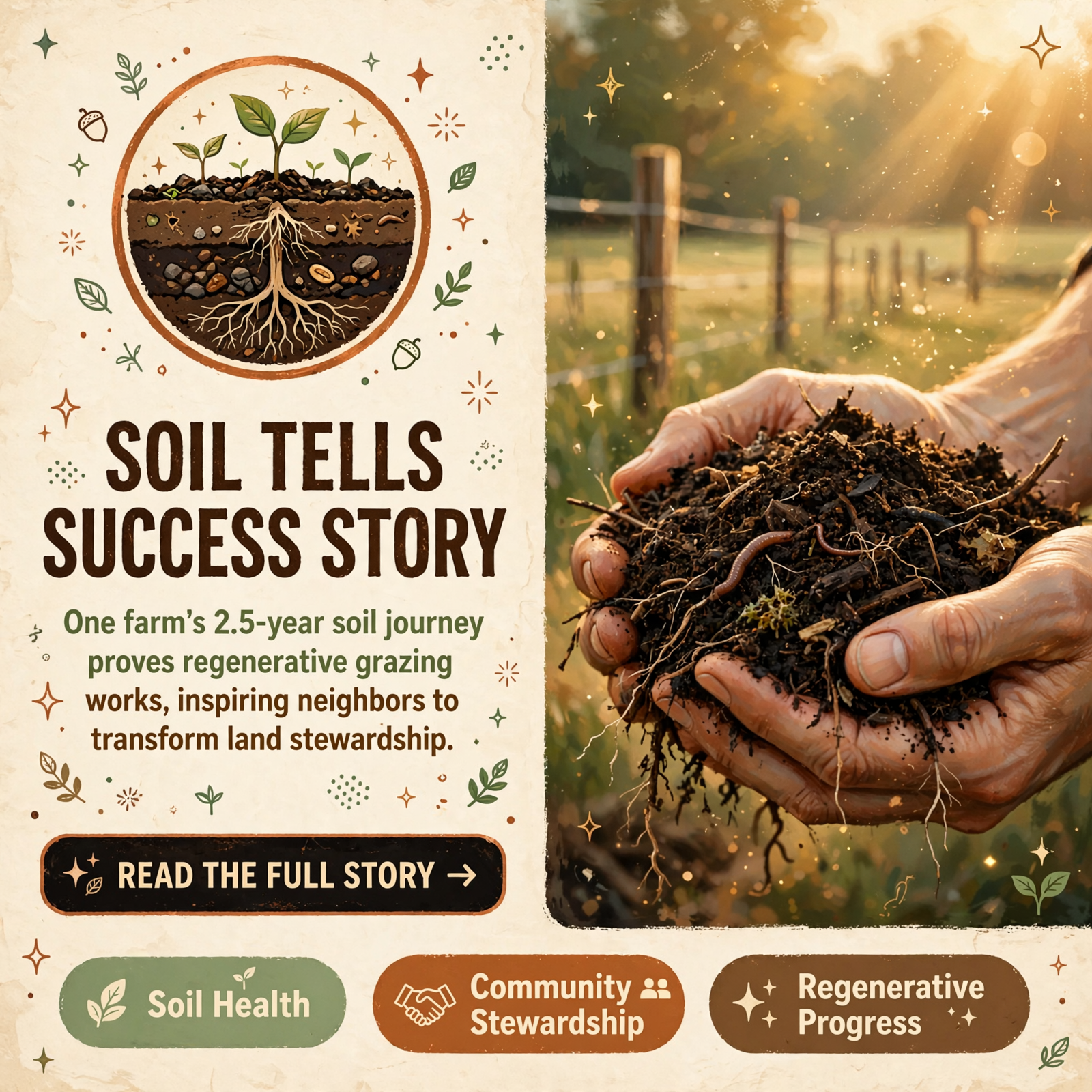
🌱 Heartwood Farm Measures 2.5 Years of Soil Improvement Through Rotational Grazing in Dunlap
Heartwood Farm in Dunlap is sharing tangible evidence of regenerative agriculture in action-soil samples taken before and after 2.5 years of rotational grazing reveal measurable progress in pasture health, offering a real-world case study for farmers and landowners across the region who are exploring sustainable land management.
📊 What the Soil Tells the Story
In March 2024, Heartwood Farm took baseline soil samples from its main pasture. The results showed challenges: acidic soil (pH 5.8), low organic matter (4.8%), and mineral deficiencies across most nutrients-except iron, which tested very high at 322 pounds per acre. Fast forward to September 2026, and new samples reveal movement in the right direction. While the improvements may appear modest on a lab report, the farm’s operators describe standing in the pasture and seeing the difference firsthand. 🌾
The data confirms what the farm suspected: copper supplementation is needed to balance the high iron levels, and mineral content is gradually improving. The soil remains acidic, but the trajectory suggests overall improvement is underway. Rather than applying expensive limestone to raise pH, Heartwood Farm is choosing to build compost-a slower but more microbially beneficial approach that aligns with regenerative principles.
💡 Why This Matters Locally
Soil health is the foundation of every farm, garden, and landscape in the Sequatchie Valley and surrounding plateau communities. When one farm documents its soil journey, it creates a reference point for neighbors and other landowners asking the same questions: Is rotational grazing working? Can I improve my pasture without expensive inputs? How long does real change take? Heartwood Farm‘s willingness to share before-and-after data-and to be honest about both progress and remaining challenges-offers practical encouragement to others considering regenerative practices. 🤝
🌍 Community Connections and Shared Learning
Regenerative agriculture is not a solitary pursuit. Heartwood Farm‘s approach depends on community participation: the farm is actively seeking carbon sources-wood chips, old hay, and straw-from neighbors and local sources to build the compost that will feed the pasture. This creates a direct link between the farm’s soil improvement and the broader community’s waste streams. What might otherwise be discarded becomes a foundation for long-term land health. Residents with carbon materials to contribute can connect directly with the farm to participate in this cycle. 🔄
❤️ Human Impact: Small Progress, Big Vision
The farm’s operators emphasize that “small incremental progress over time will add up.” This reflects a deeper truth about regenerative agriculture: it is not a quick fix but a commitment to long-term land stewardship. For farmers and landowners, this message is both realistic and hopeful. Soil improvement measured in years, not months, requires patience-but the soil samples prove that the work is paying off. For consumers and community members who care about where their food comes from, it demonstrates that local farms are investing in the health of the land they steward. 🌿
🔍 What Residents Should Know
If you have carbon materials to contribute: Heartwood Farm is actively seeking wood chips, old hay, or straw to support its compost-building efforts. Interested community members can message the farm directly through its social media channels to arrange drop-off or pickup.
About the soil analysis: The samples were analyzed by Waypoint Analytical, a soil testing service based in Memphis, Tennessee. The lab provided detailed recommendations for cool-season grass pasture management, including nitrogen application schedules and limestone guidance-information the farm is using to inform its regenerative strategy.
Rotational grazing timeline: The improvements documented span 2.5 years of consistent rotational grazing management, demonstrating that meaningful soil change requires sustained practice and observation.
📈 What Happens Next
Heartwood Farm has indicated that more detailed information about copper supplementation and mineral management will be shared in upcoming posts. The farm will likely continue monitoring soil health annually, as recommended by the lab, to track whether the compost-building strategy accelerates improvement in pH and organic matter. The community’s contribution of carbon materials will be a key variable in whether the farm can achieve its goals without expensive external inputs. 🔮
🤔 Community Questions Worth Considering
- How many other farms and landowners in the region are tracking soil health over time, and what would it mean if more did?
- What barriers prevent farmers from adopting rotational grazing or regenerative practices-and how might the community help remove them?
- If soil improvement takes 2.5+ years to measure, how do we support farmers during the transition period when yields or productivity might be uncertain?
- How could local schools, churches, or civic organizations connect with farms like Heartwood to learn about soil science and land stewardship firsthand?
🌱 Long-Term Community Impact
Heartwood Farm‘s soil improvement journey has implications beyond one pasture. If rotational grazing and compost-building practices spread across the region, they could strengthen local food security, reduce dependence on external agricultural inputs, improve water quality (healthy soil holds and filters water better), and build a culture of land stewardship among the next generation of farmers and landowners. The farm’s transparency about both progress and challenges models the kind of honest, data-driven approach that builds trust and encourages others to invest in their own land. Over time, this could shift the region’s agricultural identity toward regenerative practices-a shift that benefits soil, water, wildlife, and community resilience. 🌍
🔗 Community Threads: The Soil-to-Table Connection
The Farmer-Neighbor Relationship: Heartwood Farm‘s request for carbon materials reveals an invisible thread connecting the farm to every household, business, and property owner in the area. Compost is built from what communities discard. By inviting neighbors to contribute wood chips, hay, and straw, the farm transforms waste into shared investment in land health. This thread strengthens when residents understand that their participation directly supports the farm’s ability to improve soil without expensive external inputs.
The Soil-to-Livestock-to-Food Pipeline: Improved pasture soil means better forage for grazing animals, which means healthier livestock, which means more nutritious food for the community. Heartwood Farm‘s soil work is not abstract-it is the foundation of every product that leaves the farm. When residents understand this connection, they see soil testing not as a technical exercise but as an investment in their own family’s nutrition and health.
The Regenerative Agriculture Learning Network: By sharing soil data and progress publicly, Heartwood Farm becomes a resource for other farmers, gardeners, and landowners asking similar questions. This creates an informal but powerful learning thread-one that could eventually connect to schools, extension services, and civic organizations interested in supporting local agriculture. The farm’s willingness to be transparent about both wins and challenges builds credibility and invites collaboration.
Heartwood Farm is located at 110 H Grant Rd, Dunlap, Tennessee 37327. For more information or to inquire about contributing carbon materials, reach out through the farm’s social media channels. 📞

0 Comments