

🌾 Calves Keep Rolling to Town, Flower Beds Get Tucked In and Evergreens Get a Drink — Your Farm & Garden Report
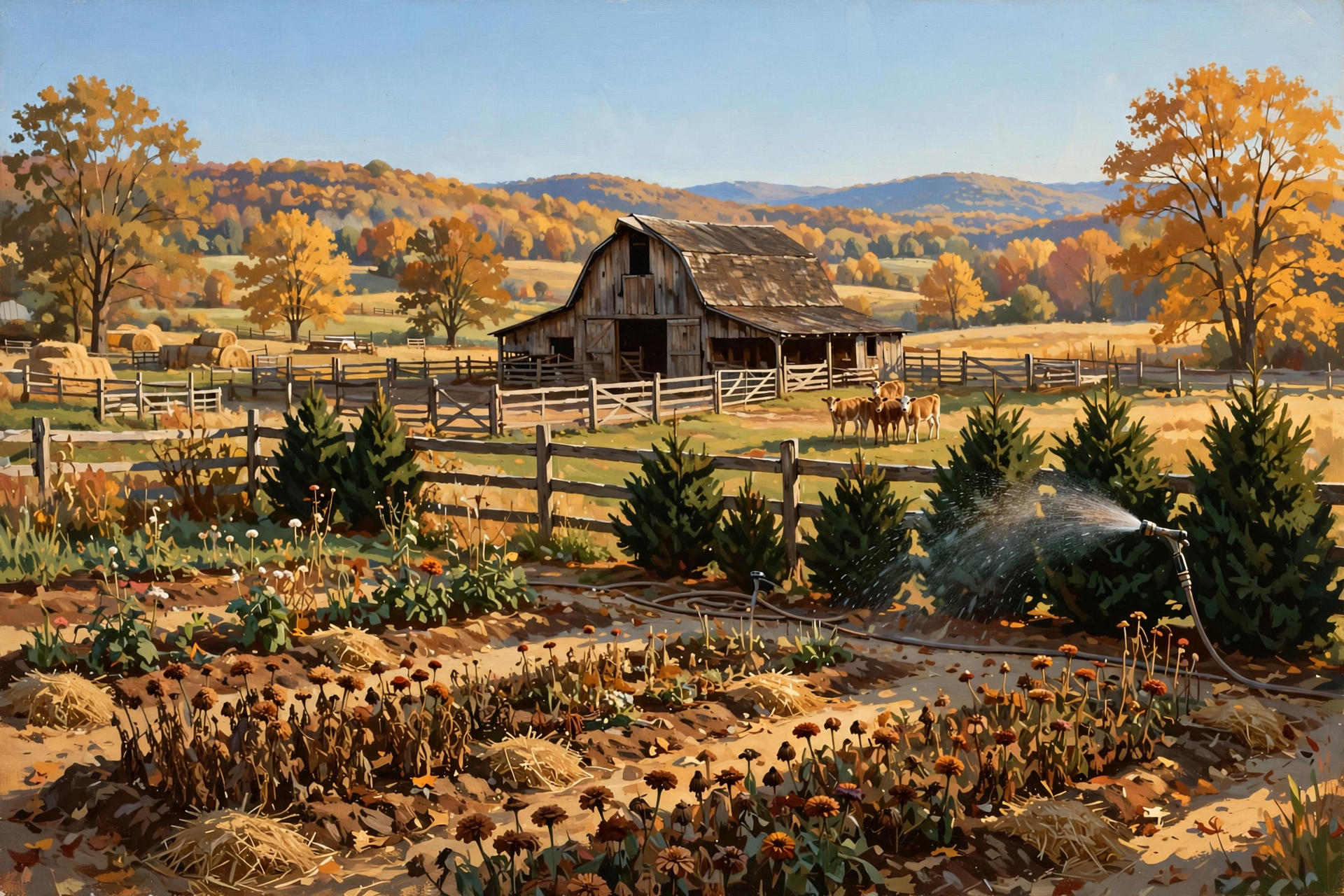
Or: A Sunny Saturday in Dunlap — What UT’s Newest Market Notes Say About Fall Calves, How to Put the Flower Beds to Bed, Why Evergreens Need Water in a Dry Fall and Two Holidays That Close the USDA Office
By Thomas Seest, Dunlap.Today · Saturday, October 24, 2026
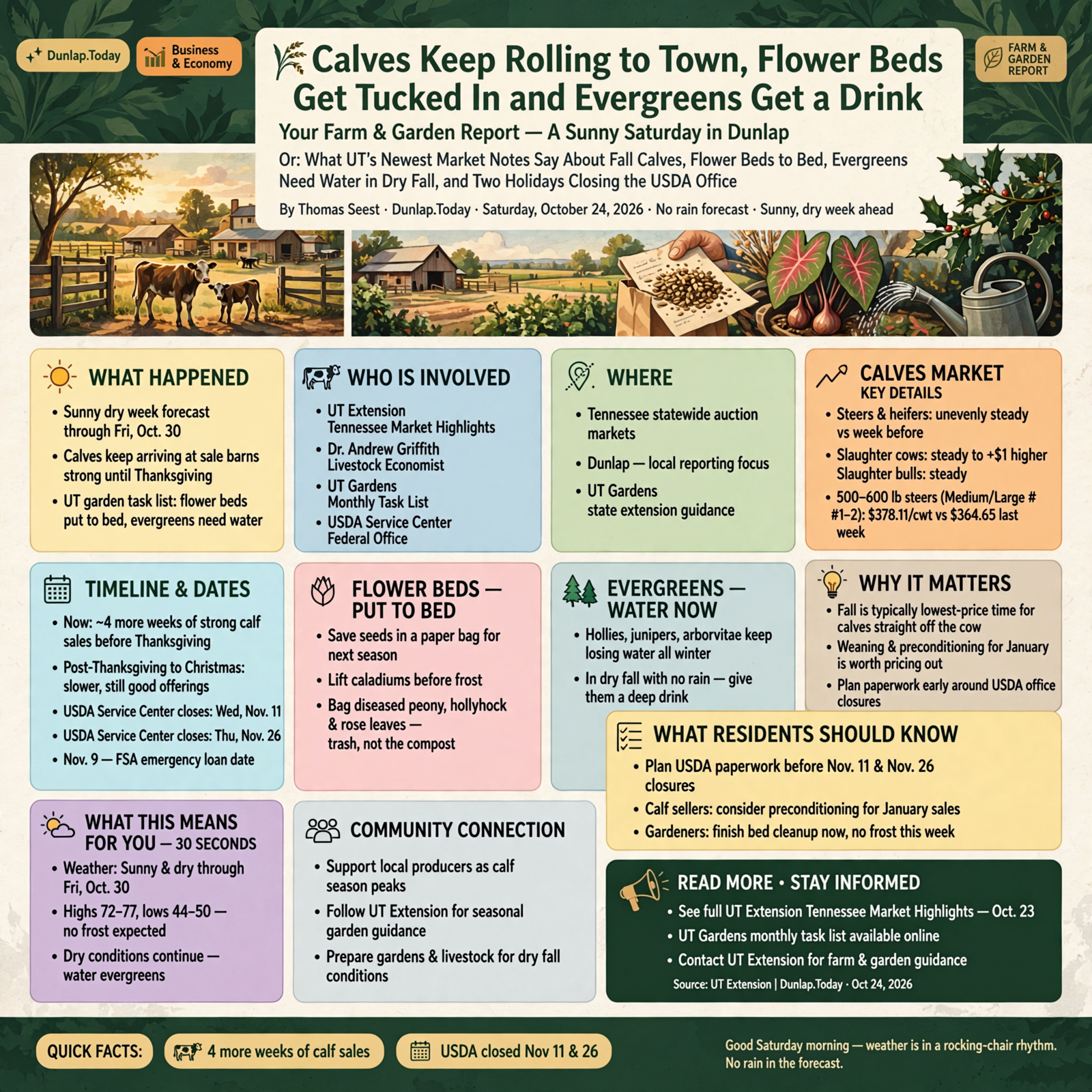
Good Saturday morning. The weather has settled into a rocking-chair rhythm. National Weather Service Dunlap calls for sunny skies today with a high near 75, and the week ahead looks about the same: highs of 72 to 77 and lows of 44 to 50 through Friday, Oct. 30. There’s no rain in the forecast, and none of those lows is close to freezing, so no frost is expected this week.
Here’s the roundup. UT Extension’s cattle economist says freshly weaned calves should keep coming to the sale barns strong until Thanksgiving, and he has a calm word for anyone deciding when to sell. UT Gardens’ monthly task list has a handful of easy jobs for putting the flower beds to bed, from saving seeds in a paper bag to lifting caladiums. UT also reminds us that evergreens still need water when fall rain is scarce, and this week won’t bring any. And two federal holidays in November will close the USDA Service Center, so it helps to plan your paperwork around them. A short checklist is at the end.
⏱️ What this means for you in 30 seconds
- Weather: Sunny and dry through Friday, Oct. 30. Highs 72–77, lows 44–50. No frost in the forecast.
- Calves: Statewide prices were unevenly steady this week. UT expects about four more busy weeks of calf sales before Thanksgiving.
- Selling tip: UT says fall is usually the lowest-price time for calves straight off the cow. Weaning and preconditioning for January is worth pricing out.
- Flower beds: Save seeds in a paper bag. Lift caladiums before frost. Bag diseased peony, hollyhock and rose leaves for the trash, not the compost.
- Evergreens: Hollies, junipers and arborvitae keep losing water all winter. In a dry stretch like this one, give them a deep drink.
- Remember: USDA Service Centers close Wednesday, Nov. 11, and Thursday, Nov. 26. The Nov. 9 FSA emergency loan date comes first.
🐄 Calves Keep Rolling to Town: UT Expects About Four More Busy Weeks Before Thanksgiving
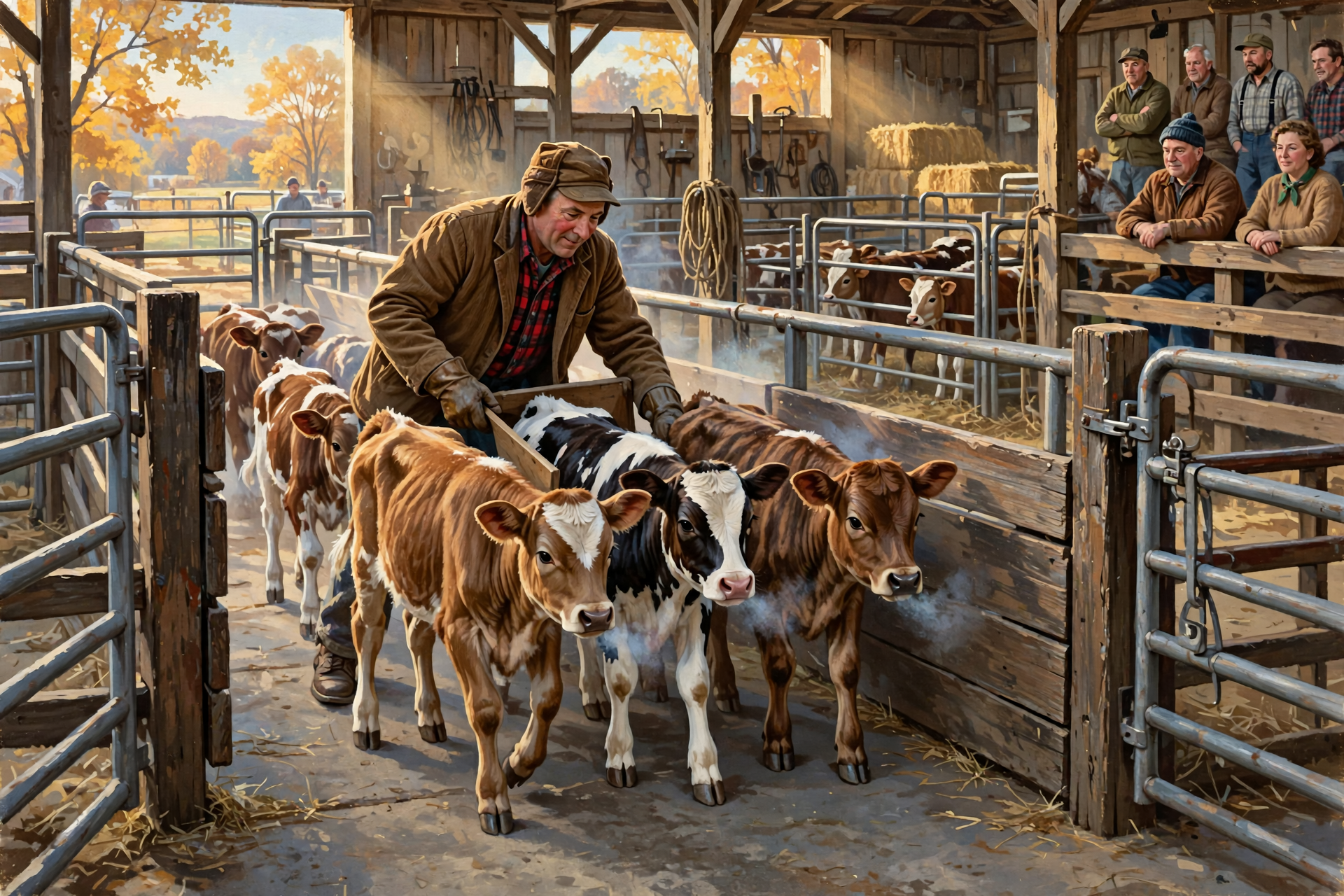
UT Extension’s Tennessee Market Highlights for Friday, Oct. 23, has a fresh look at the cattle market from livestock economist Dr. Andrew Griffith. These are statewide numbers from Tennessee’s reporting auction markets, not Sequatchie County alone:
- The week in a sentence. Based on Tennessee weekly auction averages, Griffith says steer prices and heifer prices were both unevenly steady compared with the week before. Slaughter cows were steady to $1 higher, and slaughter bulls were steady.
- One example. In UT’s auction table, medium- and large-frame No. 1–2 steers weighing 500 to 600 pounds averaged $378.11 per hundredweight, compared with $364.65 the week before. Your own calves will bring what your own sale barn’s buyers pay that day.
- Plenty of company at the sale. Griffith says producers are “earnestly hauling the spring born calf crop to town.” He expects freshly weaned calves to keep coming strong until Thanksgiving, which he counts as four more weeks of strong cattle movement. He says things should slow a little between Thanksgiving and Christmas but still have good offerings.
- The patient option. Griffith writes that fall “typically has the lowest price for calves coming straight off the cow.” He says it “would not be a terrible decision” to wean and precondition calves and sell them in January. He’s clear that feeding calves through part of the winter costs money and labor, but says preconditioned cattle typically bring more, and the market usually bounces higher after the first of the year.
- Fuel note. In the same issue, Griffith says diesel has eased nearly 25 cents a gallon over the past month, though it’s still nearly twice what it cost a year ago.
His weekly “Ask Andrew” note also touched on heifers. He says extra information like reproductive tract scores or genetic test results can make a buyer more willing to purchase heifers, as long as the buyer understands what the scores mean.
What it means for you: It’s like the line at the Saturday pancake breakfast. If everybody shows up at once, you may wait a little longer for your plate, but there’s still plenty of food. Nobody can promise where prices go next. If your calves are weaned and your pasture and hay can carry them, ask your Extension agent or sale barn whether a preconditioning program and a January sale would pencil out for you. If selling now fits your grass and your budget better, that’s a sound choice too. The Sequatchie County Extension office is at 423-949-2611.
👉 Read more (UT Extension: Tennessee Market Highlights, Oct. 23, 2026) · UT Livestock Comments archive
🌸 Putting the Flower Beds to Bed: Six Easy Jobs From UT Gardens
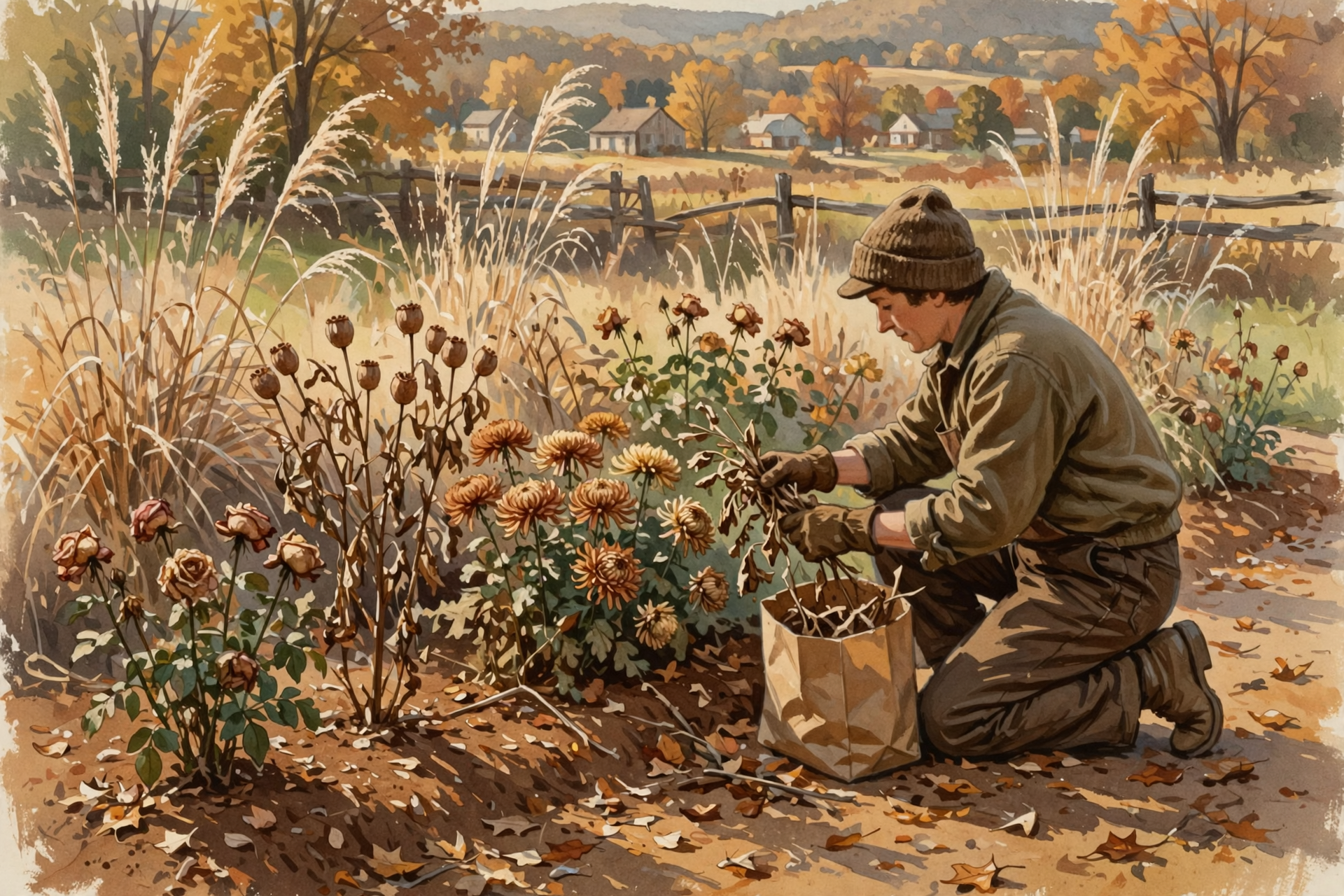
The vegetable garden got most of the attention this month. The flower beds deserve their turn. UT Gardens keeps a list of monthly gardening tasks, and its late-October and November tips add up to a tidy, unhurried weekend:
- Save the seeds you liked. UT says to collect seeds of any annual flowers you’d like to grow again next year and let them dry completely before storing. A paper bag holds the seed and lets it dry. Write the name on the bag. Future you will be grateful.
- Lift the caladiums. UT says to dig caladiums before the first frost, shake off the soil, let them dry completely and store them in a warm, dry place for winter. With no frost in this week’s forecast, there’s still a window.
- Blanket the tender ones. UT says tender plants such as cannas and elephant ears appreciate a layer of mulch for extra winter protection. It also says borderline-hardy perennials like hardy lantanas and salvias may do better if you leave their stems standing through winter.
- Bag the sick leaves, don’t compost them. To reduce peony botrytis blight and hollyhock rust, UT says to remove and dispose of all the leaves and stems this fall. Rake the leaves from under roses to help prevent black spot. UT says to put those plant materials in the trash, not the compost pile, so the disease doesn’t carry over.
- Trim the mums after they fade. UT says to cut chrysanthemum and other perennial stems back close to the ground once they’ve begun to die back. Leave ornamental grasses standing for winter interest until spring.
- Pansies: the earlier, the better. UT says winter annuals such as pansies, violas, snapdragons and ornamental cabbage and kale can still be planted in November, and “the earlier in the month, the better.”
What it means for you: It’s like putting the porch furniture away for winter. A little care now means everything’s ready to pull back out in spring. None of these jobs has to happen today. Pick the one that matters most in your yard. If you only do one thing, bag up those spotted rose and peony leaves, since that’s the job that keeps next year’s trouble from spending the winter in your beds.
👉 Read more (UT Gardens: Peony, hollyhock and rose cleanup) · Saving seeds · Caladiums · Cannas, elephant ears and borderline perennials · Mums and grasses · Winter annuals
🌲 Give the Evergreens a Drink: Dry Fall Weather Matters for Hollies and Junipers
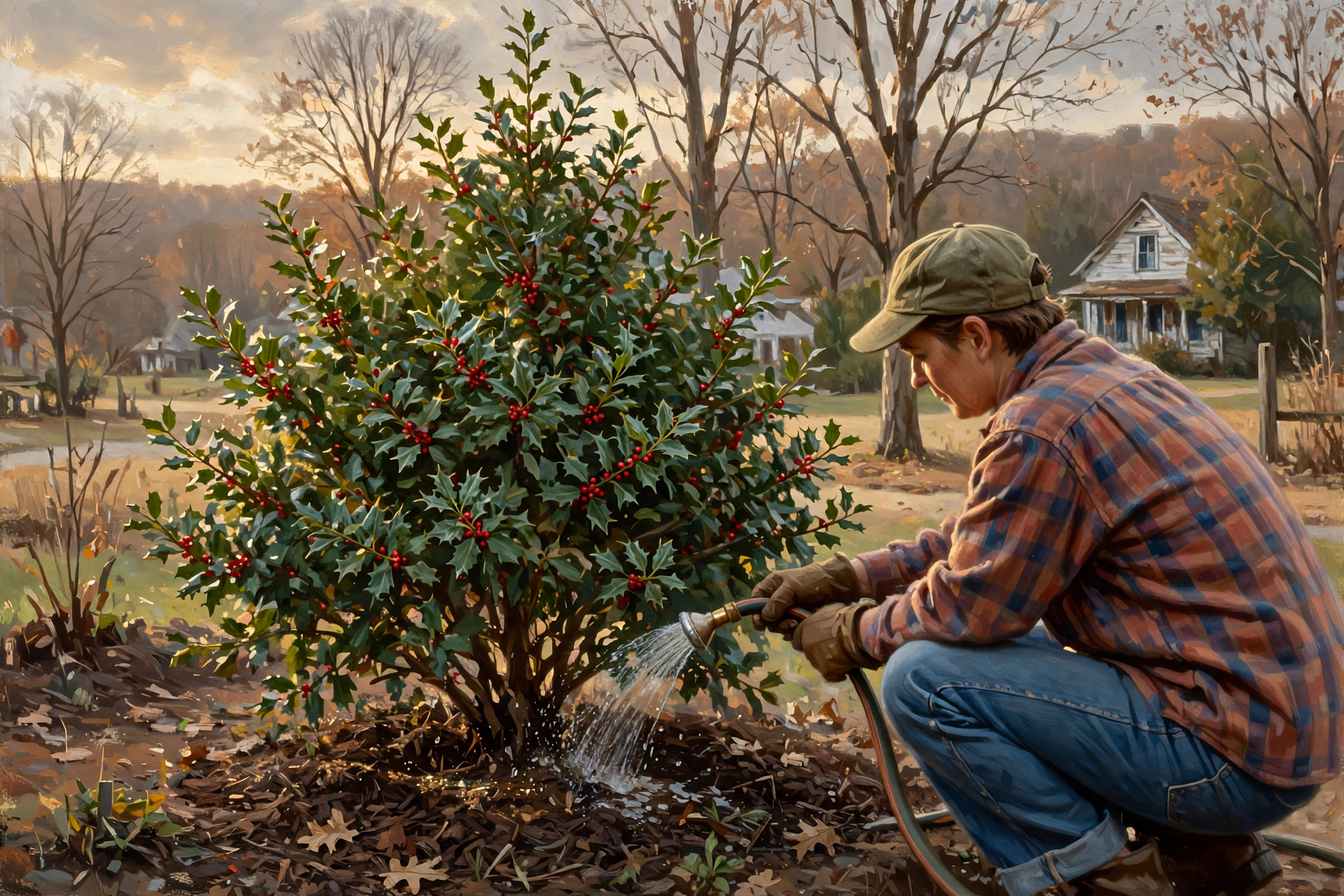
When the hardwoods drop their leaves, it’s easy to think the whole yard has gone to sleep. UT Gardens says evergreens are different. “Even in winter a plant with leaves on it will transpire,” UT writes, meaning it keeps giving off water through its leaves. UT names junipers, hollies and arborvitae and says to watch their watering needs if rain is sparse. It warns that winter wind can damage an evergreen that doesn’t have enough moisture.
A few more tips from the same UT task lists:
- New evergreens need the most watching. UT says to check newly planted evergreens regularly during the winter to make sure they’re getting enough water.
- Leafless plants are easier. UT says newly planted deciduous trees and shrubs need almost no watering in winter, but a thorough watering at planting time is a must.
- Mulch helps three ways. UT says mulching trees and shrubs helps reduce weeds, insulates against freezing temperatures and conserves moisture.
What it means for you: Think of an evergreen like a neighbor who keeps the porch light on all night. It’s still “awake,” so it still needs a drink now and then. With no rain in the seven-day forecast, a slow, deep soaking for hollies, boxwoods and young pines near the house is a good weekend chore. A hose left at a trickle at the base for a while does the job. Then spread a few inches of mulch, keeping it pulled back from the trunk.
👉 Read more (UT Gardens: Evergreens and winter water) · UT Gardens: Check newly planted evergreens · UT Gardens: Mulch trees and shrubs
📋 Paperwork Corner: Two November Days the USDA Office Is Closed
This one is short, but it’s the kind of thing that’s easy to forget. USDA Service Centers, where the Farm Service Agency (FSA) county offices work, close on federal holidays. A USDA newsletter for farmers lists two in November:
- Wednesday, Nov. 11: Closed for Veterans Day.
- Thursday, Nov. 26: Closed for Thanksgiving.
Those closures land right in the middle of a busy paperwork season. Here are the FSA dates Dunlap.Today has already reported, all still on the calendar:
- Monday, Nov. 2: 2027 ARC/PLC enrollment opens. It runs through March 15, 2027.
- Monday, Nov. 9: Last day to apply for FSA winter-storm emergency loans in Sequatchie and nearby counties. That’s two days before the Veterans Day closure.
- Friday, Dec. 11: 2026 ARC/PLC enrollment ends. FSA says that if you don’t submit a 2026 election by then, your farm is ineligible for 2026 payments.
- Friday, Dec. 18: Dairy Margin Coverage signup ends.
What it means for you: It’s like knowing the feed store closes early on Christmas Eve. Nothing’s wrong, you just plan around it. If you need to visit or call the office, aim for a week that doesn’t have a holiday in it, and call ahead for an appointment. Sequatchie County is served by the Jasper Service Center, 3709 Main St., (423) 942-2244.
👉 Read more (USDA FSA/NRCS newsletter: Dates to Remember) · FSA: National deadlines · FSA: ARC/PLC dates
📌 Sticky Notes for the Fridge
- This week: Sunny and dry in Dunlap through Friday, Oct. 30. Highs 72–77, lows 44–50. No frost expected.
- Today, Saturday, Oct. 24, 9 a.m.–1 p.m. Central: Dunlap Farmers Market at the Jeff Johnson Pavilion, Harris Park. Oct. 31 is the last regular Saturday (confirm before you go).
- Today, Saturday, Oct. 24, 3 p.m. Central: Great Pumpkin Festival, 1958 Main Street, Dunlap (listed on the Dunlap–Sequatchie County Chamber calendar).
- Sunday, Oct. 25, 1–5 p.m. Central: Fall in the Foothills, Little River Dairy, Walland. Free.
- Tuesday, Oct. 27: UT’s calendar day to cut out blackberry and raspberry canes that already fruited.
- Thursday, Oct. 29: Next U.S. Drought Monitor map.
- Saturday, Oct. 31: Halloween, and the last regular Dunlap Farmers Market Saturday.
- Sunday, Nov. 1: Clocks fall back one hour. Chores will feel an hour earlier by the sun.
- Monday, Nov. 2: 2027 ARC/PLC enrollment opens.
- Friday, Nov. 6, 8 a.m. Central: Tennessee Forage & Grassland Council annual meeting, Crossville.
- Monday, Nov. 9: Last day to apply for winter-storm emergency loans with FSA.
- Wednesday, Nov. 11: Veterans Day. USDA Service Centers closed.
- Sunday, Nov. 15: Last day of the Tennessee White Oak Initiative acorn collection.
- Friday, Nov. 20: Apply-by date for 2027 NRCS conservation funding in Tennessee.
- Thursday, Nov. 26: Thanksgiving. USDA Service Centers closed.
- Tuesday, Dec. 1: State water-quality grant proposals due to the Tennessee Department of Agriculture.
- Monday, Dec. 7: FSA county committee ballots due.
- Friday, Dec. 11: 2026 ARC/PLC enrollment deadline.
- Friday, Dec. 18: Dairy Margin Coverage signup ends.
- Thursday, Dec. 31: Organic Certification Cost Share applications due.
👉 Dunlap–Sequatchie County Chamber events · Dunlap Farmers Market · UT Extension Sequatchie County
✅ Your Farm & Garden Checklist for This Dry Week
- ✅ If you’re selling calves this fall, call your sale barn or Extension agent and ask whether weaning and preconditioning for a January sale would pay on your place.
- ✅ Count your hay against the calves you’d keep. Holding calves longer only works if the feed is there.
- ✅ Shake ripe flower seeds into a paper bag, label it and let them dry.
- ✅ Dig the caladiums before frost, dry them and store them somewhere warm and dry.
- ✅ Mulch over the cannas and elephant ears.
- ✅ Bag up peony, hollyhock and rose leaves for the trash, not the compost.
- ✅ Give hollies, junipers, arborvitae and any new evergreens a slow, deep drink.
- ✅ Write “Nov. 11 and Nov. 26: USDA office closed” on the barn calendar.
Practical rule: Sell calves on your own timetable, put the flower beds to bed one job at a time, water anything still green, and do your USDA paperwork in a week without a holiday.
— Dunlap.Today
📚 Plain-English Farm & Garden Glossary
- Hundredweight (cwt): 100 pounds. Cattle prices are quoted per hundredweight, so $378 per cwt on a 550-pound calf is about $2,080.
- Unevenly steady: Market talk for prices that were about the same overall, with some weights or classes a little higher and some a little lower.
- Weaning: Separating calves from their mothers so they live on feed and forage alone.
- Preconditioning: Getting calves ready for the next owner before sale, usually with weaning, vaccinations and getting them used to a feed bunk and water trough.
- Reproductive tract score: A score a veterinarian gives a young heifer to estimate how ready she is to breed.
- Slaughter cows and bulls: Older breeding animals sold for beef.
- Tender bulb: A bulb, tuber or root, like a caladium, that can’t handle our winter cold in the ground without help.
- Botrytis blight: A fungal disease that turns peony buds and leaves brown and moldy.
- Black spot: A fungal disease that puts black spots on rose leaves and makes them drop.
- Transpire: When a plant gives off water through its leaves.
- Desiccation: Drying out. Winter wind can dry out evergreen leaves faster than thirsty roots can replace the water.
- USDA Service Center: The local office building shared by FSA and NRCS. Sequatchie County uses the one in Jasper.
❓ Frequently Asked Questions
Are the calf prices for the Dunlap area?
No. UT’s Market Highlights uses Tennessee’s reporting auction markets statewide. They’re a good general sign, but the price your calves bring depends on their weight, quality and the buyers at your sale barn that day.
Should I hold my calves until January?
That’s a decision for each farm. UT’s Dr. Griffith says preconditioned calves typically bring more and that prices usually bounce higher after the first of the year. He also says feeding calves through part of the winter has real costs, including labor. Your hay supply, pasture and budget matter most. Your Extension agent can help you run the numbers.
Is it too late to dig my caladiums?
UT says to dig them before the first frost. There’s no frost in this week’s Dunlap forecast, so if yours are still in the ground, this is a good week. Let them dry completely before you store them.
Why shouldn’t diseased leaves go in the compost?
UT says to put peony, hollyhock and rose leaves from diseased plants in the trash to reduce the carryover of disease during the winter. A backyard compost pile may not get hot enough to kill those diseases.
How much should I water evergreens?
UT doesn’t give a set amount in its tips. It says to monitor evergreens when rain is sparse and check newly planted ones regularly through the winter. A slow, deep soaking at the root zone on a dry week is a simple approach. Poke a finger in the soil first. If it’s damp a couple of inches down, wait.
Does the Nov. 11 closure change any FSA deadline?
The closure itself doesn’t change the deadlines Dunlap.Today has reported. If you’re working on anything due around a holiday, call the Jasper Service Center ahead of time so there are no surprises.
🔗 Other Resources

- National Weather Service: Dunlap forecast
- UT Extension: Tennessee Market Highlights (Oct. 23, 2026)
- UT Extension: Livestock Comments archive
- UT Gardens: Saving annual flower seeds
- UT Gardens: Digging and storing caladiums
- UT Gardens: After-frost perennial care, cannas and elephant ears
- UT Gardens: Peony, hollyhock and rose disease cleanup
- UT Gardens: Cutting back mums; leaving ornamental grasses
- UT Gardens: Winter annuals
- UT Gardens: Trees, shrubs and evergreen watering
- UT Gardens: Watering newly planted evergreens
- UT Gardens: Mulching trees and shrubs
- USDA FSA/NRCS newsletter: Dates to Remember (Service Center holiday closures)
- USDA FSA: National deadlines
- USDA FSA: ARC/PLC program
- USDA: Service Center locator (Jasper Service Center, 3709 Main St. · 423-942-2244)
- Dunlap–Sequatchie County Chamber of Commerce: Events
- Dunlap Farmers Market
- UT Extension Sequatchie County (170 Church Street, Dunlap · 423-949-2611)
- Dunlap.Today
🏡 Keep Learning, Stay Calm and Come Back to the Porch
This is a gentle week on the farm and in the yard. The sale barns are busy, but there’s no rush to join the line if your plan says wait. The flower beds need tucking in, not a total makeover. The evergreens just want a drink. And the USDA calendar is posted well ahead, so there’s time to plan. Pick one job for this sunny weekend, enjoy the morning coffee, and leave the rest for another day.
When you want the next calm, practical update for Sequatchie Valley readers, pull up a chair at Dunlap.Today.
Know about an upcoming event or story in the Sequatchie Valley? Submit it here.




0 Comments